What is Microservices Architecture? Its impact on scaling products, reducing bottlenecks, and how the right implementation can elevate your business's engineering speed and innovation.\
Microservices Architecture has become one of the most defining approaches in modern software engineering. As businesses demand rapid feature development, global availability, and resilience at scale, microservices offer the architectural foundation to keep up with this pace.
More than 85% of enterprise organizations now use microservices to manage complex applications. This shift reflects a universal need to create software that evolves quickly without being limited by rigid, monolithic structures.
Microservices Architecture is more than a technical pattern. It represents a shift in mindset, organization, culture, and engineering principles. In this blog, we explore microservices in depth, starting from foundational concepts to real world applications, best practices, challenges, and future trends.
What Are Microservices?
Microservices are small, autonomous services that work together to form a complete application. Each microservice focuses on a specific business capability and runs independently. Because they are loosely coupled, teams can update or deploy individual services without affecting the entire system.
"A microservice architecture develops a single application as a suite of small services."
— Martin Fowler, Chief Scientist at ThoughtWorks
Insight: This quote highlights the shift from building one large application to many small components.
In practice, microservices encourage modularity. Every service behaves like a self contained unit, usually managed by a dedicated team, and can be improved or replaced without reworking the entire system.
A typical example is an ecommerce platform. Instead of one large application, there are separate services for product catalog, shopping cart, payments, user profiles, search, and recommendations. Each of these can evolve independently while still working together.
What Is Microservices Architecture?
Microservices Architecture is the structural design that organizes an application into these independent services and defines how they communicate and operate together.
In this architecture, each service:
- Represents a specific business capability.
- Runs in its own process or container.
- Communicates with other services using lightweight mechanisms such as HTTP APIs or messaging.
Microservices Architecture gained popularity as organizations needed to scale efficiently, deploy continuously, and align engineering teams with business domains. It fits naturally with containerization, cloud computing, continuous delivery, and DevOps.
Unlike traditional monolithic architectures, microservices emphasize separation of concerns, domain driven design, automation, and distributed communication.

Monolithic vs Microservices Architecture
To understand the value of microservices, it is important to compare them with monolithic architecture.
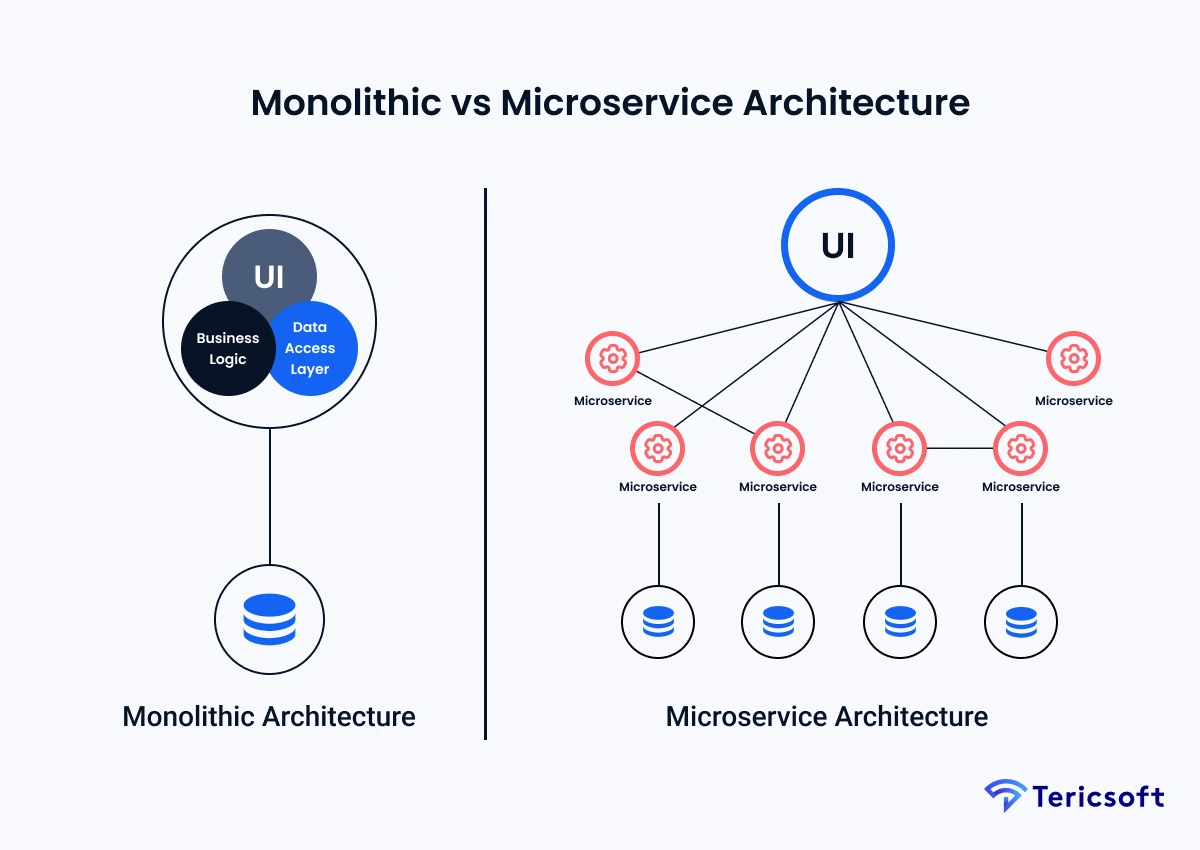
A monolithic application is built as a single, unified codebase. All modules share the same process, database, and deployment pipeline. This is simple at the beginning, but as the system grows, it becomes harder to change, scale, and test.
Microservices Architecture, on the other hand, splits the system into many smaller services. Each service has its own codebase and often its own database, and can be deployed independently.
Comparison Table
Martin Fowler advises that teams should not rush into microservices without a clear need.
"Do not start with microservices. Build a well structured monolith first."
— Stefan Tilkov, Ex CEO of Innoq
Insight: Fowler warns that microservices add operational overhead and should be adopted when complexity requires it. (Source: martinfowler.com)
This highlights that microservices are ideal for systems where growth, flexibility, and scale are primary requirements, not for every project or early stage product.
Components of Microservices Architecture
A microservices ecosystem relies on a variety of components that work together to ensure smooth communication, resilience, and operational efficiency. Each component plays a specific role in enabling services to function autonomously while still contributing to the larger system.
API Gateway
The API Gateway is the single point of entry for external clients. It manages request routing, authentication, authorization, rate limiting, caching, and protocol translation. By centralizing access control, the API Gateway simplifies external communication and protects internal services from direct exposure.
Service Registry and Discovery
In a dynamic environment where services scale up and down, a service registry keeps track of all active service instances. Discovery mechanisms allow services to locate one another programmatically without hard coding network locations. This enables loose coupling and flexibility during deployments and scaling.
Load Balancer
Load balancers distribute incoming requests across multiple service instances. This improves performance, prevents bottlenecks, and enhances system availability. They also support failover strategies by redirecting traffic away from unhealthy instances.
Independent Databases
Each microservice typically has its own dedicated database. This practice, often called database per service, prevents tight coupling at the data layer and reduces dependency related failures. It also allows each service to choose the best database type for its own needs, such as relational, document, or key value.
Messaging and Event Bus
Asynchronous communication is common in microservices. Message queues or event streaming platforms allow services to communicate without waiting for immediate responses. This improves resilience and throughput and supports event driven architectures, where services react to events rather than synchronous requests.
Containers and Orchestration
Tools like Docker standardize the packaging of services along with their runtime dependencies. Orchestration platforms such as Kubernetes automate deployment, scaling, health checks, rolling updates, and recovery. They form the operational backbone of most microservices environments.
Observability and Monitoring
Microservices require deep visibility across distributed systems. Observability includes logging, metrics, tracing, dashboards, and alerting systems. These tools help teams diagnose issues, monitor performance, detect anomalies, and ensure reliability in production.
Together, these components create a platform where independent services can run, scale, and interact in a controlled and observable way.
How Microservices Architecture Works
Microservices Architecture manages a user request through several coordinated steps.
- A user sends a request from a browser or mobile app to the API Gateway.
- The gateway authenticates the user, applies security and traffic policies, and routes the request to the appropriate microservice.
- The selected service processes the request. If it requires additional data, it may call other services through synchronous HTTP calls or asynchronous messages.
- Each service executes its own business logic, often using its own database or cache.
- The responses from downstream services are combined if necessary and returned to the API Gateway.
- The gateway constructs the final response and sends it back to the client.
Because each service is autonomous, the system can:
- Deploy updates to a single service without touching others.
- Scale only the services that experience high traffic.
- Limit the blast radius of failures.
This quote captures why microservices emphasize resilience, isolation, and recovery. The design accepts that components will fail and focuses on containing and recovering from those failures.
Benefits of Microservices Architecture
Microservices Architecture provides several powerful advantages that make it an attractive choice for large scale, fast moving applications.
Scalability
Microservices allow horizontal scaling of specific components. If the search service experiences heavy load, only that service needs to scale. This targeted scaling is more cost efficient than scaling the entire system.
Faster Development and Deployment
Because each service is independent, multiple teams can develop and release features in parallel. Continuous delivery becomes easier, and deployments can be smaller, more frequent, and less risky.
Fault Isolation
Failures remain contained within the affected service instead of bringing down the entire application. Circuit breakers, timeouts, and retries further improve resilience and user experience.
Technology Flexibility
Teams can choose the most appropriate programming language, framework, and database for each service. This flexibility encourages innovation and avoids the constraints of a single technology stack.
Organizational Alignment
Microservices closely mirror business domains by structuring each service around a clearly defined business function. This domain alignment enables small, autonomous teams to take full ownership of their services, from development to deployment and maintenance. As a result, teams can make improvements independently, reduce coordination overhead, and deliver changes faster without impacting unrelated parts of the system.
This principle aligns strongly with microservices. Teams that own services end to end are accountable for both reliability and innovation.
Challenges of Microservices Architecture
Despite their strengths, microservices introduce complexities that must be managed thoughtfully.
Operational Overhead
Operating many services is more complex than running a single monolithic application. Each service needs its own deployment pipeline, configuration management, observability, and lifecycle management.
Distributed Debugging
Since functionality is spread across multiple services, identifying the root cause of failures can be difficult. Developers rely on correlation IDs, distributed tracing, and centralized logs to follow a request journey across services.
Data Consistency
Microservices avoid shared databases, which complicates operations that span multiple services, such as multi step financial transactions. Architectural patterns such as sagas, eventual consistency, and event sourcing may be required.
Infrastructure Costs
Running several services, orchestration systems, and observability tools can increase infrastructure spending. Organizations need to tune resource usage and scaling policies to balance cost and performance.
DevOps and Cloud Maturity
Microservices demand strong DevOps practices. Teams need skills in CI and CD, container platforms, monitoring, security, and incident response. Without this maturity, the architecture can become chaotic.
Some organizations have even migrated parts of their systems back to well structured monoliths when microservices introduced unnecessary complexity. This reinforces that microservices should be a strategic choice, not a default.
Best Practices for Microservices Architecture
Successful microservices implementations follow proven architectural and organizational principles.
Model Around Business Domains
Using domain driven design helps define meaningful service boundaries. Each service represents a bounded context aligned with a business capability, such as billing, orders, or identity.
Keep Services Small and Focused
A microservice should implement a single cohesive capability. Smaller and focused services are easier to understand, test, and maintain.
Strong AP! Design
Services must expose clear, versioned, and backward compatible APIs. Good API design prevents breaking clients during deployments and enables independent evolution of services.
Automation and CI CD
Automated pipelines are essential. Every service should pass through automated builds, tests, security checks, and deployments. Manual deployment of dozens or hundreds of services is not sustainable.
Observability from Day One
Logs, metrics, traces, and dashboards must be part of the initial implementation, not an afterthought. Observability is essential for debugging, capacity planning, and reliability.
Security by Design
Zero trust security implies that every call between services is authenticated and authorized. Encryption in transit, secrets management, and principle of least privilege are important foundations.
Ownership and Accountability
Each microservice should be owned by a dedicated team that handles development, operations, and evolution.
"Conway's Law reminds us that system design mirrors communication structures."
— Melvin Conway, Computer Scientist
Insight: This principle explains how organizational structure shapes software architecture. (Source: melconway.com)
Microservices benefit from this insight. When teams are structured around well defined services, both the system and the organization become easier to scale.
Real World Examples of Microservices Architecture
Many leading companies have transitioned to microservices to handle growth, complexity, and global scale.
Netflix
Netflix migrated from a monolithic application to a distributed system made up of hundreds of microservices. This architecture supports:
- Global streaming to millions of users.
- Continuous deployment of changes many times per day.
- High availability across regions and devices.
Uber
Uber evolved from a simple ride hailing application into a global logistics and transportation network. With more than two thousand microservices organized into many business domains, Uber can roll out features rapidly and manage real time operations efficiently.
Amazon
Amazon transformed its monolithic retail platform into a set of independent services. This paved the way for the creation of Amazon Web Services, where infrastructure and services are provided as products. The service oriented model allowed teams to innovate without waiting for a central release train.
These examples show that microservices can unlock speed, flexibility, and resilience when the right practices and culture are in place.
Future Trends in Microservices Architecture
Microservices continue to evolve alongside cloud, DevOps, and platform engineering trends.
Service Mesh Adoption
Service meshes such as Istio and Linkerd provide a dedicated layer for managing service to service communication. They handle routing, retries, encryption, policies, and observability without requiring changes in individual services.
Hybrid and Modular Approaches
More companies are combining modular monoliths with microservices. Core functions may remain in a modular monolith, while high change or high scale areas are extracted into microservices. This balanced approach avoids unnecessary fragmentation.
Serverless Integration
Serverless computing models allow teams to build small functions that react to events and scale automatically. These functions often complement microservices by offloading background processing, scheduled tasks, or bursty workloads.
AI Driven Observability and Operations
Artificial intelligence is increasingly applied to logs, metrics, and traces to detect anomalies, predict incidents, optimize resources, and recommend remediation steps in complex distributed systems.
Continued Enterprise Adoption
Industry research predicts that microservices adoption will reach close to ninety percent among enterprises by 2027. As architectures mature, the focus is shifting from whether to use microservices to how to govern, observe, and optimize them effectively.
About Tericsoft
Tericsoft is a strategic technology partner specializing in modern software architecture, cloud-native engineering, and microservices transformation. We help organizations move from rigid, legacy monoliths to agile, scalable, and resilient distributed systems built for growth.
Our architecture-first approach ensures that every solution we design is secure, future-ready, and aligned with your business goals. From microservices design to CI/CD automation, containerization, DevOps adoption, and cloud modernization, Tericsoft enables teams to ship faster, operate reliably, and innovate continuously.
As your long-term partner, we combine deep technical expertise with execution strength, helping you build platforms that scale with your ambition and keep you ahead in a rapidly evolving technology landscape.
Conclusion
Microservices Architecture represents a strong foundation for building modern, scalable, and resilient applications. When applied thoughtfully, it enables faster innovation, flexible scaling, and organizational agility. However, it also demands solid engineering discipline, DevOps maturity, and careful design.
Organizations that adopt microservices with clear business goals and strong governance are better positioned to grow rapidly and remain competitive in the digital era.

Microservices Architecture is a design where applications are built as independent services that communicate through lightweight APIs.
They scale faster, deploy independently, isolate failures, and match engineering teams to business domains for quicker development.
Netflix, Uber, and Amazon use microservices to support global scale, faster releases, and high availability across distributed systems.
Distributed debugging, higher operational overhead, data consistency issues, and the need for strong DevOps maturity.
Microservices are ideal when complexity, scaling needs, or rapid feature delivery outgrow what a monolithic architecture can handle.