What is Technology as a Service (TaaS)? Its advantages and benefits for startups, and how the right model can help boost your business’s technology leadership and innovation.
We all know the stereotype: the IT team, heroes of the server room, working late to patch a critical failure or swap a dying hard drive. For decades, this "all-hands-on-deck" firefighting was seen as a necessary part of business. It was the cost of having technology.
But here's the uncomfortable truth: this heroism is a symptom of a broken model.
Every hour your most technical minds spend on routine maintenance, procurement cycles, and help-desk tickets is an hour not spent on building your next product, securing your data, or integrating that new AI model.
The business sees a massive opportunity; your IT team sees a massive new burden. They're forced to be gatekeepers, not innovators, because they're chained to the daily care and feeding of assets.
What if you could fundamentally change this dynamic? What if you could liberate your tech team to focus 100% on initiatives that drive revenue?
This is the strategic promise of Technology as a Service (TaaS). It's a model that reframes your entire approach: Stop managing assets and start consuming outcomes.
TaaS isn't just about outsourcing your help-desk; it's about subscribing to a complete, 'always-on" technology stack-hardware, software, and support-for a single, predictable fee.
This post explores the TaaS model, why it's a strategic imperative for cost and innovation, and how to implement it.
What is Technology as a Service
So, what is Taas?
Think of it this way: You don't build a power plant to turn on your lights; you just pay a utility bill for the electricity you use. Taas applies this exact logic to your entire technology stack.
Technology as a Service (TaaS) is a business model where organizations subscribe to a comprehensive bundle of technology-hardware, software, and management services-for a predictable, recurring fee.
It's the evolution of isolated service models into one holistic solution. It's not just "Software as a Service" (SaaS) or "Hardware as a Service" (HaaS). A true TaaS solution bundles them together with the most critical, and often overlooked, layer: the human- centric managed support.
Instead of buying, imaging, and maintaining a laptop for a new employee, you simply request a "seat," and the TaaS provider delivers a fully configured machine, manages its security, provides 24/7 support, and replaces it before it gets old-all for one flat fee.
Why Technology as a Service Matters for Modern Businesses
The shift to TaaS is more than an IT trend; it's a fundamental business strategy. It directly addresses the three biggest challenges modern companies face: managing costs, the
Unlock Capital by Shifting from CapEx to OpEx
This is the most immediate advantage. TaaS moves your entire technology spend from a Capital Expenditure (CapEx) to an Operational Expenditure (OpEx).
- The Old Way (CapEx): You spend $100,000 upfront on new servers. That cash is now gone, locked into a depreciating asset. It's a huge capital risk, especially for a startup or SME.
- The TaaS Way (OpEx): You pay a predictable $5,000 a month for your infrastructure, support, and upgrades. Your cash stays in the bank, available for you to invest in what grows your business: R&D, marketing, and talent.
This financial shift isn't just an accounting trick; it's a liberation. It makes best-in-class technology accessible to everyone, not just corporations with deep pockets. It converts unpredictable IT costs into a stable, predictable line item on your budget.
Achieve True Agility and On-Demand Scalability
Business agility is the ability to react to opportunity-or crisis-instantly. A traditional IT model is the enemy of agility. Need to add 20 new developers for a critical project? That means sourcing, buying, and configuring 20 high-end machines, a process that can take weeks.
Taas makes your business elastic.
"Technology as a Service gives companies quick access to... technological resources... and allows scaling up or down to accommodate business demand fluctuations."
With a TaaS partner, you simply request 20 more "seats." They arrive the next day, ready to go. When the project ends, you scale back down. This elasticity allows you to pursue growth, handle seasonal peaks, and adapt to market changes without your own technology holding you back.
“In the future, all companies will be technology companies. The ones that embrace the ‘as-a-service’ model will be the ones that win.”
—Tia Williams, Tech Futurist & Forbes Contributor
Eliminate Technology Obsolescence for Good
In a traditional model, the moment you buy a piece of hardware, the clock starts ticking on its obsolescence. In three years, it will be slow, unsupported, and potentially a security risk.
In a Taas model, technology lifecycle management is built into the subscription. Your provider is responsible for ensuring your team always has current, secure, and efficient tools.
This means you are no longer just buying a laptop; you are subscribing to a guarantee of "current." Your team's productivity is higher, your data is more secure, and you are free from the multi-year, budget-draining refresh cycles that plague traditional IT.
Embrace Sustainable IT with a Circular Economy
TaaS is also a powerful strategy for sustainable IT. When you own hardware, you are responsible for its "end-of-life," and often, that means it ends up in a landfill, contributing to e-waste.
Taas providers, however, operate on a "circular economy" model. It's their business to maximize the value of an asset. When your hardware is refreshed, they professionally refurbish, redeploy, or responsibly recycle it. By subscribing to Taas, you are also subscribing to a greener, more sustainable business practice.
How to Implement Technology as a Service in Your Organization
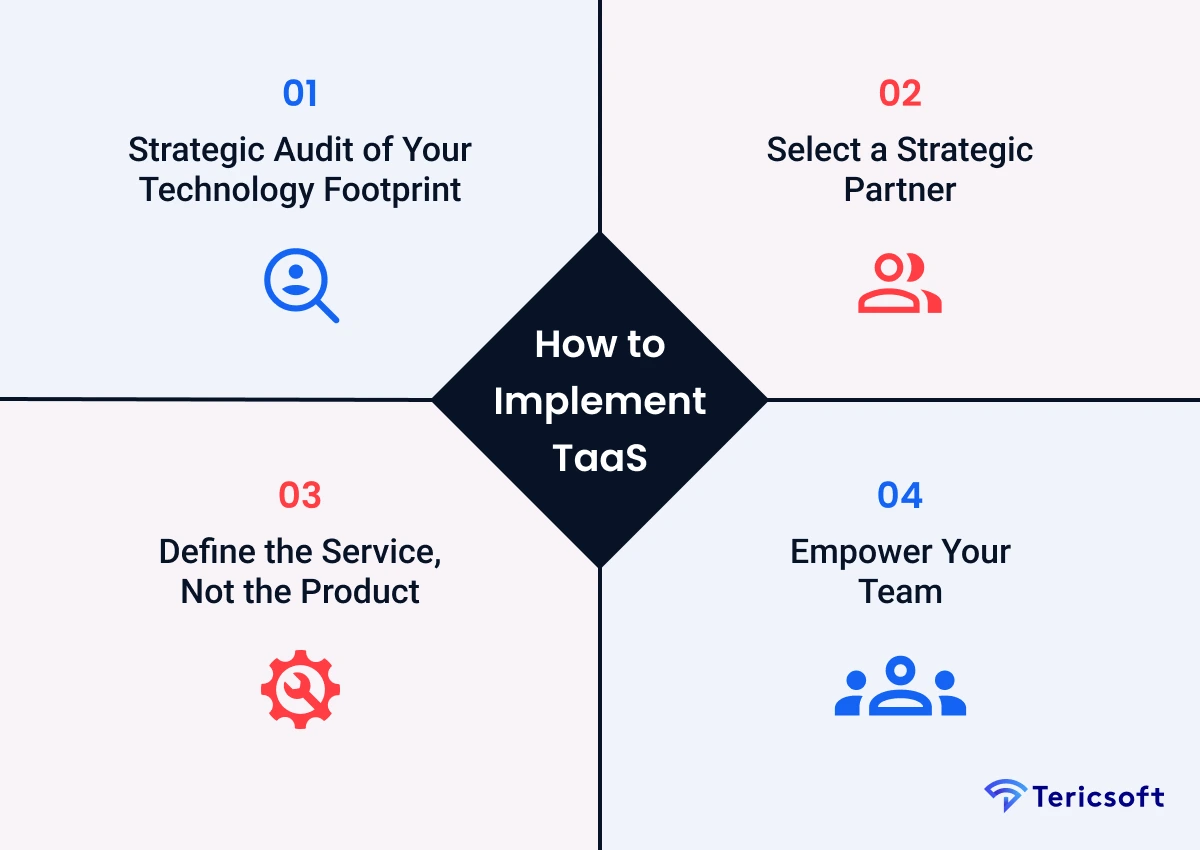
Pivoting to a TaaS model isn't just a technical swap; it's a strategic business decision that requires a clear plan. Here's a practical roadmap for making the transition.
1. Start with a Strategic Audit of Your Technology Footprint
Before you can move, you need to know where you are. Start with a comprehensive audit of your current technology footprint.
- Inventory: What do you own (hardware, software, licenses)? How old is it?
- Costs: How much are you really spending? Factor in not just the purchase price, Bbut also maintenance, support hours, and downtime.
- Pain Points: Where are the biggest frustrations? Is it outdated laptops? Is it managing software patches? Is it the slow response from your IT helpdesk?
- Future Goals: Where is the business going? Are you planning to grow, shrink, or move into remote work?
This assessment will clarify your "why" and identify the most critical areas to move to a service model first.
2. Select a Strategic Partner, Not Just a Provider
This is the most critical step. A provider just sells you a product; a partner invests in your outcome. Your TaaS partner is an extension of your team, so your selection criteria should be deep.
Key questions to ask potential partners:
- Beyond the Price: "What exactly is included-and, more importantly, excluded-from the monthly fee?"
- On Flexibility: "What is the real-world process for scaling up and scaling down? What are the penalties or lead times?"
- On Support: "What are your guaranteed SLAs for support response? Who will I be talking to-a call center or a dedicated technical expert?"
- On Refresh: "What is your hardware refresh policy? How do you manage the transition to new equipment with zero downtime?"
- On The Exit: "What happens at the end of the contract? What are the renewal terms, and what is the process for returning assets?"
3. Define the Service, Not the Product
Your TaaS contract is your single source of truth. It should be built around outcomes, not products.
This agreement must clearly define the Service Level Agreements (SLAs) that matter to your business. Don't settle for vague promises. Get concrete, guaranteed metrics: 99.99% service uptime, 15-minute support response time, 24-hour hardware replacement. This contract shifts the burden of performance from your team to your partner.
4. Empower Your Team: From Maintenance to Mission
For your internal IT team, this is a massive (and positive) evolution. Their role will shift from being reactive "firefighters"-running around fixing printers and patching servers-to becoming strategic "enablers." TaaS frees your most valuable technical talent to focus on high-impact work: managing the vendor relationship, analyzing data, and finding new ways to use technology to drive business goals.
What are Different Technology as a Service Models
"TaaS" isn't one single product. It's a category of services that can be bundled to fit your exact needs. Understanding the building blocks helps you create the perfect solution.
1. Hardware as a Service (HaaS)
This is the most tangible layer: subscribing to your physical infrastructure. It includes laptops, desktops, servers, and networking gear. The service includes maintenance and regular upgrades, ending the cycle of owning depreciating hardware.
2. Software as a Service (SaaS)
This is the model you're likely already using. Platforms like Salesforce, Microsoft 365, or Slack are all SaaS. In a TaaS ecosystem, these are integrated and managed for you, so your team has a seamless, single-sign-on experience.
3. Platform (PaaS) & Infrastructure as a Service (laaS)
These are the cloud-computing foundations. laaS (like Amazon Web Services) provides the raw, on-demand computing power, storage, and networking. PaaS provides the next layer up-a complete environment for your developers to build, test, and deploy applications without worrying about the underlying infrastructure.
4. Managed IT & Lifecycle Services
This is the "service" wrapper that makes TaaS truly valuable. This component includes everything: 24/7 help-desk support, proactive security monitoring and patching, data backup, and managing the entire technology lifecycle. This is what frees your team to focus on their jobs, not on IT.
5. Custom & Hybrid TaaS Models
The real power of TaaS is in the bundling. A "one-size-fits-all" model rarely works. A modern TaaS partner will work with you to create a hybrid model:
- For an SME: This might be a bundle of new laptops (HaaS), Microsoft 365 (Saas), and 24/7 security and support (Managed Services).
- For an Enterprise: This could be a custom PaaS environment for their dev team, combined with a fully managed laaS for their production applications.
Future Trends and What to Watch in Technology as a Service
The TaaS model itself is just the beginning. The future of service-based technology is intelligent, autonomous, and fully integrated.
"The only constant in the technology industry is change."
—Marc Benioff, CEO of Salesforce
The XaaS Expansion
TaaS is the gateway to "Everything as a Service" (XaaS). This is a model where any business function can be subscribed to. We are already seeing the rise of AI as a Service (AlaaS), Cybersecurity as a Service (SECaaS), and even entire Business Processes as a Service (BPaaS). The future is a composable enterprise built from an ecosystem of integrated, on-demand services.
Predictive TaaS
The next generation of TaaS is predictive. AI and machine learning will be so deeply targeted that your provider won't wait for something to break. The TaaS platform will analyze performance data from your laptop and predict a hard drive failure before it happens. A replacement will be shipped to you automatically, with zero downtime or data loss.
TaaS and Data
As more critical infrastructure is managed by third-party partners, the focus on data security and sovereignty will intensify. Expect to see TaaS contracts with even more robust, transparent guarantees around cybersecurity, data encryption, and data residency-ensuring you have full control and visibility over your data, no matter where it lives.
Why Choose Tericsoft as Your Technology Partner
Choosing the right technology strategy is only the first step. The ultimate success of this strategy depends on the partner you choose. Tericsoft operates not just as a vendor, but as a strategic technology partner dedicated to your long-term growth.
Strategic Technology Partnership for Growth
Tericsoft acts as an extension of your leadership team. We move beyond simple outsourcing to a model of shared accountability, aligning our technology solutions directly with your core business goals to ensure technology is a driver of growth, not a cost center.
Product & Technology Strategy
We help you refine your product roadmap, optimize your architecture, and ensure your technology stack is purpose-built for your business vision. Our services include CTO-level advisory, architecture design, and strategic execution planning.
Engineering Team Building & Capability Expansion
Tericsoft helps you build and scale your in-house technology teams. We provide talent upskilling, optimize your engineering processes, implement robust design systems, and set up the infrastructure needed to scale your capabilities efficiently.
Scalable Tech Execution & Cloud Deployment
Our expertise in micro-services, CI/CD delivery, and scalable cloud infrastructure ensures your business is agile and future-proof. We build and manage systems that allow for continuous innovation and deployment, keeping you ahead of the competition.
Research & Development and Digital Transformation
As your R&D partner, Tericsoft drives your digital transformation agenda. We lead innovation through proofs-of-concept, AI transformation, and complex integrations like LLMs, ensuring you are always leveraging the next wave of technology for a competitive advantage.
Conclusion: Stop Owning, Start Innovating
Technology as a Service is not just a different way to buy technology; it's a different way to think about it. It's a strategic shift from managing depreciating assets to consuming dynamic, always-current services.
For startups and SMEs, it levels the playing field, providing access to enterprise-grade tools without the enterprise-grade price tag. For large enterprises, it unlocks the agility and flexibility needed to innovate at the speed of a startup.
The future of business is not about who has the most powerful servers locked in their basement. It's about who can adapt the fastest, deliver the most value, and focus their energy on what truly matters: their customers and their core mission. TaaS is the engine that enables that focus. The only question left is, are you ready to make the shift?

TaaS is a subscription model where businesses get hardware, software, and IT support for a predictable monthly fee.
It shifts spending from CapEx to OpEx, turning large upfront investments into predictable monthly expenses.
TaaS offers cost control, scalability, continuous upgrades, and 24/7 managed IT support for business agility.
Startups and SMEs get enterprise-level tech, flexible scaling, and no hardware ownership burden through TaaS.
Tericsoft provides scalable tech solutions, lifecycle management, and digital transformation expertise for growth.