What is SAP ERP, how does it synchronize complex global operations with one trusted system of record, and why is it becoming indispensable for organizations seeking to scale digital operations without risking process fragmentation or data inconsistency?
It is 6:00 PM on the final Friday of the quarter. In the finance department, three different managers are looking at three different versions of the truth. The sales lead reports record- breaking revenue based on signed contracts, but the logistics manager is staring at a warehouse backlog that says half those orders haven't shipped. Meanwhile, the CFO is trying to reconcile a procurement discrepancy that exists only in a password-protected Excel file on a laptop in a different time zone.
This is "The Spreadsheet Wall." It is the invisible ceiling that growing companies hit when their processes outpace their tools. The business isn't broken, but it is running on disconnected data. Decisions are made on intuition and lagging indicators rather than real- time insights. In this environment, the quiet question eventually emerges: "Where is the definitive truth in this business?"
Breaking through this wall requires more than just a software upgrade. It requires an operating model upgrade. This is where SAP ERP enters the conversation, not merely as an application, but as the central nervous system of the modern enterprise.
What is SAP?
To understand the platform, one must first understand the entity. SAP (Systems, Applications, and Products in Data Processing) is a global leader in enterprise software. Founded in 1972 by five former IBM engineers in Mannheim, Germany, the company set out to create a standard software solution for real-time business processing.
Today, when professionals say "we are running SAP," they are typically referring to the company's flagship Enterprise Resource Planning software. SAP has evolved from a small regional venture into a global titan that powers roughly 77% of the world's transaction revenue. It is the ecosystem that provides the "digital backbone" for the world's most complex organizations, ensuring that finance, human resources, and supply chains operate in a unified, synchronized manner.
"Strategy without process is little more than a wish list."
— Robert Filek, Senior Managing Director of FTI Consulting, Inc
What is ERP?
Before diving into the specifics of SAP, we must define the category it dominates. What is ERP?
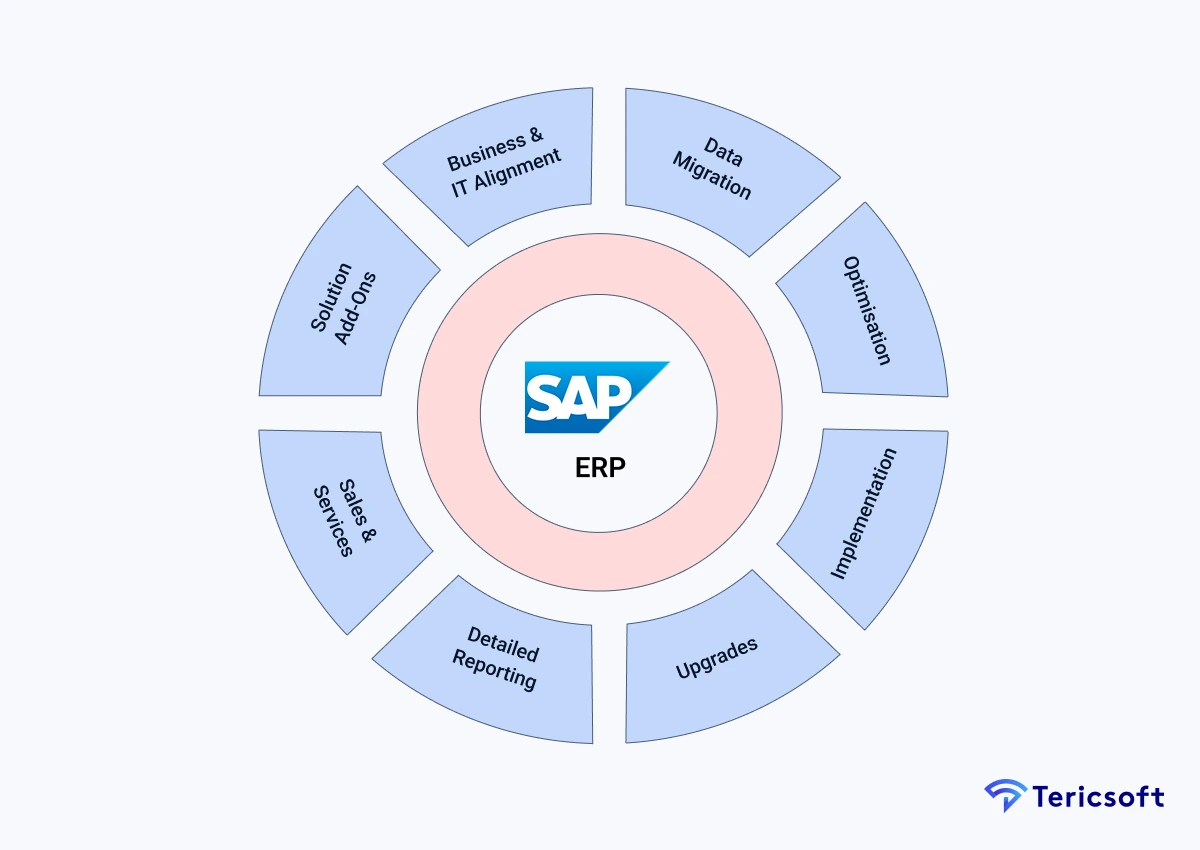
Enterprise Resource Planning (ERP) is a type of software suite that organizations use to manage day-to-day business activities. At its core, an ERP is an integrated system that runs core processes on a single, shared data foundation.
In a pre-ERP world, a company might use one tool for accounting, another for inventory, and a third for sales. These "silos" do not talk to each other. An ERP platform eliminates these silos. When a sales order is placed, the ERP automatically checks inventory levels, updates the ledger, notifies the warehouse, and triggers a procurement request if stock is low. It is the integration of these moving parts into a single source of truth that defines the value of an ERP.
SAP vs SAP ERP vs SAP S/4HANA
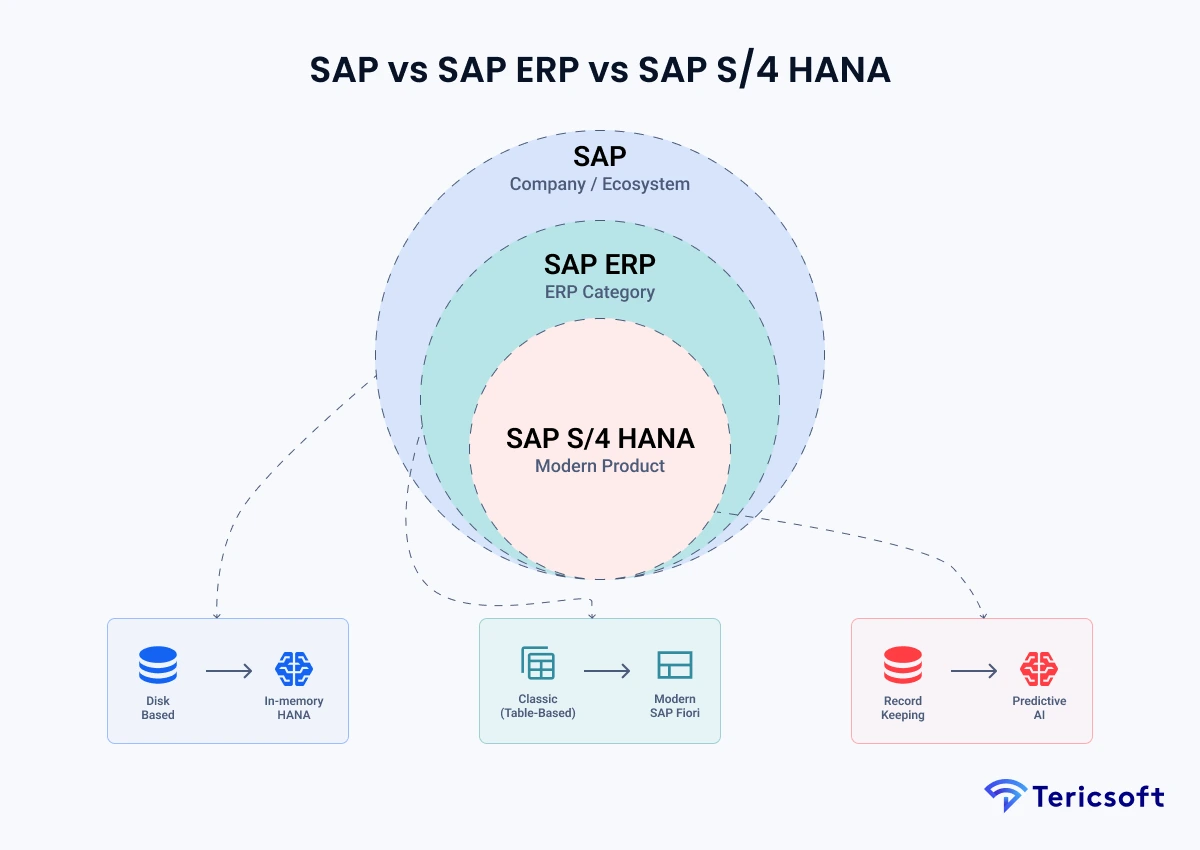
The terminology surrounding SAP can often be confusing for those entering the ecosystem. It is helpful to view these terms through a hierarchical lens, moving from the entity to the category and finally to the specific modern engine.
Understanding the Distinctions
To distinguish these further, consider the following points of divergence:
- The Evolution of the Core: SAP ERP (specifically the older ECC version) was designed for traditional disk-based databases. SAP S/4HANA is rewritten entirely to leverage the HANA in-memory database, allowing it to process massive datasets in milliseconds.
- Simplification of Data: Legacy SAP ERP systems often required complex tables and "summaries" to generate reports. S/4HANA simplifies the data model, removing redundancy and allowing for a "single source of truth" without the need for overnight batch processing.
- User Experience: While older SAP ERP interfaces were often criticized for complexity, S/4HANA introduces SAP Fiori, a modern, web-based user experience that is intuitive and mobile-responsive.
- Intelligence: SAP S/4HANA is not just a recording system. It is a predictive one. It uses embedded AI to forecast supply chain disruptions or suggest financial adjustments before a crisis occurs.
Executive Insight: System of Record vs. System of Intelligence
A legacy ERP is often used as a "System of Record": a place to store what happened in the past. SAP S/4HANA shifts this paradigm toward a "System of Intelligence." By utilizing the speed of the HANA database, the system provides "Live Business" capabilities, allowing executives to simulate the impact of decisions (like price changes or supplier shifts) before they are executed.
History of SAP in 60 seconds
The journey of SAP is a mirror of the history of computing itself, evolving through four distinct technological epochs. It began in the early 1970s with SAP R/1 (Real-time processing), which was revolutionary because it allowed data to be processed as it happened. In an era where businesses relied on "batch processing": waiting for hours or days for mainframe updates, SAP introduced the concept of immediate data entry and retrieval from a single database.
By the 1980s, SAP R/2 expanded this vision to a mainframe-based, multi-language and multi-currency system, allowing global corporations to standardize their operations for the first time. The true global explosion occurred in the 1990s with SAP R/3. This marked the transition to the client-server era, introducing a three-tier architecture (database, application, and presentation) that became the blueprint for modern enterprise software. This era saw the introduction of the SAP Business Suite (ERP Central Component or ECC), which expanded the ERP core to include specialized modules for CRM, Supply Chain Management, and Supplier Relationship Management.
The current era, which began in 2015, is defined by SAP S/4HANA. This transition was not just an update. It was a total architectural shift. By moving from traditional databases to the proprietary HANA in-memory database, SAP eliminated the physical limitations of disk-based storage. This allows for data processing at speeds previously thought impossible, enabling "Live Business" where analytics and transactions happen simultaneously. Today, the history continues with the shift to the cloud, embedding Artificial Intelligence directly into the business fabric to move from automated processes to autonomous ones.
What does SAP do? (explained through business processes)
Instead of looking at software features, it is more effective to look at how SAP orchestrates "End-to-End" (E2E) business flows. When people ask what does SAP do, they are really asking how it manages these four critical cycles:
- Order-to-Cash (O2C): This covers the entire lifecycle of a customer interaction. From the moment a sales quote is generated, SAP tracks the order, manages the delivery logistics, issues the invoice, and finally reconciles the payment in the general ledger. It ensures that the sales promise matches the logistical reality.
- Procure-to-Pay (P2P): This manages the "spend" side of the business. It starts with a purchase requisition, moves through vendor selection and purchase orders, tracks the goods receipt, and handles the final vendor payment. It provides visibility into every dollar leaving the organization.
- Plan-to-Produce (P2P): For manufacturers, this is the heartbeat of the factory. It translates market demand into production schedules, ensures raw materials are available via "Material Requirements Planning" (MRP), and manages the inventory of finished goods.
- Record-to-Report (R2R): This is the ultimate financial governance flow. It involves capturing all transactional data to close the books, perform audits, and produce the regulatory reports that stakeholders and investors rely on. It turns raw transactions into strategic insights.
Executive Insight: The Integration Multiplier
The real value of SAP isn't in any single process. It is in the "Integration Multiplier." When P2P and O2C are on the same platform, your procurement team knows exactly what raw materials to buy because they have real-time visibility into the sales pipeline. This synchronization reduces "safety stock" and frees up working capital that was previously trapped in the warehouse.
How SAP works? (simple architecture)
SAP functions as a unified engine built on three core pillars that ensure consistency across the enterprise:
- The Single Data Backbone: Unlike fragmented systems, SAP uses a central database. Master data (like customer addresses or product specs) is created once and used everywhere. This prevents the "different versions of the truth" problem and ensures that if a customer's address changes in sales, it is updated for billing and shipping simultaneously.
- Role-Based Access Control: Not everyone sees everything. A warehouse clerk sees picking lists, while a CFO sees high-level P&L statements. This ensures security and data integrity while keeping the user interface relevant to the individual's job. This "Persona-based" approach reduces clutter and improves efficiency.
- Real-Time Orchestration: Because everything is integrated, a change in one area triggers an immediate update in another. If a shipment is delayed, the finance team can see the impact on projected cash flow instantly. The system doesn't just store data. It communicates it across the organization.
SAP Products in the Enterprise Stack
The SAP ecosystem is vast, but it can be grouped into logical business outcomes that align with specific executive priorities.
SAP S/4HANA
The flagship "Digital Core." It is the modern ERP that handles finance, logistics, and operations. It is designed to be the "intelligent" center of the business, using AI and machine learning to predict trends, automate routine reconciliations, and provide a 360-degree view of the enterprise.
SAP SuccessFactors
The Human Experience Management (HXM) suite. It goes beyond traditional HR to manage the entire employee lifecycle. By integrating HR with the core ERP, companies can see the direct link between people costs and business performance.
SAP Ariba & SAP Concur
Focused on spend management. Ariba is the world's largest B2B marketplace for procurement, allowing businesses to collaborate with millions of suppliers. Concur is the gold standard for managing employee travel and expenses, ensuring compliance and transparency.
SAP Customer Experience (CX)
A suite of tools designed to manage sales, service, and commerce. It ensures that the "front office" (sales) is perfectly aligned with the "back office" (inventory and fulfillment), providing a seamless experience for the end customer.
SAP Business Technology Platform (BTP)
The "Innovation Layer." BP is the platform where developers build extensions, integrate SAP with non-SAP tools (like Salesforce or specialized industry apps), and utilize advanced data analytics. It is the glue that keeps the ecosystem flexible and scalable without cluttering the core.
SAP implementation (what success looks like)
Implementing SAP is as much a cultural and strategic shift as it is a technical one. A successful SAP implementation follows a disciplined methodology (such as SAP Activate) to ensure the software aligns with business goals rather than just replicating legacy habits.
Discovery & fit-to-standard
The most successful projects avoid "over-customization." Instead of rewriting the software to match old, inefficient habits, leaders use "fit-to-standard" workshops to adopt the industry best practices already built into SAP. This speeds up the implementation and makes future upgrades significantly easier.
Data migration & governance
A system is only as good as the data inside it. Success requires a rigorous cleaning of legacy data before it is migrated to the new environment. This is the time to remove duplicates, fix formatting, and ensure that the "new truth" is accurate from day one.
Testing & change management
The technical build is only half the battle. Success depends on "User Acceptance Testing" (UAT) and a robust change management strategy. Employees need to understand not just how to use the new screens, but why the new processes benefit the organization as a whole.
Go-live & hypercare
The transition period requires "Hypercare," a dedicated window of intense support to ensure any minor friction points are resolved immediately. This phase is critical for maintaining business continuity and building user confidence in the new system.
"Management is doing things right; leadership is doing the right things."
— Peter Drucker, Austrian-American consultant
Executive Insight: The Cost of "Different"
One of the most expensive mistakes in implementation is confusing "unique" with "differentiated." Most back-office processes (like accounts payable) are not competitive dvantages. They are utilities. Customizing these utilities adds cost and complexity. Success in the SAP world comes from focusing customizations only on the 10% of your business that differentiates you in the market.
Choosing the right SAP (RISE vs GROW + deployment options)
Every business has a different starting point, which is why SAP offers tailored pathways to the cloud based on maturity and complexity:
- GROW with SAP: Designed for mid-market companies or fast-growing scale-ups. It is a "Public Cloud" offering that is quick to deploy (often in weeks or a few months), highly standardized, and easy to scale as the business grows.
- RISE with SAP: Designed for existing large enterprises or those with complex, highly regulated requirements. It is a "Business Transformation as a Service" that helps move legacy systems to a "Private Cloud" environment while modernizing processes and reducing technical debt.
- Deployment Options: Businesses can choose between Public Cloud (shared infrastructure, lower cost, highest standardization) or Private Cloud (dedicated infrastructure, more control over upgrade cycles, allows for deeper complexity).
Practical Reality: Cost, Timeline, and Common Pitfalls
It is important to be realistic about the journey. The cost of an SAP project is driven by three main factors: Scope (how many modules?), Data (how much history are you moving?), and customization (how much unique code are you writing?).
Typical Timelines: A "GROW" implementation for a mid-market firm might take 4 to 6 months, while a global "RISE" transformation for a diversified enterprise can span 12 to 18 months or more.
The Pitfalls:
- Over-Customizing: Trying to make SAP look like your old system defeats the purpose of upgrading and creates a "technical debt" that is expensive to maintain.
- Weak Data Governance: Importing "dirty" data leads to "dirty" insights. The migration must be seen as a "house cleaning" event.
- Ignoring the People: If the team doesn't understand the "why" behind the change, they will find ways to work around the system, recreating the Spreadsheet Wall.
The mantra for modern success is a "Clean Core" mindset. Keeping the core ERP standard and using BTP for any necessary innovations or industry-specific extensions.
About Tericsoft: Secure, Private AI-Powered Intelligence on SAP
Technology alone doesn’t create business advantage. Intelligence does, and in the enterprise, intelligence must be secure by design.
Tericsoft is an AI services company that helps enterprises transform SAP from a traditional system of record into an intelligent, decision-driven platform. For organizations running SAP across finance, operations, or ERP, the opportunity isn’t just automation. It is unlocking trusted, real-time intelligence from enterprise data without compromising security or control.
All our AI solutions are built and deployed within private enterprise ecosystems, including private cloud and on-premise LLM environments. Sensitive financial, operational, and customer data never leaves the organization’s controlled infrastructure, giving decision-makers confidence that innovation does not come at the cost of compliance or data privacy.
We specialize in securely integrating SAP with private, enterprise-grade AI and LLM solutions, enabling leaders to move beyond static reports toward intelligent, conversational decision-making, all within a governed environment.
Intelligent Summary & Insight Workflows
We build AI-powered intelligence layers on top of SAP that automatically generate summaries, key takeaways, risks, and opportunities. Stakeholders receive dynamic, context-aware insights without manual analysis, enabling faster decisions while maintaining full data control.
AI-Driven Data Fusion & Digital Employee Solutions
SAP is often one of many enterprise data sources. We securely fuse SAP with other internal systems to create intelligent data platforms and LLM-powered digital employees that operate entirely within the organization’s private ecosystem.
Conversational AI for Finance & ERP
We enable executives to interact with SAP data using natural language, asking questions, exploring scenarios, and deriving insights directly from financial and operational systems, without exposing sensitive data to public AI platforms.
Custom AI & Business Applications on SAP Foundations
For enterprises with existing SAP landscapes, we design and build customized AI-enabled business applications tailored to specific industry and operational needs. These solutions extend SAP while preserving a clean core and adhering to strict enterprise security standards.
The result is a shift from systems that record what happened to systems that securely explain, predict, and guide what to do next.
If your organization is already invested in SAP and wants to adopt AI without data leakage, compliance risk, or loss of control, Tericsoft helps you build intelligence where it belongs, inside your enterprise.

SAP ERP is used to manage and integrate core business processes such as finance, supply chain, manufacturing, HR, and operations in a single system.
Yes. SAP offers solutions like GROW with SAP that are designed for small and mid-sized businesses, while larger enterprises typically use RISE with SAP.
SAP ERP refers to the traditional ERP systems, while SAP S/4HANA is the modern, next-generation ERP built on an in-memory database for real-time processing.
SAP ERP eliminates data silos, automates workflows, and provides real-time insights, enabling faster decision-making and better operational control.
Implementation timelines vary by scope and complexity. Mid-sized deployments may take 4–6 months, while large enterprise transformations can take 12–18 months.