Can offline travel operations scale without a digital backbone? Learn how Srinivasa Travels unified 3 verticals and lifted fleet utilization by 15%.
Most travel companies in India run three different operations on three different tools. Tours are managed by one team. Corporate shuttles are handled by another. Airport transfers are coordinated separately. Leadership has no single view of fleet, demand, or revenue. The business grows. The operations do not.
Srinivasa Travels hit this exact wall. Founded in 2004 by Mr. Koti Srinivas Rao, the business had grown to serve more than 2,00,000 customers across tours and leisure travel, corporate employee transportation, and airport transfer logistics. But as all three verticals scaled simultaneously, the manual coordination model that had worked for years stopped working.
This travel company digital transformation case study documents how Tericsoft is building a centralized digital mobility platform for Srinivasa Travels. The engagement started in 2025 and is actively in progress.
What Is Srinivasa Travels?
Srinivasa Travels is one of Hyderabad's most established travel and transportation companies. It operates across three distinct verticals, each with its own customer base, booking workflows, and fleet requirements:
- Tours and Leisure Travel: Ramoji Film City packages, Wonderla and Wild Waters transfers, Hyderabad city sightseeing tours, and airport pick and drop services
- Corporate Employee Transportation: scheduled employee shuttle services for corporate clients across Hyderabad
- Airport Transfer Logistics: passenger and crew transfer management for airport arrivals and departures
Each vertical was managed by experienced coordinators who knew their routes, clients, and vehicles. The business had a strong reputation built on reliability. But as demand scaled across all three verticals simultaneously, experienced coordinators were no longer enough.
Three verticals on three disconnected systems meant no shared fleet visibility, no shared allocation logic, and no way for leadership to see the business as a whole.
Three Problems That Were Holding Srinivasa Travels Back
Srinivasa Travels faced three specific operational problems. Each one was limiting a different dimension of the business. Together, they were creating a ceiling that no amount of manual effort could break through.
Problem 1: Why Manual Fleet Dispatch Fails When Operations Scale
With three verticals running on separate tools and no unified view of the fleet, dispatchers had to switch between disconnected systems to manage each vertical. There was no consolidated view of which vehicles were deployed, which were available, and where demand was coming from.
The specific cost of this fragmentation:
- Vehicles dispatched to the wrong zone because no one had visibility across all three verticals
- Coordinators unable to reallocate a vehicle finishing one trip to the next available demand without manual phone coordination
- Leadership making allocation and pricing decisions based on end-of-day summaries, not real-time data
- No consolidated revenue or demand reporting across the business
Manual fleet dispatch works when one coordinator can hold all variables in their head. At scale, this is impossible. The coordinator becomes the bottleneck. The business cannot grow past the capacity of its best individual.
Problem 2: Fleet Utilization Optimization: What Was Left on the Table
Srinivasa Travels had a large fleet operating across Hyderabad. But without demand-supply visibility, vehicles were frequently underutilized. Trips were dispatched reactively. There was no forward-looking signal connecting where the fleet was to where demand was going.
What was missing:
- No real-time visibility into booking patterns or route demand across the city
- No occupancy tracking or seat utilization data across active trips
- Vehicles sitting idle in low-demand zones while high-demand zones were underserved
- Revenue missed on every shift where demand exceeded what coordinators could see
Fleet utilization optimization is not a capacity problem. It is a data problem. The fleet was large enough to serve the growing business. It was not being deployed intelligently because the data to deploy it intelligently did not exist.
Problem 3: Offline to Online Business Transformation India: Where It All Starts
The tours and leisure vertical ran entirely on phone bookings and walk-in inquiries. Every booking required a coordinator. Every potential customer who searched online and found no booking option was lost.
The impact extended beyond missed bookings:
- No structured booking data for analysis or demand forecasting
- Coordinator time consumed by routine transactions instead of exceptions
- Customer experience dependent entirely on whoever answered the phone
- No ability to scale bookings without scaling coordination headcount at the same rate
The business needed a customer-facing digital channel. But building one without first digitizing the operations behind it would only create a digital front end on an analog back end.
Digital Mobility Platform Development: Building the Solution
Tericsoft built one centralized platform connecting all three verticals under a single operational system. Each solution maps directly to one of the three challenges. The architecture was designed cloud-first so it could scale across routes, verticals, and eventually cities without requiring infrastructure changes.
Solution 1: Fleet Management Software India: Connecting All Three Verticals
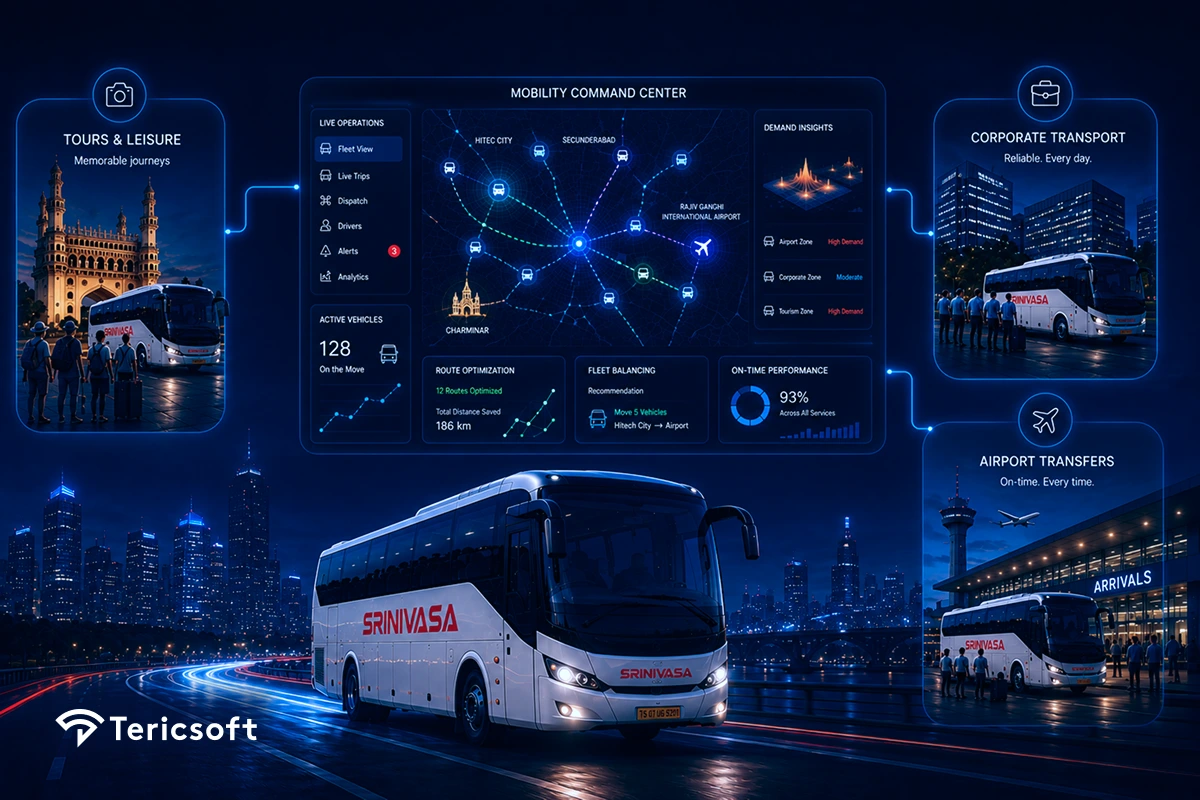
The first solution was a unified fleet and operations management platform. This fleet management software for India's travel operations brings tours and leisure, corporate employee transport, and airport logistics under one operational command center.
What the platform delivers:
- Real-time fleet position tracking across all vehicles and all three verticals in one interface
- Unified booking queue management: tours, corporate shuttles, and airport transfers visible together
- Cross-vertical vehicle allocation without switching between disconnected systems
- Driver availability and trip status visible from dispatch through completion
- Leadership dashboard showing fleet performance, demand, and revenue in real time
Dispatchers now see the full fleet in one screen. A vehicle finishing an airport transfer can be routed immediately to a tour pickup without a phone call or manual check. Leadership no longer waits for end-of-day summaries. Performance is visible now.
Insight: The first output of a digitalization project is not efficiency. It is visibility. Efficiency follows once the data is flowing.
Solution 2: Demand Supply Optimization Transport Operations: The Second Solution
The second solution was a demand-supply optimization engine for transport operations. This system analyzes real-time demand patterns across Hyderabad and recommends how the fleet should be deployed to maximize occupancy and minimize idle time.
What the optimization engine does:
- Analyzes real-time demand by zone, time of day, and route across Hyderabad
- Recommends fleet positioning before demand peaks rather than after
- Tracks seat occupancy and route performance across all active trips
- Surfaces underperforming routes and recommends reallocation
- Builds a demand dataset that improves in accuracy with every completed trip
Route planning is now data-driven. The system replaces individual coordinator judgment with a consistent recommendation that improves over time. The coordinator who manages 50 trips per day cannot manage 500 with the same accuracy. The optimization engine removes that ceiling.
Insight: Reactive dispatch is sustainable at small scale. At larger scale, it is always the first thing that breaks. The optimization engine does not add more vehicles. It makes existing vehicles earn more.
Solution 3: Travel Booking Platform Development for Tours and Leisure
The third solution was travel booking platform development for the tours and leisure vertical. Srinivasa Travels offers Ramoji Film City packages, Wonderla and Wild Waters transfers, Hyderabad city sightseeing tours, and airport pick and drop services. All of these were booked by phone or walk-in before this engagement.
What was built:
- Customer-facing mobile app for tour package discovery, booking, and real-time transport tracking
- Web platform for desktop bookings and package browsing with digital payment integration
- Tour operator software layer for India's leisure travel market: automated availability, pricing, and confirmation
- Airport transfer management software: passengers request transfers on arrival; system matches to nearest available vehicle in real time
- Automated booking confirmation and trip update notifications removing coordinator involvement from routine transactions
Every booking that moves from phone to digital removes a fixed coordination cost from the operation. The tours business can now capture inbound demand it was previously losing entirely. And because the booking connects directly to the fleet management layer, the coordination loop closes automatically.
Insight: Starting with the customer app before the operations backbone is in place creates a digital front end on an analog back end. The sequence matters: operations first, customer layer second.
Employee Transport Management Software: Corporate Shuttle Service
The fourth solution extends the platform to the corporate employee transport vertical. The employee transport management software manages scheduling, route planning, and trip tracking for Srinivasa Travels' corporate clients.
What the corporate transport module delivers:
- Scheduled route management for regular corporate shuttle runs replacing phone and WhatsApp coordination
- Employee roster management and digital pickup confirmation for corporate clients
- Trip logs and SLA reporting accessible to both Srinivasa Travels and the corporate client
- Real-time vehicle tracking visible to corporate clients monitoring employee transport
- Exception alerts for delays, route changes, or missed pickups
Before the platform, the corporate shuttle service was managed through phone calls, WhatsApp messages, and individual coordinator knowledge. Every shuttle request was a coordination task. The platform replaces that entire workflow with automated scheduling, real-time vehicle matching, and digital confirmation.
Corporate clients now have a level of accountability and reporting that was not possible before. Trip logs, SLA performance, and employee travel data are available in real time. This kind of visibility becomes a competitive differentiator when renewing or acquiring corporate contracts.
Insight: Corporate transport requires accountability that leisure bookings do not. Without digital records, SLA reporting is always manual and always incomplete. A corporate transport management system closes that accountability gap.
Impact Created by the Digital Mobility Platform
The engagement is in active progress. The following are early-stage metrics, currently in validation with the Srinivasa Travels team.
3 Verticals Unified on One Platform
Tours and leisure travel, corporate employee transport, and airport logistics now operate from a single technology backbone. Leadership has consolidated visibility across all three verticals for the first time. Dispatchers work from one interface instead of three disconnected systems.
70%+ Internal Workflows Digitized
More than 70 percent of internal workflows across booking, dispatch, and fleet allocation have been moved to the platform. The coordination capacity freed by removing manual touchpoints is being reinvested into managing more trips, not more calls.
~15% Fleet Utilization Lift
Early-stage data shows approximately 15 percent improvement in fleet utilization. As the demand-supply optimization engine accumulates more trip data across Hyderabad routes, this figure is expected to improve. The data asset compounds over time.
~10% Online Booking Adoption in Year One
Approximately 10 percent of bookings are now arriving through digital channels in year one. For a business that had zero digital booking capability before this engagement, this is a meaningful directional signal. The channel is established and growing.
*All figures are early-stage. This engagement is in active transformation phase. Figures are pending full client validation.
Key Lessons From This Travel Company Digital Transformation
These lessons apply to any traditional travel, transport, or fleet operations business considering digitalization.
Start With Operations Visibility Before Customer-Facing Products
The most common mistake in travel company digital transformation is starting with the customer app. The operations backbone is invisible but critical. The customer experience is only as good as the operations it connects to. Build the internal platform first.
Digitize the Dispatch Layer Before the Booking Layer
If dispatch is not digitized, every new booking creates more manual coordination work. Digitizing the booking layer without digitizing dispatch moves the bottleneck. It does not remove it. Get dispatch working on real-time data first. Then accept digital bookings at scale.
Unified Platforms Win Over Multi-Tool Patchwork
Adding a separate app for tours, a separate system for corporate transport, and a separate tool for airport logistics creates more fragmentation, not less. A single platform serving all three verticals is harder to build but significantly easier to operate and scale.
Early Metrics Are Direction Signals, Not Destinations
The 15 percent fleet utilization lift and 10 percent online booking adoption confirm the system is working and the direction is right. They are not the final outcome. Digital transformation in a traditional business takes 18 to 36 months to fully stabilize.
Why Travel Companies in India Need Digital Transformation Now
India's travel and transport sector is growing. Corporate shuttle demand is rising. Leisure travel is recovering strongly. Airport passenger volumes are increasing. But demand growth without operational transformation creates a different kind of problem: a business that breaks under the weight of its own success.
The companies that will define this market are not the ones with the most vehicles. They are the ones with the best operational visibility, the fastest response to demand, and a digital customer experience in a sector that is still largely offline.
Transport Management System India: What the Right Platform Needs
A transport management system for India's travel sector has to handle realities that standard enterprise software does not account for: route changes based on Hyderabad traffic, mobile access on low-end Android devices, SLA reporting for corporate clients, and multi-vertical data visibility in a single interface. Most systems built for logistics do not meet these requirements. The right system has to be built for the actual operating environment.
Why Travel Companies Choose Long-Term Technology Partners
Three separate verticals, each with its own operational logic, coordination requirements, and customer expectations, cannot be digitized through a single scope and a fixed delivery date. The kind of transformation Srinivasa Travels is undergoing requires a partner who understands the domain, maps the actual workflows, builds iteratively, and stays accountable for the outcome as the business evolves.
That is the model Tericsoft brought to this engagement. Not a product vendor. A long-term technology partner.
Conclusion
Srinivasa Travels started this engagement with a clear ambition: to become Hyderabad's first fully digital, technology-enabled travel and mobility company. The platform Tericsoft is building brings fleet management software, demand-supply optimization, customer-facing booking apps, corporate shuttle management, and airport transfer logistics under one centralized system. Three verticals. One technology backbone.
Digital transformation in a traditional travel business is not a single project. It is a continuous process of replacing manual touchpoints with intelligent, data-driven systems. The businesses that start early, build the right foundation, and stay committed to the process will define what modern travel operations look like in India.
If your travel or transport business is navigating a similar problem, scaling across multiple verticals, reducing fleet idle time, or moving bookings online, we are happy to think through it with you.

How Tericsoft helped Srinivasa Travels digitize 3 business verticals with a unified mobility platform, fleet optimization, and customer-facing apps.
Tericsoft built fleet management software, a demand supply optimization engine, travel booking platform, and a corporate shuttle service management system.
It analyzes real-time demand across routes and recommends fleet positioning, replacing reactive dispatch with data-driven decisions that improve over time.
Srinivasa Travels achieved 3 verticals unified, 70%+ workflows digitized, 15% fleet utilization lift, and 10% online booking adoption in year one.
Multi-vertical travel operations require iterative platform development, domain understanding, and ongoing accountability that a product vendor cannot provide.