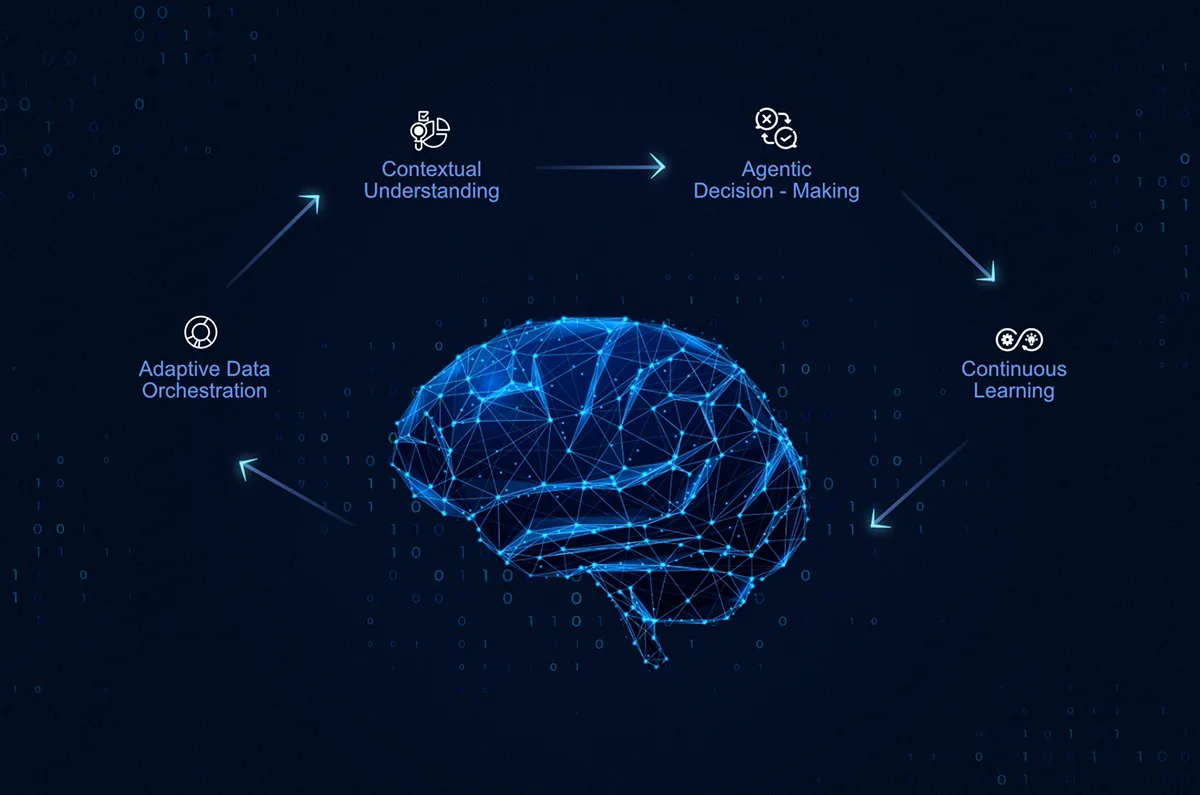
How is AI reshaping fintech operations in 2026, and where does it deliver real business value? What real-world AI use cases should B2B fintech leaders prioritize today? And how can enterprises adopt AI strategically while staying compliant, scalable, and secure?
In 2024, a mid-sized digital lending fintech operating across the United States and India shared its operational challenges at an industry forum. The company had crossed one million active users in under three years, driven by rapid adoption of instant credit products. Revenue growth remained strong, but internal operations told a different story.
Fraud alerts were rising faster than transaction volumes. Manual credit reviews delayed approvals. Compliance reporting across jurisdictions consumed increasing time and resources. Customer support requests doubled within months. Despite being digitally native, the organization realized that rule-based systems and manual decision-making could not scale safely.
Leadership reached a critical conclusion. Growth without intelligence would increase operational risk rather than resilience.
This story reflects a broader shift across fintech in 2026. Digital transformation solved speed and access. It did not solve adaptability, intelligence, or regulatory scale. That gap is now being filled by artificial intelligence.
“AI is infrastructure.”
— Jensen Huang, CEO of NVIDIA
In fintech, this statement is literal. AI now forms the backbone of fraud detection, credit decisioning, compliance monitoring, personalization, and forecasting. Without AI embedded into core workflows, fintech organizations struggle to scale sustainably.
Top Industries Using AI in 2026
AI adoption is accelerating across industries, but financial services remains among the most advanced adopters globally due to its reliance on real-time data, regulatory oversight, and risk sensitivity.
Generative AI could add between 200 billion and 340 billion dollars annually in value across the global banking industry if fully implemented.
“This is like a tsunami hitting the labour market.”
— Kristalina Georgieva, Managing Director, IMF
This transformation is already underway, and fintech firms that delay adoption risk falling behind competitors that operationalize AI at scale.
Benefits of AI in Fintech
AI enables fintech organizations to make faster, more consistent decisions by analyzing large volumes of data with reduced human bias. It lowers operational cost per transaction by automating repetitive workflows and improves risk management through continuous learning.
A concrete example comes from JPMorgan Chase. In 2025, the bank reported that its internal AI coding assistant increased software engineer productivity by 10 to 20 percent.
This demonstrates how AI delivers measurable value when embedded directly into core operations.
Top 10 AI Use Cases in Fintech
1. Fraud Detection and Prevention
Problem:
Traditional rule-based fraud systems rely on static thresholds that struggle to keep up with evolving fraud tactics. This leads to high false positives and missed sophisticated attacks as transaction volumes grow.
The World Economic Forum reports that 52% of end users experienced fraud attempts or successful fraud in 2025.
AI Solution:
Machine learning models analyze real-time transaction behavior across devices, locations, and patterns. These models adapt continuously as new fraud techniques emerge.
Business Impact:
- Reduced false positives
- Faster fraud response
- Improved customer trust
2. Smart and Secure Payments Automation
Problem:
Manual payment checks slow transaction throughput and introduce inconsistencies across payment rails and regions, increasing operational friction.
AI Solution:
AI systems monitor payment flows in real time, detecting anomalies and optimizing routing decisions to balance speed and security.
Business Impact:
- Faster settlement times
- Higher transaction success rates
- Stronger payment security
3. Credit Scoring and Loan Decisioning
Problem:
Traditional credit models rely heavily on historical credit data, excluding underbanked and new-to-credit customers while slowing approval cycles.
AI Solution:
AI-driven credit models assess alternative data such as transaction behavior and cash flow patterns to generate more accurate risk profiles.
Business Impact:
- Faster loan approvals
- Expanded customer inclusion
- Improved risk prediction
4. KYC and Identity Verification
Problem:
Manual KYC processes are time-consuming and error-prone, creating onboarding delays and increasing compliance costs.
AI Solution:
Computer vision and natural language processing automate identity document verification and inconsistency detection in near real time.
Business Impact:
- Reduced onboarding time
- Lower compliance effort
- Improved regulatory alignment
5. Personalized Financial Advisory and AI Advisors
Problem:
Generic financial advice fails to reflect individual goals, risk tolerance, and market conditions, limiting engagement.
AI Solution:
AI recommendation engines deliver personalized insights by analyzing user behavior, financial data, and real-time market signals.
Business Impact:
- Higher customer engagement
- Improved retention
- Increased cross-sell opportunities
6. Automated Customer Service and Chatbots
Problem:
Support teams struggle to scale with rapid user growth, driving up costs and response times.
AI Solution:
Context-aware AI chatbots handle routine queries, provide instant responses, and escalate complex issues to human agents.
Gartner reports that 85% of customer service leaders will pilot conversational GenAI by 2025, while 64% of customers remain cautious about AI-led support.
Business Impact:
- Lower support costs
- Faster response times
- Balanced automation
7. Anti-Money Laundering (AML) Monitoring
Problem:
Rule-based AML systems generate large volumes of low-risk alerts, overwhelming compliance teams and slowing investigations.
AI Solution:
AI models analyze behavioral patterns across transactions and networks to prioritize genuinely high-risk cases.
Business Impact:
- Improved compliance accuracy
- Reduced investigator workload
- Faster reporting
8. Predictive Analytics and Market Insights
Problem:
Reactive decision-making based on historical reports limits the ability to anticipate market shifts and customer behavior changes.
AI Solution:
Predictive models combine historical and real-time data to forecast trends, risks, and demand patterns.
Business Impact:
- Proactive strategy
- Better capital allocation
- Stronger positioning
9. Portfolio Optimization and Algorithmic Trading Support
Problem:
Human portfolio managers cannot process large datasets or simulate complex market scenarios in real time.
AI Solution:
AI-assisted optimization engines continuously analyze market signals and rebalance portfolios based on defined risk parameters.
Business Impact:
- Improved risk-adjusted returns
- Faster execution
- Data-driven decisions
10. Regulatory Compliance and Reporting Automation
Problem:
Manual compliance reporting is time-consuming and vulnerable to errors, especially across jurisdictions.
AI Solution:
AI platforms automate data aggregation, validation, and regulatory reporting while tracking rule changes.
Business Impact:
- Lower compliance costs
- Faster audits
- Reduced regulatory risk
Why AI Use Cases in Fintech Demand Enterprise-Grade Engineering
“We risk letting the wave of AI adoption pass us by and jeopardise Europe’s future.”
— Christine Lagarde, President, European Central Bank
Fintech AI systems must be explainable, auditable, secure, and compliant by design. Without enterprise-grade engineering, AI adoption increases risk rather than reducing it.
How Tericsoft Enables AI Use Cases in Fintech
Tericsoft builds enterprise-grade AI solutions for fintech organizations operating in regulated environments. We specialize in AI-driven workflow automation, secure AI architectures, custom model development, and end-to-end deployment from strategy to production.
Conclusion: The Fintech Leaders Who Win in 2026
“We need to remain competitive in the artificial intelligence race.”
— Jamie Dimon, CEO, JPMorgan Chase
The fintech leaders who succeed in 2026 will operationalize AI across fraud, compliance, payments, analytics, and customer experience.
AI is no longer optional. It is the operational backbone of modern fintech.

AI enables fintechs to scale safely by automating fraud, credit, compliance, and support while reducing risk and operational cost.
Key use cases include fraud detection, credit scoring, KYC automation, AML monitoring, payments optimization, and compliance reporting.
AI analyzes real-time transaction patterns and behavior to detect evolving fraud, reduce false positives, and respond faster.
AI prioritizes high-risk cases, automates reporting, tracks regulatory changes, and reduces manual compliance workload.
Tericsoft builds secure, enterprise-grade AI systems for fintech, covering strategy, model development, compliance, and deployment.