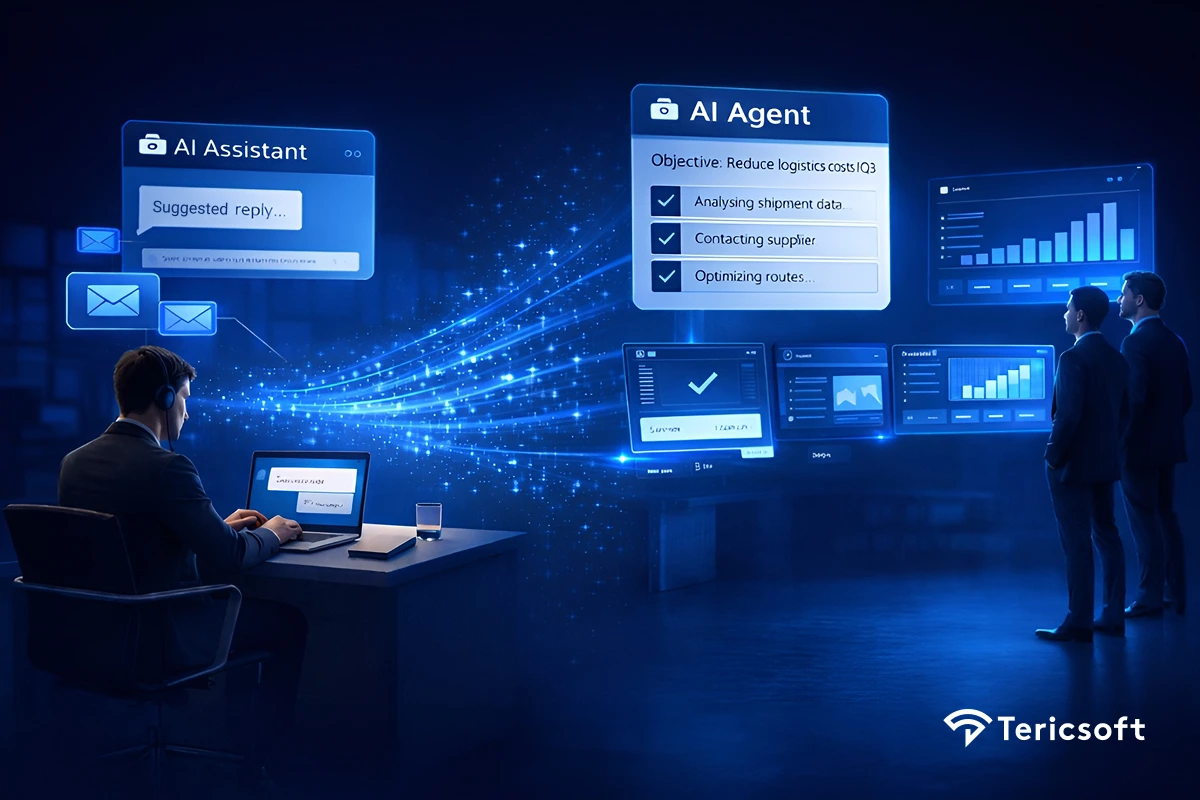
How will Agent Experience shape the future of websites and software? Learn why traditional UX is no longer enough, how AI agents interact with digital systems, and what businesses need to build agent-friendly products and applications.
"The future is already here. It's just not evenly distributed."
— William Gibson
For decades, the internet was designed around a single assumption: the user would always be human.
Every layer of modern software evolved around this idea. UX teams optimized onboarding flows. Product teams reduced friction across customer journeys. Designers focused on aesthetics, clarity, and emotional engagement. Entire industries emerged around improving how humans interact with digital systems.
But the internet is entering a structural transition.
It no longer has only human users.
It now has AI agents.
AI systems are already browsing websites, operating Saas platforms, comparing vendors, executing workflows, conducting research, interacting with APIs, and coordinating enterprise systems autonomously. According to Gartner, by 2028, one-third of enterprise software applications will include agentic AI capabilities, compared to less than 1% today.
This is not just another AI trend.
It changes how digital infrastructure itself must be designed.
The next generation of software will need to support two fundamentally different audiences simultaneously:
- Humans who consume interfaces visually
- AI agents that operate systems structurally
That is where Agent Experience (AX) becomes critical.
What Is Agent Experience?
The rise of AI agents is introducing a completely new operational layer across the internet. Businesses are no longer designing systems only for people interacting with screens. They are increasingly designing systems that autonomous software can understand, navigate, and execute reliably.
This is where Agent Experience begins to matter.
Defining Agent Experience
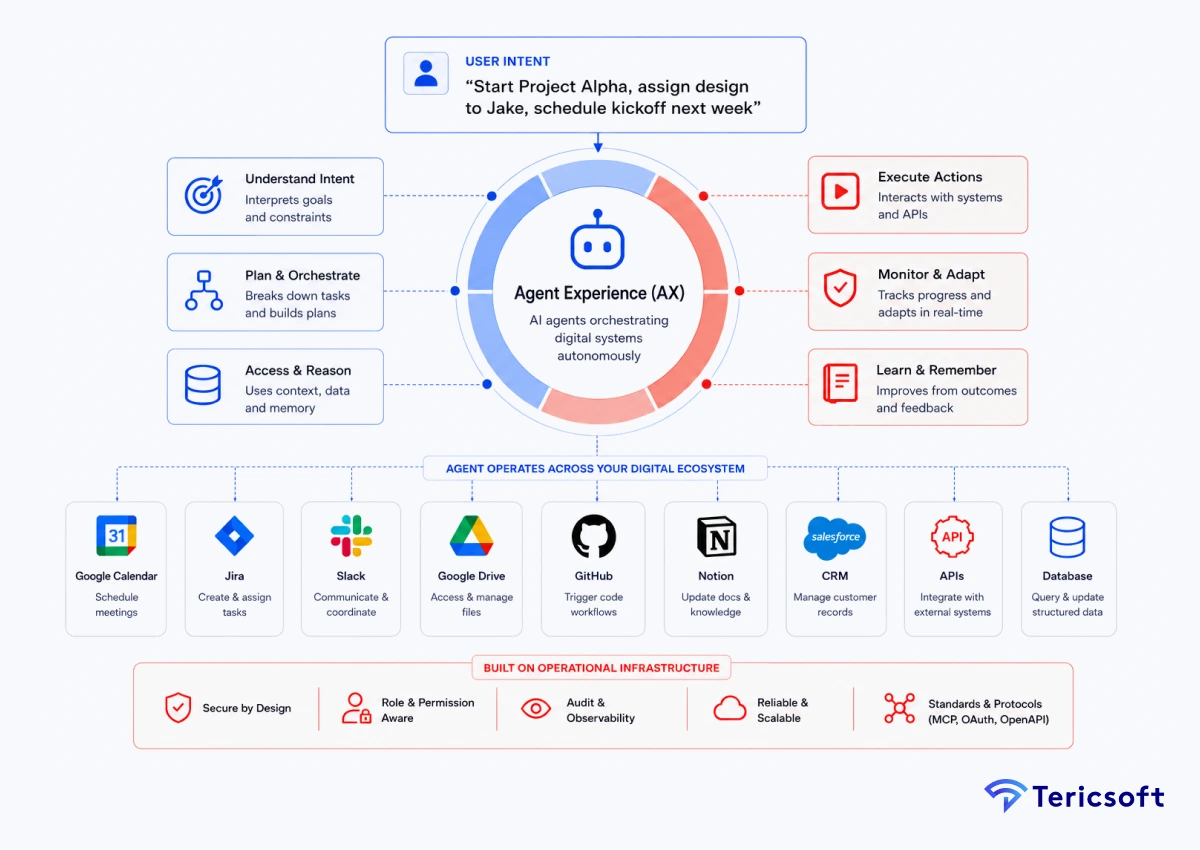
Agent Experience (AX) is the practice of designing websites, applications, APIs, and digital systems so AI agents can reliably understand and operate them.
Just as UX focuses on human usability, AX focuses on machine operability.
This distinction matters more than most organizations realize.
Humans interpret software through visual intuition. They understand layouts, infer meaning from context, recover from inconsistencies, and adapt to friction naturally.
AI agents do not.
They interpret systems through structure, semantics, workflows, state transitions, metadata, and operational predictability.
That means the future internet will not simply reward products that look intuitive. It will reward products that behave predictably.
Why AX Is Emerging Now?
The rise of AX is directly tied to a larger architectural shift happening across enterprise technology.
AI is moving from assistant-based interaction toward operational execution.
Earlier generations of AI primarily generated outputs:
- summaries
- recommendations
- predictions
- content
Modern AI agents increasingly execute actions.
They book meetings, coordinate systems, trigger workflows, manage operational tasks, and navigate enterprise software autonomously.
This is the beginning of what many technologists are calling the "agentic internet" which is an internet where software is no longer only consumed by humans, but increasingly operated by intelligent systems.
According to McKinsey & Company, generative AI could contribute up to $4.4 trillion annually in economic impact across industries. Much of this value comes from operational automation and workflow execution.
UX vs AX
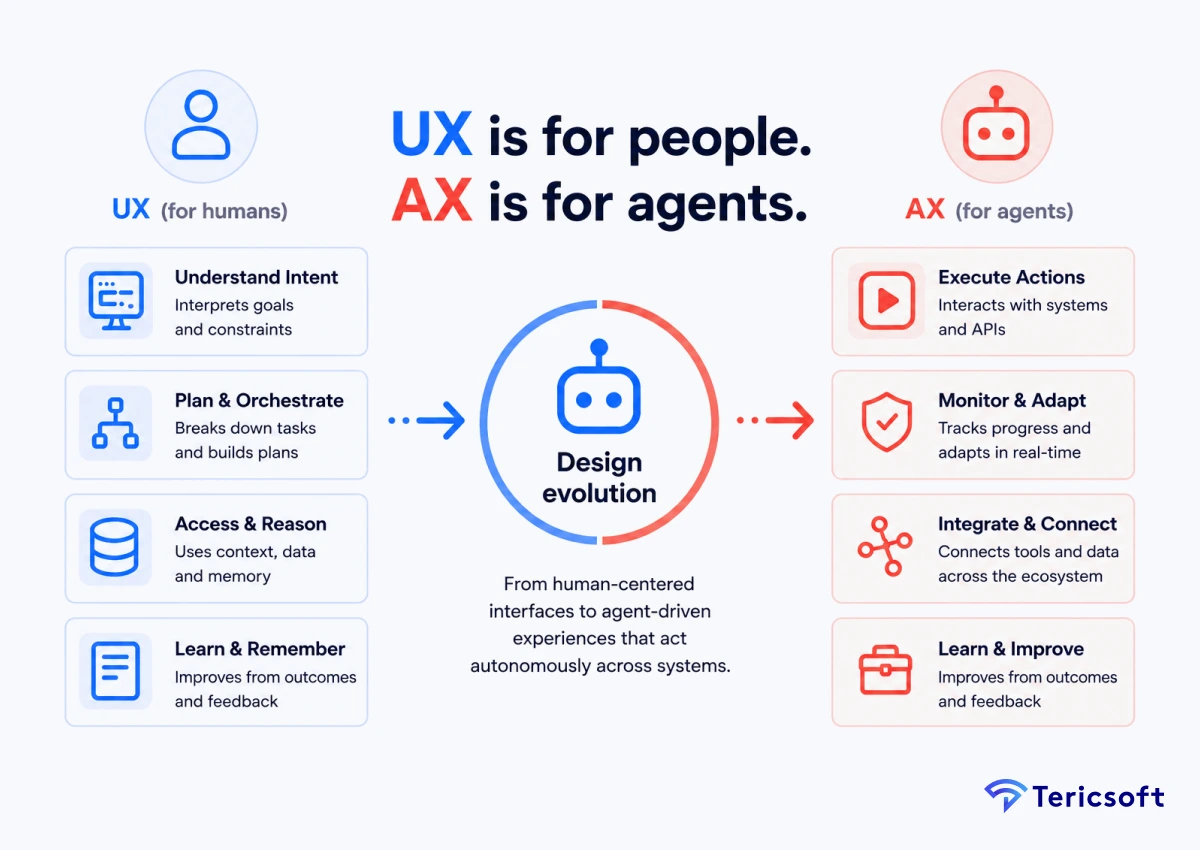
UX optimizes experiences.
AX optimizes execution.
A visually beautiful interface can still be operationally fragile for AI systems.
An enterprise platform may feel intuitive for humans while remaining nearly unusable for autonomous agents because of inconsistent workflows, unstable identifiers, or poor semantic structure.
The future internet will not choose between UX and AX.
The most valuable systems will master both.
Why AI Agents Struggle With Traditional Websites
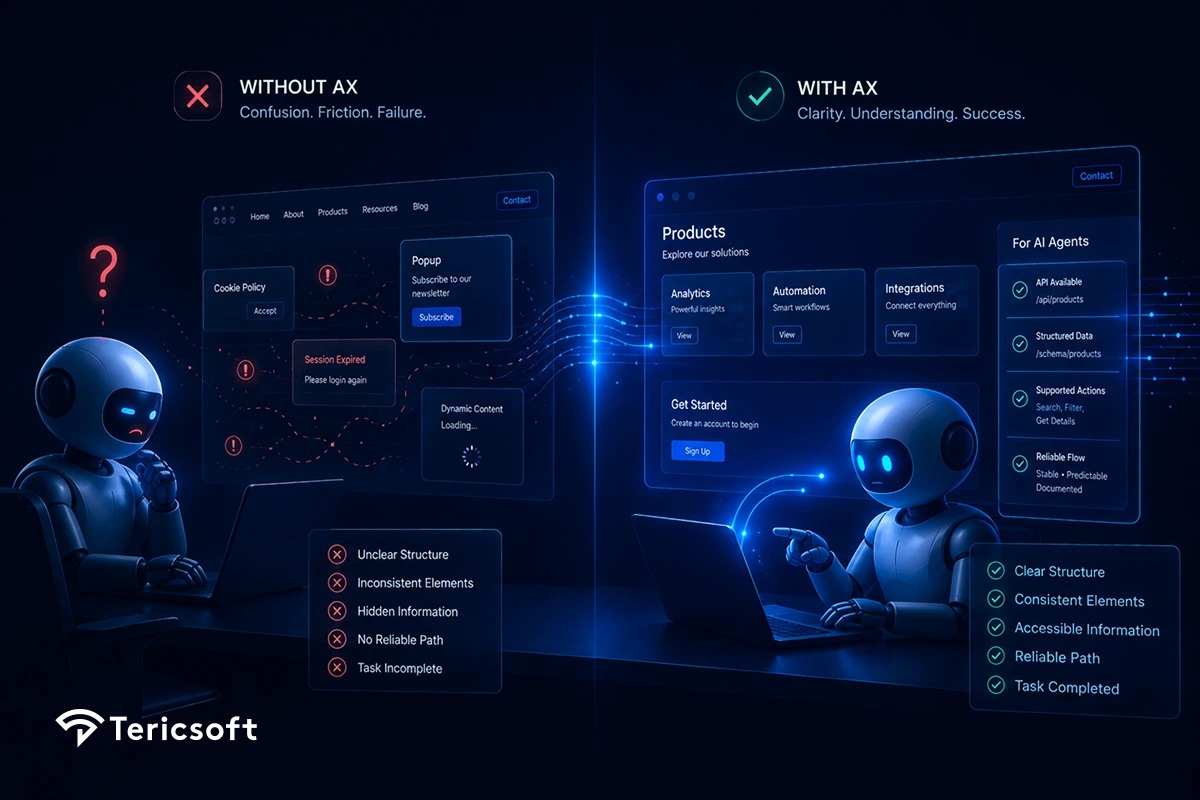
Most modern websites were designed around human adaptability, not machine reliability. As AI agents become more capable, this design gap becomes increasingly visible.
The challenge is not intelligence alone. The challenge is operability.
Human Interfaces vs Machine Operability
Humans naturally compensate for inconsistency. If a button changes position, users adapt. If a workflow behaves slightly differently, people improvise around it.
AI agents cannot rely on intuition.
They depend on operational consistency.
This creates a major mismatch between how humans experience software and how AI systems operate it.
A human sees a checkout flow.
An AI agent sees:
- DOM structures
- identifiers
- workflow states
- semantic meaning
- execution logic
- state confirmations
What feels visually smooth to a person may appear structurally chaotic to an AI system.
Why Modern Websites Break AI Workflows
Modern frontend ecosystems increasingly prioritize visual dynamism.
Single-page applications, asynchronous rendering, floating UI layers, dynamic selectors, and animation-heavy interfaces create highly fluid user experiences.
But fluidity often reduces machine reliability.
An AI agent attempting a simple task such as:
“Find a coffee mug and add it to cart”
may need to:
- identify actionable elements
- interpret page hierarchy
- understand metadata
- track loading states
- validate whether the cart updated successfully
- recover from interruptions
- determine whether execution failed silently
Small inconsistencies can completely break the workflow.
A renamed button. A popup interruption. A changing selector. A delayed rendering state.
Humans barely notice these issues.
For autonomous systems, they can become fatal execution failures.
The Difference Between Human Adaptability and Agent Reliability
One of the biggest misconceptions in enterprise AI is assuming that if software works for humans, it automatically works for AI agents.
It does not.
Humans improvise around ambiguity.
Agents require operational certainty.
This is why the next generation of software architecture will increasingly prioritize:
- predictability
- semantic clarity
- structured capability exposure
- machine-readable workflows
- reliable state management
The organizations that recognize this shift early will gain a major advantage as agent- driven systems become mainstream.
How to Build AI Agent Friendly Websites and Applications
Building AI agent friendly systems requires organizations to rethink how software exposes functionality, communicates intent, and supports autonomous execution.
The goal is not only usability.
The goal is operational clarity.
Predictable Workflows
AI agents perform best in environments where workflows behave consistently.
Predictability is no longer just a usability feature. It becomes operational infrastructure.
This requires:
- stable execution paths
- deterministic behavior
- explicit workflow logic
- reliable state transitions
The more autonomous systems enterprises deploy, the more important operational consistency becomes.
Stable Identifiers and Semantic Structure
AI agents rely heavily on structure.
Semantic HTML, meaningful metadata, stable identifiers, and clear hierarchy dramatically improve machine operability.
Interestingly, many of the engineering practices that improve AX also improve:
- accessibility
- SEO
- maintainability
- interoperability
This suggests something important: good AX is often a byproduct of disciplined engineering.
Reliable State Confirmations
One of the most overlooked aspects of agent systems is state reliability.
Humans tolerate uncertainty surprisingly well.
AI agents do not.
An agent executing a workflow must know:
- Did the action succeed?
- Did the system update correctly?
- Did the workflow complete?
- Is recovery required?
Without reliable confirmations, autonomous systems become fragile.
Machine-Readable Operational Design
The internet is gradually shifting from visually interpreted software toward machine- readable infrastructure.
Future-ready systems increasingly expose operational capability through:
- APIs
- manifests
- structured metadata
- operational instruction layers
- interoperability protocols
In the AI era, systems that expose capability clearly will outperform systems that expose capability only visually.
APIs, MCP, and AI Agent Infrastructure Explained
As AI agents become more operational, APIs and interoperability frameworks are becoming foundational infrastructure layers for the modern internet.
This shift moves software from interface-first architecture toward execution-first architecture.
APIs as Structured Capability Layers
APIs are becoming the operational foundation of the AI-driven internet.
Instead of forcing agents to visually navigate interfaces, APIs expose functionality directly in structured formats.
This dramatically improves reliability, speed, and interoperability.
According to Postman's 2024 State of the API Report, APIs have become foundational infrastructure for modern digital transformation and AI-driven application ecosystems.
In the AI era, APIs increasingly become more than developer infrastructure.
They become machine-operable capability layers.
Tools and Agent Execution Systems
Modern AI agents are increasingly tool-driven systems.
Rather than existing as isolated chat models, they operate through connected execution environments:
- databases
- browsers
- CRMs
- file systems
- APIs
- enterprise platforms
- external integrations
Applications are no longer just interfaces for people.
They are becoming operational environments for intelligent systems.
MCP (Model Context Protocol)
Anthropic introduced MCP (Model Context Protocol) to standardize how AI systems connect with external tools and services.
MCP represents something larger than a technical protocol.
It signals the emergence of interoperability-first AI infrastructure.
Historically, software ecosystems scaled through standards:
- HTTP standardized the web
- REST standardized APIs
- OAuth standardized identity
MCP may play a similar role for AI agent ecosystems.
Because as enterprises deploy multiple AI systems simultaneously, interoperability becomes essential.
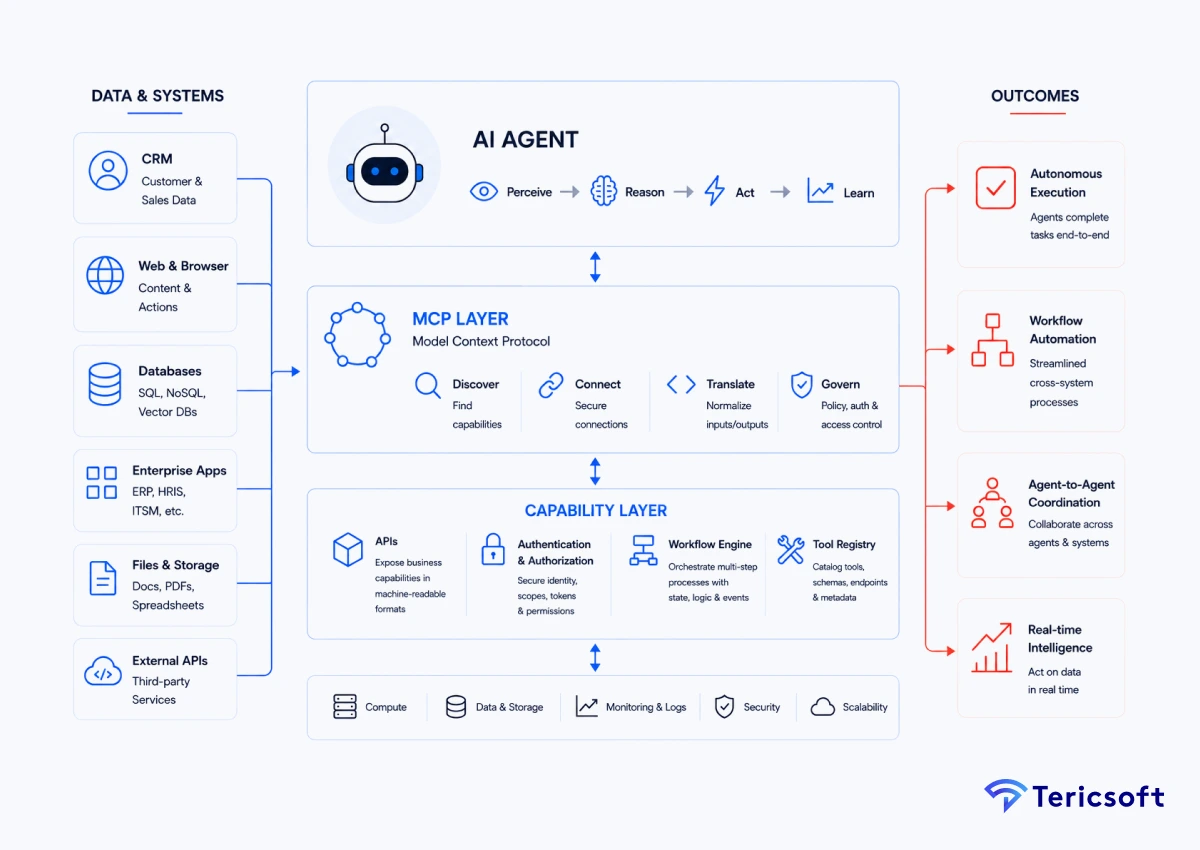
Why Context Matters in AI Agent Systems?
As enterprises move toward autonomous AI systems, context becomes one of the most important operational layers in modern software architecture.
Intelligence alone does not create reliability.
Context does.
Operational Context for AI Agents
AI agents require onboarding.
Not visual onboarding designed for humans.
Structured onboarding designed for machines.
That includes:
- workflow understanding
- execution constraints
- recovery behavior
- operational priorities
- architecture guidance
Without context, agents behave like brittle automation scripts. With context, they behave more like reliable digital operators.
Files and Context Systems Used by AI Agents
Engineering teams are increasingly introducing operational context layers such as:
- llms.txt
- AGENTS.md
- capability manifests
- operational instruction files
These systems help agents understand how environments behave before execution begins.
The internet historically optimized for discoverability by humans.
The next generation of systems will increasingly optimize discoverability for AI agents.
Why Context Creates Reliable Agent Behavior?
Reliability is not just a model problem.
It is an architecture problem.
The organizations that build strong contextual systems will create agents that:
- fail less frequently
- recover more intelligently
- coordinate workflows better
- operate more predictably
In many ways, context becomes the operational memory layer of the agentic internet.
Why UX and AX Will Need to Work Together?
One of the biggest mistakes organizations can make is treating Agent Experience as only a backend or engineering concern.
It is much broader than that.
The future of software will depend on how effectively organizations combine usability with operability.
How Good AX Improves UX
One of the most interesting aspects of AX is that it often improves UX indirectly.
Systems that are:
- semantically structured
- operationally predictable
- state-aware
- logically organized
tend to become easier for humans to use as well.
Clarity improves reliability for everyone.
Designing for Humans and Agents Simultaneously
The next generation of software platforms will increasingly support dual-experience architecture:
- interfaces optimized for humans
- operational layers optimized for agents
This may become as transformational as mobile-first architecture was during the smartphone era.
Except now, the second user is not another human.
It is an intelligent system.
The Rise of Dual-Experience Architecture
Future enterprise platforms will likely include:
- human-facing UX layers
- machine-facing operational layers
- interoperability frameworks
- structured capability systems
- AI-native execution environments
The organizations building this architecture early will adapt faster to the AI-operated internet.
The Future of the Internet Is AI Agent Driven
The internet is entering a new operational phase.
A phase where software is no longer only consumed by humans, but increasingly operated by intelligent systems.
The Rise of AI-Operated Systems
AI agents are already:
- browsing websites
- coordinating workflows
- operating enterprise software
- conducting procurement analysis
- executing operational tasks
- orchestrating systems autonomously
This is no longer theoretical infrastructure.
It is already emerging operational reality.
From Human-Centric Internet to Agentic Internet
The internet is transitioning from:
- human-centric
to:
- AI-assisted
- AI-operated
- agent-to-agent
- autonomous-by-default
This will fundamentally reshape how software platforms compete.
Why Every Website Is Becoming an AI Interface?
Every enterprise platform now faces a new strategic question:
"Can autonomous systems reliably operate our infrastructure?"
Because in the AI era, operability becomes competitive advantage.
The winners will not simply build products people love.
They will build systems intelligent agents can reliably execute.
Why Agent Experience Will Become a Competitive Advantage?
The emergence of AI agents is changing how digital systems create value. Earlier generations of internet companies optimized for clicks, engagement, and attention. The next generation will increasingly optimize for operability, interoperability, and autonomous execution.
The Shift From Attention Economy to Operability Economy
The earlier internet optimized for attention.
The next internet will increasingly optimize for execution.
That changes the economics of software.
The most valuable systems may not be the most visually impressive. They may be the most operationally interoperable.
Why Operability Will Define AI-Era Winners?
The companies leading the AI era will likely be those that:
- expose capability clearly
- support interoperability
- maintain operational consistency
- design for autonomous execution
- create structured machine-readable systems
In many ways, AX may become what SEO once was for the early web: an invisible infrastructure advantage that quietly determines who scales and who gets ignored.
How We Help Enterprises Build AI Agent Ready Systems?
As organizations prepare for AI-native operations, they increasingly need infrastructure that supports both human interaction and autonomous execution. This requires more than automation. It requires operationally intelligent architecture.
AI-Native System Design
At Tericsoft, we help enterprises design AI-native systems optimized for both human interaction and autonomous machine operability.
API and MCP Integration Architecture
We build interoperable operational layers that support:
- AI agents
- MCP ecosystems
- workflow orchestration
- enterprise interoperability
Agent-Friendly Workflow Engineering
Our engineering approach focuses on:
- predictable workflows
- semantic operational design
- machine-readable systems
- reliable execution environments
Enterprise AX Strategy and Consulting
We help enterprises prepare for:
- agentic systems
- AI-native infrastructure
- autonomous workflows
- interoperable AI ecosystems
The Internet Is Entering the AX Era
AI agents are no longer experimental interfaces.
They are becoming operational infrastructure across the internet.
Businesses that prepare their systems for machine operability today will hold a major strategic advantage tomorrow.
Because the future internet will not only be experienced by humans.
It will increasingly be operated by intelligent autonomous systems.
Your systems should not only be easy to use.
They should also be easy for AI agents to operate.

Agent Experience (AX) is the practice of designing websites, APIs, and digital systems so AI agents can reliably understand, navigate, and execute workflows.
Most websites are built for human interaction, not machine operability. Dynamic interfaces, inconsistent workflows, and poor semantic structure can break AI agent execution.
APIs expose functionality in structured formats, allowing AI agents to interact with systems more reliably, efficiently, and autonomously than visual navigation.
MCP (Model Context Protocol) is an interoperability framework introduced by Anthropic that helps AI systems connect with tools, services, and operational environments consistently.
As AI agents become operational across industries, businesses with AI agent friendly systems will gain advantages in automation, interoperability, scalability, and execution reliability.