What are AI Agents? Their core benefits for the enterprise, and how Tericsoft's unique agentic Framework helps boost your business's autonomous execution and innovation.
The landscape of enterprise technology is undergoing a seismic shift, moving beyond the era of passive software to the age of active, autonomous intelligence. For the past decade, digital transformation focused on visibility and insight; today, that is no longer enough. The first wave of generative AI introduced the "Copilot," a sophisticated digital shadow providing recommendations and drafting content, but the honeymoon phase with mere assistance is ending. CIOs, CDOs, and CTOs are no longer satisfied with AI that simply "suggests"; they demand systems that "execute."
This demand has birthed the Agentic Operating Layer, a fundamental architectural evolution where AI transcends the limitations of the chat box to become a digital workforce. These are not just upgraded chatbots; they are systems capable of multi-step planning, high-level reasoning, and autonomous execution across fragmented business workflows. This represents a transition from software you use to systems that work for you, effectively replacing reactive tools with proactive, autonomous teammates.
"AI agents will become our digital assistants, helping us navigate the complexities of the modern world. They will make our lives easier and more efficient."
— Jeff Bezos, Founder and CEO of Amazon
What Are AI Agents? (The Shift to Goal-Seeking Autonomy)
At their core, AI Agents are autonomous, goal-driven systems designed to perceive their environment, reason through problems, formulate plans, and take actions to achieve specific objectives. While a traditional program follows a path, an AI Agent pursues a destination.
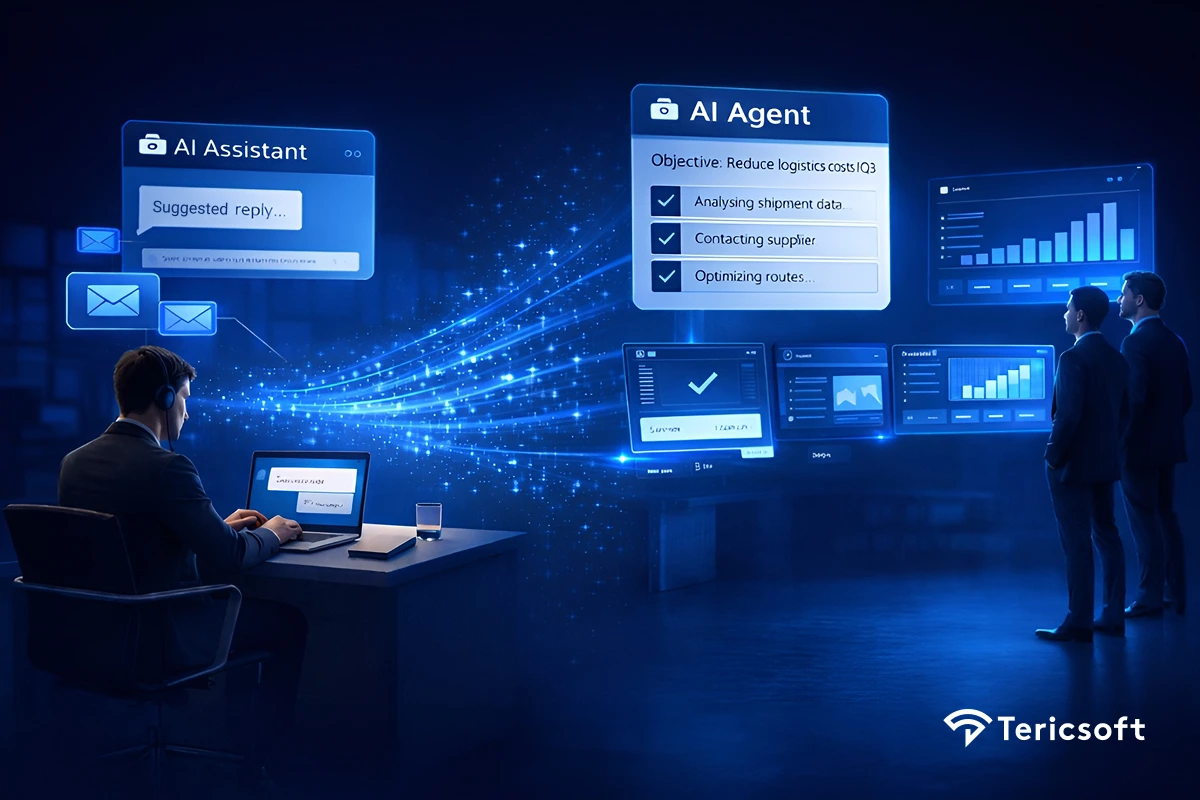
Unlike traditional bots, which follow rigid "if-then" scripts, or AI assistants, which require constant human prompting (human-in-the-loop), AI Agents operate with a degree of independent agency. They don't just process data; they possess the ability to use tools: APIs, software suites, and databases, to bridge the gap between intention and result.
Why AI Agents are the New Digital Workforce
In the enterprise context, an AI Agent is the difference between an assistant that tells you your supply chain is delayed and an agent that autonomously negotiates with secondary suppliers to rectify the shortage before it impacts production. They represent the first "digital employees" capable of handling the cognitive load of process management, allowing human talent to shift from "doing the work" to "directing the outcomes."
Why Now? The Convergence of Agency
The shift toward agentic systems is driven by three technological convergences and a massive market pull:
- Market Velocity: Gartner predicts that by 2028, at least 15% of day-to-day work decisions will be made autonomously through agentic AI, up from nearly 0% in 2024.
- Reasoning Maturity: LLMs have moved from pattern matching to logical sequence planning, allowing models to understand cause and effect.
- Contextual Grounding: Technologies like Contextual Retrieval allow agents to remember" enterprise-specific nuances and operate with real-time awareness of corporate data.
How Do AI Agents Work? The Anatomy of Autonomy
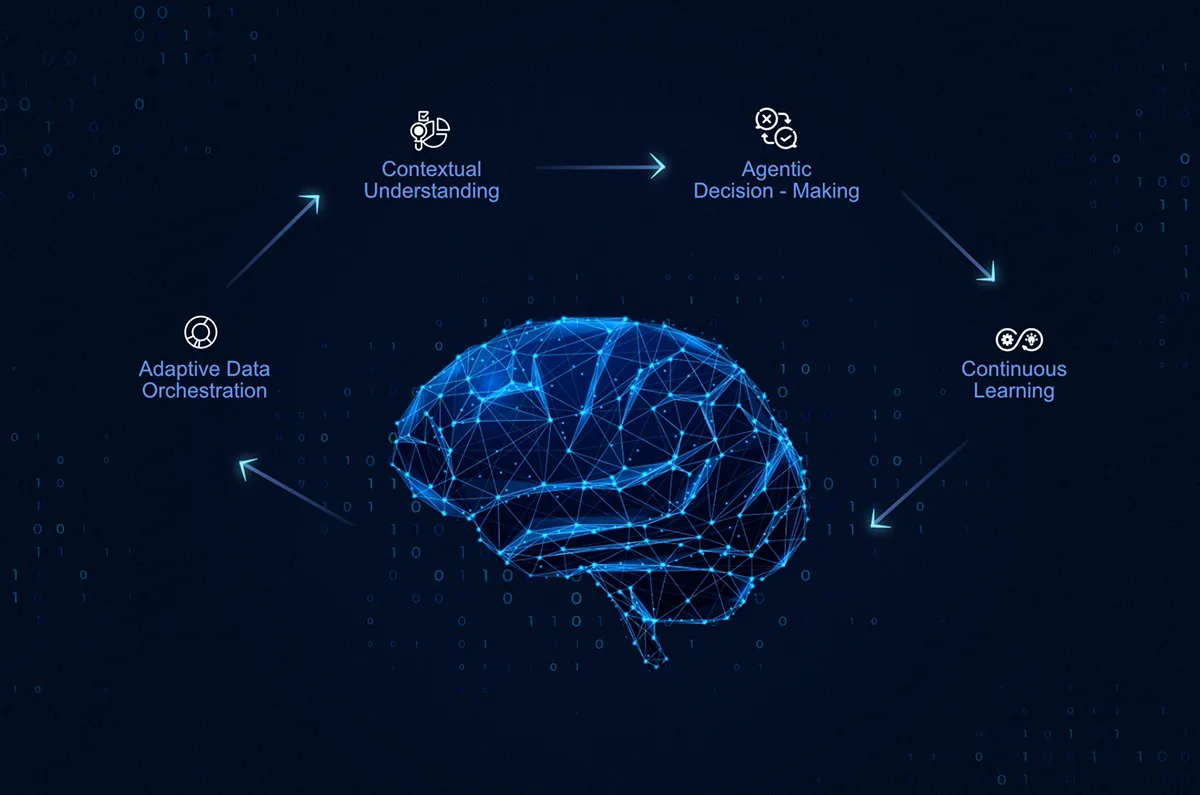
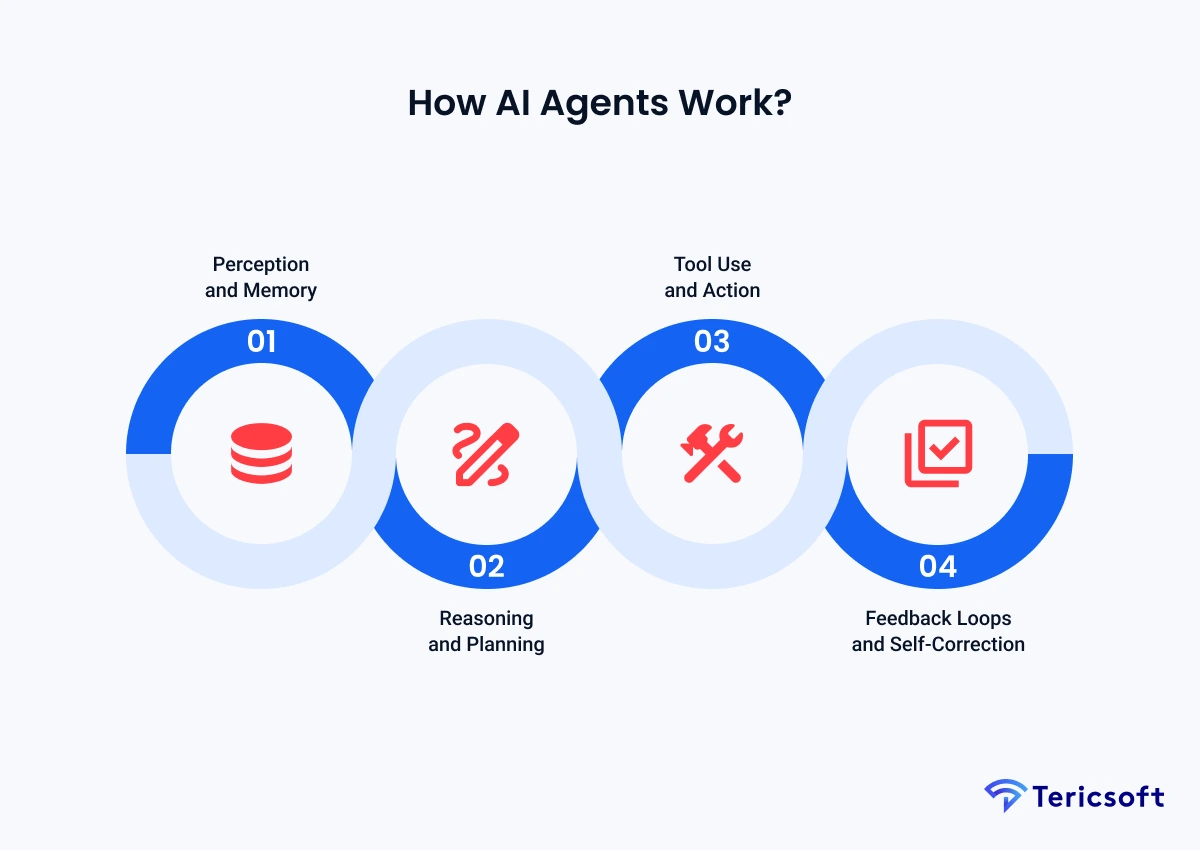
The transition to Agentic Automation requires a sophisticated architectural stack. For an AI Agent to function, it must move through a closed-loop cycle: Observe, Decide, Act, and Learn.
1. Perception and Memory
Agents ingest multi-modal data from across the enterprise. Using Retrieval-Augmented Generation (RAG), they access long-term memory stored in vector databases, ensuring their actions are grounded in real-time enterprise facts rather than static training data.
2. Reasoning and Planning
Utilizing the cognitive power of Large Language Models (LLMs), the agent breaks down a high-level goal, such as "Optimize Q3 logistics spend," into a sequence of actionable sub- tasks. It anticipates obstacles, evaluates trade-offs, and creates contingency paths.
3. Tool Use and Action
This is the "agency" in AI Agents. They utilize "Tool Calling" to interact with CRM systems, ERPs, or custom APIs to execute changes, update records, or send communications. They are effectively "users" of your existing software stack.
4. Feedback Loops and Self-Correction
Advanced agents monitor the outcome of their actions. If a task fails or an API returns an error, they analyze the failure, re-plan, and retry. This exhibiting of resilience is what separates them from legacy automation.
Enterprise-Grade AI Agent Architecture
Building a production-ready agent requires more than a simple prompt. It necessitates a "system of systems" approach to ensure reliability and scale:
- Agent Frameworks and Orchestrators: Tools like LangGraph or CrewAl manage the flow between specialized agents, ensuring that a "Finance Agent" and a "Compliance Agent" can hand off tasks seamlessly.
- State Management: Maintaining the state of a complex, multi-day workflow. If an agent is waiting for an external vendor's response, the system must retain the context and "hibernate" until the trigger arrives.
- Reasoning Engines: Moving away from a single model to a chain of thought. This often involves a "primary" agent using a smaller, faster model for simple tasks and a "reasoning" model for complex planning.
- Observability and Traceability: Detailed logging is required to understand why an gent made a specific decision. This is not just for debugging, it is a requirement for regulatory compliance and internal audit trails.
Agentic Design Patterns: The Blueprints of Action
When architecting agents for the enterprise, we follow specific cognitive patterns:
- Reflection: The agent critiques its own work before presenting it. It generates a response, checks it against its grounding data, and iterates until the accuracy meets a specific threshold.
- Tool Use: The agent identifies when it lacks information and autonomously calls a specific tool, such as a SQL database or a web search, to fill that gap.
- Planning: The agent creates a step-by-step roadmap for a complex goal and updates that roadmap in real-time as environmental conditions change.
- Multi-Agent Collaboration: A "Swarms" approach where agents with different personas (e.g., a "Researcher" and a "Writer") work together, critiquing and improving each other's output.
The Taxonomy of Intelligence: Types of AI Agents
To build an "Agentic Enterprise," leaders must understand which type of intelligence fits each workflow.
- Simple Reflex Agents: Condition-action systems for high-volume, predictable tasks where "if this, then that" suffices.
- Model-Based Reflex Agents: Systems that maintain an internal state to handle partially observable environments, tracking changes over time.
- Goal-Based Agents: The standard for enterprise planning, evaluating different paths to reach an objective rather than just reacting to stimuli.
- Utility-Based Agents: Optimizers that choose the "best" path based on specific business KPIs, such as lowest cost vs. fastest speed or highest customer satisfaction.
- Multi-Agent System (MAS): Collaborative swarms where specialized agents, such as "Procurement" and "Legal," work together on cross-functional projects.
- Hierarchical Agents: A manager-worker structure where a "Super-Agent" orchestrates sub-agents under corporate governance, acting as the primary interface for human leads.
Beyond the Bot: AI Agents vs. AI Assistants vs. Bots
Understanding the differentiation is critical for ROI mapping. While bots handle repetition and assistants provide support, agents drive outcomes.
The Directive for Leaders: Move from software that waits for a command to systems that pursue an intention.
AI Agents in Action: Enterprise Use Cases
Transitioning from theoretical potential to operational reality, AI Agents are already being deployed to solve high-friction bottlenecks across the value chain.
Customer Experience and Support
Agents that resolve tickets, refunding payments and scheduling service calls, rather than just answering questions. Salesforce reports that their internal Agentforce implementation already resolves 85% of customer service requests autonomously, while simultaneously reducing response times by 65%.
Sales and CRM Automation
Agents that conduct deep research on prospects, personalize multi-channel outreach, and update CRM records based on the sentiment of received replies. These agents act as "Sales Development Reps" that never sleep, ensuring no lead goes cold due to manual bandwidth constraints.
DevOps and SRE
Agents that monitor system health, perform initial root-cause analysis during outages, and execute "self-healing" scripts to restart services or scale resources before a human engineer is even alerted. They handle the "toil" of infrastructure management.
Supply Chain and Logistics
Autonomous agents that monitor inventory levels across global warehouses and automatically issue purchase orders. McKinsey research suggests that digitalizing supply chains can reduce operational costs by up to 30% while minimizing lost sales by 75% through improved responsiveness.
The Enterprise Stack: RAG, Fine-Tuning, and Liquid LLMs
Building a secure, scalable AI Agent platform requires a composable intelligence stack:
- Retrieval-Augmented Generation (RAG): AI Agents utilize Retrieval-Augmented Generation (RAG) to eliminate hallucinations, ensuring every action is grounded in "contextual intelligence" derived from private enterprise data.
- Fine-Tuning: While RAG provides the facts, the specific behavioral nuances, mastery of industry jargon, and adherence to internal compliance standards are achieved through Fine-Tuning.
- Liquid LLMs: For agents operating in highly dynamic, real-time environments, Liquid LLMs offer the necessary adaptability to process continuous data streams without the massive compute overhead of static transformers.
Metrics That Matter: Measuring the Agentic Enterprise
To prove the value of AI Agents, CIOs must move beyond "number of chats" and focus on outcome-based KPIs:
- Task Success Rate (TSR): The percentage of goals successfully completed without human intervention.
- Automation Coverage: The percentage of end-to-end workflows handled by agents. IBM reports that their internal AI automation initiatives saved an estimated 3.9 million hours in 2024, achieving a 40% reduction in specific HR process times.
- Decision-to-Action Cycle Time: The reduction in time between identifying a problem and the agent executing a fix.
- Override Rate: How often a human-on-the-loop has to correct or stop an agent's action, a key metric for measuring the maturity of the system and the level of user trust.
Addressing the Challenges: Governance and Safety
Autonomy without governance is a liability. For the enterprise, the transition to AI Agents must address the "Agentic Safety Shield":
- Security and Access: Ensuring agents only access data they are authorized to see through deep IAM (Identity and Access Management) integration.
- Human-in-the-Loop: Designing "checkpoints" where high-stakes decisions, such as financial transfers above a certain threshold, require explicit human approval.
- Accuracy: Implementing rigorous guardrails through Contextual Retrieval to prevent the agent from taking action based on hallucinated data.
- Agent Alignment and Drift: Monitoring agents to ensure their goal-seeking behavior remains aligned with corporate ethics, safety policies, and brand voice over time.
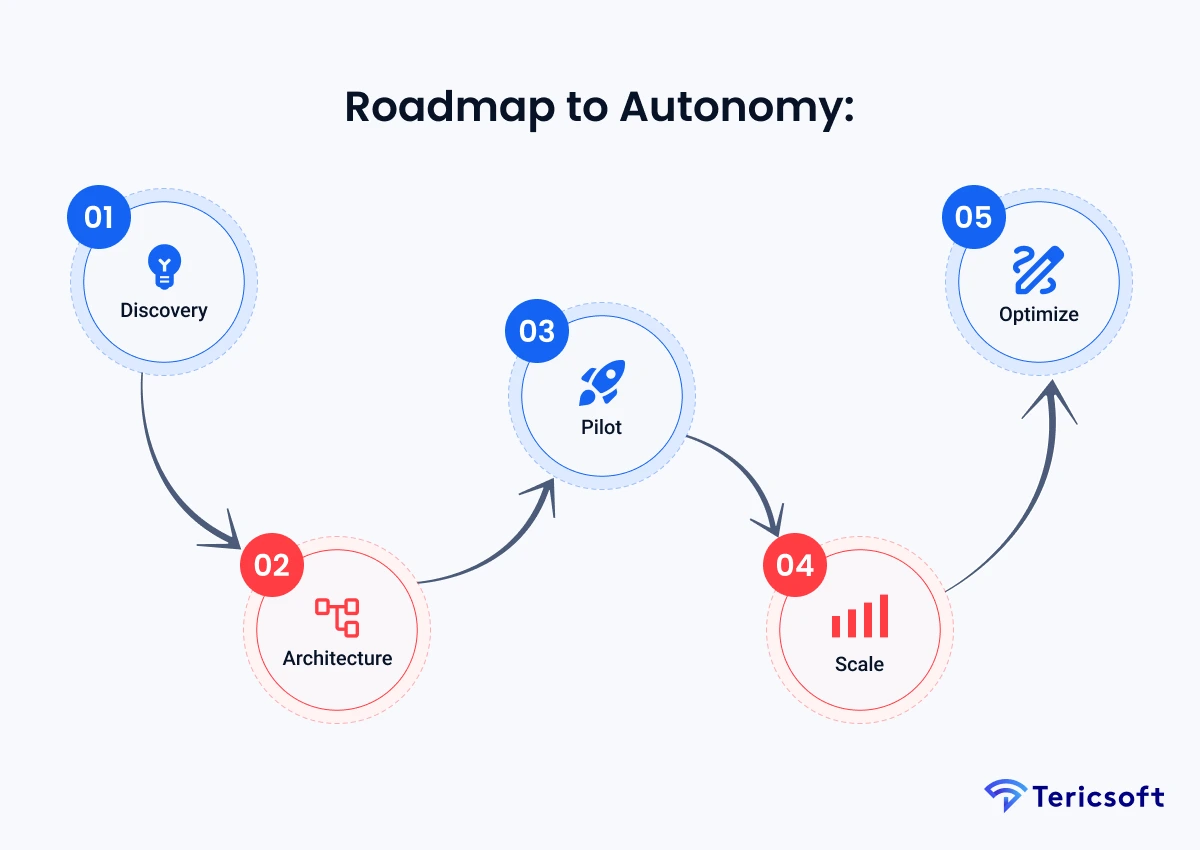
Roadmap to Autonomy: A Strategy for Leaders
- Discovery: Identify high-friction, low-creativity workflows (e.g., ticket resolution, data reconciliation).
- Architecture: Build the "Memory and Reasoning" layer using RAG and orchestration frameworks.
- Pilot: Deploy a single-agent "Human-on-the-loop" system to establish a baseline for TSR (Task Success Rate).
- Scale: Move toward Multi-Agent Systems and cross-functional swarms.
- Optimize: Use feedback loops and fine-tuning to drive towards a 90% autonomous resolution rate.
The Future: From Tools to Teammates
The "AI-First" company is no longer a vision; it is a requirement. As we move toward self- optimizing workflows and autonomous departments, the role of the CIO shifts from managing software to orchestrating a hybrid workforce. We are moving toward a future where "every company will become an AI-first company," and those who bridge the gap from assistance to autonomy first will define the market.
"AI agents will become the primary way we interact with computers in the future. They will be able to understand our needs and preferences, and proactively help us with tasks and decision making."
— Satya Nadella, CEO of Microsoft
How Tericsoft Enables Your Agentic Journey
At Tericsoft, we architect autonomous systems. We specialize in building secure, enterprise-grade AI Agent platforms that integrate seamlessly with your data via RAG and contextual retrieval. Our strategy-to-architecture approach ensures that your agentic deployment is compliant, scalable, and ROI-focused.

AI agents are autonomous systems that reason, plan, and act to achieve goals across enterprise workflows using tools and data.
They observe data, reason with LLMs, plan steps, use tools, and learn from feedback in a closed loop.
Chatbots reply to prompts, while AI agents execute tasks end to end using tools and enterprise systems.
AI agents automate support, sales, DevOps, and supply chains to boost productivity and speed.
Yes, with RAG grounding, access control, audit logs, and human oversight for safe adoption.