Can treasury leaders truly eliminate liquidity blind spots, or are we simply digitizing administrative friction? The answer lies in moving beyond manual entry toward predictive systems that prioritize strategic intent over data volume.
The modern enterprise is currently navigating a period of unprecedented financial friction. For decades, the corporate treasury has been the engine room of the organization, responsible for the vital pulse of liquidity, yet it has operated with instruments that are fundamentally outdated.
While marketing, logistics, and manufacturing have fully embraced the cognitive revolution, many treasury departments remain tethered to fragmented spreadsheets. These legacy systems offer only a rearview mirror perspective of financial health, creating a strategic vacuum where there should be clarity.
The Strategic Gap: According to the 2025 AFP Treasury Benchmarking Survey Report, nearly 75% of treasury practitioners cite cash management and forecasting as their department's top priority, yet over 60% identify liquidity forecasting as the most challenging task they face.
Organizations are increasingly struggling with fragmented treasury data spread across SAP Treasury and Risk Management, TMS platforms, and complex banking reports. Tericsoft addresses this specifically by engineering a unified financial intelligence layer that converts these fragmented streams into a cohesive decision engine without replacing your core systems.
This paradigm is shifting. We are entering the era of AI Treasury Intelligence, a fundamental evolution where financial operations move from manual oversight toward a state of predictive, autonomous decision making. With Tericsoft as the implementation partner, AI transforms the treasury into a predictive platform that prioritizes the automation of understanding over simple transaction processing.
"AI is the new electricity, transforming every industry it touches."
— Andrew Ng
In the theater of enterprise finance, Tericsoft ensures that AI Treasury Intelligence becomes that transformative current, allowing leaders to navigate global volatility with mathematical certainty.
Understanding Treasury Operations in Modern Enterprises
Enterprise treasury functions serve as the financial control center, ensuring that the right amount of cash is in the right place, at the right time. However, in the traditional model, these functions are hampered by data silos and manual latency.
According to the PwC Global Treasury Survey 2023, while treasurers are increasingly expected to serve as strategic business partners, 43 percent still cite inaccurate forecasting and limited visibility as their primary challenge. Tericsoft bridges this gap by deploying an intelligence layer that connects to SAP and other ERP systems to interpret what the data actually means for future funding.
Core Treasury Functions
The treasury manages several primary pillars of financial stability, each of which generates massive data streams that Tericsoft leverages for optimization:
When these streams are harnessed by a Tericsoft intelligence layer, the treasury moves from a cost center to a strategic value generator, providing the executive team with the foresight needed to deploy capital aggressively.
What Is AI Treasury Intelligence?
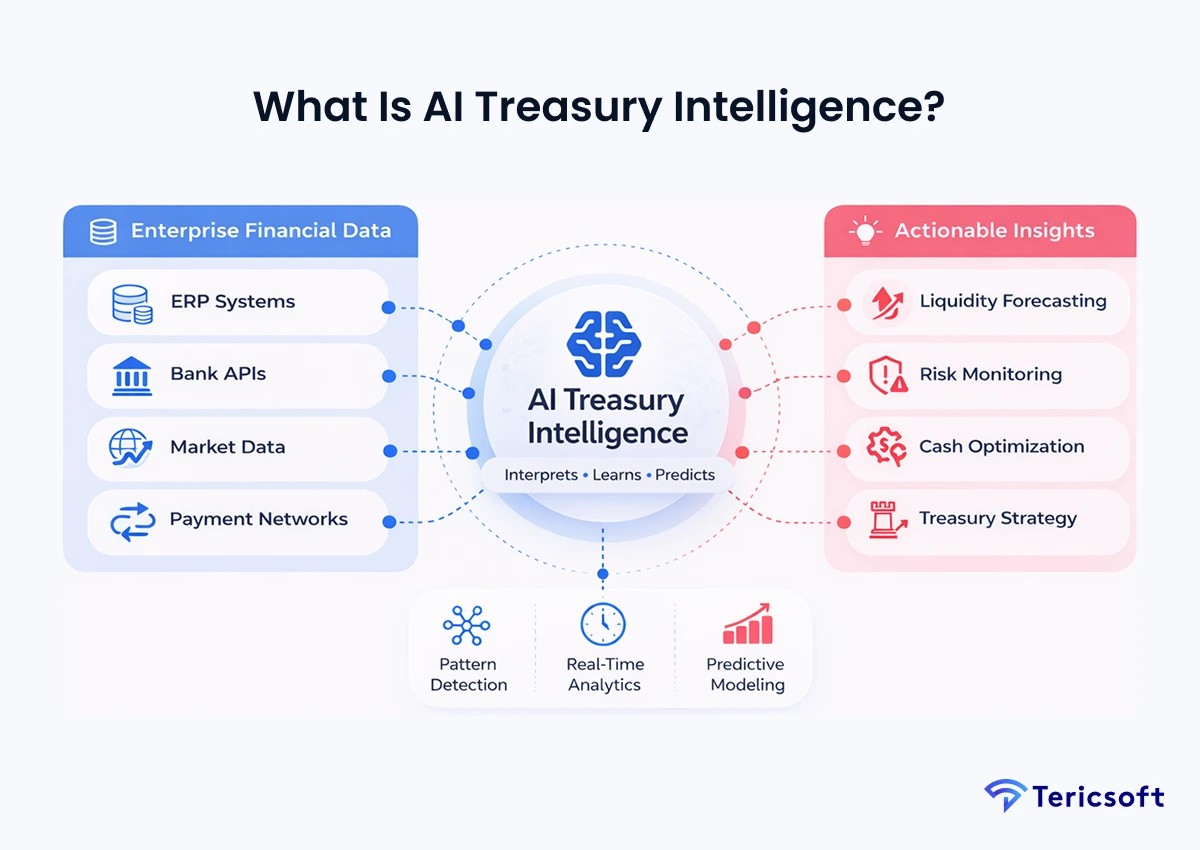
If traditional treasury systems provide a map of where you have been, Tericsoft's Treasury Intelligence provides a high definition GPS of where you are going. It is a non invasive enterprise intelligence layer that transforms fragmented SAP and treasury data into structured, decision ready insight.
Defining Treasury Intelligence
Treasury Intelligence is the synthesis of advanced machine learning and real time data analytics applied specifically to the financial lifecycle. Unlike standard automation, which follows a script, this intelligence layer interprets market shifts and identifies non obvious correlations between disparate cash pools. It allows teams to move beyond dashboards and static reports into a state of continuous understanding.
Traditional Treasury Systems vs AI-Driven Treasury
The distinction between legacy systems and AI driven platforms lies in the nature of their logic. Traditional systems are deterministic; they follow if then rules. AI systems are probabilistic. They learn from patterns to identify outcomes that a human might not consider.
In the 2022 Deloitte Global Corporate Treasury Survey, 64% of treasurers acknowledged that their most critical challenge was the increased need for visibility into global operations. Tericsoft addresses this by prioritizing decision velocity over raw data accumulation.
"Every company is becoming a data company."
— Satya Nadella, CEO of Microsoft
How Tericsoft's Treasury Intelligence Works
The mechanics of this intelligence rely on the seamless flow of data from the edge of the enterprise to a centralized engine. By connecting directly to banking APIs and internal SAP systems, the Tericsoft architecture creates a digital twin of the organization's financial state.
Conversational Intelligence
Tericsoft empowers treasury teams to interact with their data using natural language. This removes the dependency on manual Excel analysis and creates a direct line to executive ready insights. Treasury teams can now ask questions such as:
- "Where is liquidity most concentrated over the next twelve months?"
- "Which lenders represent our highest counterparty risk today?"
- "What happens to our cost of funds if interest rates rise by 100 bps?"
Example of Decision-Ready Insight
Tericsoft's platforms generate structured summaries that are ready for the CFO. A typical AI generated insight might look like this:
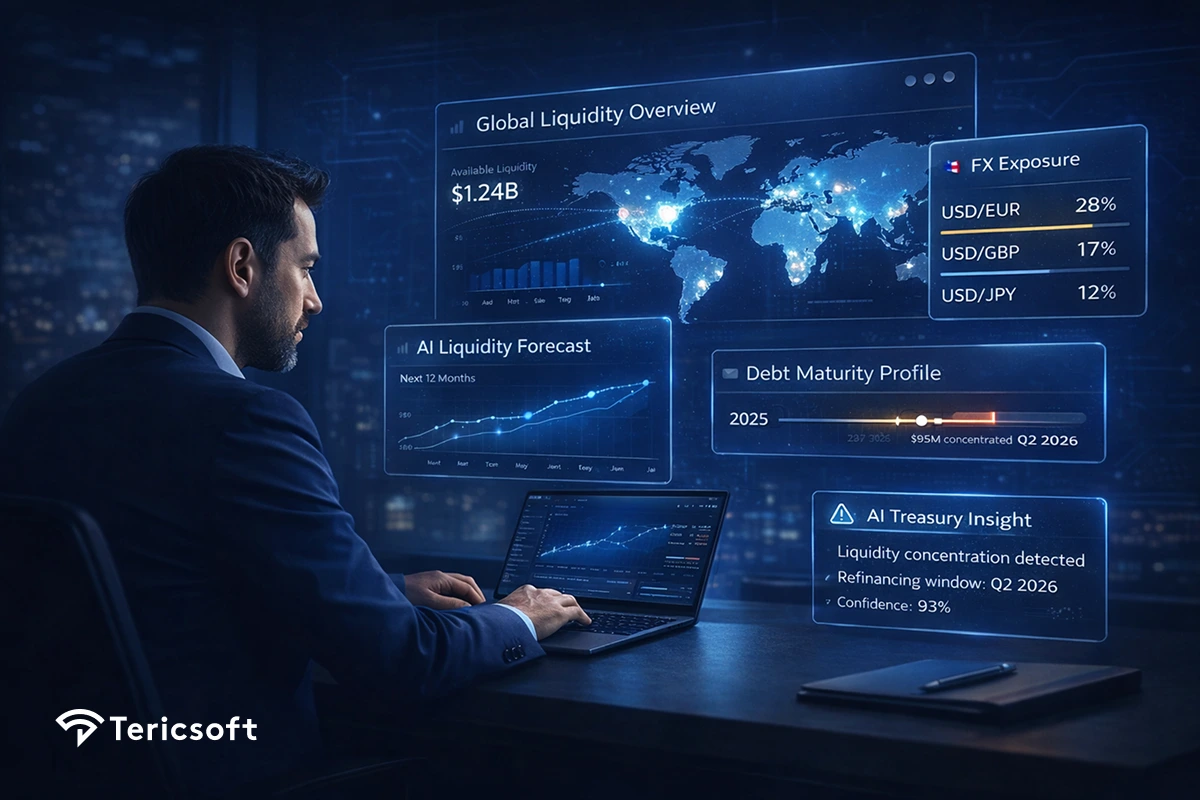
The organization maintains 240M USD in committed credit facilities across eight lenders. Currently, 62% of capacity matures within 18 months, with 95M USD concentrated in the second quarter of the 2026 fiscal year. Furthermore, 41% of exposure is concentrated with a single counterparty. The weighted average cost of funds stands at 4.73%, representing a 180 bps spread across current facilities.
Use Cases of AI Treasury Intelligence in Enterprises
Tericsoft focuses on high level decision intelligence that handles complex business scenarios where the cost of a wrong decision is high.
Portfolio and Executive Risk Review
The platform unifies enterprise, market, and conversation data to deliver real time risk insights for investment committee meetings and board updates. Traditional systems struggle to correlate how market shifts impact strategic assumptions discussed in meetings. Tericsoft's AI identifies these contradictions and provides data backed alternative scenarios in real time.
High-Impact Business Scenarios
- Maturity and Concentration Analysis: AI identifies maturity concentrations that often surface too late in traditional systems, allowing for proactive refinancing.
- Liquidity Optimization Across Subsidiaries: AI identifies idle cash in regional subsidiaries and automatically suggests intercompany sweeps to cover deficits, minimizing external borrowing.
- AI-Driven Investment Strategy: For enterprises with large cash surpluses, AI models analyze yield curves to recommend portfolios that maximize returns while maintaining required buffers.
- Automated Debt Optimization: AI tracks debt covenants and interest rate trends to identify the optimal timing for early repayments or refinancing.
- Real Time Risk Dashboards: Executives gain a single pane of glass view that combines FX exposure, counterparty credit risk, and liquidity stress tests.
Enterprise Architecture of an AI Treasury Intelligence Platform
For AI Treasury Intelligence to function effectively, it must be built as a layer that works alongside existing systems without replacing accounting logic or internal controls.
Data Integration Layer: ERP, Banks, Payment Networks
Tericsoft connects to SAP Treasury and Risk Management, ERP platforms, and bank data. It consolidates fragmented data into a unified intelligence layer, ensuring a single source of truth that is accessible through both dashboards and conversational AI.
AI and Analytics Layer for Financial Prediction
This is the engine room where machine learning models reside. These models are responsible for the heavy lifting of financial prediction, maturity profiling, and cost of funds analysis. This layer converts raw transaction metadata into high fidelity intelligence.
Decision Intelligence and Scenario Simulation
Tericsoft prioritizes the enabling layer that allows finance leaders to run what if scenarios using real enterprise data. This turns the treasury from a reporting unit into a strategic advisory unit that can quantify the impact of market shifts in seconds.
Dashboard and Treasury Control Center for CFOs and Finance Teams
The final layer provides a centralized treasury dashboard. This serves as the single source of truth for financial leaders, providing the tools needed for strategic decision making and global cash monitoring. This unified view ensures that the CFO and treasury director are always operating from the same dataset.

Challenges in Implementing AI Treasury Intelligence
Success requires navigating technical and organizational obstacles where Tericsoft's implementation expertise becomes critical:
- Fragmented Data Across Systems: Treasury data is often spread across SAP, spreadsheets, and bank reports. Tericsoft specializes in the data normalization required to see liquidity and borrowing together.
- Analyst Dependency: Insights often depend on manual analysis, slowing down decisions. Our intelligence layer automates the interpretation, not just the data move.
- Reactive Visibility: Risks like liquidity stress or maturity concentration often surface after they become material. We shift the focus to proactive early warning signals.
How Tericsoft Successfully Implements Treasury Intelligence
Successful implementations require a phased transformation strategy that maintains operational continuity while delivering immediate strategic value:
"What gets measured gets managed."
— Peter Drucker
The Business Impact of Tericsoft Implementation
Implementing a Tericsoft led AI treasury platform delivers measurable benefits that directly impact the enterprise bottom line:
- Decision Velocity: Faster and clearer liquidity and funding decisions that allow for aggressive capital deployment.
- Reduced Operational Overhead: Significant reduction in reliance on manual analysis and external consultants for routine risk reviews.
- Risk Mitigation: Early identification of maturity and concentration risk before they impact the balance sheet.
- Executive Readiness: Instant access to management ready insights without the need for manual data extracts or analyst intervention.
The Future of Treasury
The future of enterprise treasury will move toward autonomous financial intelligence systems. AI will enable self optimizing liquidity management and real time global treasury orchestration. Treasury will evolve from a back office utility to a strategic intelligence hub for enterprise financial decision making.
How Tericsoft Enables AI Treasury Intelligence for Enterprises
Tericsoft is the hero of your treasury transformation. We help enterprises build secure, scalable AI Treasury Intelligence layers tailored to their specific SAP and finance infrastructure. We don't just provide software; we provide the strategic roadmap to transform fragmented data into structured, decision ready insight.
About Tericsoft
Tericsoft is an enterprise AI strategy and implementation partner specializing in AI systems for financial and regulated industries. We build secure, scalable financial intelligence platforms that support enterprise transformation through AI driven analytics and automation, with a relentless focus on governance, compliance, and production ready AI systems.

AI Treasury Intelligence is the use of artificial intelligence and analytics to transform treasury data into predictive insights for liquidity forecasting, risk monitoring, and financial decision making.
AI improves treasury management by analyzing large financial datasets, forecasting cash positions, identifying financial risks, and providing real time insights for faster strategic decisions.
Common use cases include cash flow forecasting, liquidity optimization, FX risk monitoring, debt management, and real time treasury risk analysis across global operations.
Yes, modern AI treasury platforms integrate with ERP systems such as SAP, Oracle, and banking APIs to unify financial data and generate decision ready insights.
Enterprises adopt AI to improve liquidity visibility, reduce manual analysis, detect financial risks earlier, and enable faster data driven treasury decisions.