Can airport cargo security truly be automated using AI? Learn how GMR Cargo Hyderabad achieved 35% faster alerts with intelligent video analytics.
Most high-security facilities operate on the same broken model. Manual identity checks at entry points that cannot keep up with volume. CCTV cameras recording footage that no one reviews until an incident has already occurred. PPE compliance managed through periodic walkthroughs that miss more than they catch.
The problem is not a lack of cameras. It is a lack of intelligence. Footage without analytics is storage, not security.
GMR Hyderabad Air Cargo faced this problem at scale. As one of India's high-traffic cargo terminals, the facility processes continuous flow of personnel, vehicles, and sensitive cargo across multiple access zones. The stakes for security lapses are significant. The existing tools were not adequate.
This is how Tericsoft's AI and computer vision capabilities were applied to build an AI surveillance system for GMR Cargo Hyderabad in six months, delivering intelligent video analytics across face recognition, PPE compliance, and checkpoint monitoring.
What Is GMR Cargo Hyderabad?
GMR Hyderabad Air Cargo is one of India's major air cargo terminals, operating at Rajiv Gandhi International Airport, Hyderabad. The facility handles diverse cargo types including time-sensitive and high-value shipments across multiple access zones and operational areas.
With a large number of personnel entering and exiting daily, multiple high-risk operational zones, and continuous cargo movement, the facility requires consistent and fast security monitoring. These are conditions that manual systems cannot meet at scale.
The mission for this engagement was clear: build a trusted cargo gateway defined by safety and operational reliability.
Three Security Challenges at GMR Cargo Hyderabad
GMR Cargo Hyderabad faced three distinct security and safety problems. Each one limited a different dimension of operations. Together, they created a risk environment that no amount of additional manual staffing could resolve.
Challenge 1: Airport Cargo Security - The Scale of the Challenge at GMR Hyderabad
Airport cargo security at high volume creates a compounding problem. Multiple access points. High daily personnel movement. Time pressure on every check.
The scale of daily movement at GMR Cargo Hyderabad meant that any manual-dependent security system would have gaps. During peak hours, security teams struggled to detect blacklisted individuals. The exposure to unauthorized access was real and growing with volume.
Specific pain points:
- Multiple access points with no unified identity verification layer
- Manual checks becoming inconsistent under peak-hour pressure
- Blacklisted individuals able to pass through during high-traffic windows
- No real-time alert system to notify security teams of unauthorized access attempts
Insight: Manual verification fails not because security teams are inadequate. It fails because the volume of daily movement exceeds what any manual system can process consistently. Volume is the enemy of manual security.
Challenge 2: Face Recognition Access Control - Why Manual Verification Was Failing
Manual identity checks at GMR Cargo were slow, inconsistent, and dependent on individual security personnel making real-time decisions under pressure. During busy periods, the speed required to keep operations moving meant that checks were rushed.
The risk was structural, not incidental. The problem would not improve by adding more security personnel. It required a different approach entirely.
What was failing:
- Identity verification dependent on officers recognizing faces from documentation under time pressure
- No automated cross-check against blacklist databases at the point of entry
- Inconsistent verification quality across different access points and different shifts
- Zero alert mechanism when a blacklisted individual was detected or suspected
Insight: The failure mode of manual access control is always the same. High volume reduces accuracy. Accuracy reduction at a high-traffic cargo terminal is a security liability that cannot be managed by effort alone.
Challenge 3: PPE Compliance Monitoring - Oversight Gaps Across High-Risk Zones
GMR Cargo operates across multiple high-risk zones where PPE compliance is mandatory. With hundreds of cameras streaming continuously, monitoring PPE usage manually was not feasible.
Important safety requirements were missed. Responses were delayed. Maintaining consistent compliance across every zone, every shift, every day was beyond the capacity of a manual team.
What was missing:
- No automated system to detect PPE violations across the full camera network
- Manual walkthroughs covering only a fraction of the facility at any given time
- Violations occurring and going unaddressed between manual inspection cycles
- No real-time alert routing to safety teams for immediate response
- Compliance reporting relying on manual records rather than verified data
Insight: PPE compliance gaps are not a training problem. Workers know the requirements. The gap is in monitoring. When monitoring is manual and periodic, violations occur between walkthroughs. That gap cannot be closed without automation.
Building an AI Surveillance System in Six Months
Tericsoft developed an integrated computer vision solution for GMR Cargo Hyderabad within six months. The engagement covered three distinct security requirements across the full camera network. Each solution maps directly to one of the three operational challenges.
The architecture was built on top of the existing CCTV infrastructure without requiring a full hardware replacement. Tericsoft's AI system development approach applied intelligence layers above the existing network, transforming passive recording into active security intelligence.
Solution 1: Real-Time Face Recognition for Blacklisted Person Detection
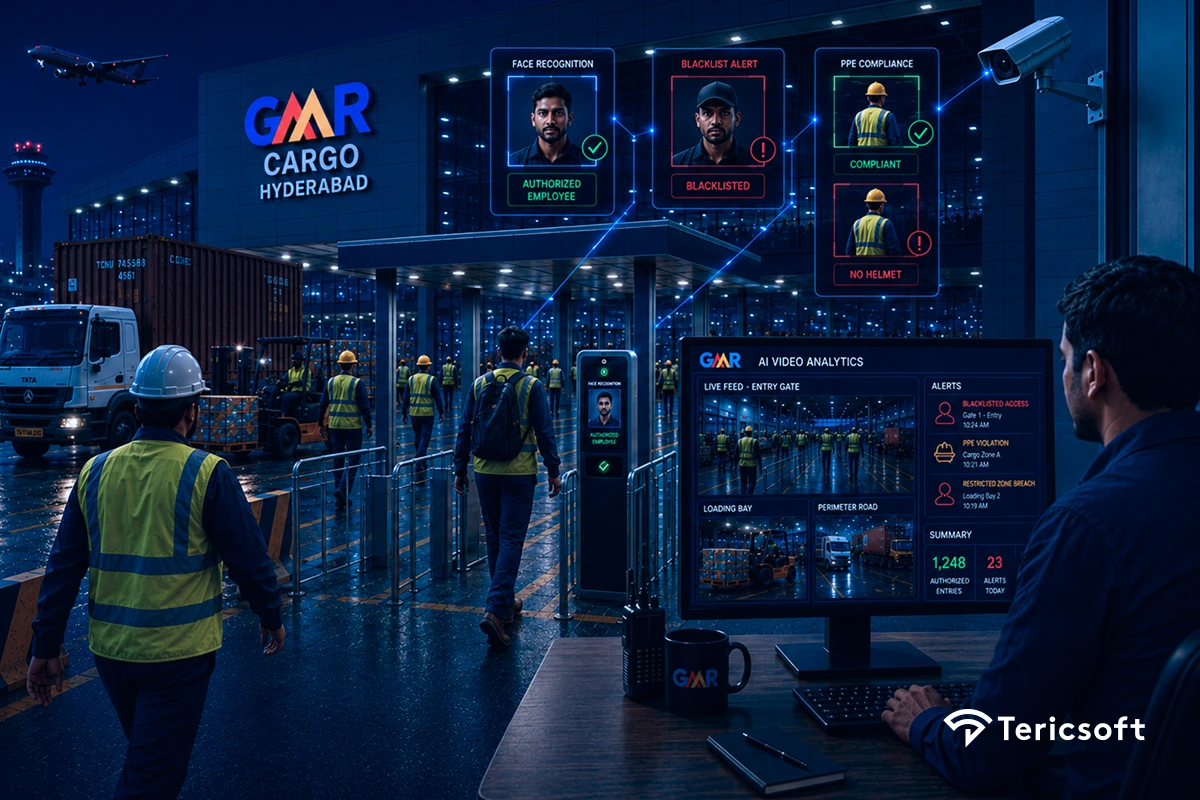
The first solution replaced manual identity verification with high-accuracy real-time face recognition at critical entry and exit points across GMR Cargo Hyderabad.
What the system delivers:
- High-accuracy identity verification at every access point without manual intervention
- Instant matching against a centralized blacklist database at the point of entry
- Real-time alerts routed directly to security teams when a match is detected
- Consistent detection performance during peak hours when manual checks are most likely to fail
- Audit trail of all access events for compliance and incident review
The verification step no longer depends on a security officer recognizing a face under pressure. The system does not tire, does not rush, and does not miss.
Solution 2: Automated PPE Detection Across the Full Camera Network
The second solution deployed automated PPE detection across the full camera network at GMR Cargo Hyderabad. Computer vision models monitored for helmets, vests, gloves, and safety shoes in real time across every high-risk zone simultaneously.
What the system delivers:
- Continuous compliance monitoring across all high-risk zones without additional staffing
- Real-time alerts notifying safety teams of specific violations at specific locations
- Coverage across all shifts without any degradation in monitoring quality
- 60% reduction in missed PPE violations compared to manual walkthroughs
- Verified compliance data for reporting rather than manually maintained records
This shifted PPE compliance from periodic oversight to continuous enforcement. The difference is not incremental. It is categorical.
Solution 3: AI Video Analytics: Building the Unified Monitoring Dashboard
The third solution was a unified monitoring dashboard built on AI video analytics across the full checkpoint infrastructure. The legacy CCTV system recorded footage. It did not generate alerts, identify skipped frisking steps, or flag unusual behavior.
What the unified dashboard delivers:
- Automated checkpoint monitoring identifying skipped frisking steps and procedural gaps
- Unusual behavior detection triggering timely alerts for security response
- Zone activity tracking providing real-time visibility across all operational areas
- Audit trails supporting faster incident review and compliance reporting
- ~90% decrease in manual review effort after adding intelligent video insights
The system transformed passive CCTV footage into an active intelligence layer. Footage that was previously reviewed only after an incident now generates alerts before consequences develop.
Impact of the Computer Vision Security Ecosystem
The results reflect what happens when intelligent video analytics replaces manual monitoring across a high-traffic, high-risk operational environment.
35% Faster Alert Response
Alert response time improved by 35 percent. Automated detection and alert routing eliminated the lag between a security event occurring and a security team member being notified. Real-time alerts replaced retrospective footage review. Response became immediate.
2X Improved Zone Safety
Zone safety performance doubled. Continuous automated monitoring across all high-risk zones meant that safety requirements were enforced consistently rather than intermittently. The improvement reflects the difference between periodic oversight and continuous coverage.
50% Lower Manual Effort
Manual security and safety monitoring effort was reduced by 50 percent. Personnel previously assigned to continuous camera monitoring and periodic PPE walkthroughs were freed for higher-value security tasks. The AI system absorbed the high-volume, repetitive monitoring workload.
3X Improved Monitoring Efficiency
Overall monitoring efficiency improved by three times. The combination of face recognition, automated PPE detection, and AI-driven checkpoint monitoring delivered a unified, always-on security layer that outperformed the previous manual-camera model on every measurable dimension.
Additional outcomes from the computer vision ecosystem:
- 60% reduction in missed PPE violations due to real-time automated alerts
- ~90% decrease in manual review effort after adding intelligent video insights
- 40% faster incident response achieved through instant checkpoint alerts
Key Lessons From This AI Security Case Study
These lessons apply to any high-traffic, high-risk facility considering a move from manual security monitoring to intelligent automated systems.
Automate the Highest-Volume Manual Check First
The highest-impact automation target at GMR Cargo was identity verification at access points: the check performed most frequently, with the highest failure cost. Automating the highest-volume manual task first delivers the largest immediate reduction in security exposure. The lesson applies to any high-traffic security operation.
Real-Time Alerts Are Worth More Than Perfect Footage
The existing CCTV system generated perfect footage of security events reviewed after the fact. That is the fundamental limitation of passive surveillance: it documents what happened, it does not prevent it. Intelligent video analytics converts footage into alerts. That conversion is the difference between documentation and prevention.
Build for Scale From Day One
The AI surveillance system at GMR Cargo was deployed across the full camera network from the first implementation. Full-facility deployment from day one is what makes outcomes measurable. Partial coverage creates partial protection. That is not an acceptable standard for a high-security cargo environment.
Why Intelligent Video Analytics Is Replacing Legacy CCTV in High-Risk Operations
Legacy CCTV systems are recording tools. They capture what happened. They do not identify what is happening now, what has already gone wrong, or which personnel are out of compliance at this moment.
In low-risk environments, that is adequate. In high-traffic cargo terminals, manufacturing facilities, warehouses, and industrial operations, it is not. The shift from passive CCTV to intelligent video analytics is not a hardware upgrade. It is a functional transformation. The cameras stay. The intelligence layer above them changes what those cameras can do.
See more case studies from Tericsoft across AI, security, and complex operational environments.
Why High-Risk Operations Need a Long-Term Technology Partner
Deploying face recognition access control, automated PPE monitoring, and unified AI video analytics across a live, high-security facility is not a project that can be scoped once and delivered by a vendor who then disappears. The operational environment changes. Blacklist databases update. Camera infrastructure evolves. AI models require retraining as conditions change.
Tericsoft worked with GMR Cargo Hyderabad as a long-term technology partner throughout this engagement, delivering a fully integrated AI security system within six months and maintaining accountability for the outcomes promised.
Conclusion
GMR Hyderabad Air Cargo had a security challenge its existing tools could not solve. Manual verification at scale fails. Passive CCTV without intelligence documents but does not prevent. PPE compliance monitored periodically misses more than it catches.
The AI surveillance system Tericsoft built addressed all three problems with one integrated computer vision approach: face recognition access control at entry and exit points, automated PPE detection across the full camera network, and AI video analytics powering a unified monitoring dashboard.
The outcomes confirm what intelligent video analytics delivers when implemented correctly. 35% faster alert response. 2X improved zone safety. 50% lower manual effort. 3X improved monitoring efficiency. High-risk operations do not need more cameras. They need intelligence above the cameras they already have.

How Tericsoft built an AI surveillance system for GMR Cargo Hyderabad using face recognition, automated PPE monitoring, and AI video analytics within six months.
Face recognition access control, automated PPE compliance monitoring, and a unified AI video analytics dashboard for GMR Cargo Hyderabad.
It instantly verifies individuals against a blacklist database at entry points, triggering real-time alerts without manual intervention.
35% faster alert response, 2X improved zone safety, 50% lower manual effort, 3X monitoring efficiency, and 60% fewer missed PPE violations.
Tericsoft delivered the full computer vision solution for GMR Cargo Hyderabad within six months, covering all three security requirements.