Can siloed security tools protect critical infrastructure? Learn how CrisisShield cut incident response time by 68% across 8 Indian agencies in 2018.
In its 2018 deployment across Indian critical infrastructure, CrisisShield processed over 500,000 security events, served 8 agencies and infrastructure operators, reduced mean incident response time by 68%, and maintained 99.7% platform availability through its first operational year.
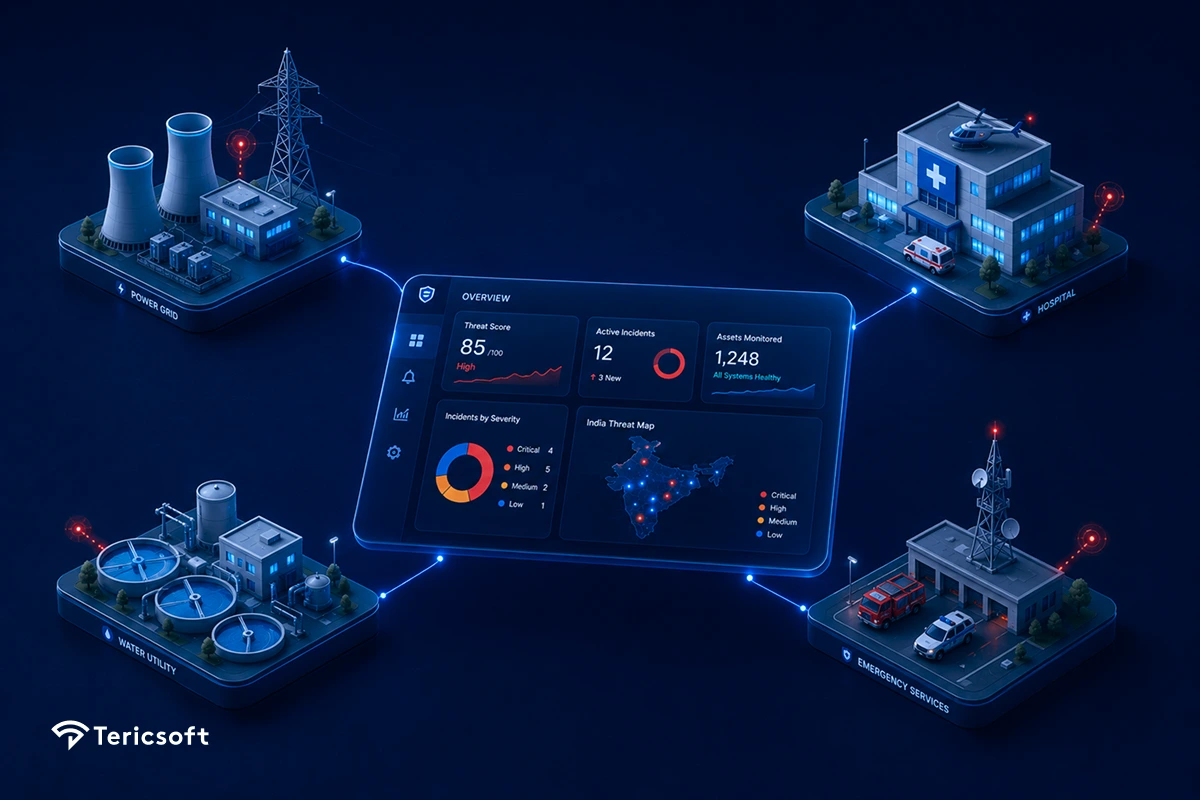
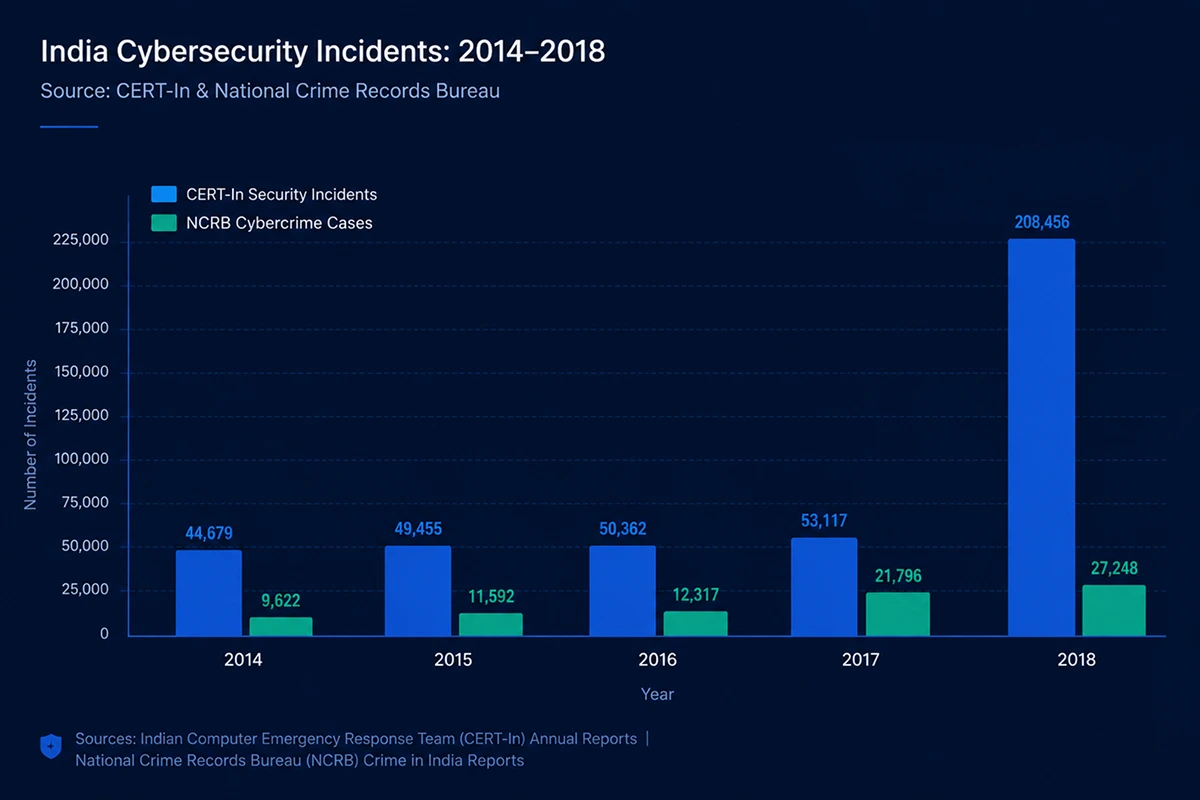
India's critical infrastructure operates under a threat environment that has changed faster than the systems designed to protect it. Power grids, water utilities, hospital networks, and emergency services face an increasing volume of targeted cyberattacks. The 2014-to-2018 period saw a sharp and sustained rise in reported incidents, driven by the convergence of IT and operational technology networks and the growing sophistication of intrusion campaigns targeting government and public infrastructure. The more consequential problem was not the attack volume. It was the response architecture. Every agency operated a different monitoring tool. Every incident required manual coordination across teams that had no shared operational picture. Analysts under pressure were prioritizing by instinct rather than data. By the time leadership received a briefing, the incident had already escalated. CrisisShield was built to close that gap. Not by adding another monitoring tool, but by connecting the tools already in operation and putting a correlation, prioritization, and coordination layer on top of them.
The Challenge: Fragmented Systems in a Complex Threat Environment
I identified the core problem while working at the intersection of cybersecurity operations and emergency management. Indian agencies were not under-resourced in monitoring technology. They were under-connected. The intelligence existed across separate systems. No one was synthesizing it in real time, and no shared workflow existed to act on it when it mattered most.
Cybersecurity Risks
Operational technology and SCADA systems (the control infrastructure behind power generation, water treatment, and industrial operations) were being targeted at an increasing rate. Coordinated intrusion attempts, ransomware staging activity, and IT/OT convergence vulnerabilities created exposure points that fragmented monitoring tools could not adequately surface. Delayed threat identification was the operational consequence. Without a unified view across security data sources, analysts were discovering incidents late, often after lateral movement had already occurred.
Emergency Management Gaps
Incident response in most agencies ran on phone calls and manual status updates. When a security event crossed organizational boundaries, as significant infrastructure incidents often do, and coordination required hours of manual effort that the situation could not absorb.
Analysts faced high alert volumes with no automated triage logic. Prioritization was experience- dependent and inconsistent. The gap between initial detection and coordinated action measured in hours rather than minutes.
Infrastructure Protection Shortfalls
Monitoring systems operated in isolation with no cross-system correlation. The operational posture was entirely reactive: risk assessments were conducted after incidents were identified, and escalation procedures depended on individual knowledge rather than automated logic. The result was an infrastructure protection environment that was slower, less consistent, and more exposed than it needed to be, given the tools and data already present in the environment.
Design Principle: The core problem in Indian critical infrastructure security was not a shortage of monitoring capability. It was the absence of a layer that connected existing monitoring tools, correlated events across them, and produced a unified operational picture in real time. We designed CrisisShield to provide exactly that layer, without requiring agencies to replace the infrastructure already in place.
The Solution: The CrisisShield Platform
We designed CrisisShield from the ground up to unify fragmented security and emergency management systems under a single operational platform. The architecture ingests security event data from existing monitoring tools, correlates events using rule-based logic and machine learning models trained on historical Indian incident data, and surfaces prioritized intelligence to operators and decision- makers in real time. We built the platform with the practical constraints of Indian infrastructure environments in mind: variable network infrastructure, multi-agency coordination requirements, and the need for executive- level outputs that decision-makers could act on without translating technical detail.
Platform Modules
CrisisShield delivers six integrated capabilities across the detection, analysis, and response lifecycle:
- Security Event Monitoring and Log Aggregation
- Rule-Based and Machine Learning-Assisted Threat Correlation Engine
- Critical Infrastructure Asset and Dependency Mapping
- Automated Risk Scoring and Severity Classification
- Multi-Agency Incident Coordination Dashboard
- Executive Briefing and Decision Support Interface
Technology Approach
The machine learning components use supervised classification models trained on labeled security event data from Indian infrastructure environments. The training corpus was drawn specifically from the threat patterns we observed in this context: intrusion attempts targeting operational technology, ransomware staging behavior, and lateral movement across IT/OT boundaries. This specificity matters. A model trained on generic enterprise security data would produce different prioritization outcomes than one calibrated to the actual incident landscape our customers face. The platform integrates with existing SIEM deployments, network monitoring tools, and threat intelligence feeds including open-source sources such as MISP and AlienVault OTX, as well as agency-shared indicator feeds. Agencies do not replace their existing infrastructure. Crisis Shield adds the correlation and decision-support layer on top of what they already operate.
Integration Architecture Insight: Our decision to build as a correlation layer rather than a full-stack replacement was deliberate. Agencies had made significant investments in monitoring tools. A platform that required replacing those investments would face adoption friction unrelated to its technical merit. Our integration architecture reduced time-to-deployment and preserved the institutional knowledge embedded in existing configurations.
How It Works: The Incident Response Workflow
My core design objective was reducing the time from initial detection to coordinated response. In the environment we were addressing, that process required multiple manual steps across separate teams and often took hours. We structured the workflow into five sequential stages, each automated except where human judgment is specifically required.
Event Collection and Monitoring
The platform continuously ingests log and telemetry data from connected security tools, network sensors, and infrastructure monitoring systems. Incoming events are normalized into a common data format for analysis, eliminating the compatibility gaps that prevented cross-system correlation in the previous environment.
Threat Correlation
Rule-based filters and machine learning classification models analyze incoming events against known attack patterns, behavioral baselines, and cross-system dependencies. The correlation engine identifies which combinations of events represent an incident requiring attention, rather than isolated alerts that can be safely dismissed.
Risk Scoring and Prioritization
Each identified incident is scored across four dimensions: asset criticality, estimated threat severity, potential operational impact, and public safety risk. This composite score determines queue position, ensuring analysts address the incidents with the highest potential consequences first rather than the ones that arrived most recently.
Coordinated Response Workflow
Relevant teams are automatically notified based on incident type and severity. Response actions are tracked through a shared dashboard visible to all involved parties, eliminating the parallel phone-call coordination that previously consumed hours of response time and created information gaps between agencies.
Executive Situation Reporting
Leadership receives a structured briefing containing incident description, affected systems, estimated impact, and recommended next steps. We designed this format specifically for decision-makers rather than technical analysts, enabling leadership to act without waiting for a manual summary to be prepared.
Automated Incident Prioritization
Manual alert triage was one of the most significant bottlenecks in the environments we were addressing. Analysts reviewed alert queues and made prioritization decisions based on individual expertise. During high-volume events, this approach failed in two ways: it was inconsistent across analysts, and it did not scale. CrisisShield's risk scoring engine produces a composite severity rating for each incident based on the type of activity detected, the criticality of affected assets, and the potential for cascading impact across dependent systems. Analysts receive a ranked incident queue alongside suggested initial response steps. The result is consistent prioritization regardless of analyst experience level or alert volume. This matters most during the events where it is hardest to get right: simultaneous incidents, high-alert periods following a major detection, and multi-agency situations where different teams are independently evaluating different signals from the same underlying event.
Triage Design Insight: Automated prioritization does not replace analyst judgment. It structures the environment in which judgment is exercised. An analyst working from a ranked, composite-scored queue makes different decisions than one working from a raw chronological alert log. The inputs are the same. The cognitive load and consistency of the output are not.
Early Results Across Indian Deployments
Following our initial deployment across agencies and infrastructure operators in India through 2018, we observed measurable improvements across four dimensions: detection speed, coordination efficiency, platform reliability, and operational scale.
- 500,000+ security events processed across connected agencies and infrastructure operators
- 8 agencies and infrastructure operators deployed on the platform through 2018
- 68% reduction in mean incident response time from detection to coordinated action
- 99.7% platform availability through the first full operational year
Key Outcomes Observed
- Faster identification of intrusion attempts targeting operational technology networks, with analysts reaching confirmed incidents rather than investigating ambiguous alerts
- Unified incident view eliminating the need for manual cross-agency status calls during active response operations
- Consistent triage decisions replacing analyst-dependent manual prioritization across high-volume alert periods
- Improved coordination between IT security teams and physical infrastructure operators who previously operated in separate response workflows
- Reduction in duplicate investigation effort caused by separate teams independently examining the same underlying incident
- Executive adren precanving struned savation reports within minutes of incident detection,
Key Lessons from the India Deployment
Our 2018 deployment across eight agencies and infrastructure operators produced operational results and validated a set of design principles that apply beyond the specific context of India's critical infrastructure.
Integration Beats Replacement
Agencies carry institutional knowledge and compliance configurations in their existing monitoring tools. A platform that requires replacing those tools faces adoption barriers unrelated to its technical merit. Our integration-first architecture shortened deployment timelines and preserved the investments agencies had already made.
Correlation Is the Capability Gap
The monitoring data already existed in most of the environments where we deployed. What was missing was the layer that connected events across sources, removed noise, and surfaced the patterns that indicated a real incident. The capability gap in Indian critical infrastructure security was not detection. It was correlation.
Executive Reporting Is a Response Capability
During active incidents, leadership delays produce operational delays. An executive who cannot understand the situation cannot authorize the response. We treated executive-formatted situation reporting as a core platform capability, not a post-incident communications task. The 68% reduction in mean response time reflects, in part, how much time was previously consumed by manual briefing preparation.
Consistency Matters More Than Peak Performance
A skilled analyst making manual prioritization decisions will outperform an automated system in ideal conditions. During high-alert periods, multi-agency incidents, and simultaneous events, manual triage becomes inconsistent under pressure. Our composite risk scoring produces consistent outputs across all conditions. That consistency is the operational value during the incidents that matter most.
Conclusion
India's critical infrastructure faces a threat environment that is continuing to evolve. The 2014-to-2018 trajectory in reported incidents was not an anomaly. It was a baseline. Our initial deployment validated a core premise: that unifying fragmented monitoring tools under a common correlation and coordination layer produces measurably faster, more consistent, and more effective responses. We processed more than 500,000 security events, served eight agencies and infrastructure operators, reduced mean response time by 68%, and maintained 99.7% availability through CrisisShield's first operational year. Purpose-built platforms designed for the operational realities of critical infrastructure security represent a different category of tool than the general-purpose enterprise security products most organizations adapt to this context. The specificity of our machine learning models, the integration architecture, and the executive reporting layer are not incidental features. They are the direct response to the failure modes we observed before CrisisShield was deployed.
CrisisShield connects fragmented monitoring tools under a correlation layer, enabling faster threat detection and coordinated incident response.
CrisisShield automates alert triage, inter-agency coordination, and situation reporting, reducing mean incident response time by 68%.
No. CrisisShield integrates with existing SIEM tools and threat intelligence feeds, adding a correlation layer on top of current infrastructure.
Each incident is scored on asset criticality, threat severity, operational impact, and public safety risk, giving analysts a ranked priority queue.
Deployed across power, water, healthcare, and public safety sectors in India, serving 8 agencies and processing 500,000+ security events in 2018.