
How can finance leaders bridge the massive execution gap between static reporting and proactive liquidity control in 2026? Learn how finance leaders are connecting fragmented systems, predicting cash risk earlier, and turning finance data into faster forecasting decisions.
The quarter looked strong on paper. Revenue was up. New customers were signed. Margins were stable. Yet inside the CFO review meeting, one number created concern: available cash was tighter than expected. Collections had slipped. Supplier payments were poorly timed. Excess cash sat idle in one entity while another faced pressure. By the time reports explained what happened, the window to act had already closed.
That is the modern finance challenge. Growth alone does not guarantee liquidity. Visibility alone does not create action. For most CFOs and Treasury Heads, the question is not simply "What is my cash position?" but rather: "Why are my teams still surprised by cash gaps when we already have an ERP, reporting dashboards, and treasury tools?" This is where AI Cash Flow Forecasting becomes essential.
"Never take your eye off the cash flow because it's the lifeblood of business."
— Richard Branson, Co-founder of the Virgin Group
Why Business Resilience Matters Now?
In an environment of persistent inflation and high interest rates, cash is more expensive and capital is harder to access. Finance teams can no longer depend on monthly reporting cycles to manage weekly liquidity risk. Resilience is now a proactive competitive strategy built on three core pillars:
- Cost of Capital Optimization: Identifying liquidity gaps weeks in advance reduces reliance on expensive, last-minute credit lines and prevents the high cost of emergency funding.
- Strategic Deployment Speed: High-confidence forecasts allow leadership to commit to M&A or capital expenditures with the certainty that they are not over-leveraging their immediate operational capacity.
- Stronger Balance Sheet Control: Continuous oversight ensures that the cash conversion cycle is optimized, protecting credit ratings and ensuring stability during sudden market shocks.
What Is AI Cash Flow Forecasting?
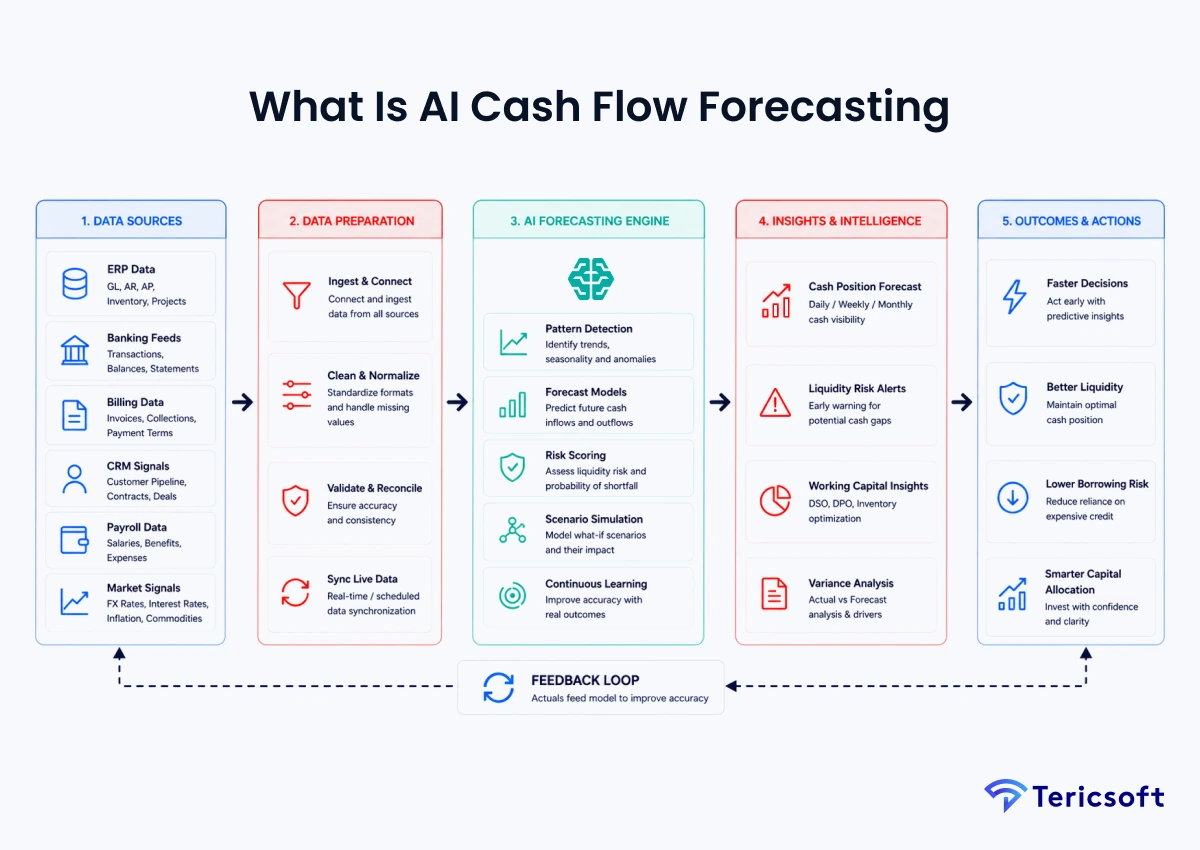
AI Cash Flow Forecasting uses connected finance data, adaptive models, and automated workflows to predict cash movement and liquidity risk. Instead of relying only on static assumptions, it continuously learns from real business activity to act as a liquidity control layer.
How AI Uses Data to Predict Future Cash Flow?
AI analyzes patterns across receivables, payables, payroll, invoices, customer behavior, seasonality, bank transactions, and market signals to forecast likely future cash movement. By layering external signals over internal transactional data, it identifies anomalies that human analysts often miss.
- Behavioral Analysis: Analyzing customer-specific payment cycles to predict actual collection dates.
- Data Orchestration: Pulling live feeds from AI for billing to ensure the invoice-to-cash transition is modeled with transactional precision.
- External Signals: Incorporating interest rate changes or supply chain disruptions into the liquidity model.
AI Cash Flow Forecasting vs Traditional Forecasting
Traditional forecasting depends on spreadsheets, manual assumptions, and monthly updates. AI forecasting uses live data, dynamic models, and continuous recalibration.
Insight: Companies with faster decision cycles often outperform peers because they act before risk becomes visible. Data suggests that AI-driven forecasting can reduce forecast errors by 20% to 50% compared with traditional spreadsheet-based methods.
Why Cash Flow Surprises Still Hurt Growing Businesses?
Many growing companies assume revenue momentum equals financial strength. In reality, timing differences and operational friction can create hidden stress. The problem is not that CFOs misunderstand liquidity: it is that their systems show liquidity too late, after receivables have slipped and borrowing decisions have already become expensive.
Revenue Growth Does Not Always Mean Healthy Cash Flow
Sales growth may look strong while receivables remain unpaid, discounts rise, or billing delays slow collections. Rapid growth often requires significant upfront cash for inventory and payroll, creating a "growth gap" that legacy systems fail to flag in real time.
Why Profitable Companies Still Face Liquidity Pressure?
Profitability is measured over time. Liquidity is measured today. A profitable business can still face immediate cash constraints due to asset misalignment or mismatched timing between customer payments and supplier obligations. Without AI treasury intelligence, these companies find themselves "asset rich but cash poor."
The Hidden Cost of Late Visibility in Finance
Late visibility leads to rushed borrowing, delayed investments, strained suppliers, and missed opportunities. Organizations are often looking to automate financial operations without replacing ERP because existing systems simply cannot move at the speed of the market.
"Revenue is vanity, profit is sanity, cash is reality."
— Alan Miltz, Co-founder of CashflowStory
What AI Cash Flow Forecasting Really Means for Finance Teams?
This is not just a forecasting tool. It is a shift from backward-looking reporting to forward-looking finance leadership: a move toward forecast governance.
From Historical Reporting to Forward-Looking Intelligence
Instead of asking what happened last month, teams ask what is likely to happen next week and what to do now. This shift allows finance to serve as a navigator for the business, providing early warning signals for potential liquidity shortfalls.
How AI Learns Cash Movement Patterns Over Time?
Models improve as they learn payment behaviors, delays, seasonal cycles, and entity-level trends. The more data the system processes, the more accurate its predictions become, which is essential for maintaining AI in banking compliance.
Why Forecasting Is Becoming a Continuous Process?
Modern finance teams cannot wait for month-end cycles. Forecasting must update as the business moves to ensure that working capital pressure never becomes a business constraint.
The Shift From Spreadsheet Forecasting to Intelligent Forecasting
Spreadsheets built finance for years, but complexity now exposes their limits.
Strategic Insight: The Spreadsheet Security BlanketA common mistake enterprises make is clinging to the "Spreadsheet Security Blanket." Leaders often feel a sense of control because they can see the cells and formulas, yet these manual models are frequently riddled with hidden errors and fail to account for non-linear market shifts. True security comes from auditable, data-driven systems that remove human bias.
Why Static Models Break During Market Changes?
Fixed assumptions fail when demand shifts, supply chains tighten, or customers change payment behavior. A spreadsheet cannot adapt fast enough to the number of variables affecting cash movement.
The Risk of Version Control and Manual Assumptions
Multiple files, hidden formulas, and disconnected owners reduce trust in forecasts. Manual entry is prone to human error, which is a major reason why 61% of companies miss their cash flow forecasts by more than 10% each month.
What Real-Time Forecasting Changes for CFOs?
CFOs gain earlier warnings, faster decisions, and clearer confidence in liquidity strategy. Real-time insights allow for defensive actions, like securing credit lines early, and offensive actions, like deploying idle cash into high-yield investments.
How AI Predicts Future Cash Positions?
AI combines internal data with external signals to estimate future cash balances across various horizons. By running simulations, the system provides a range of probable outcomes rather than a single, fragile number.
Insight: Better forecasts do not eliminate uncertainty. They improve preparedness.
Where AI Creates Immediate Value in Working Capital?
Working capital is often the fastest area for measurable ROI. A working capital command system provides rank-ordered recommendations for the highest liquidity impact.
Identifying Slow-Paying Customers Earlier
AI highlights accounts likely to pay late so teams can intervene sooner. By analyzing historical payment lag, the system flags high-risk invoices before they become overdue.
Optimizing Payment Timing Without Supplier Risk
Organizations can schedule payments strategically while preserving supplier trust. AI identifies the optimal window to pay vendors to maximize Days Payable Outstanding (DPO).
Reducing Idle Cash Across Entities and Accounts
AI surfaces trapped or underutilized cash across regions and business units. This visibility allows treasury leaders to consolidate funds and reduce reliance on external credit lines.
Prioritizing Actions That Release Cash Faster
Finance teams receive ranked recommendations with the highest liquidity impact first, ensuring that resources are allocated where they provide the most immediate capital relief.
AI Cash Flow Forecasting Use Cases That Matter to CFOs
The adoption of AI is accelerating rapidly. 44% of CFOs said they used GenAI for more than five finance use cases in 2025, a significant jump from previous years.
- Daily liquidity visibility across global entities.
- Rolling 13-week cash forecasting for operational stability.
- Scenario planning for potential market shocks or interest rate hikes.
- Borrowing and debt planning to minimize interest expenses.
- Seasonal demand forecasting for inventory and labor planning.
What a Modern Cash Flow Forecasting Stack Looks Like
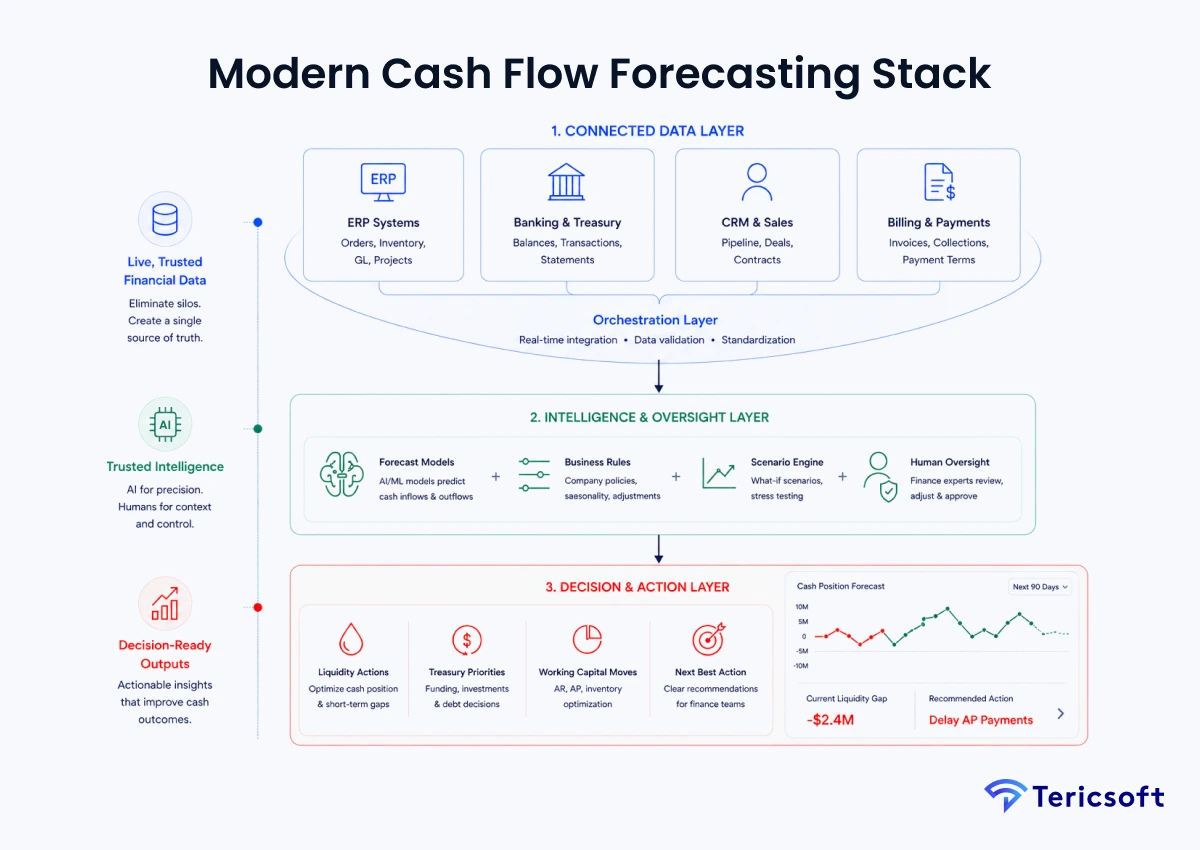
A strong forecasting system is built on connected data, trusted models, and decision-ready outputs.
Connecting ERP, Banking, CRM, and Billing Data
Finance decisions improve when systems stop operating in silos. An orchestration layer must integrate live feeds from every transactional system to ensure the forecast is grounded in reality.
Forecast Models, Rules, and Human Oversight
AI should recommend outcomes while finance leaders retain final control. This ensures that institutional knowledge is combined with algorithmic precision.
Dashboards That Turn Predictions Into Decisions
Dashboards must prioritize actions, not just charts. A modern stack provides a clear "next best action" for treasury and finance managers based on current liquidity gaps.
How Leading Finance Teams Roll Out AI Successfully
Adoption succeeds when trust and measurable wins come first.
Start With One High-Impact Forecast Window
Begin with a use case such as 13-week liquidity forecasting. Focusing on a single, high-stakes metric allows the team to prove the value of AI before scaling.
Build Trust With Explainable Predictions
Users must understand why forecasts changed. Transparent AI models allow finance teams to see the underlying drivers of a prediction, which is essential for auditability.
Keep Finance Teams in Control of Decisions
AI supports judgment. It should not replace accountability. The system acts as a decision support layer, handling data-heavy analysis so finance leaders can focus on strategic decisions.
Scale Across Regions, Entities, and Time Horizons
Once proven, extend forecasting across the enterprise. Successful teams move from local pilot programs to global liquidity control towers.
Common Mistakes That Delay ROI
The Next Frontier of Treasury Intelligence
Treasury is moving toward autonomous finance systems where forecasts refresh automatically and AI assistants help finance leaders query scenarios and make faster decisions.
Self-Updating Forecasts
Forecasts refresh automatically as new transactions occur. No manual intervention is required to see the impact of a large payment or a new vendor contract.
Prescriptive Actions for Working Capital
Systems recommend actions to improve liquidity, not just report gaps. The focus shifts from "What is the forecast?" to "What action should I take?"
AI Assistants for CFO and Treasury Teams
Executives can ask natural language questions such as "What is our liquidity buffer if receivables delay by 10 days?" and receive scenario-based answers instantly.
Always-On Liquidity Control Towers
Continuous monitoring creates enterprise-wide awareness. These systems act as a central nervous system for finance, providing a unified view of global cash positions.
“The future CFO will lead with data, speed, and foresight.”
Why Enterprises Choose Partners Instead of Point Tools
Point tools often solve one narrow task in isolation. Enterprises need connected transformation. They choose partners who can integrate systems, govern data, customize models, ensure security, and scale globally. The real value is in building a decision engine for finance.
Key Takeaways
In an environment where volatility is the new constant, the ability to predict and control liquidity is the ultimate differentiator. For the busy executive, the transition to AI-driven forecasting can be summarized in five strategic pillars:
- Data-Driven Precision: AI reduces forecast variance by using live finance and operating data instead of manual assumptions.
- Strategic Agility: Daily liquidity visibility helps CFOs act before risk becomes urgent.
- Operational Efficiency: ERP, banking, CRM, and billing integrations reduce manual finance effort.
- Proactive Resilience: Scenario planning helps leaders prepare for shocks before they hit cash flow.
- Unified Governance: Explainable AI creates a trusted, auditable source of truth.
About Tericsoft
Tericsoft helps enterprises build the intelligence layer between ERP data and finance decisions. Instead of replacing core systems, we connect ERP, banking, billing, and CRM workflows into AI-powered forecasting systems that help CFOs improve liquidity visibility, reduce forecast variance, and act faster on working capital risk.
From 13-week rolling forecasts to treasury command centers and secure enterprise integrations, we build solutions designed for measurable ROI and global scale. If your finance team is ready to modernize liquidity planning, Tericsoft can help turn forecasting into a measurable strategic advantage.

AI Cash Flow Forecasting uses data and machine learning to predict future cash inflows, outflows, and liquidity risks more accurately.
It uses live data, updates continuously, reduces manual errors, and gives faster insights than static spreadsheet models.
Yes, AI helps identify slow collections, optimize payments, and reduce idle cash to improve working capital efficiency.
Mid-sized and enterprise businesses with complex finance operations, multiple entities, or cash flow uncertainty benefit the most.
No, it supports finance teams with better insights and automation while humans remain in control of decisions.