What is Finance Operation Automation? Its strategic advantages and benefits for enterprises, and how Tericsoft’s Unique Automation Layer combined with Decide NOW can help boost your business’s financial speed, auditability, and operational control.
The CFO sits in a quarterly review meeting. Outside the window, the city lights flicker, but his focus is on a spreadsheet that refuses to balance. Revenue is growing at a double-digit rate, yet the cost of the finance function is rising in lockstep.
His teams are still chasing approvals via scattered email threads and reconciling complex spreadsheets at midnight. They are manually processing thousands of exceptions across multiple global entities.
The ERP exists, and it was a multi-million dollar investment, but operational efficiency does not.
That is the modern finance paradox. Large enterprises invested heavily in ERP platforms to be the "single source of truth," yet daily operations remain fragmented and slow.
The next competitive advantage is not another massive system replacement. It is the ability to Automate Financial Operations intelligently around the systems already in place.
“The CFO is no longer just a steward of capital, but a steward of data and digital transformation.”
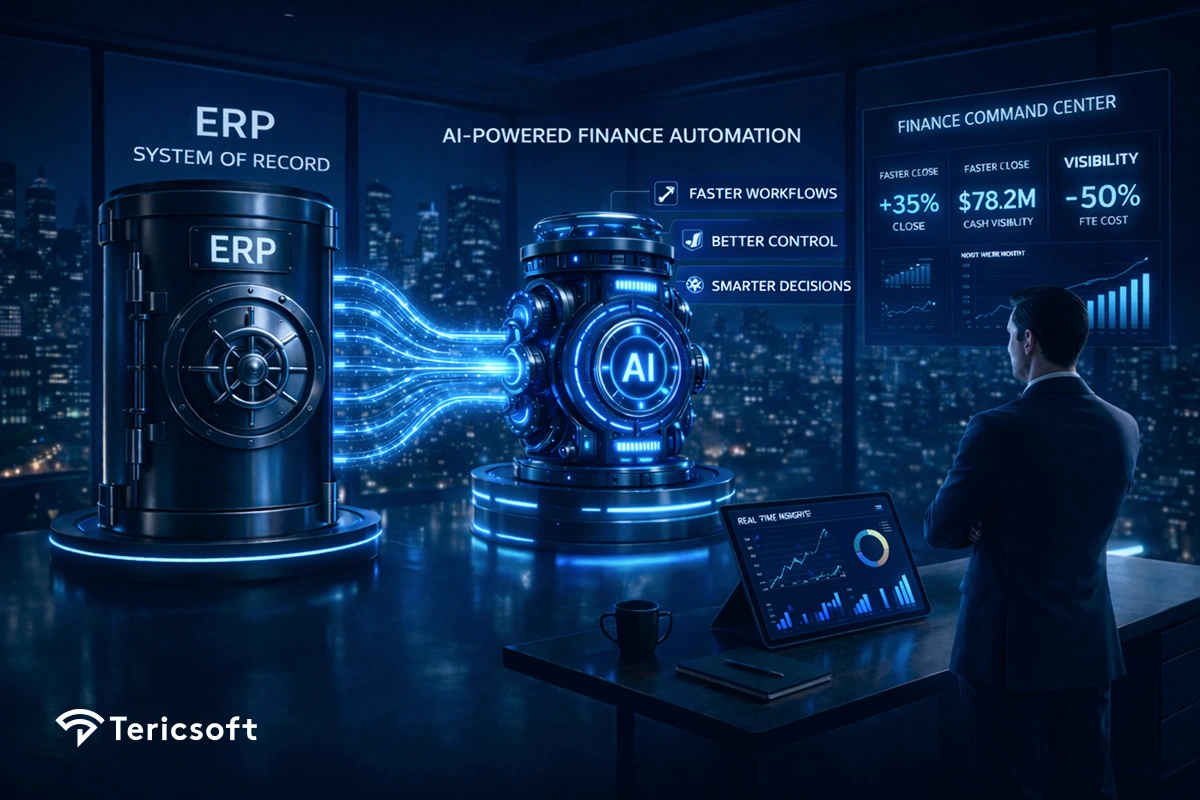
Enterprises do not need to replace ERP to modernize finance. A smart automation layer can accelerate workflows, improve control, and unlock real-time decision-making.
Why ERP Automation Often Fails Inside the ERP
Many organizations assume the ERP alone should solve every workflow inefficiency. In reality, ERP platforms are excellent systems of record, but they are rarely the ideal systems of execution for dynamic finance processes.
ERP as System of Record vs Workflow System
ERP systems are designed for control, integrity, and recordkeeping. They preserve financial truth.However, dynamic workflows need speed, collaboration, and flexibility.
That is where an external automation layer creates value. By separating the "vault" (the ERP) from the "engine" (the automation layer), organizations can modernize without breaking their core financial logic.
Comparison: Inside ERP vs External Automation Layer
Common Bottlenecks in Approvals, Exceptions, and Reconciliations
Where most delays happen in the traditional model:
- Manual Approval Chains: Routed through email threads that lack a central audit trail, leading to missed deadlines.
- Complex Exceptions: Price or quantity variances require human follow-up across departments, stalling the payment cycle.
- Data Fragmentation: Reconciliation mismatches across banking and procurement systems do not sync in real time.
- Close Pressure: Missing data or incorrect coding causes massive rework during the month-end close.
Enterprises that eliminate these approval delays and reconciliation lags often unlock faster closes, stronger cash visibility, and lower finance operating costs. This is the core of a successful CFO automation strategy.
Finance Automation Strategy That Keeps Your ERP
The smartest transformation strategy protects prior ERP investments while modernizing the operating layer around them. This approach allows for AI Adoption in Finance without the risk of a high-stakes rip-and-replace program.
What an Automation Layer Means in Practice
An automation layer sits on top of your existing infrastructure. It acts as an intelligent bridge between systems and people.
- Workflow Orchestration: Managing tasks across people and software systems.
- Real-Time Data Flow: Ensuring the ERP and external tools stay in sync without manual entry.
- Intelligent Governance: Enforcing compliance and policy rules automatically.
Why Integration Is the Make-or-Break Factor
Automation fails when systems cannot exchange data reliably. Integration quality determines the speed, trust, and scale of the entire operation. Without a robust integration strategy, you simply create more "digital silos" that require manual intervention to maintain.
“Technology alone is not transformation. Integration of people, process, and platforms creates value.”
Technical Architecture Patterns for Automating Finance Operations
Modern enterprise finance automation software requires a modular architecture. This ensures your technology can evolve as your business grows.
API-First Integrations for Modern Finance Workflows
APIs are the connective tissue of the modern enterprise. An API-first approach ensures that data is always current. Triggers in one system (like a signed contract in CRM) can instantly launch a workflow in another (like invoice generation in the ERP).
iPaaS and Managed Connectors for ERP Connectivity
Integration Platform as a Service (iPaaS) reduces custom coding. It uses reusable, pre-built connectors to keep systems aligned. This is essential for maintaining AI Treasury Intelligence by ensuring bank feeds are piped into your decision-making engines.
RPA for Legacy ERPs and Edge Cases
When modern APIs are unavailable, Robotic Process Automation (RPA) can automate screen-level tasks. While APIs are preferred for stability, RPA remains a vital tool for bridging the gap to legacy software.
IDP for Invoice, Email, and Document Intake
Intelligent Document Processing (IDP) uses AI to extract structured data from unstructured sources. This eliminates the "data entry tax" that often introduces human error into the ledger.
AI in Finance Operations: Copilots and Assistance
AI in finance operations is moving toward assistive copilots. These tools act as digital analysts. They can summarize complex vendor contracts or suggest the correct GL coding for unusual expenses, allowing your team to focus on strategic analysis.
Decide NOW: Decisions That Cannot Wait for Tomorrow
For enterprises that require immediate clarity, Decide NOW connects to over 200 data sources, analyzing information in seconds.
Leaders get instant clarity, scenario exploration, and actionable recommendations through an intuitive assistant. It helps CFOs and CIOs make smarter decisions with speed and confidence by bridging the gap between raw data and executive action.
“Automation applied to an efficient operation will magnify the efficiency.”
— Bill Gates, Co-Founder of Microsoft
High-ROI Finance Processes to Automate First
Focus on areas where time, errors, and delays create a measurable business impact on the bottom line.
Accounts Payable From Capture to Posting
Accounts payable automation is the low-hanging fruit of finance transformation.
- The ROI: Best-in-class AP organizations process invoices at costs 80% lower than peers.
- The Goal: Turn a cost center into a strategic function that captures early payment discounts.
Accounts Receivable and Collections Workflows
Finance workflow automation in AR involves more than just sending invoices. It includes automated reminders, promise-to-pay tracking, and aging alerts. This improves working capital by reducing Days Sales Outstanding (DSO) without increasing headcount.
Reconciliations and Financial Close Orchestration
The monthly close is often the most stressful period for finance teams. Financial close automation can lead to 35% faster reporting cycles. This allows for a "continuous close" model where data is always audit-ready.
Governance, Security, and Auditability in Finance Automation
Without governance, automation can scale mistakes faster than humans. A robust finance process automation strategy must prioritize controls.
Controls for SoD, Approvals, and Exception Policies
Segregation of Duties (SoD) must be baked into the automation logic. The system should automatically enforce approval hierarchies based on dollar thresholds. If an invoice exceeds a certain amount, the system escalates it to the appropriate executive automatically.
Data Quality and Master Data Governance
Automation is only as good as the data it processes. Master data governance ensures that the golden record in the ERP is accurate. Poor data quality is a leading reason why Enterprise AI Transformations Fail.
Audit Trails and Evidence Readiness
Every automated decision must be traceable with timestamps and logs. When an AI agent approves an invoice, the system logs exactly which rules were satisfied. This readiness makes the annual audit process significantly faster and less intrusive.
“Remember, every business process is being digitized.”
— Satya Nadella, CEO of Microsoft
Build vs Buy and Vendor Evaluation
Choosing between building internal capabilities or buying external platforms is a critical strategic fork in the road.
Requirements Checklist for Integrations, Controls, and Scalability
Evaluate vendors on their ability to:
- Seamlessly read and write to your specific ERP version.
- Provide SOC2 or ISO 27001 security certifications.
- Offer low-code workflow modeling for business users.
- Scale across global entities and handle high transaction volumes.
KPI Model for Cost, Cycle Time, and Error Rate
Success should be measured by clear metrics. Finance automation initiatives can deliver 27% fewer invoice processing errors. Track your cost per transaction and cycle time from day one to justify the program's expansion.
Common Challenges in Finance Automation Programs
Even strong strategies can fail during execution. Understanding why transformations fail is the first step to success.
- Resistance to Change: Focus on training so employees see automation as a tool that removes "drudge work."
- Dirty Master Data: Automation cannot fix a messy database; it only processes bad data faster.
- Over-customization: Avoid rebuilding your ERP's specific flaws in your new automation layer.
The Future of Finance Operations Is Autonomous
The next phase is not basic task automation. It is intelligent finance operations where systems detect anomalies and recommend actions.
By moving From AI Pilots to Enterprise Plfatforms, organizations prepare for a future where cash forecasting is real-time and anomaly detection is proactive.
“While we do not know the full effect or the precise rate at which AI will change our business — or how it will affect society at large — we are completely convinced the consequences will be extraordinary and possibly as transformational as some of the major technological inventions of the past several hundred years.”
— Jamie Dimon, CEO of JPMorgan Chase
How Tericsoft Helps Enterprises Automate Financial Operations
At Tericsoft, we recognize that the greatest barrier to finance modernization is the complexity of existing legacy systems.
We help organizations modernize their financial operations without the risk and upheaval of replacing core ERP systems. Our role is to act as the strategic architect that bridges the gap between your systems of record and the future of autonomous finance.
Our Core Capabilities for Finance Leaders
- ERP Integration Architecture: We specialize in creating high-performance integration layers for SAP, Oracle, Microsoft Dynamics, and NetSuite.
- Bespoke Finance Workflow Automation: We design and deploy custom workflows for AP, AR, and Treasury operations that align with your unique business rules.
- AI-First Document Intelligence: Using advanced IDP, we help finance teams eliminate manual data entry with accuracy rates that improve over time.
- Compliance-First Control Frameworks: We embed Segregation of Duties (SoD) and permanent audit trails into every automation we build.
Why Leading Enterprises Partner with Tericsoft
We provide a blueprint for a faster, smarter finance engine. By integrating the decision-making power of Decide NOW into our automation layer, we empower CFOs to move from historical reporting to predictive strategy.
Whether you are aiming for an 80% reduction in processing costs or a 35% faster monthly close, Tericsoft provides the technical expertise and the modular platform to achieve those goals at enterprise scale.
The winners in finance transformation will not be those with the largest ERP budgets. They will be those who turn finance into a faster, smarter operating engine that drives enterprise value.

Finance operations automation uses software, AI, and workflows to streamline approvals, reconciliations, invoicing, and reporting processes.
Yes, an automation layer can integrate with existing ERP systems to improve workflows without a full system replacement.
High-impact areas include accounts payable, accounts receivable, reconciliations, approvals, and financial close processes.
It creates audit trails, enforces approval rules, reduces manual errors, and strengthens governance across finance workflows.
Key benefits include faster processing, lower costs, better visibility, fewer errors, improved cash flow, and quicker decision-making.