What is Enterprise AI Transformation and why are global enterprises in 2026 rushing to scale their models faster than ever? Learn how production-grade AI is transforming operational workflows, driving measurable ROI, and enabling even legacy organizations to build secure, decision-ready systems in weeks.
Picture a quarterly business review at a Fortune 500 logistics firm. The Chief Information Officer is presenting the results of a year-long artificial intelligence initiative. The presentation is visually stunning, featuring advanced neural network architectures and a highly sophisticated predictive dashboard designed to forecast supply chain bottlenecks.
Then the Chief Financial Officer asks the critical question: "How has this improved our operating margins?"
The room falls silent. The models work perfectly in a sterile, isolated sandbox environment, yet they remain entirely disconnected from the core enterprise resource planning systems. Warehouse managers and procurement officers are still relying on legacy spreadsheets to make daily decisions. Millions of dollars were spent on an ambitious technological experiment that failed to meaningfully reshape operational workflows.
This scenario plays out daily in boardrooms across the globe. Organizations are purchasing the technology but failing to engineer the transformation. To survive the current technological shift, enterprises must bridge the massive gap between isolated algorithmic experiments and true, scalable operational embedding.
What Is Enterprise AI Transformation
Understanding the true definition of AI integration is the first step toward realizing its value. It requires looking beyond the hype to see how the technology fundamentally alters business mechanics and drives long-term competitive advantage.
What Defines an Enterprise AI Transformation
Enterprise AI Transformation refers to embedding AI into core business systems, workflows, and decision-making, not just running isolated models. It moves beyond experimentation into enterprise-wide operational impact.
True transformation occurs when predictive intelligence and automated reasoning become indistinguishable from the daily operations of the business. It requires a fundamental rewiring of data flows, software delivery, and human interaction with enterprise systems.
How AI Transformation Differs from Traditional Digital Transformation
Unlike digital transformation, Enterprise AI Transformation introduces autonomous decision-making systems, not just digitization. AI shifts enterprises from process automation to decision intelligence.
Why Enterprises Are Investing Heavily in AI Today
The current push toward intelligent systems is driven by a convergence of technological breakthroughs and market realities. There is an explosion of enterprise data waiting to be monetized. The rise of generative AI has made complex unstructured data usable for the first time. Furthermore, the competitive pressure from digitally native disruptors forces traditional enterprises to adapt or face obsolescence.
Yet, investment does not guarantee integration. According to McKinsey, 88% of enterprises are investing in AI, but only a small fraction achieve meaningful scale. The urgency to adopt is high, but the roadmap to scalable execution remains unclear for many leaders.
Why Enterprise AI Transformations Fail
Despite immense capital investments, many organizations hit a wall when attempting to roll out AI capabilities globally. The root causes of these failures are often not purely technical; they are structural, operational, and organizational.
Why AI Experiments Fail to Deliver Business Impact
Challenge: Data science teams often build brilliant algorithms that sit in standalone cloud containers. According to Gartner research, only 54% of AI projects make it from pilot to production, primarily because they fail at the architectural level. They are built as isolated technical experiments rather than deeply integrated software modules.
How to Avoid: Prioritize strict architectural integration. Connect AI securely to core systems via robust API gateways from day one. Treat machine learning models as modular infrastructure that must communicate seamlessly with existing enterprise software layers.
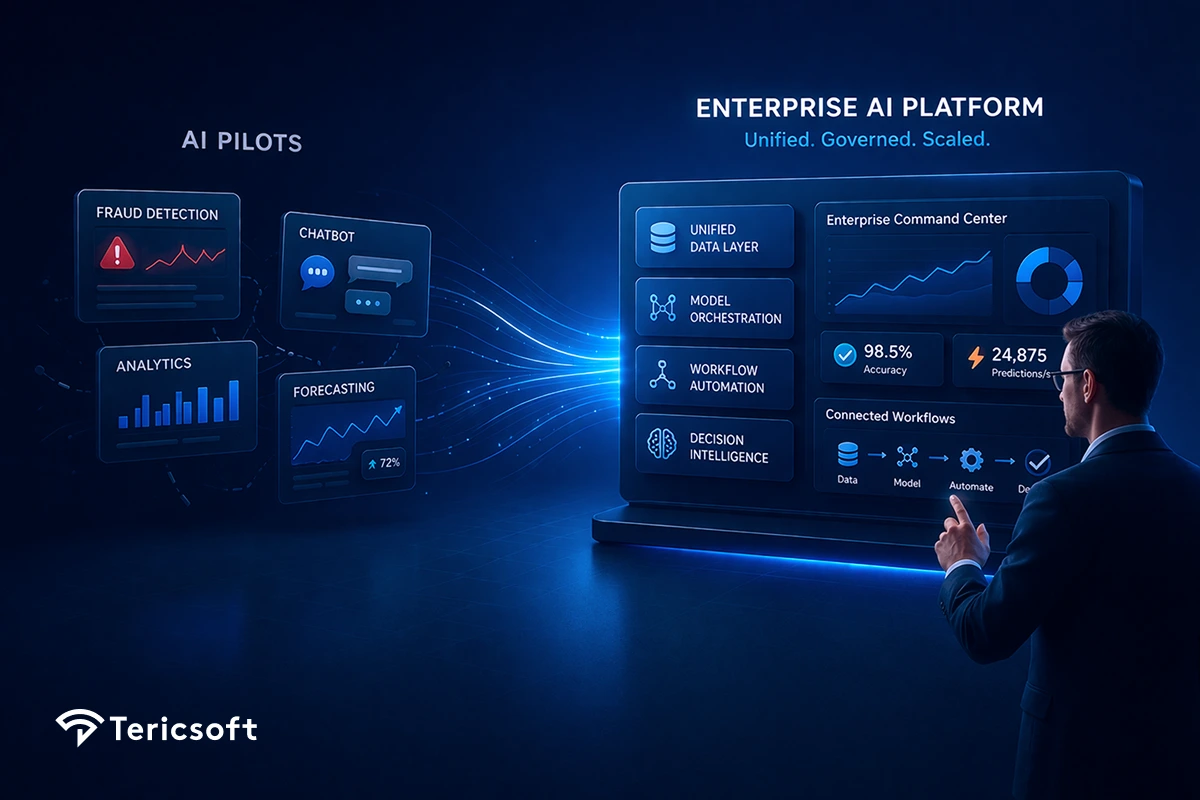
To clearly understand this disconnect, consider the structural differences between a simple pilot and a true enterprise platform:
Lack of Clear Business Objectives and ROI Alignment
Challenge: AI initiatives start with technology, not business problems. Engineering teams often adopt the latest large language model just to test its capabilities, without tying the experiment to a specific fiduciary goal.
How to Avoid: Define measurable KPIs like cost reduction, revenue lift, or efficiency gains before building models. If a project cannot definitively prove how it will save time, reduce overhead, or generate capital, it should not leave the planning phase.
Data Silos and Poor Data Quality
Challenge: A model is only as intelligent as the data feeding it. Industry analysis highlights that data scientists still spend up to 80% of their time simply finding, cleaning, and organizing data. When customer records live in Salesforce while operational logs sit in on-premise servers, AI models suffer from incomplete context and dangerous hallucinations.
How to Avoid: Build a unified data layer and governance framework. Centralize data ingestion and implement strict quality controls before allowing algorithms to process the information.
Legacy Systems and Integration Challenges
Challenge: AI cannot plug into outdated infrastructure. A report by MIT Sloan Management Review notes that integrating with legacy systems is consistently cited by executives as a top barrier to scaling AI enterprise-wide. Many established companies rely on monolithic architectures that simply do not support real-time data streaming.
How to Avoid: Use API-first and middleware-driven architectures. Create secure abstraction layers that allow modern AI microservices to communicate safely with legacy mainframes without requiring a complete system overhaul.
Lack of AI Governance and Ownership
Challenge: No accountability leads to stalled initiatives. When it is unclear whether the IT department, the data science team, or the business unit owns the AI project, security reviews drag on for months and deployment stalls entirely.
How to Avoid: Establish AI governance frameworks, ownership models, and compliance layers. Form a dedicated AI steering committee that includes legal, technical, and business leaders.
Talent Gaps and Over-Reliance on External Vendors
Challenge: Lack of internal AI capability slows scaling. While consulting firms can build excellent initial pilots, relying entirely on outsourced talent leaves the enterprise incapable of maintaining, tuning, or scaling the models long-term.
How to Avoid: Build cross-functional AI teams combining business and technical expertise. Pair internal domain experts with technical specialists to ensure the technology serves the core business logic.
Common Challenges in Enterprise AI Implementation
Transitioning from a successful proof of concept to a globally deployed solution introduces immense friction. Organizations must navigate complex technical, cultural, and regulatory barriers to ensure smooth adoption.
Why Scaling AI in Enterprises Is So Difficult
Scaling AI requires strict alignment across data, infrastructure, and cross-functional teams.
Transitioning a model from a local machine to a secure, load-balanced, enterprise-grade cloud environment requires rigorous MLOps practices.
Only approximately 23% of organizations are scaling AI systems in at least one function. The operational friction of managing compute resources, version control, and model drift at a global scale often overwhelms traditional IT departments.
The Challenge of Embedding AI into Business Workflows
AI must function as an invisible utility powering daily decisions. A major implementation hurdle is poor user experience design.
Asking employees to log into a separate analytics portal forces them to context-switch, immediately creating UX friction.
True workflow embedding means the AI surfaces recommendations directly where the work happens. It must live inside the CRM when a sales representative is on a call, or act as an integrated prompt inside the supply chain software when a logistics manager is routing a complex shipment.
Managing Risk, Compliance, and AI Ethics
This is especially critical in BFSI and healthcare, where regulatory frameworks define AI adoption speed. Enterprises face severe penalties for data breaches, biased algorithms, or non-compliance with privacy regulations like GDPR and HIPAA. Building traceable, explainable AI is a mandatory technical hurdle, not a secondary feature.
Change Management and Organizational Resistance
Employees naturally resist AI when it disrupts their routine without clear value. Historical business data shows that approximately 70% of complex transformation programs fail, and AI is no exception when organizations ignore cultural alignment. If workers perceive an AI system as a surveillance tool or a threat to their job security, adoption rates will plummet.
Why Enterprise AI Projects Fail After Initial Success
Commercial failure often follows technical success. Many AI projects ultimately fail to deliver their promised ROI, not because the code is broken, but because the workforce refuses to trust the outputs.
If the system acts as a "black box" that cannot explain its reasoning, business users will simply bypass the AI. They will reject the new technology and return to their familiar legacy spreadsheets, causing adoption metrics to flatline entirely.
What Successful Enterprise AI Transformations Get Right
The top percentile of organizations that achieve actual return on investment from their AI initiatives share a common blueprint. They treat artificial intelligence as a strategic business enabler rather than an isolated IT sandbox project.
Starting with Business Problems, Not Models
Successful enterprises focus on business outcomes first, then apply AI. They do not ask how they can use generative AI. Instead, they ask how they can reduce customer onboarding time by forty percent, and then they evaluate if machine learning is the right technical solution for that specific operational bottleneck.
Building a Scalable AI Architecture and Data Foundation
Market leaders do not build fragile, one-off scripts. They invest in a robust foundation that includes:
- Data pipelines for continuous ingestion and cleaning.
- MLOps for automated testing, deployment, and monitoring.
- Model lifecycle management to handle retraining when data patterns drift.
To maintain high accuracy and prevent models from generating false information, forward-thinking architecture teams often rely on advanced RAG (Retrieval-Augmented Generation) setups. This ensures the models retrieve the most current internal documents before generating any response, effectively bridging the gap between static algorithms and dynamic enterprise knowledge.
Aligning AI Strategy with Business Goals
AI must align with revenue, cost, and efficiency goals. Every deployed model has a continuous compute cost. Successful organizations meticulously track cloud expenditure against the business value generated by the AI, ensuring the technology remains a profit driver rather than an expensive IT overhead.
Establishing AI Governance and Accountability
Governance ensures risk control, compliance, and scalability. Top-tier enterprises implement strict access controls, automated bias testing, and human-in-the-loop review processes before any AI system is permitted to interact directly with a customer or execute a financial transaction.
Investing in Cross-Functional AI Teams
Transformation requires diverse perspectives. Elite organizations build teams that combine:
- Data scientists to design the algorithms.
- Engineers to build the production infrastructure.
- Business stakeholders to ensure the output actually solves the operational problem.
How to Fix Failed or Stalled AI Initiatives
If your AI projects are currently stuck in development purgatory, it is not too late to pivot. Reviving a stalled initiative requires stepping back, assessing the roadblocks, and realigning the technology with core operational workflows.
How to Move from AI Pilots to Production Systems
Shift from experimentation to production-grade AI platforms. If your pilot has proven its value, the next step is standardizing the deployment architecture. For organizations dealing with highly sensitive data, this often involves transitioning from public APIs to a secure, private Enterprise LLM setup, guaranteeing that proprietary corporate knowledge never leaves the company network.
Breaking Down Data Silos and Improving Data Readiness
Create centralized, high-quality data ecosystems. A stalled AI project is often a data engineering problem in disguise. Re-evaluating your data pipelines using advanced Contextual Retrieval techniques can drastically improve how the AI understands the nuanced relationships within your unstructured enterprise data.
Integrating AI into Core Business Systems and Workflows
Stop building standalone AI web applications. Dedicate engineering resources to build robust API connectors that embed AI directly into:
- ERP systems for automated resource forecasting.
- CRM platforms for intelligent lead scoring and automated follow-ups.
- Operational systems for real-time risk assessment.
Measuring AI Performance and Business Impact
Transition away from measuring technical metrics like loss functions or epoch training times. Start tracking:
- ROI on the engineering and compute spend.
- Efficiency improvements in employee task completion.
- Decision accuracy and subsequent risk mitigation.
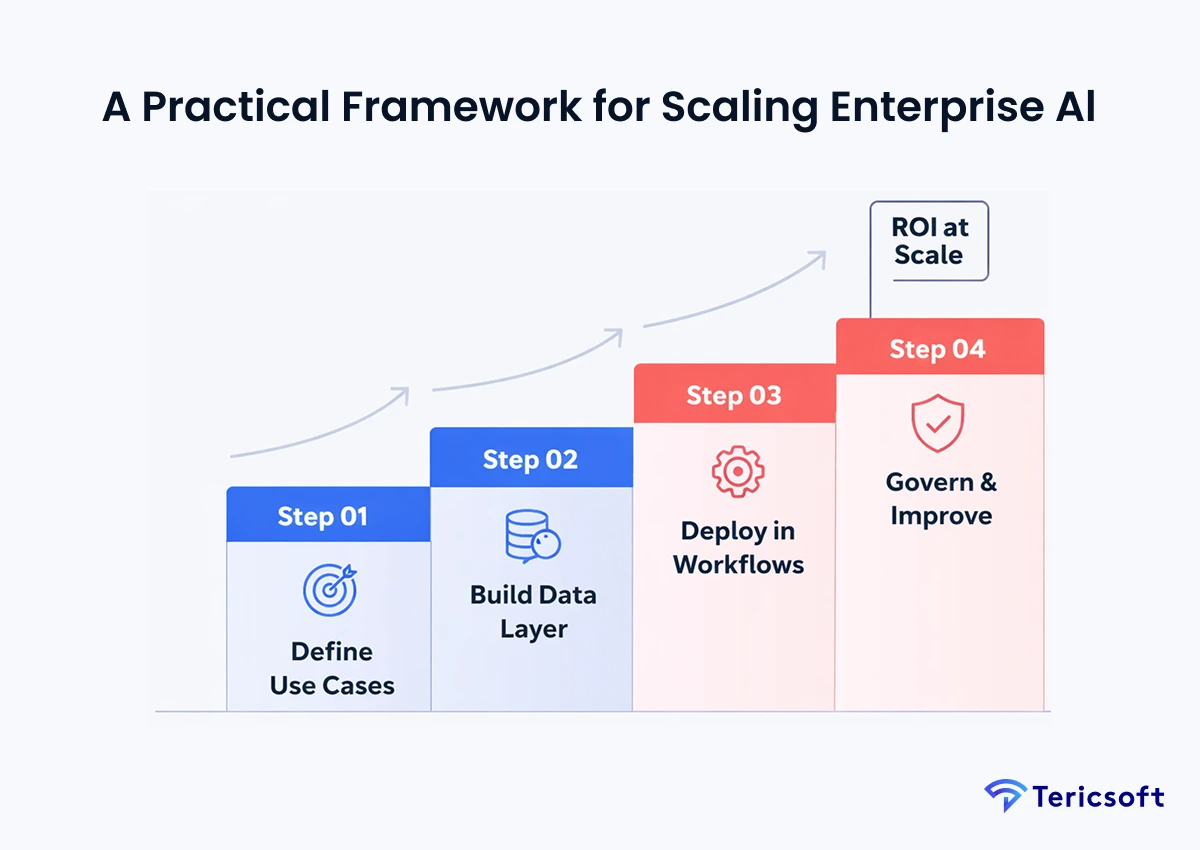
A Practical Framework for Scaling Enterprise AI
Achieving scale requires a structured, repeatable methodology. By following a proven sequence, enterprises can minimize implementation risk, align technical teams with business units, and accelerate their time to value.
Step 1: Define Clear Use Cases with Measurable Outcomes
Focus on high-impact, measurable business problems. Start by auditing your most expensive operational bottlenecks. Select one primary use case, define the exact financial metric you intend to move, and establish a clear baseline before writing a single line of code.
Step 2: Build a Strong Data and Infrastructure Layer
This is the foundation for scalable AI systems. Audit your data sources for accuracy and completeness. Implement secure vector databases for unstructured data and ensure your cloud infrastructure supports dynamic scaling to handle variable inference workloads seamlessly.
Step 3: Deploy AI Within Business Workflows
Ensure AI is used daily, not just analyzed. Work closely with UI/UX designers and the actual end-users to ensure the AI's output is delivered in a format that effortlessly fits into their existing daily habits and software ecosystems.
Step 4: Establish Governance, Monitoring, and Feedback Loops
Continuous improvement and compliance are mandatory. Deploy automated monitoring to watch for model degradation. Create simple feedback mechanisms so employees can flag inaccurate AI outputs, allowing the engineering team to continuously refine the system over time.
The Future of Enterprise AI Transformation
The horizon of artificial intelligence is expanding rapidly. However, the organizations that will dominate the next decade are not just adopting smarter tools; they are fundamentally redesigning their operating models to support autonomous platform architectures.
From AI Tools to AI-Driven Decision Systems
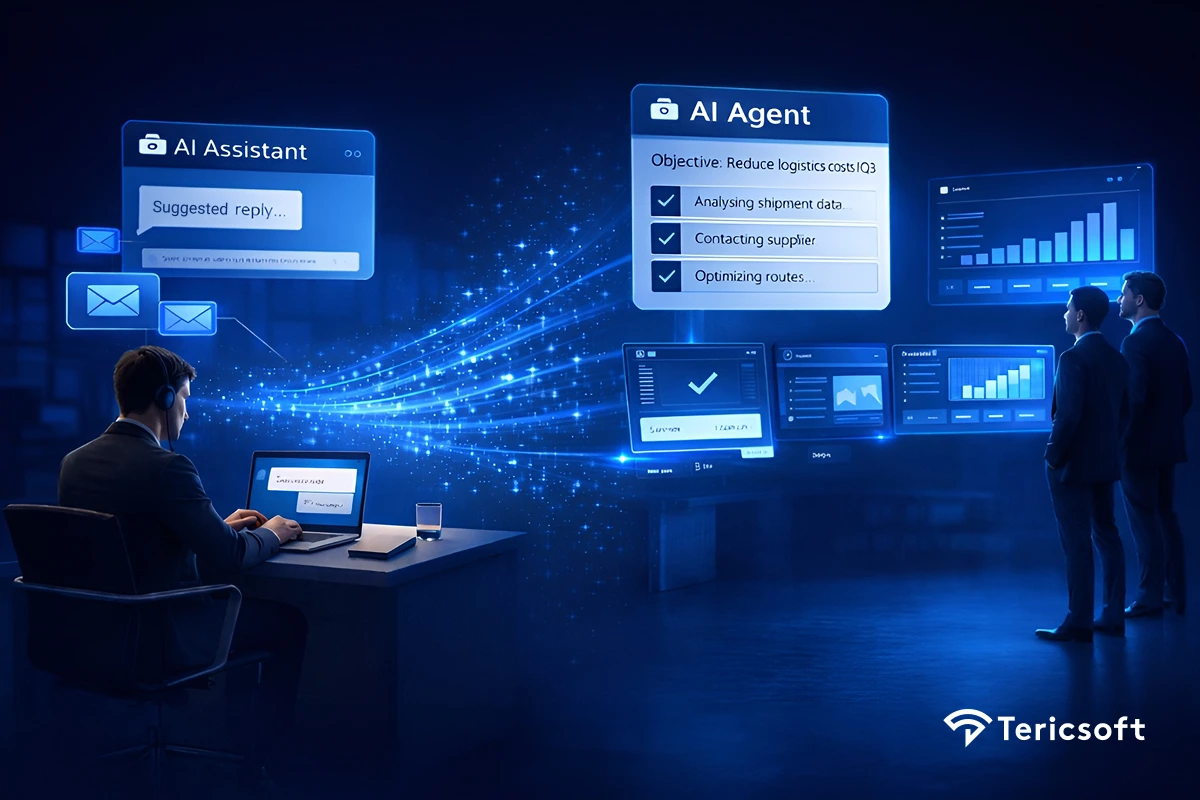
We are witnessing a shift from support tools to autonomous decision systems. Today, AI summarizes a report for a human to read. Tomorrow, AI will analyze the report, cross-reference it with market data, and execute the optimal business decision automatically, requiring human intervention only for absolute edge cases.
The Rise of Agentic and Autonomous Enterprise Systems
"We are moving from a world of apps to a world of agents."
— Satya Nadella, CEO of Microsoft
39% of companies are experimenting with AI agents, but scaling remains limited. Overcoming this scaling hurdle is the next great enterprise frontier.
By leveraging AI Agents and broader AI Agentic Automation, companies will deploy networks of specialized digital workers capable of completing multi-step tasks in the background.
However, deploying these agentic systems will require highly dynamic governance frameworks. Organizations will need real-time auditing capabilities to ensure autonomous agents act strictly within enterprise risk boundaries.
Why Enterprises Must Move from Pilots to Platforms
The future belongs to platform-based AI ecosystems.
Enterprises that try to manage dozens of disconnected AI applications will inevitably drown in technical debt.
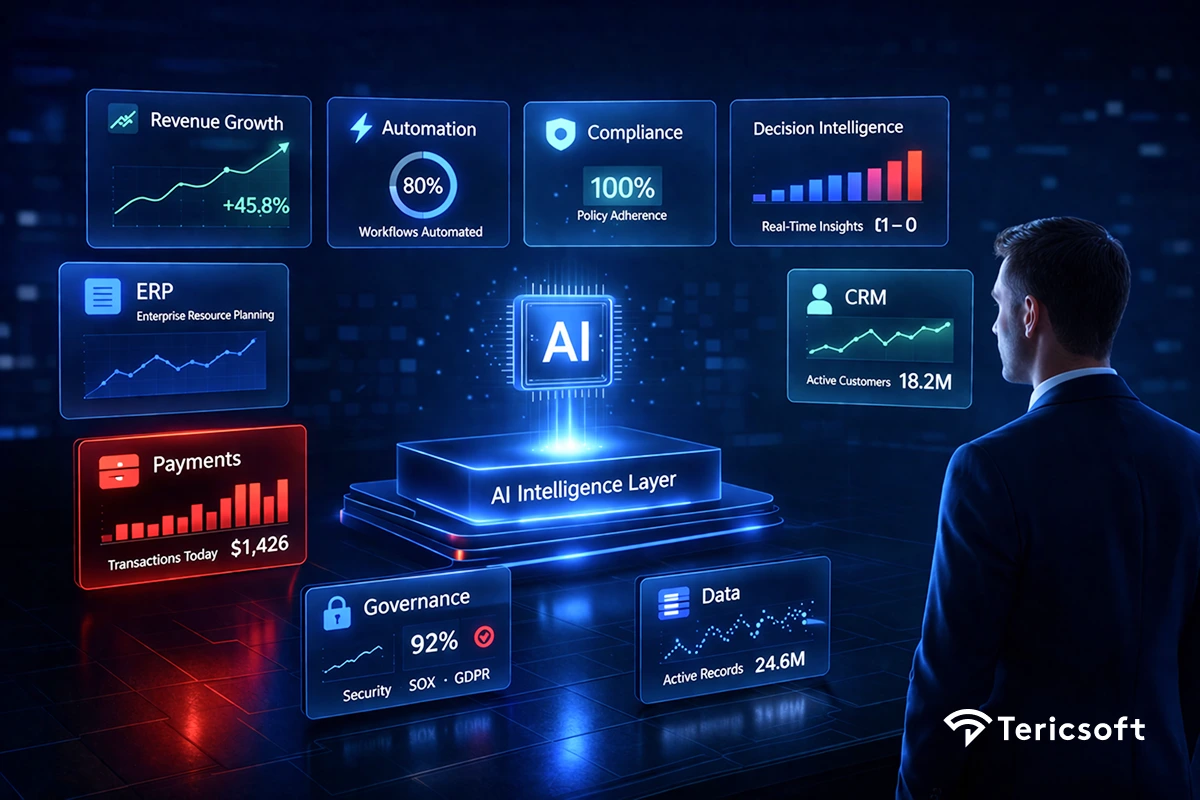
The ultimate goal is a unified, secure platform architecture that manages data ingestion, governance, and autonomous execution across the entire corporate footprint from a single, centralized layer.
“AI will not replace humans, but humans with AI will replace humans without AI.”
— Prof. Karim Lakhani, Harvard Business School
About Tericsoft
Tericsoft is a premier artificial intelligence strategy and execution partner dedicated to moving your organization from isolated experiments to scalable, production-grade AI platforms. We specialize in building secure enterprise data foundations and embedding system-level intelligence directly into your ERP, CRM, and core operational workflows. By engineering solutions focused purely on measurable ROI, Tericsoft helps enterprise leaders bridge the gap between technical potential and actual business impact.

Enterprise AI Transformation is the process of embedding AI into core systems and workflows to drive automation, ROI, and decision intelligence.
Most AI projects fail due to poor integration with business systems, unclear ROI goals, data silos, and lack of governance.
Enterprises scale AI by aligning use cases with business goals, building strong data foundations, and integrating AI into workflows.
AI pilots are isolated experiments, while enterprise AI integrates into core systems, delivering measurable impact and scalable value.
Key components include data pipelines, MLOps, governance frameworks, model monitoring, and integration with ERP and CRM systems.