
Can AI systems truly transform reactive billing into proactive revenue intelligence, or are they just faster tools for old errors? Learn how AI for Billing is reducing denials, improving collections, and helping enterprises turn billing performance into a strategic advantage where foresight, not just invoicing, defines success.
Revenue is growing, yet cash flow feels tighter than expected. Claims are delayed. Invoices are disputed. Teams are spending hours fixing errors that should never have happened.
At the monthly review meeting, leaders have reports explaining what happened last month, but no system that can prevent what happens next week.
By the time a denial is identified, reimbursement has already slowed. By the time overdue accounts are escalated, working capital is already under pressure.
Billing is no longer just an administrative function. It is a strategic lever for growth, liquidity, and customer trust. That is where AI for Billing becomes essential.
“Cash flow is the lifeblood of business.”
— Richard Branson, Co-founder of the Virgin Group
What Is AI for Billing?
AI for Billing uses machine learning, automation, predictive analytics, and intelligent decision systems to improve invoice accuracy, reduce denials, accelerate collections, and strengthen revenue performance. It transforms billing from manual processing into a real-time intelligence function.
Defining AI for Billing is only the starting point. Its real value becomes clear when we compare it with the reactive logic found in traditional billing systems.
How AI Improves Traditional Billing Processes
Traditional billing processes rely on fragmented workflows, static rules, spreadsheets, and manual reviews. These systems are inherently reactive, identifying errors only after a payment has been missed or a claim has been rejected.
AI for Billing functions as a continuous validation layer across billing workflows. It identifies anomalies, predicts issues, and suggests corrections before revenue is impacted by learning from every transaction.
Why Enterprises Are Adopting AI for Billing
Enterprises are adopting AI for Billing because the increasing volume of complex payer rules and global tax regulations has outpaced manual capacity. Organizations can no longer scale their revenue cycle by simply adding headcount.
AI enables smarter and more scalable billing operations that handle massive transaction volumes without a linear increase in costs. This shift allows teams to move from high-volume data entry to high-value exception management.
AI for Billing vs Traditional Billing Systems
Traditional systems record transactions after they happen. They are essentially digital filing cabinets that lack the ability to intervene when an invoice or claim goes off track.
AI for Billing anticipates issues before they happen and recommends the best next action. It provides a layer of proactive intelligence that traditional ERP or billing software cannot match.
Why Billing Is Now a Strategic Priority?
Billing performance now influences boardroom metrics such as working capital, revenue predictability, customer retention, and operational efficiency. Enterprises can no longer treat billing as a siloed support process.
The move toward boardroom-level billing strategy is driven by the realization that billing is the final validator of the customer lifecycle. When this process is optimized, it directly fuels the enterprise's most critical financial KPIs.
Billing and Working Capital Performance
Faster collections and fewer disputes directly improve liquidity and reduce borrowing pressure. When revenue is trapped in accounts receivable due to preventable errors, the enterprise loses the ability to reinvest in growth.
AI helps shorten the cash conversion cycle by reducing preventable delays in billing and collections. By ensuring revenue is captured quickly, AI directly strengthens the balance sheet and improves overall revenue realization.
Billing and Customer Trust
Clear invoices, fewer errors, and faster resolutions improve customer satisfaction and retention. Billing friction is a leading cause of involuntary churn in subscription models and a source of frustration in B2B relationships.
When an enterprise provides accurate, transparent billing, it reinforces its brand promise. AI eliminates the "bad friction" of errors while preserving necessary financial controls.
Common Billing Challenges AI Can Solve
While every enterprise faces unique obstacles, vulnerabilities in the revenue cycle often stem from fundamental gaps in accuracy and visibility. AI is designed to bridge these gaps by neutralizing errors that lead to revenue leakage.
Billing Errors and Manual Rework
ChallengeManual entry mistakes, duplicate invoices, and inconsistent pricing logic create avoidable billing errors that consume time and delay payments.
How to Avoid ItUse AI for Billing to validate inputs automatically and detect anomalies in real time. This standardizes workflows across teams and prevents the aggregation of significant financial leaks.
InsightPoor data quality remains a hidden cost in finance operations. It forces skilled professionals to act as data cleaners rather than strategists focusing on revenue performance.
Claim Denials and Delayed Payments
ChallengeIn healthcare and payer environments, incomplete information and rule mismatches often lead to denials. Research indicates that 12% of healthcare claims were denied in 2023.
How to Avoid ItAI for Billing can predict denial risk before submission and prioritize high-value claims. Many organizations report that AI-driven automation reduced claim denials by at least 10% within the first 6 months for 83% of healthcare organizations.
“What gets measured gets managed.”
— Peter Drucker
Slow Collections and Outstanding Receivables
ChallengeLate invoicing and weak follow-up processes increase receivables and slow cash conversion cycles. This slows overall revenue cycle performance and puts pressure on working capital, as noted in studies regarding AI in Revenue Cycle Management.
How to Avoid ItUse AI to score accounts by payment likelihood and guide collection teams toward high-impact actions. Studies show that AI can reduce average Days in Accounts Receivable (AR) by 15–30%.
Compliance Risks and Audit Gaps
ChallengeChanging regulations, tax rules, and payer policies make manual compliance checks difficult to sustain at scale, increasing the risk of audit gaps.
How to Avoid ItAI for Billing continuously monitors policy rules and flags risky transactions. This creates a "compliance-by-design" framework that ensures the enterprise is always audit-ready.
Poor Visibility Across Billing Workflows
ChallengeBilling data often lives across ERP platforms, payer portals, and spreadsheets, making it hard to identify bottlenecks quickly.
How to Avoid ItAI consolidates fragmented data into unified dashboards that surface denials and workflow performance in real time. This provides the "single source of truth" required for strategic decision-making.
The Billing AI Maturity Model
To implement AI successfully, leaders must understand their current position on the maturity curve. This framework serves as a guide for transitioning from basic digitization to a fully intelligent billing operation.
- Level 1: Rules-based Automation. Using basic bots for data entry and simple logic.
- Level 2: Predictive Denial Prevention. Systems that flag errors before submission based on historical patterns.
- Level 3: Autonomous Collections Orchestration. AI agents that handle follow-ups and payment retries independently.
- Level 4: Revenue Intelligence Command Center. Full integration where AI predicts cash flow and optimizes the entire revenue lifecycle.
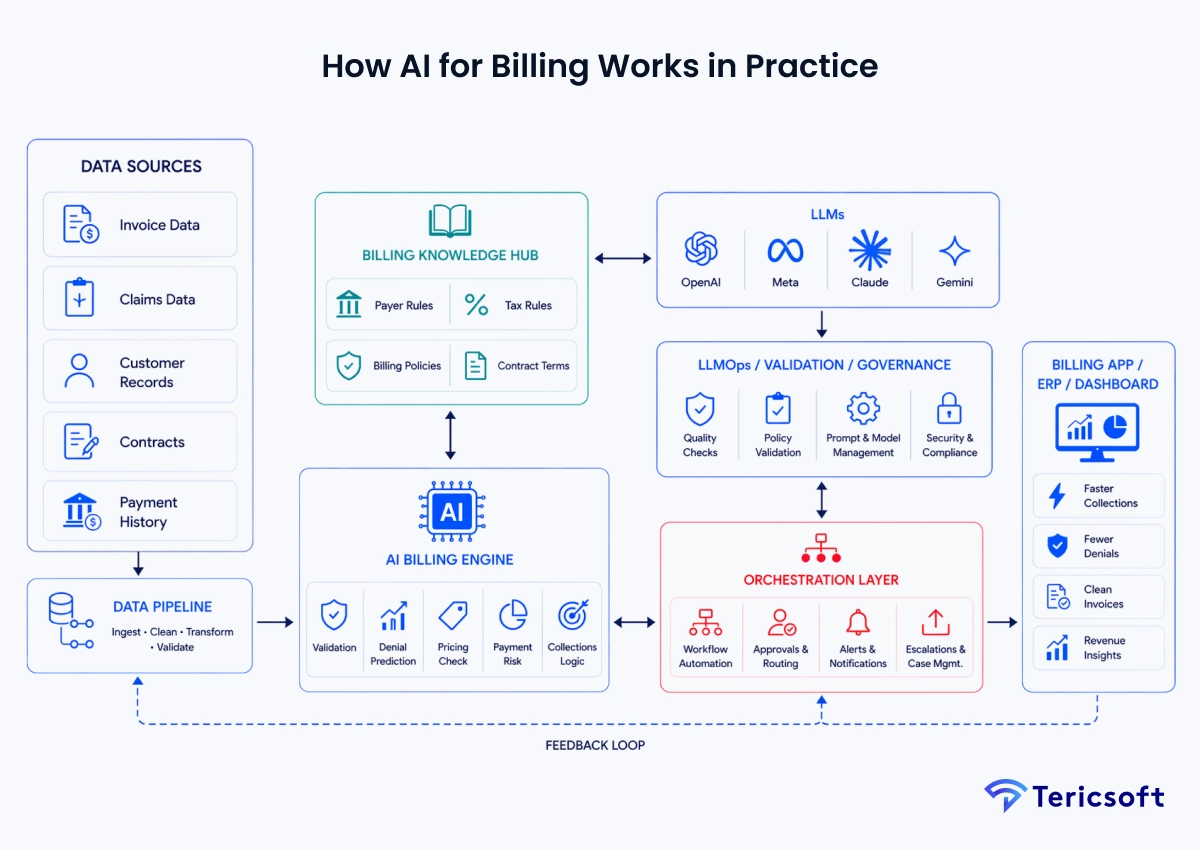
How AI for Billing Works in Practice?
AI for Billing connects enterprise systems such as ERP, EHR, CRM, and payment gateways. It creates a "smart layer" that sits on top of existing infrastructure to orchestrate the flow of funds.
This process turns billing data into decisions, predictions, and automated actions. Understanding these stages is critical for any leader looking to modernize their revenue cycle performance.
Unified Data Integration
Data is pulled from invoices, claims, contracts, customer records, and ledgers into one decision layer. This breaks down silos and ensures the billing engine has the context needed to make accurate decisions.
Predictive Intelligence Engine
Models identify denial risk, late-payment probability, and pricing errors before they impact revenue. Some implementations suggest that AI can increase reimbursement accuracy by up to 25%.
Intelligent Workflow Automation
Tasks such as approvals, reminders, and exception handling are automated using business logic. This allows the system to handle routine transactions while humans focus on complex disputes.
Continuous Performance Learning
The system improves over time by learning from payment outcomes, denials, and user feedback. As these systems process more data, they refine their accuracy based on specific payer behaviors.
AI Use Cases in Healthcare, Finance, and Enterprise Billing
The versatility of AI allows it to be adapted to the specific regulatory requirements of diverse industries. By applying sector-specific logic, AI can solve the unique revenue leakage points that define each market.
Healthcare Billing
AI flags missing modifiers or incorrect patient eligibility data before claim submission. By connecting with AI for Clinical Documentation, it ensures services are accurately reflected in billing codes.
Finance Billing
In the banking and insurance sectors, AI automates the reconciliation of thousands of daily transactions. It identifies discrepancies in premium payments or interest calculations that manual audits often miss.
SaaS and Subscription Billing
AI predicts failed renewals based on subtle changes in payment behavior or usage patterns. It triggers personalized outreach and adjusts retry logic to prevent involuntary churn.
Telecom and Utilities Billing
AI detects billing leakage from usage anomalies in real time. If a meter reports data that contradicts historical patterns, AI flags it for review before the customer receives an incorrect bill.
B2B Enterprise Services Billing
Managing milestone billing for complex contracts is simplified. AI ensures invoices are only sent when contractual milestones are met and verified by the system.
Benefits of AI for Billing and Revenue Performance
Moving from manual processing to an AI-led framework unlocks advantages that stabilize the balance sheet. By neutralizing the variables that cause payment friction, enterprises can shift focus from fire-fighting errors to orchestrating growth.
- Faster collections and stronger cash flow: Shorter DSO cycles mean more liquid capital.
- Lower denial rates and fewer disputes: Accuracy at the source prevents downstream delays.
- Reduced manual effort and operational cost: Teams focus on strategy, not repetitive data entry.
- Better compliance and audit readiness: Automated logs provide a clear trail for regulators.
- Improved customer billing experience: Transparency reduces friction and builds loyalty.
- Higher revenue realization: AI identifies and recovers leaked revenue from under-billing.
- Real-time visibility for leadership teams: Dashboards provide foresight, not just hindsight.
- Scalable operations without linear headcount growth: Grow volume without bloating the team.
“Revenue is vanity, profit is sanity, cash is reality.”
— Alan Miltz, Co-founder of CashflowStory
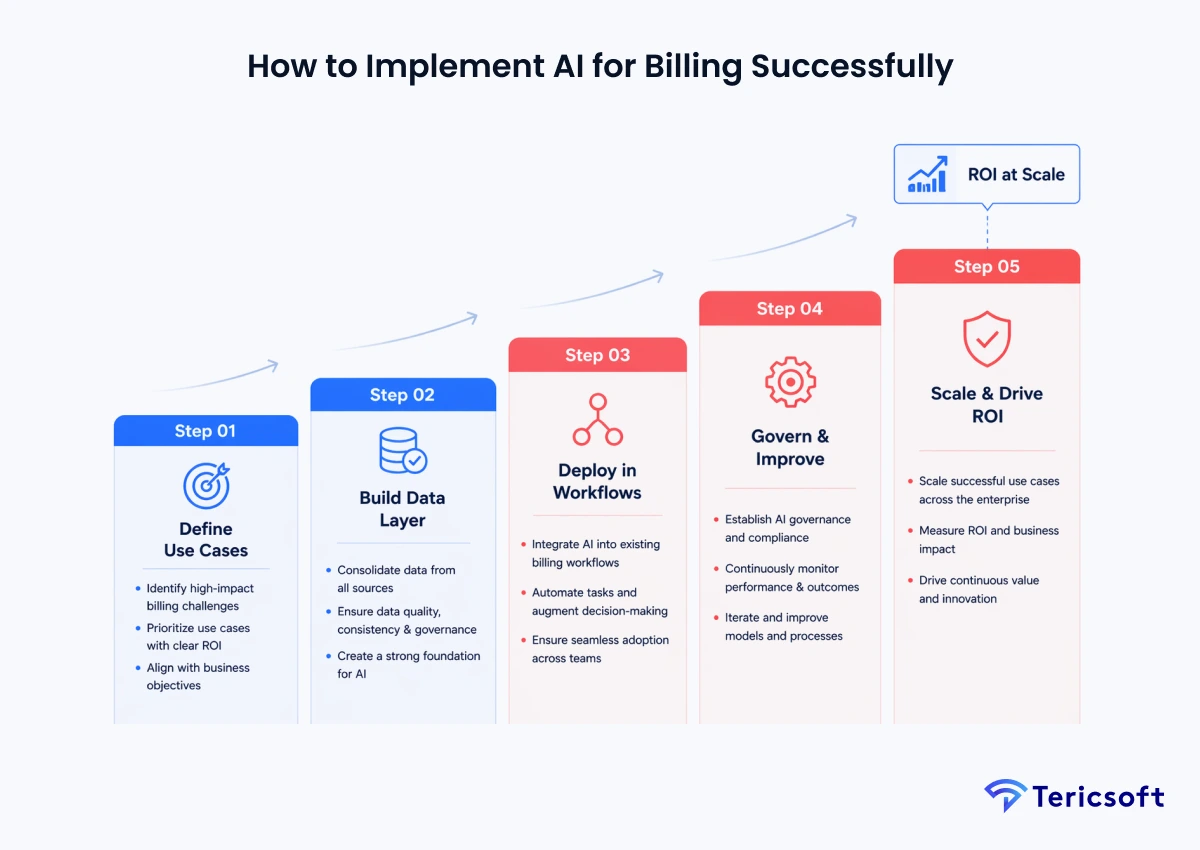
How to Implement AI for Billing Successfully?
Implementation of AI for billing is a strategic journey, not a one-time software installation. It requires a balance of technical integration and process redesign to ensure the AI has the right data to make an impact.
Success demands a structured methodology that prioritizes immediate wins while building a foundation for long-term revenue operations.
Start With High-Impact Billing Pain Points
Prioritize measurable problems such as denial reduction, DSO improvement, or invoice accuracy. Solving a high-visibility problem first builds the internal momentum needed for broader transformation.
Build a Unified Data Foundation
Clean, connected data is the foundation of every successful AI for Billing initiative. Without high-quality data, the predictive models will struggle to provide accurate reimbursement recommendations.
Integrate AI With Existing Systems
AI should strengthen ERP, EHR, CRM, and billing platforms rather than forcing replacements. The most effective implementations act as an "intelligent brain" connected to the existing enterprise systems.
Measure ROI Continuously
Track denial rates, collection speed, and revenue leakage. These metrics provide the evidence needed to scale the solution and prove the ROI of the billing transformation.
Add Governance and Human Oversight
Ensure privacy, explainability, and approvals remain built into every workflow. A "human-in-the-loop" approach ensures that AI enhances human decision-making rather than operating as a black box.
Strategic Decision-Stage Questions for Finance Leaders
As organizations move toward adoption, certain practical questions define the path forward. Addressing these concerns early ensures the project remains aligned with broader organizational goals.
- What is the typical ROI timeline? Depending on workflow maturity, many organizations begin seeing improvements in DSO and denial rates within 90 days of full integration.
- Should we build or buy? While internal teams understand the business, purpose-built AI billing platforms offer pre-trained models that significantly accelerate time-to-value.
- How does this affect our security posture? Modern AI billing systems use enterprise-grade encryption to ensure that sensitive financial data and patient information remain protected.
Why Traditional Billing Systems Are Falling Behind
Traditional billing systems were built to process transactions, not optimize outcomes. Their technical limitations create significant bottlenecks as enterprises scale and payer rules become more dynamic.
The legacy approach to billing relies on static logic that cannot adapt to the speed of modern finance. This gap between system capabilities and market reality is a primary driver of revenue loss.
Static Rules Cannot Adapt Fast Enough
Manual rule updates lag behind changing billing realities. When a payer changes their submission requirements, a static system will continue to produce errors until a human manually intervenes.
Manual Processes Limit Growth
Transaction volume grows faster than teams can manage manually. This leads to a billing bottleneck where revenue growth is capped by the administrative capacity of the finance department.
Historical Reporting Is Too Late
Reports explain yesterday’s issues but do not prevent tomorrow’s revenue loss. In a fast-moving market, looking at last month's data to solve today's problems is no longer sufficient.
The Future of AI for Billing
The trajectory of financial technology is moving toward a self-correcting ecosystem where the revenue cycle manages itself. This shift is being driven by automation, conversational analytics, and more adaptive collection strategies.
Autonomous Billing Workflows
Many enterprises are moving toward low-touch or exception-based billing models. AI agents will increasingly manage approvals, follow-ups, and collections with minimal human effort.
Conversational Billing Intelligence
Leaders will ask natural-language questions and receive instant billing insights and forecasts. Questions about how new contract terms affect Q4 collections will be answered in seconds.
Hyper-Personalized Collections
Collection strategies will adapt dynamically based on customer behavior and relationship value. AI will determine the right message and channel to reach every customer efficiently.
Embedded Compliance Monitoring
Regulatory and contract checks will happen continuously within billing workflows instead of after the fact. Compliance becomes an automated byproduct of the process rather than a separate hurdle.
Self-Optimizing Revenue Operations
Billing systems can improve over time as they learn from payment outcomes, denials, and disputes. The system you have next year will be more intelligent as it refines its accuracy based on real-world feedback.
About Tericsoft
Tericsoft helps enterprises move from manual billing operations to intelligent revenue systems through secure, scalable, and outcome-driven AI solutions. Our approach designs AI frameworks that integrate with ERP, EHR, CRM, and finance platforms without disrupting existing workflows.
We combine deep domain expertise with enterprise-grade engineering to deliver measurable ROI. By focusing on a human plus AI operating model, we ensure that our solutions are secure, compliance-first, and built to scale. Whether the goal is reducing denials or modernizing legacy billing infrastructure, Tericsoft helps organizations turn billing performance into a strategic growth advantage.

AI for Billing uses machine learning and automation to improve invoice accuracy, reduce denials, and accelerate collections.
AI detects missing data, coding errors, and rule mismatches before claims or invoices are submitted.
Yes, AI speeds up collections, reduces payment delays, and helps lower outstanding receivables.
Healthcare, finance, SaaS, telecom, utilities, and enterprise service businesses commonly use AI-driven billing systems.
No, most solutions integrate with existing ERP, CRM, EHR, and billing platforms without replacing them.