Can AI systems truly understand what needs to be achieved, or are they still reacting to instructions? Learn how Intent Engineering is redefining goal alignment, execution reliability, and why outcomes, not responses, are becoming the real measure of intelligent systems.
For the past few years, AI engineering conversations have revolved around prompts. Then the focus shifted to context windows, retrieval pipelines, and memory management. Each step improved model performance, but a deeper issue remained unresolved. Most AI systems still respond to instructions without understanding the larger objective they are meant to achieve.
That limitation becomes obvious in enterprise environments. An AI agent may produce well-structured text, retrieve accurate data, and maintain multi-turn reasoning, yet still fail to achieve the intended business outcome. The reason is simple. It was never engineered around intent.
This structural limitation is increasingly recognized in the broader AI ecosystem. As systems become more autonomous and operate across longer workflows, architectural thinking must replace surface-level prompt optimization.
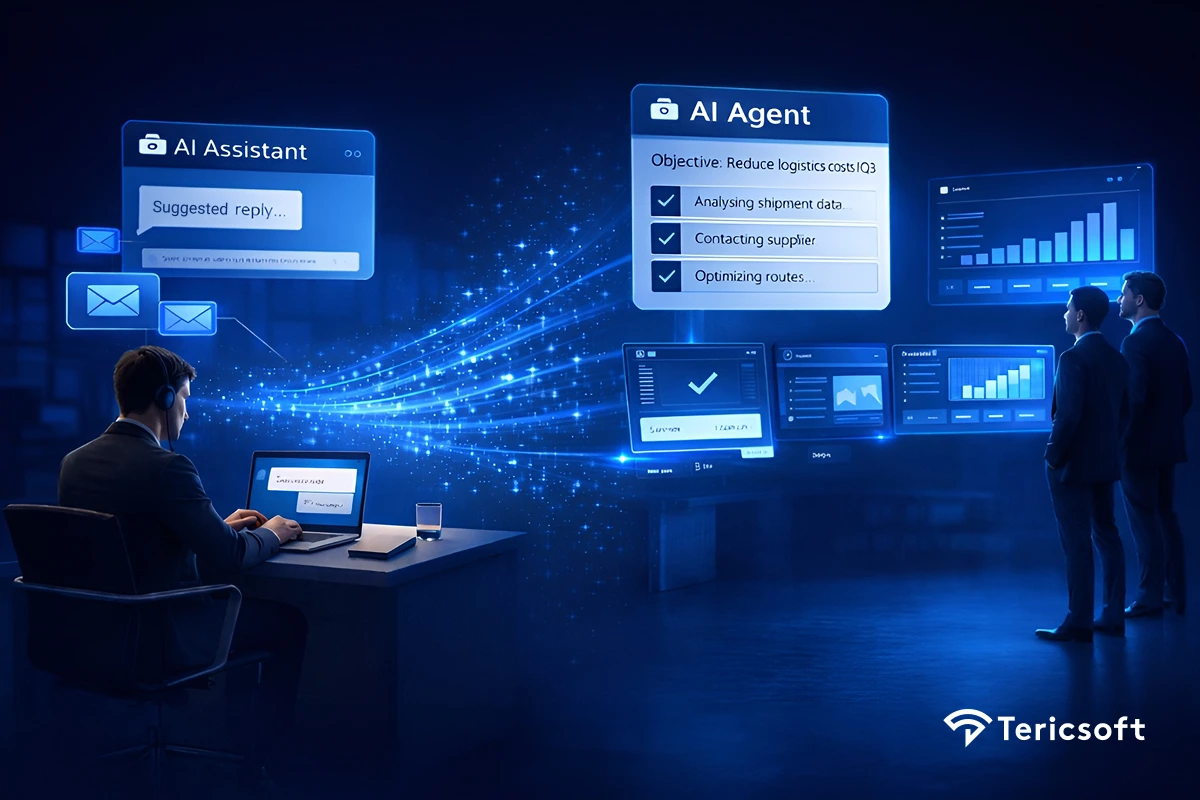
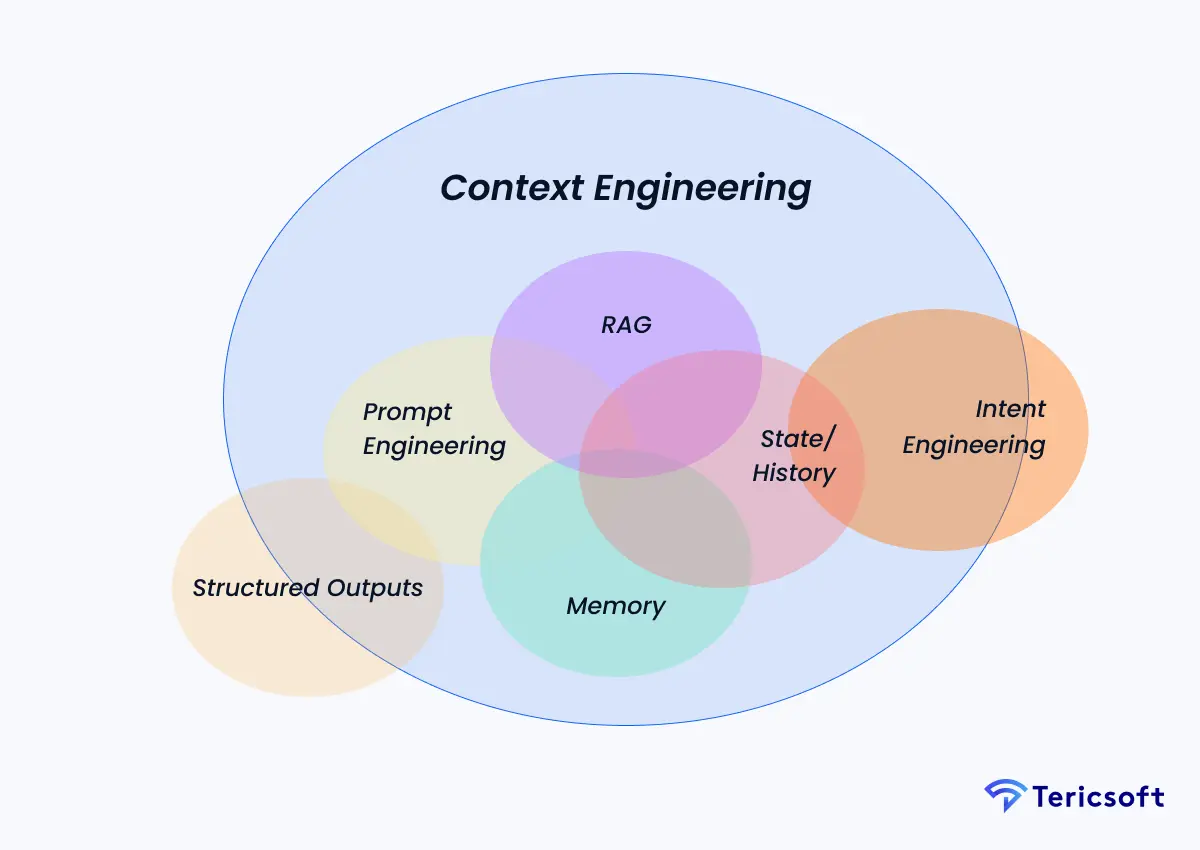
This is where Intent Engineering in AI becomes critical. It represents a structural shift from reactive generation to outcome-driven system design. Prompt Engineering refined communication. Context Engineering improved reasoning continuity. Intent Engineering defines purpose and success.
When AI systems move from answering questions to executing objectives, engineering discipline must evolve accordingly.
What is Intent?
Intent in AI systems is often misunderstood as a synonym for instruction. In reality, intent is far more structured and operational.
Intent includes:
- A defined objective
- Clear success conditions
- Explicit constraints
- Measurable performance expectations
An instruction tells the system what to generate. Intent tells the system what must be accomplished and how success will be evaluated.
Consider the following contrast:
Instruction:
"Generate a financial summary."
Intent:
"Enable leadership to make a funding decision within five minutes by presenting the three most critical financial indicators, highlighting risks, and summarizing cash runway projections."
The difference is not semantic. It is architectural. The instruction focuses on output. The intent focuses on outcome, context of use, time sensitivity, and decision impact.
“I really like the term ‘context engineering’ over prompt engineering.”
— Andrej Karpathy, Founder of Eureka Labs.
His statement reflects the industry’s evolution from surface-level prompting toward structural design. Intent Engineering builds on that progression by moving beyond context toward measurable objectives.
In enterprise AI, this distinction determines whether systems assist or actually execute meaningful objectives.
What is Intent Engineering in AI?
Intent Engineering in AI is the structured design of AI systems around goals, constraints, and measurable outcomes rather than surface-level instructions.
It introduces a deliberate architectural layer that includes:
- Goal modeling
- Task decomposition
- Constraint reasoning
- Tool orchestration
- Continuous validation
Traditional prompt-based systems optimize how something is said. Context Engineering optimizes what information is available. Intent Engineering optimizes what must be achieved.
The importance of context management itself has been validated by leading AI infrastructure frameworks. LangChain notes that when agents are exposed to too many overlapping tool descriptions, they can become confused. They report that applying retrieval over tool descriptions improved tool selection accuracy by three-fold.
LangChain also highlights that agents can run across very long interactions, sometimes spanning hundreds of turns, which requires deliberate context management strategies.
These findings reinforce a critical point. If tool selection can degrade simply due to overlapping descriptions, and if interactions span hundreds of turns, then architectural clarity at the intent level becomes essential. Context alone cannot guarantee goal alignment across extended workflows.
An intent-engineered system operates with explicit success conditions. It decomposes high-level objectives into smaller tasks, selects tools strategically, evaluates outputs against constraints, and adapts until success criteria are met.
Instead of asking, “What should I generate next?” the system operates under a more rigorous internal question: “What objective am I accountable for, and what evidence proves completion?”
That shift transforms AI from a conversational interface into a structured execution engine.
Evolution from Prompt Engineering to Intent Engineering
The progression from prompts to intent reflects increasing system complexity and enterprise adoption.
Prompt Engineering
Prompt Engineering focuses on language control. Engineers refine phrasing to influence outputs. It is highly effective for bounded tasks such as classification, summarization, rewriting, or structured generation.
Research has shown that structured prompting techniques can significantly improve reasoning performance. In the paper “Chain-of-Thought Prompting Elicits Reasoning in Large Language Models”, researchers demonstrated substantial accuracy improvements on reasoning benchmarks like GSM8K when models were prompted to generate intermediate reasoning steps.
This validates that Prompt Engineering measurably enhances reasoning quality under benchmark conditions.
However, prompt-level systems are fragile. Small phrasing changes can produce large behavioral variations. Complex workflows require long prompt chains, which are difficult to maintain and debug.
Prompt Engineering optimizes outputs. It does not guarantee outcomes.
Context Engineering
As applications expanded, developers recognized that memory and information flow were equally important.
“Context Engineering is the delicate art and science of filling the context window with just the right information for the next step.”
— Andrej Karpathy, Founder of Eureka Labs.
LangChain’s documented improvements in tool selection accuracy demonstrate how critical structured context is. They report a three-fold improvement in tool selection accuracy when retrieval was applied over tool descriptions.
LangChain also notes that agents can operate across hundreds of turns, requiring deliberate context management strategies.
This confirms that Context Engineering improves structural reliability and agent precision in measurable ways.
Yet even with retrieval-augmented context, agents remain reactive unless intent is explicitly modeled.
Intent Engineering
Intent Engineering represents the next structural layer. Instead of optimizing language or context flow, it defines purpose at the system level.
The progression can be summarized as:
Prompt Engineering → Controls wording
Context Engineering → Controls relevance and memory
Intent Engineering → Controls objectives and measurable outcomes
As AI agents increasingly operate in production systems, outcome-driven architecture becomes necessary. Enterprises do not measure AI success by eloquence. They measure it by impact.
At present, there is no large-scale published benchmark that quantifies the efficiency uplift of Intent Engineering as a formal discipline. Therefore, any performance expectations should be considered forward-looking projections rather than confirmed results.
Based on the measurable improvements seen in prompt structuring and context optimization, Intent Engineering is expected to impact:
- Multi-step task completion consistency
- Goal alignment reliability
- Reduction in workflow failure under ambiguity
- KPI-based validation success rates
These are projected improvements over the next one to two years as intent modeling becomes more widely implemented in production AI systems.
Architectural Clarity
The concept of intent also appears in enterprise networking. However, its implementation differs significantly from AI-based systems. Clarifying this distinction is essential for architectural precision.
Intent-Based Networking
Intent-Based Networking is the operational philosophy within enterprise networking where administrators declare the desired state rather than configuring devices manually.
The system automatically implements and maintains that declared state.
While philosophically similar, networking intent does not involve reasoning decomposition or dynamic goal planning. It is declarative automation rather than cognitive execution.
Networking intent configures systems.
AI intent orchestrates reasoning and execution toward measurable goals.
Intent-Based Architectures in AI
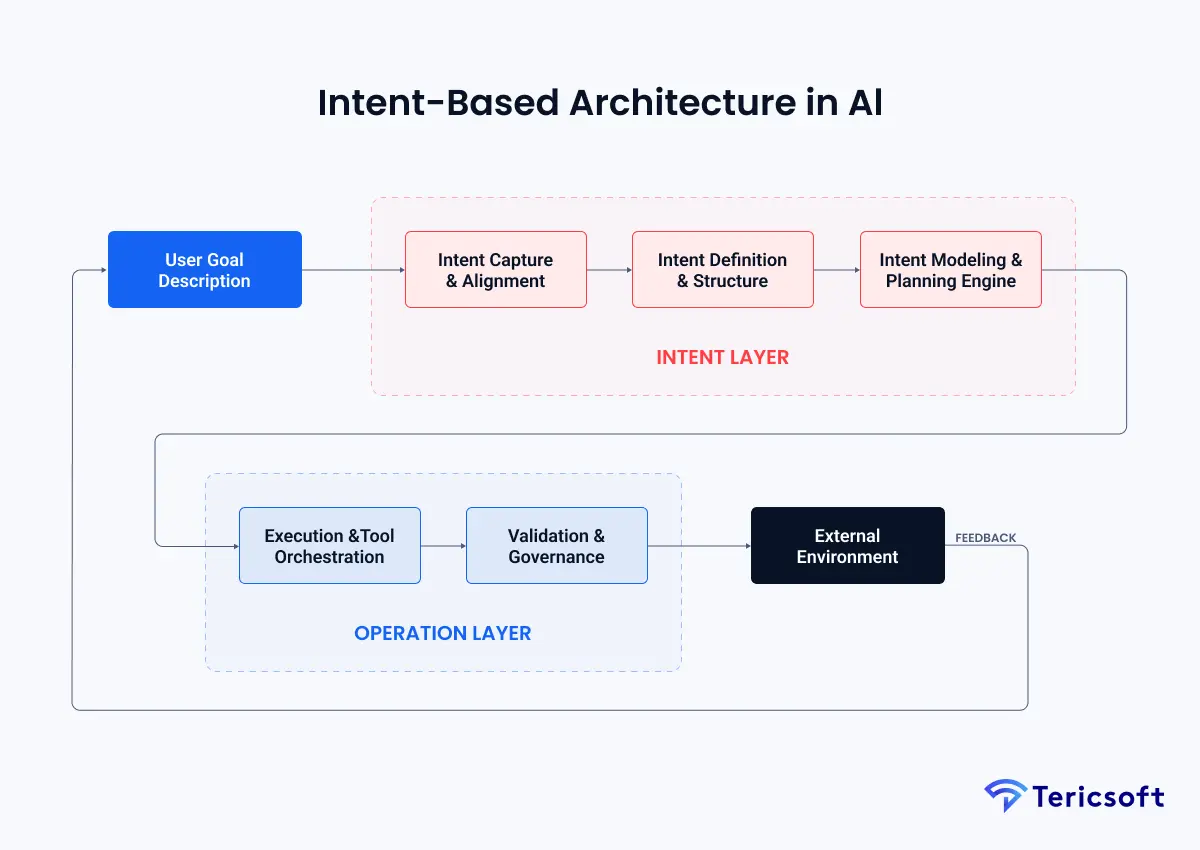
Intent-Based Architectures in AI translate high-level business objectives into structured reasoning workflows.
A mature AI intent architecture typically includes:
- Intent Capture & Alignment
- Intent Definition & Structure
- Intent Modeling & Planning Engine
- Execution &Tool Orchestration
- Validation & Governance
Practical Example:
An AI operations agent tasked with reducing procurement expenses does not merely summarize vendor contracts. It identifies renegotiation opportunities, benchmarks pricing, models projected savings, and validates whether the target reduction threshold has been achieved before recommending execution.
This architecture moves from declarative instruction to measurable execution.
Intent-Based Networking Architectures
Intent-Based Networking Architectures structure how high-level network policies are translated into enforceable configurations.
“Intent-based networking uses software to automate tasks across the network. It allows administrators to define the desired state of the network, and the system implements the necessary changes.”
— Hewlett Packard Enterprise
This approach focuses on infrastructure state management and compliance validation.
AI Agents Efficiency in Prompt Engineering: Where It Breaks
Prompt chaining remains common in AI agent development. However, real-world deployments reveal structural weaknesses:
- Lack of explicit goal modeling
- Inconsistent tool selection
- Workflow collapse under ambiguity
- No built-in success verification
LangChain’s findings on tool confusion and long multi-turn interactions highlight the limitations of prompt-only systems. When agents operate across hundreds of turns, intent-level structure becomes necessary to maintain coherence and alignment.
Without intent modeling, systems remain reactive assistants. With intent modeling, they become accountable operators.
Difference Between Prompt Engineering vs Context Engineering vs Intent Engineering
Prompt Engineering optimizes language.
Context Engineering optimizes knowledge flow.
Intent Engineering optimizes business impact.
Future after Intent Engineering
If Prompt Engineering improved benchmark reasoning accuracy and Context Engineering delivered measurable improvements in tool selection precision, the next frontier is measurable objective completion.
Intent Engineering is expected to enable:
- Higher multi-step workflow reliability
- Reduced failure rates in long-running agent systems
- Stronger KPI alignment
- Increased enterprise trust in autonomous AI execution
These outcomes are projections based on structural design improvements rather than currently published benchmark data.
Over the next one to two years, as organizations adopt intent modeling layers and validation-based agent architectures, measurable performance data is likely to emerge. At present, Intent Engineering represents a forward-looking architectural evolution rather than a quantified industry metric.
Advantages of Implementing Intent Engineering
Intent Engineering introduces measurable improvements in enterprise AI systems:
- Goal-directed agent behavior
- Built-in validation and feedback loops
- Reduced brittleness in multi-step workflows
- Clear alignment with KPIs and operational objectives
- Foundation for scalable autonomy
As AI adoption accelerates across industries, systems that lack measurable alignment will struggle in production environments. Intent-based architectures address this structural requirement directly.
About Tericsoft
Tericsoft builds intent-aligned LLM systems and AI agents engineered around measurable business objectives.
We design:
- Goal-driven LLM pipelines
- Intent-aware chatbots
- Autonomous AI workflows
- Context-managed reasoning systems
- Validation-based agent architectures
Our engineering philosophy follows a structured evolution:
Prompt → Context → Intent → Autonomous Execution
We design AI systems aligned with purpose, constraints, and measurable business outcomes.
Conclusion
Prompt Engineering improved interaction quality and demonstrated measurable reasoning gains in benchmark research. Context Engineering improved reasoning continuity and delivered documented improvements in tool selection accuracy.
Intent Engineering represents the next structural step. While its performance impact is currently forward-looking rather than benchmark-quantified, its architectural necessity is increasingly evident.
AI agents that understand intent will outperform those that only understand language. That transition is now moving from theory toward implementation.

Intent Engineering is the design of AI systems around goals, constraints, and measurable outcomes rather than prompts alone.
Prompt Engineering controls wording, while Intent Engineering controls objectives and success criteria for AI execution.
Context Engineering improves relevance and memory, but it does not ensure goal alignment or outcome validation.
Today, most agents infer intent indirectly; explicit intent modeling is needed for reliable, goal-driven execution.
Intent Engineering is emerging and forward-looking, with early adoption underway but limited benchmark data available.