Can an LLM wiki really replace RAG for company knowledge? Learn how this self-updating AI knowledge base compiles, links, and maintains your docs at scale.
Most teams do not lose their knowledge in one dramatic moment. They lose it slowly. A decision gets made in a chat thread, a lesson gets learned in a post-mortem, a vendor quirk gets solved at two in the morning, and none of it survives contact with the next quarter.
Knowledge workers already spend close to two hours of every working day simply searching for and gathering information they know exists somewhere McKinsey Global Institute, 2012. The information is not missing. It is scattered.
The common fix is retrieval augmented generation (RAG). You index your documents, and a model retrieves the relevant chunks every time you ask. It works, but it never learns. Each query starts from zero, re-deriving the same answer from the same raw text, with no memory of what it concluded last week. The pile of documents grows. The intelligence does not.
An llm wiki inverts that model. Instead of retrieving from raw files at query time, an AI agent compiles those files into a structured, interlinked llm knowledge base that it actively maintains. This article explains what an llm wiki is, how it differs from RAG, how to build one, and the question most guides avoid: whether a personal markdown knowledge base pattern can become a governed ai knowledge base and a real enterprise knowledge base ai system, rather than one researcher's private notes.
What Is an LLM Wiki? A Plain-English Definition
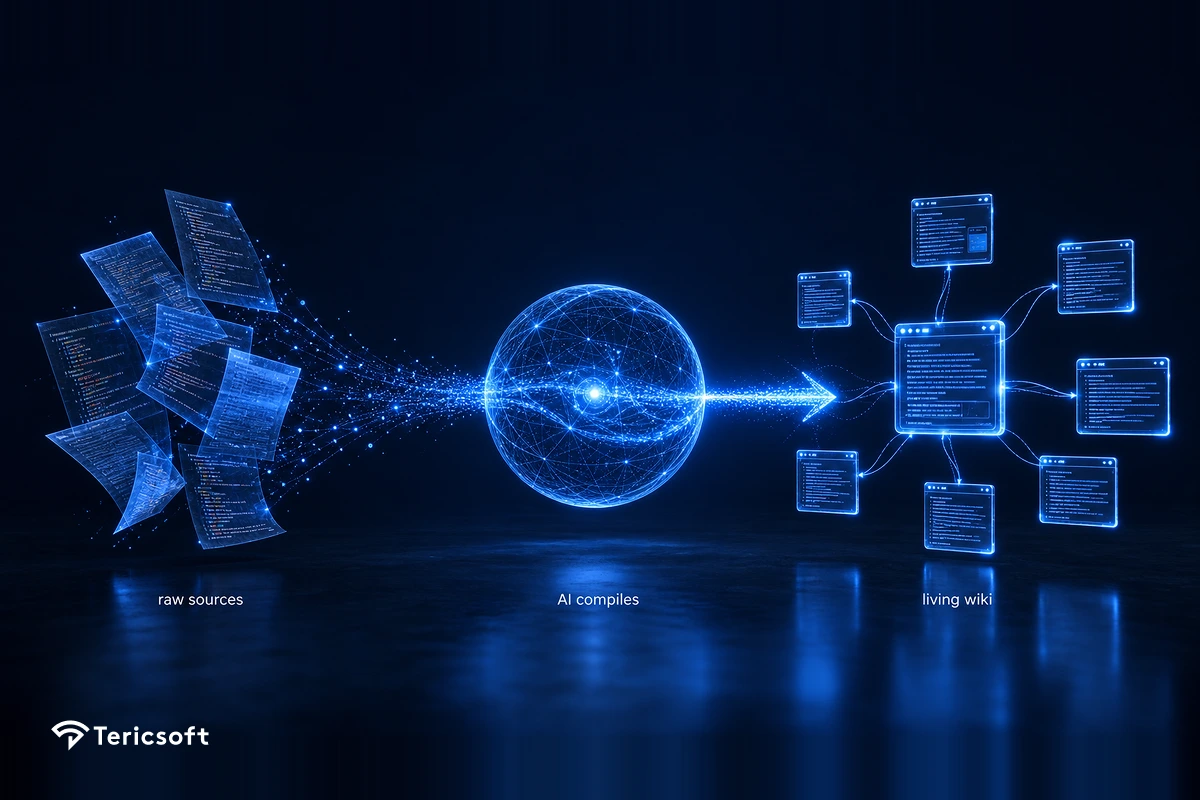
An llm wiki is an AI-maintained knowledge base. Instead of retrieving answers from raw files on every query, a large language model reads your sources and compiles them into a structured set of interlinked markdown pages that it keeps current. The result is a living knowledge base that compounds over time, rather than resetting with each question.
The architecture has three layers, and only one of them is the part most people notice.
The first is raw sources. These are your original documents: PDFs, web clippings, meeting notes, code, datasets. The model reads them. It never edits them. They stay immutable.
The second is the wiki itself. This is a folder of markdown files the model owns and rewrites: concept pages, entity summaries, and the links between them.
The third is the schema. This is a single instruction file that tells the model how to ingest a new source, how to format a page, how to link concepts, and how to audit the whole thing. Here is the non-obvious part. The durable asset is not the markdown. It is the schema. The pages can be regenerated. The schema is the institutional memory of how your organisation thinks about its own knowledge.
This separation is what makes the pattern durable. Your raw sources remain the ground truth you can always recompile from. The wiki is a derived artefact, so a bad compile is never catastrophic. You regenerate it. Few knowledge systems give you that safety, because most blend the source and the synthesis into one editable surface where every mistake is permanent.
Consider a practical example. A research team drops twenty papers into the raw folder. The model produces a page for each core concept, links attention to transformers and transformers to scaling, and notes where two papers disagree on a benchmark. Six months later a new hire reads the wiki in an afternoon and inherits the team's synthesised understanding, not a stack of PDFs.
Who Created It: The Karpathy LLM Wiki Origin
The karpathy llm wiki concept entered the mainstream in April 2026. Andrej Karpathy, co-founder of OpenAI and former director of AI at Tesla, published a short gist titled llm-wiki.md (Andrej Karpathy, 2026). It was not a product. It was an idea file, designed to be copied into your own setup.
His framing was a compiler analogy that explains the whole pattern in one line.
"You don't execute source code every time you want to run a program. You compile it once into a binary and run that."
— Andrej Karpathy, llm-wiki.md (2026)
Karpathy reported that his own wiki reached roughly 100 articles and 400,000 words while remaining navigable, because the model used an index and page summaries rather than re-reading everything Andrej Karpathy / Data Science Dojo, 2026. The idea spread within days, and Google soon formalised a related standard, the Open Knowledge Format, aimed at making these curated knowledge files portable across tools. The concept was no longer a personal experiment. It was becoming infrastructure.
LLM Knowledge Base vs Traditional Notes: Why It Compounds
LLM Wiki vs RAG: Which Knowledge Architecture Wins?
How to Build an LLM Wiki: A Step-by-Step Walkthrough
The build is genuinely minimal. There is no database, no vector store, and no server required to start. There are two folders and one instruction file.
my-wiki/
├── raw/          # Immutable sources: PDFs, clippings, notes, code
├── wiki/         # Markdown pages the agent writes and maintains
└── schema.md     # Rules for ingesting, linking, and linting the wiki
The four steps are straightforward. First, drop your sources into raw/ and never edit them by hand. Second, write a schema that defines your page format and linking rules. Third, point a capable agent at the folder and run a compile prompt. Fourth, review the output and run a linting pass.
The compile prompt is the engine. A workable starting version looks like this.
Read every file in raw/ and the existing pages in wiki/.

For each key concept, create or update one Markdown page in wiki/ with:
  - A one-line summary at the top
  - The explanation
  - [[wiki-links]] to related concepts
  - Any contradictions between sources, flagged inline

Then update index.md with a one-line description of every page.
Here is the part the quick-start guides gloss over. The schema is where an enterprise wiki succeeds or fails. A generic schema produces a generic wiki. A schema that encodes how your teams actually name systems, scope decisions, and cite evidence produces a knowledge base that reflects how your organisation reasons.
The linting pass deserves its own discipline. Every twenty new pages, ask the agent to find orphan pages, resolve flagged contradictions, and confirm that each summary still matches its page body. This is the maintenance that humans abandon in a traditional wiki, and the reason most internal wikis decay into stale folklore. The model does not get bored. That is the quiet advantage of the entire pattern.
Setting Up the LLM Wiki Obsidian Front-End
Most people pair the pattern with an llm wiki obsidian setup. Obsidian is a local-first markdown editor, and the model is the programmer that writes into it. Karpathy described it cleanly: the editor is the IDE, the model is the programmer, and the wiki is the codebase.
The practical win is the graph view. Your [[wiki-links]] render as edges between pages, so after even a handful of sources you can see the shape of your knowledge. Your files stay on your disk as plain markdown. There is no lock-in, and any other editor will open them tomorrow.
Packaging the Workflow as an LLM Wiki Skill
Once the workflow stabilises, package it as an llm wiki skill. A skill is a reusable bundle of the ingest, linking, and audit logic, so every person on the team runs the same compile and the same checks rather than improvising their own prompt.
This is the difference between a clever personal habit and a system a team can depend on. The skill makes the behaviour consistent. Consistency is what makes the knowledge base trustworthy.
From Prototype to LLM Wiki Implementation
Moving from a single-person prototype to a shared llm wiki implementation introduces the parts that personal setups ignore. You add version control so every change is reviewable. You add access boundaries so the right people read and write the right pages. You schedule the linting pass so drift is caught on a cadence, not by luck.
None of this is exotic engineering. It is the same discipline that turns a script into a product. That discipline is exactly what the enterprise version of this pattern demands.
AI Knowledge Management at Enterprise Scale
This is the gap almost every existing guide leaves open. The most-read tutorials on the llm wiki pattern frame it as a personal tool and explicitly note that it is not designed for enterprise-grade deployments. That caveat is honest. It is also an opportunity, because the enterprise problems are solvable.
Serious ai knowledge management at scale comes down to four questions. Who owns the schema. How is access governed across many contributors. How do you prevent drift when a hundred people feed the wiki. How do you audit where any given claim came from.
In our work building enterprise AI knowledge solutions for clients across SaaS, fintech, and professional services, we have found that the wiki is the easy part. The governance is the product. Across the 70+ products we have delivered, the systems that lasted were never the ones with the cleverest prompts. They were the ones with clear ownership and a defined audit cadence.
There is a cost dimension that decides these projects in practice. A RAG pipeline pays its compute on every single query, forever. A wiki pays a larger cost once during compilation, then serves cheap reads from digested pages. For a knowledge base queried thousands of times a day across an organisation, that difference compounds into a material line item, not a rounding error.
The governance model is what we spend the most time on with clients. A wiki without a named owner becomes a confident liar within a quarter, because nobody is accountable for the drift. The teams that succeed assign an editor for each major section, define what a source must contain before it is ingested, and treat the schema as a versioned artefact that changes through review. The technology is the simple part. The operating model is the work.
Provenance is the requirement that separates a demo from an enterprise system. When a wiki page asserts a fact, an auditor needs to trace it to the source that justified it. We design the schema so every page carries citations back into the raw sources, which means the knowledge base can answer not only what is true but why we believe it. In regulated industries that audit trail is not a convenience. It is the precondition for using the system at all.
The freshness problem that worries enterprise buyers is real, and the answer is architectural rather than aspirational. Pair the wiki with a retrieval layer for volatile data, version every page, and treat the linting pass as a governed process with an owner. Knowledge that nobody owns will rot, whether a human or a model maintains it.
Building a Knowledge Base for AI Agents
The most forward-looking use is a knowledge base for ai agents. The wiki is not only for humans to query. Because it is plain markdown, agents can read and write the same pages, which gives them persistent context that survives across sessions.
As of 2026, this agent-memory framing is moving from experiment to architecture. An agent that can consult and update a shared, governed knowledge base stops starting every task from a blank slate. It accumulates context the way a good colleague does. For teams already investing in agentic systems, the llm wiki is the memory layer those agents have been missing. You can read more insights on agentic AI on our blog.
There is a second-order effect here. When agents both read and write the wiki, the knowledge base becomes a shared workspace between humans and machines rather than a static reference. A human resolves a contradiction the agent flagged. The agent then propagates that correction across every linked page. The maintenance loop closes, and the knowledge base grows more accurate the more it is used.
The pattern that began as one researcher's notes is becoming the substrate for how teams and their agents will hold knowledge together. The organisations that treat it as infrastructure now, rather than a novelty, will compound an advantage that is very hard to copy. The knowledge base that improves itself is no longer a thought experiment. It is a design decision.
About Tericsoft
We have helped companies across SaaS, fintech, and professional services turn scattered information into governed, production-grade AI knowledge systems. We are Tericsoft Technology Solutions, an AI-first, outcome-driven AI-first technology partner that has delivered 70+ products for 30+ global clients across MVP development, AI and ML integration, computer vision, LLM implementation, and digital transformation. Recognised as a Clutch Top Digital Transformation Company India 2026, we are an AWS Select Tier partner and NVIDIA Inception member with 90% client retention across 3+ year partnerships.

An LLM wiki is an AI-maintained knowledge base. A model compiles your raw documents into interlinked markdown pages and keeps them current.
RAG retrieves and answers from scratch on every query. An LLM wiki pre-compiles sources into linked pages and flags contradictions.
Yes, with governance. Add version control, access boundaries, a shared schema, and a scheduled linting pass to control drift and provenance at scale.
Create raw and wiki folders plus a schema file, point an agent at them, run a compile prompt to generate linked pages, then lint periodically.
Andrej Karpathy, co-founder of OpenAI and former Tesla AI director, described it in a GitHub gist in April 2026. It went viral within days.