What is Monolithic Architecture, and when should you use it? Explore its advantages, challenges, scaling limits, and migration strategies to build smarter, future-ready systems.
In an industry constantly chasing the next architectural trend, it's easy to dismiss Monolithic Architecture as an obsolete relic. Yet, for thousands of successful companies, from high-growth startups to massive enterprises, the monolith remains the foundational engine of their business.
Perhaps you're a founder launching fast, needing speed over complexity. Or perhaps you're a CTO staring at a six-hour deployment that risks the entire platform. This is the reality of the monolith, it can be both a high-velocity accelerator and a complex bottleneck. We cut through the hype to provide the clear, pragmatic answers you need: identifying when your Monolithic Architecture is a strength, how to address its liabilities, and the safest strategies for evolving your unified codebase from a simple launchpad into a scalable, hybrid future.
What is Monolithic Architecture?
Monolithic Architecture describes a single, unified, and self-contained application. All functions, from user interface to data access, are bundled together into one large, interconnected program.
Definition & Core Characteristics of Monolithic Architecture
At its core, a Monolithic Architecture is a single deployable unit. It includes all components required to execute the application, such as:
- Front-end UI: Presentation layer (often bundled or served by the back-end).
- Business Logic: The application's core logic and processes.
- Data Access Layer: Handles transactions with a single, shared database.
Think of Monolithic Architecture as a high-rise building carved from a single block of stone, sitting on one foundation. Everything is tightly integrated, sharing the same walls, plumbing, and electrical grid.
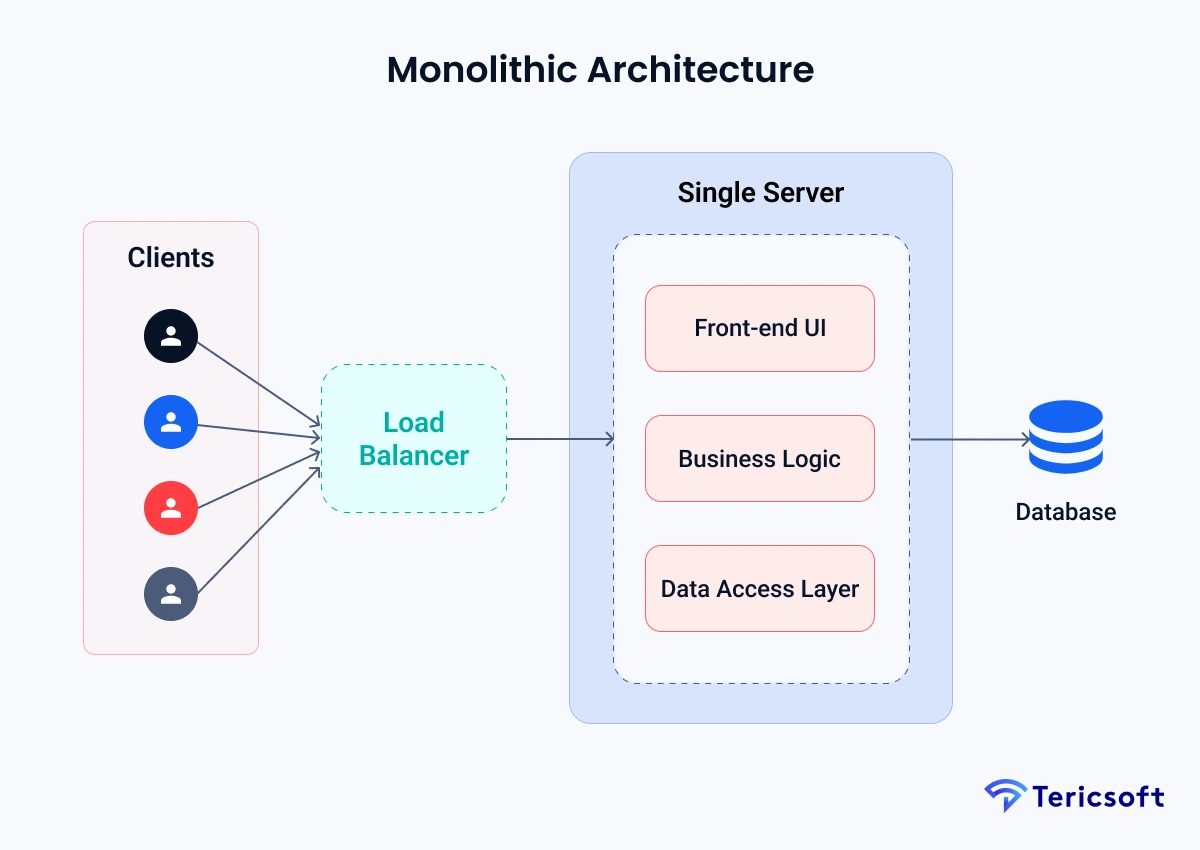
Monolithic Architecture in Traditional Web Applications
Historically, Monolithic Architecture was the default design pattern for web applications, e-commerce platforms, CRM tools, and enterprise resource planning (ERP) systems. The classic stack involved a single application server, a unified runtime environment (like a single JVM or Ruby interpreter), and a shared database instance. This simplicity accelerated early development.
Monolithic Architecture in the Modern Cloud Era
While the rise of containers and cloud-native services has popularized microservices, Monolithic Architecture is far from dead. Many modern applications begin their lives as a containerized monolith deployed as a single Docker image, often managed by Kubernetes. This approach leverages cloud infrastructure for resilience and scaling without incurring the complexity of distributed systems.
Monolithic vs Microservices Architecture
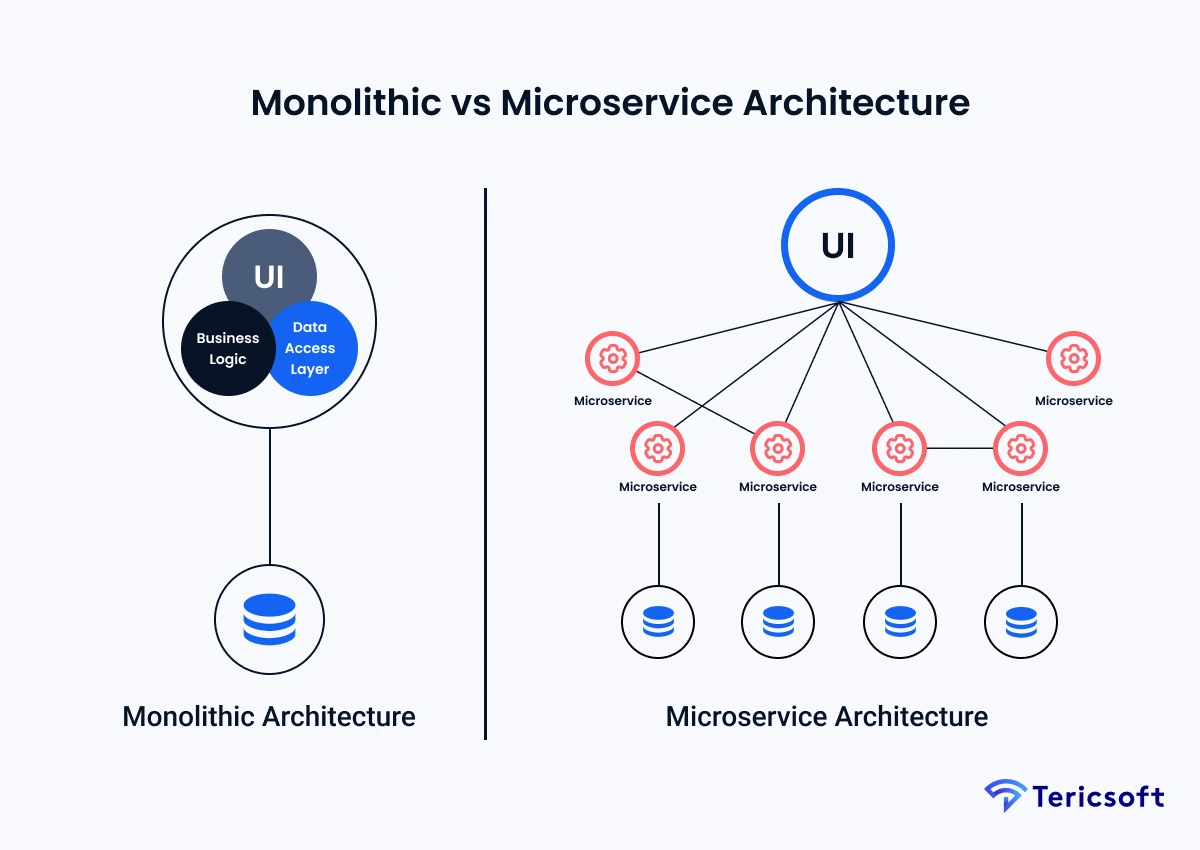
The fundamental choice between these two paradigms hinges on coupling, complexity, and team autonomy.
Conceptual Differences: Monolithic Architecture vs Microservices
Deployment Models: One Big Monolithic Architecture vs Many Small Services
Monolithic Architecture simplifies the build and release process into one continuous integration/continuous deployment (CI/CD) pipeline. While simple, a small change requires rebuilding and deploying the entire monolith, making releases riskier and increasing downtime for maintenance. Microservices, conversely, have independent deployment pipelines, enabling zero-downtime releases for specific services.
Scaling Trade-offs: Scaling Monolithic Architecture vs Scaling Microservices
In a Monolithic Architecture, scaling usually means horizontal scaling: running multiple, identical copies of the entire application behind a load balancer. If only the "Image Upload" module is overloaded, you still have to scale the entire monolith, wasting resources on the "Billing" module which may be idle. Microservices allow targeted scaling, optimizing resource usage by only scaling the high-load services.
Expert's Insight: "Don't Start with Microservices, Start with a Monolith first"
For many engineering leaders, the debate is settled: start with the simplicity of the monolith. Martin Fowler, a leading voice in software architecture, captured this sentiment:
"Almost all the successful microservice stories have started with a monolith that got too big and was broken up."
— Martin Fowler, Chief Scientist at ThoughtWorks
This principle, often called "Monolith First," stresses that you should only introduce the cost and complexity of microservices when your organization and business domain truly demand it.
Advantages of Monolithic Architecture
For many scenarios, especially early-stage products and MVPs, Monolithic Architecture offers significant, often underestimated, advantages.
Development Speed and Simplicity in Monolithic Architecture
- Easy Setup: Developers deal with one repository, one local development environment, and one stack. This translates to incredibly fast onboarding and quicker setup of the first production environment.
- Fast Iteration: Because all code resides in one location, refactoring and making cross-cutting changes are often simpler and faster in a smaller monolith.
Unified Deployment and Operations in Monolithic Architecture
A single build artifact means fewer operational complexities. Teams reduce overhead related to service discovery, logging correlation, and network management. Rollback strategies are also straightforward: simply revert to the previous successful monolithic artifact.
High Performance & Low Latency in Monolithic Architecture
Internal communication happens via in-memory function calls, which are milliseconds faster than network calls between services. This is crucial for high-performance applications requiring low latency, as it reduces serialization/deserialization overhead and simplifies single-transaction (ACID) workflows.
Ease of Testing and Debugging in Monolithic Architecture
Monolithic Architecture allows for seamless, end-to-end testing within a single application instance. Debugging is easier because developers can step through the entire call stack from the API endpoint through the business logic to the database, all in one place with a single debugger.
Disadvantages of Monolithic Architecture
As a business scales and complexity increases, the liabilities of a tightly coupled Monolithic Architecture become painfully clear.
Scaling Constraints in Monolithic Architecture
The "all-or-nothing" scaling rule is the biggest resource inefficiency. If only the authentication service is spiking during peak hours, you still deploy full copies of the entire monolith, including unused components like analytics engines or reporting tools.
Reliability and Fault Isolation in Monolithic Architecture
A major vulnerability in Monolithic Architecture is its lack of fault isolation. A memory leak in one seemingly small module can consume all available resources, causing the entire application to crash. Single point of failure means unified downtime for all users.
Slower Development at Scale in Monolithic Architecture
When the codebase grows into millions of lines, the build and test times balloon. Teams working on different features constantly face merge conflicts, increasing coordination overhead and slowing feature velocity. The tight coupling makes it difficult for teams to be truly autonomous.
Technological Inflexibility of Monolithic Architecture
You are locked into the initial technological decisions. Introducing a new language (e.g., Python for ML) or a specialized database (e.g., a graph database) requires retrofitting it into the existing, often outdated, Monolithic Architecture stack, risking technical debt and delaying upgrades.
When to Choose Monolithic Architecture
Monolithic Architecture is not a compromise; it is often the smartest strategic choice.
Ideal Scenarios for Monolithic Architecture in Startups and MVPs
For early-stage products, the primary goal is achieving product-market fit (PMF). Monolithic Architecture provides the maximum speed of iteration and minimizes the time spent on complex DevOps. Founders and product owners should choose the monolith to ship features faster and validate the business model before taking on the "Microservice Premium, the cost of managing distributed complexity.
Small and Medium Teams Thriving on Monolithic Architecture
Teams under 8-10 developers typically find that the communication overhead of microservices is greater than the friction of sharing a well-structured monolith. If you can manage all development and deployment coordination in daily stand-ups, the simplicity of a single codebase wins.
Consistency, Data Integrity, and Monolithic Architecture
Applications that require strict transactional consistency across multiple domains (e.g., moving money from one account to another) are simpler to build and maintain in a Monolithic Architecture using a single database transaction. This eliminates the complexities of distributed transactions and eventual consistency inherent in microservices.
Migrating from Monolithic to Microservices
The realization that your Monolithic Architecture has hit its limits, slow deployments, hot spots, or blocked teams should trigger a strategic evolution, not a panic button.
Monolith-First, Microservices-Later: Strategy for Monolithic Architecture Evolution
Migration should always be an evolutionary path driven by defined business needs (scaling a specific bottleneck, improving team autonomy), not a technical fad. The key is to avoid the high-risk "big-bang" rewrite.
Strangler Fig Pattern: Incrementally Extracting from Monolithic Architecture
The Strangler Fig Pattern, coined by Martin Fowler, is the gold standard for safe migration.
- Introduce a Façade: A routing layer (like an API Gateway) is placed in front of the existing Monolithic Architecture.
- Extract Functionality: A new service (the "strangler") is built to replace one specific function (e.g., "User Authentication").
- Reroute Traffic: The Façade redirects requests for the new function to the microservice while the majority of traffic still goes to the monolith.
- Decommission: Once the microservice is proven stable, the corresponding code is removed from the monolith, which is gradually strangled until it can be safely decommissioned.
Domain-Driven Design: Finding Service Boundaries in Monolithic Architecture
Before extracting anything, architects must define Bounded Contexts, the logical boundaries around distinct business capabilities (e.g., Shipping, Catalog, Invoicing). These boundaries, rooted in Domain-Driven Design (DDD), provide the blueprint for stable, loosely coupled services. Refactoring internal module boundaries within the monolith is far easier than fixing communication issues between deployed microservices.
Real-World Examples of Monolithic Architecture
Successful companies prove that Monolithic Architecture can be scaled to global standards with careful engineering.
Shopify: Scaling a Massive Monolithic Architecture
Shopify, the massive e-commerce platform, famously runs a core system based on Ruby on Rails: a single, massive Monolithic Architecture codebase. Their strategy is the Modular Monolith (sometimes called the "Majestic Monolith"). They maintain all code in one repository but enforce strict internal module boundaries using internal tools to ensure code within one domain (e.g., Inventory) cannot directly access the internals of another (e.g., Payments). This allows the rapid development speed of a monolith with the organizational discipline needed for future extraction.
eBay: Evolving Legacy Monolithic Architecture over Time
eBay's early success was built on a massive Monolithic Architecture that handled global auctions. As their scale increased exponentially, they successfully used targeted service extraction and the Strangler Fig pattern to peel off high-traffic, high-change areas while keeping core, stable systems running, proving that a monolith can handle billions of transactions.
The Hybrid Approach: Monolith + Microservices
Today, most large-scale architectures are not purely monolith or purely microservices; they are hybrid.
Hybrid Models: Combining Monolithic Architecture with Microservices
A hybrid architecture uses a reliable, robust core Monolithic Architecture for stable, mission-critical functions (like billing or core inventory) while using satellite microservices for highly volatile, scalable, or specialized components (like search, recommendation engines, or real-time analytics).
Modular Monolith: Designing Better Monolithic Architecture
The Modular Monolith is a best-practice strategy. It means building your monolith with future extraction in mind, enforcing clear boundaries between internal modules, and communicating between these modules only via defined internal APIs. This discipline keeps the benefits of the monolith while preparing the application for decomposition without requiring a full rewrite.
About Tericsoft
Choosing the right architecture is a high-stakes business decision that impacts budgets, risk, and time-to-market.
Tericsoft: Your Architecture Partner for Monolithic Architecture and Beyond
At Tericsoft, we don't follow trends; we follow business needs. We specialize in providing the pragmatic, data-backed guidance founders, CTOs, and enterprise architects require. Whether you are building an MVP on a budget, wrestling with legacy Monolithic Architecture, or planning a hybrid model, we help you make informed choices that reduce risk and accelerate value delivery.
How Tericsoft Modernizes Monolithic Architecture for Enterprises
We offer a focused suite of services designed for evolutionary architecture:
- Architecture Audits: We assess your existing Monolithic Architecture system to identify bottlenecks, technical debt, and natural service boundaries (Bounded Contexts).
- Modularization Roadmaps: We help your teams restructure tight-coupled monoliths into disciplined Modular Monoliths, preparing them for future microservice extraction.
- Safe Migration Execution: We deploy proven patterns like the Strangler Fig to incrementally transition critical functions to a cloud-native microservices environment without risking downtime.
Conclusion
Monolithic Architecture as a Pragmatic, Not Obsolete, Choice
The discussion about Monolithic Architecture should move past simply labeling it "bad" or "legacy." It remains the most effective architecture for initial product development, small organizations, and systems requiring high transactional consistency and low operational complexity.
From Monolithic Architecture to Hybrid Futures
Treat your Monolithic Architecture as a starting point is a flexible foundation you can build upon. By embracing the principles of the Modular Monolith and strategic extraction patterns, you ensure your architecture choices - monolith, microservices, or hybrid always align with your organizational scale and core business goals.

Monolithic Architecture is a single unified application where all features run in one codebase, sharing the same runtime and database.
It is ideal for startups, MVPs, and smaller teams that want faster development, simpler operations, and strong data consistency before scaling.
A monolith deploys and scales as one unit. Microservices split the system into independent services that can scale, update, and recover separately.
It offers easier development, lower initial complexity, faster performance, simpler debugging, and unified deployment in a single environment.
Yes, Teams often extract high-growth features into independent services gradually, using proven architectural patterns without rewriting the entire system.