Every unplanned breakdown bills a fleet three times. Once for the repair. Once for the dead vehicle-days while the vehicle waits for parts and a workshop slot. And once for the trip it failed to serve, which under an SLA contract often carries a penalty on top.
At 500 or more vehicles, reactive maintenance stops being a workshop problem and becomes a revenue leak with a maintenance department attached. The frustrating part is that most breakdowns announce themselves weeks in advance, in OBD fault codes, battery degradation curves, coolant temperature drift, and charging anomalies that nobody is reading.
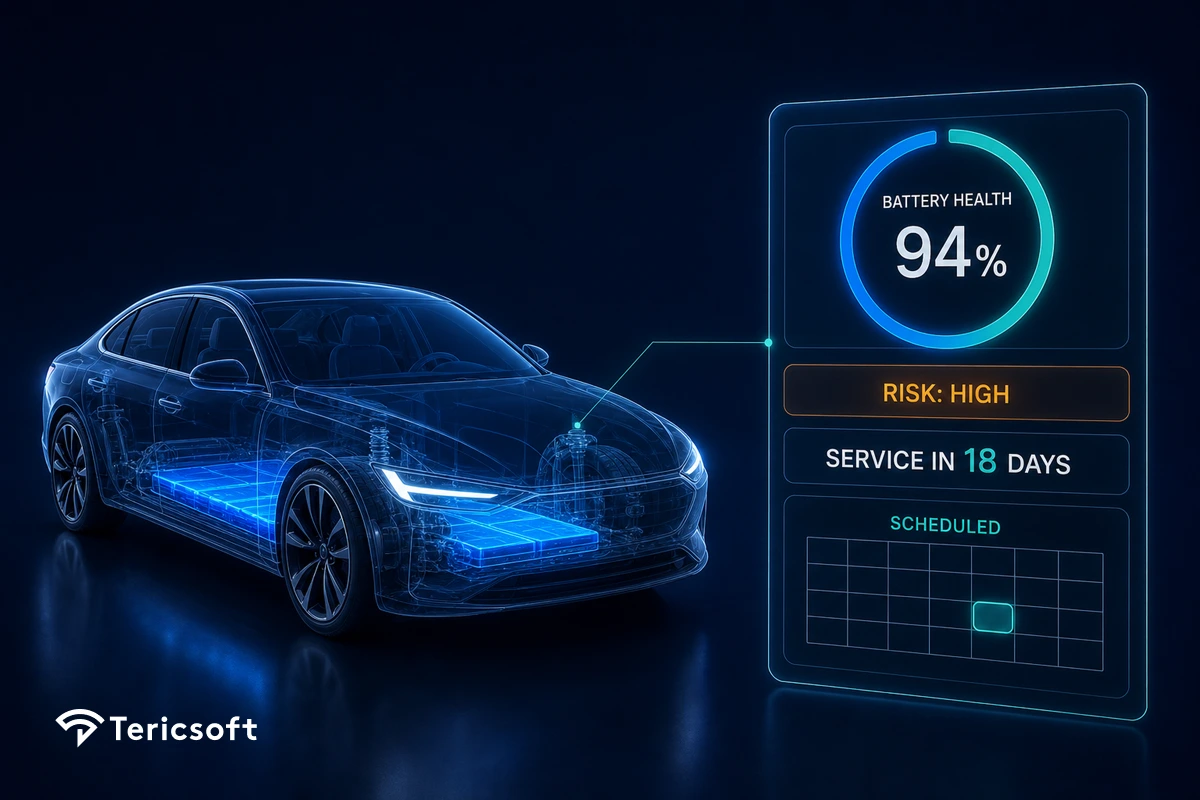
Predictive fleet maintenance closes that gap. It reads each vehicle's own telematics and battery data, flags the component likely to fail, and books the repair before the vehicle stops on the road. In our fleet engagements, including the telematics platform behind Lithium Urban Technologies' 3,000+ electric vehicles, the prediction layer flags failures two to three weeks before they happen. This post explains how that works and what it changes operationally.
Preventive vs Predictive Maintenance: Why the Odometer Is the Wrong Trigger
Most large fleets run preventive maintenance: service every set number of kilometres or months, whichever comes first. It beats running a vehicle to failure, but it carries a structural flaw. The odometer does not know the vehicle's condition.
Calendar-based servicing fails in two directions at once. It over-services healthy vehicles, pulling them off the road and consuming workshop slots and parts they did not need. And it misses the failing ones, because a clutch dying at 40,000 km does not wait for the 45,000 km service.
Predictive maintenance flips the trigger. The vehicle's own data, not the calendar, decides when it needs the workshop. The difference between preventive vs predictive maintenance is the difference between a schedule and a diagnosis.
Problem 1: Predictive Maintenance for Vehicles Starts With Data Nobody Reads
A modern commercial vehicle streams hundreds of signals: fault codes, voltage patterns, temperature curves, brake wear indicators. An electric vehicle adds a richer layer still, with cell-level battery voltages, charging-cycle behaviour, and thermal management data.
At fleet scale this becomes millions of data points a day. The Lithium fleet platform processes data at the scale of 1 billion or more API calls a month. No maintenance team can read that manually, so in practice nobody does, and the early-warning signals scroll past unwatched until the vehicle stops on the road.
This is the starting point for predictive maintenance for vehicles. The raw material already exists in almost every large fleet. What is missing is the layer that watches it.
What Vehicle Telematics Already Streams
Vehicle telematics is not a future purchase for most operators. It is already installed and already transmitting. The gap is not the sensor. It is the absence of a model reading the stream and turning a voltage drift into a booked repair.
Problem 2: The Workshop Runs on the Odometer, Not Condition Based Maintenance
Even fleets with telematics typically schedule maintenance from a spreadsheet of due-by-kilometre dates. The workshop calendar fills with healthy vehicles getting routine attention, while a genuinely degrading vehicle, flagged by its own sensors, stays in revenue service because it is not due yet.
Condition based maintenance resolves the contradiction. Instead of a fixed interval, the work order is triggered by the vehicle's measured condition. The information and the decision finally live in the same system, so the decision stops losing to the calendar.
Problem 3: EV Fleets Need Battery Health Monitoring a Garage Cannot See
For electric fleets, the most expensive component is the battery, often 30 to 40 percent of the vehicle's value, and it degrades invisibly. No mechanic's inspection detects a cell group drifting out of balance or a degradation curve steepening. It shows only in longitudinal data: range per charge trending down, charging time creeping up, thermal behaviour shifting.
This is why EV battery health monitoring is a data discipline, not a garage discipline. The graphical vehicle timelines we built for Lithium consolidate charging cycles, battery status, and alerts per vehicle, so that battery health is something the operations team sees, not something they discover at replacement time.
What an EV Battery Monitoring System Watches
An EV battery monitoring system tracks the signals a physical inspection cannot: per-cell voltage balance, charge and discharge curves, temperature under load, and capacity fade over hundreds of cycles. Caught early, a drifting cell group is a scheduled intervention. Caught late, it is a battery replacement and a stranded vehicle.
The Fix: Fleet Maintenance Software for India Wired Into the Workshop
A prediction that lands in an inbox is trivia. A prediction that auto-generates a workshop ticket, reserves a slot, and triggers parts procurement is an avoided breakdown. The architecture that makes fleet maintenance software for India worth installing has three parts, and the third is the one most implementations skip.
- Signal collection. Full telematics and OBD streaming from every vehicle, including charging and battery data for EVs, into one data platform
- Failure prediction. Pattern detection across the fleet's history, learning which signal signatures preceded which failures, and producing a per-vehicle risk flag with a 2 to 3 week horizon
- Automatic workshop integration. The prediction becomes a booked workshop slot, a reserved part, and a scheduled vehicle, with no human re-keying the alert into another system
Signal Collection: IoT Sensors for Predictive Maintenance
IoT sensors for predictive maintenance are the layer the industry talks about first, and for most large fleets they are already in place. Tyre pressure, fluid levels, engine temperature, battery telemetry: the vehicle is already instrumented. Collection is rarely the constraint. Interpretation is.
Failure Prediction: Predictive Maintenance Using AI
Predictive maintenance using AI is where fleet scale becomes an advantage rather than a burden. Three thousand vehicles generate failure-pattern data a thirty-vehicle fleet never could. The more vehicles in the history, the faster the model learns which voltage signature or thermal drift precedes which failure. Large operators are structurally better positioned for prediction than small ones.
The operational case is well documented. McKinsey finds that predictive maintenance can reduce equipment downtime by 30 to 50 percent and extend machine life by 20 to 40 percent. Deloitte reports that it raises equipment uptime by 10 to 20 percent while cutting maintenance costs and planning time. For a fleet, uptime is revenue.
Why Predictive Maintenance Software Must Trigger a Workshop Ticket
This is the part most tools miss. Predictive maintenance software that only displays a dashboard has moved the problem, not solved it. Prediction without a workflow attached is just better-informed anxiety. The deliverable is a booked workshop slot, not an alert.
What Predictive Fleet Maintenance Is Worth
Run the arithmetic on your own fleet rather than taking a vendor's word for it. The numbers compound in three places.
- Avoided roadside breakdowns. Each one saved spares 2 to 4 vehicle-days of towing, diagnosis queue, and parts wait, against a planned 4-hour workshop visit
- Planned versus failure repairs. A component replaced on warning does not take the gearbox, the towing bill, and the SLA penalty with it
- Fleet productivity. Across our EV fleet engagements, condition-based operations contribute to a fleet productivity improvement of more than 10 percent, which is more available vehicle-days from the same fleet
For electric fleets there is a fourth line. Early battery-anomaly detection protects the single largest item on the vehicle's balance sheet, the one a garage inspection cannot see coming.
Why this matters beyond fleet maintenance: Any high-value asset that streams condition data behaves the same way: gensets, industrial machinery, medical equipment. The asset changes; the discipline of reading the data before it fails does not.
Key Lessons
- The data already exists. Almost every 500-plus vehicle fleet already streams the signals prediction needs, so the gap is the watching layer, not the sensors
- Prediction is worthless without a workshop workflow. The deliverable is a booked slot, not an alert in an inbox
- EV maintenance is a data discipline. Battery health lives in longitudinal data no inspection can see
- Fleet scale is a modelling advantage. The more vehicles, the faster the failure-pattern library compounds, so large operators are better positioned for prediction than small ones
Stop Discovering Failures on the Roadside
If your maintenance calendar is still driven by the odometer, your fleet is telling you about its next breakdowns right now, in data nobody is reading.
Our free Ops Intelligence Brief reviews your existing telematics stream and shows what a prediction layer would have caught last quarter. If your team is weighing the move from calendar-based servicing to condition-based prediction, we are happy to think through it with you.
About Tericsoft
At Tericsoft, we believe the next breakdown in a large fleet is almost always already visible, sitting in data the operation generates but never reads. We build the layer that turns that signal into a booked workshop slot before the vehicle stops on the road.
Our focus is the unglamorous join between prediction and the workshop floor, the point where most tools stop and most breakdowns begin. If your maintenance still runs on the odometer rather than on condition, that is the gap worth a conversation.

Predictive fleet maintenance uses live OBD, telematics and battery data to forecast component failures 2 to 3 weeks early and book repairs proactively.
Preventive maintenance follows a fixed schedule. Predictive maintenance triggers service from each vehicle's real condition, so only vehicles that need it stop.
Standard telematics and OBD streams: fault codes, voltage, temperature and brake signals, plus charging and battery data for EVs. Most fleets already have it.
Yes. Diesel prediction centres on engine and transmission signatures. EV prediction centres on battery health, the costliest component inspection misses.
Each avoided breakdown saves 2 to 4 vehicle-days, plus the gap between planned and failure repairs and less over-servicing, adding meaningful vehicle-days.