How will an AI COO reshape the way large fleets run operations? Learn why dashboards alone are no longer enough, how AI agents escalate SLA breaches from app push to a phone call, and what operators need to act before penalties hit.
At 6:05 a.m., a depot's on-time departure rate slips below its SLA threshold. In most operations that fact sits unread on a dashboard until the 10 a.m. review. By then the morning peak is lost, the client has noticed, and a penalty clause is in play.
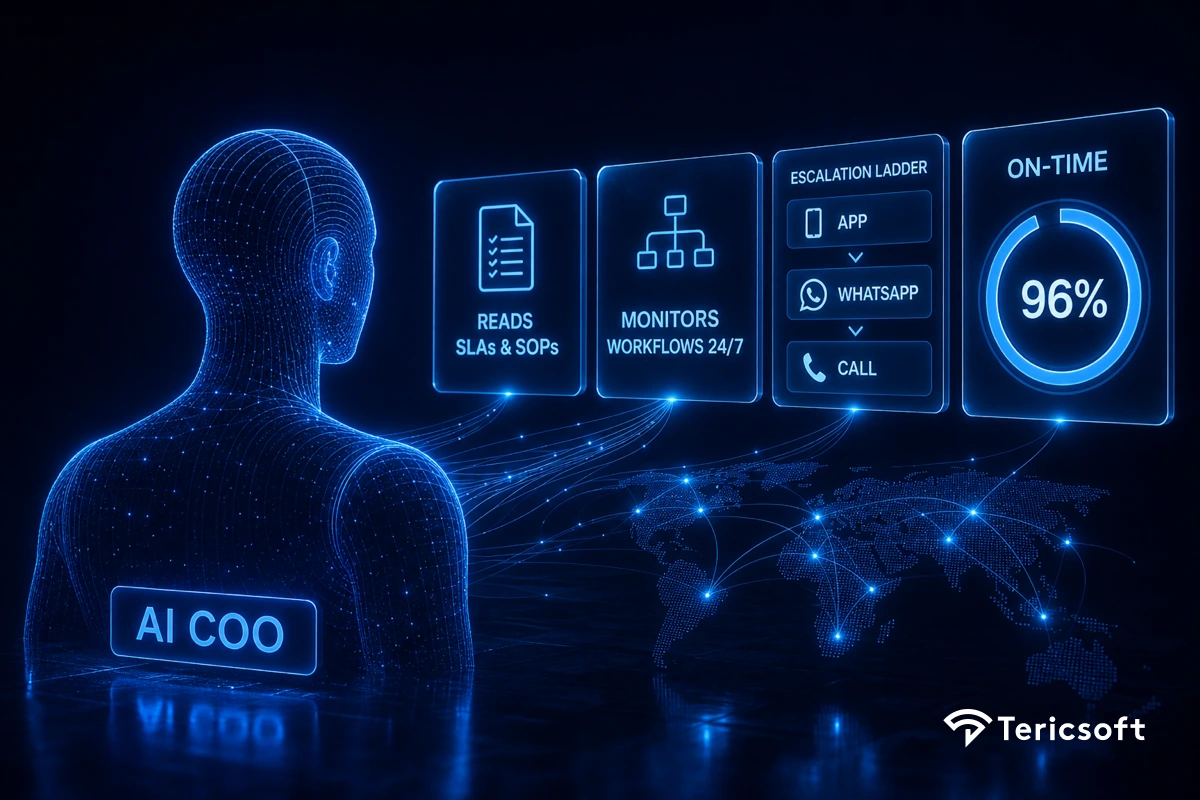
An AI COO closes the gap between knowing and acting. It is an AI agent that reads your SLAs, SOPs, and checklists, watches every workflow against them, and escalates each deviation through your own hierarchy: an app notification, then a WhatsApp message, then an AI voice call. It does not replace your operations leaders. It becomes their copilot. This is AI in fleet management once it moves from dashboards that inform to an agent that acts.
“By 2028, at least 15% of day-to-day work decisions will be made autonomously through agentic AI, up from 0% in 2024.”
— Gartner, Top Strategic Technology Trends for 2025 (2024)
Fleet operations are among the first places this lands, because a fleet already runs against contracts and SOPs that are written down Gartner, Top Strategic Technology Trends for 2025. That is exactly what an agent needs in order to act.
A Morning in the Life of an AI COO
Here is one breach, start to finish, inside a live mobility deployment.
06:05 - The Whitefield depot's on-time departure rate crosses its SLA floor. The AI COO reads the breach against the client contract and identifies the task owner.
06:06 - An app notification reaches the depot supervisor. It names the vehicle, the route, the SLA breached, and the action required.
06:11 - No acknowledgement, and the metric is still slipping. A WhatsApp message goes to the supervisor and the shift manager, with full context.
06:18 - Still unresolved, and the penalty window is thirty minutes out. The AI voice agent calls the operations head, in their language, states the breach and its cost, and records the response.
06:24 - A standby vehicle is dispatched. The agent logs the resolution, every timestamp, and the full channel trail.
Nineteen minutes, and no human had to notice first. Before the AI COO, the same breach surfaced at the 10 a.m. review. Four hours and one penalty later.
Why Dashboards Inform but an AI Operations Agent Acts
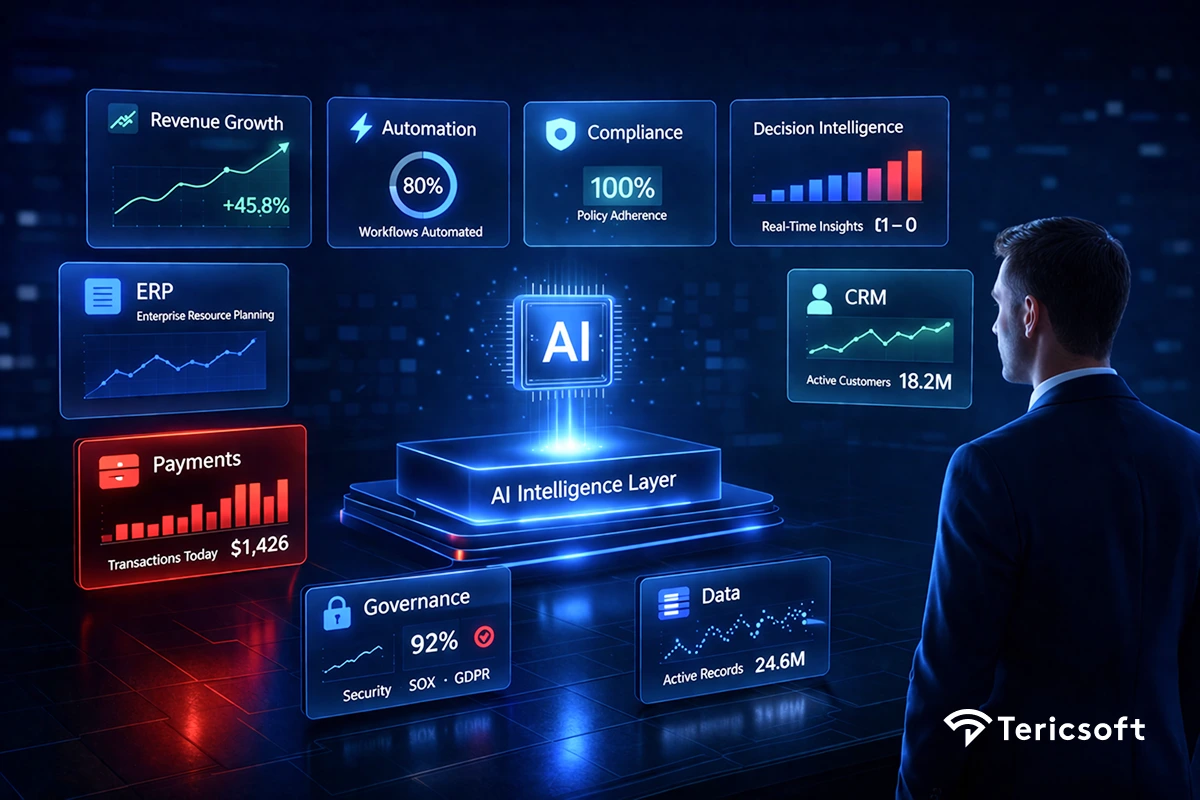
Modern fleet operations are not short of data. Telematics, trip systems, maintenance logs, and attendance feeds run at the scale of 1B+ API calls a month across our deployments. The pipeline from data to dashboard is solved.
The pipeline from dashboard to action is not. It still runs through a human noticing, interpreting, deciding whom to call, and chasing them. For every exception.
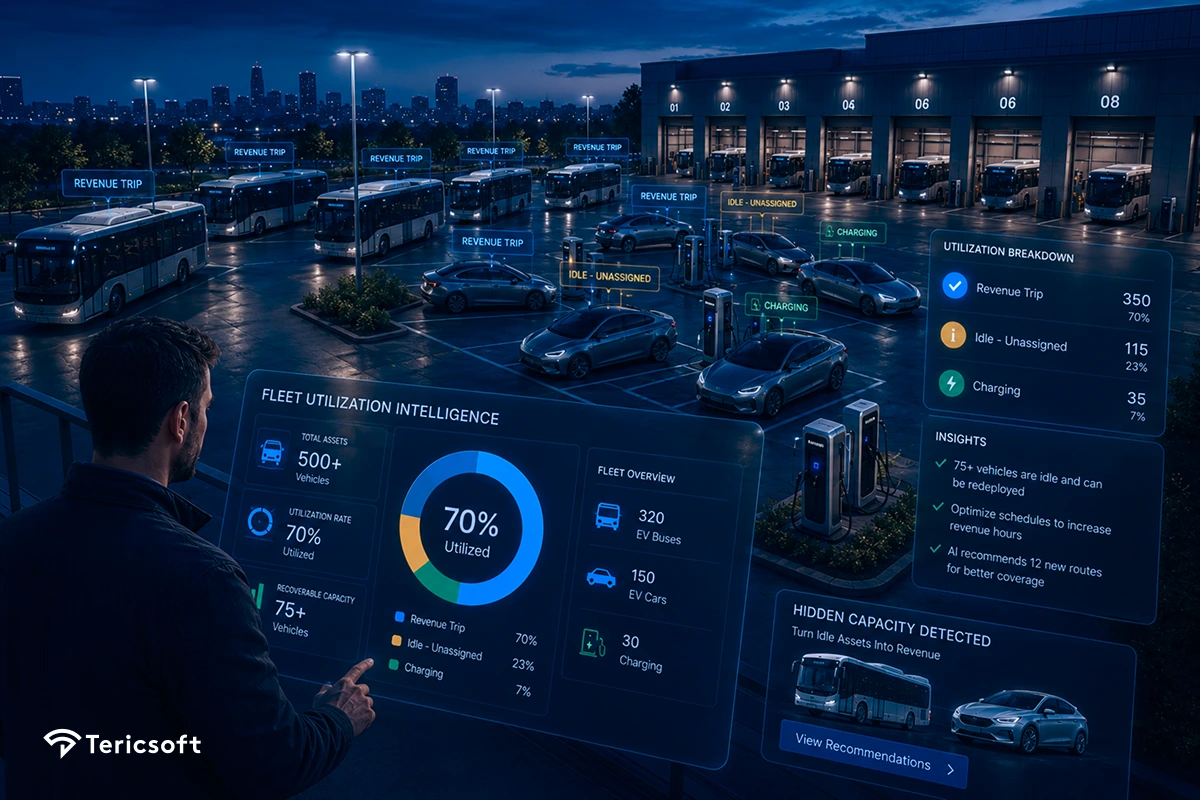
That human pipeline has a bandwidth ceiling, and large operations breach it daily. Vehicles idle on one side of a city while dispatch on the other turns away demand it cannot see, a steady drain on fleet utilization. A maintenance flag waits while the vehicle keeps earning. A checklist step is skipped on a busy morning.
None of these are visibility failures. They are follow-through failures. An AI operations agent closes that second pipeline. It does not add another screen. It watches the screens and pursues the response.
Fleet SLA Compliance: Why Escalations Decide Penalties
Every large operator has an escalation matrix on paper. In practice, escalation is a message in a 200-member WhatsApp group at 11 p.m., read by everyone responsible for nothing.
Whether a breach gets handled depends on which supervisor is awake and which manager checks their phone. Fleet SLA compliance cannot rest on that.
The cost is concrete. SLA penalty clauses in corporate transport contracts bill per incident or per day. In one operation we mapped, exposure ran to ₹4.2 lakh per day when specific compliance metrics went unwatched. A penalty is the price of an escalation that did not happen in time.
From Alert Fatigue to Autonomous Fleet Operations
Operators who reach for notifications hit the next failure mode: alert fatigue. When a minor delay and a contract-threatening breach arrive as the same push, supervisors learn to ignore both within a month.
Urgency needs a gradient that matches your policy on what is routine, what is important, and what is drop-everything critical. Autonomous fleet operations do not remove the human. They carry each event to the right person at the right intensity, automatically, so attention lands where it is owed.
How the AI COO Works: Agentic AI for Operations
The AI COO is not a dashboard with alerts bolted on. It is agentic AI for operations: a closed loop from raw telemetry to a resolved incident.
Telemetry → Rules Engine → AI COO Agent → App Notification → WhatsApp → AI Voice Call → Escalation Ladder → Resolution
Four capabilities make that loop work. Each is deliberately simple.
- Ingests your rulebook. SLA terms, SOPs, checklists, and KPI thresholds, encoded once. The agent judges every event by the same rules your penalty clauses use
- Watches workflows end to end. Trip lifecycles, maintenance, demand and supply, compliance steps. It sees both sides of a mismatch at once
- Escalates on a ladder. App push first. WhatsApp with context next. Then an AI voice call. Critical flows can start at the call
- Speaks to each persona. Supervisors get incidents. Managers get trends. The COO gets patterns and exposure
Every step is logged: who was notified, when, on which channel, and what happened. SLA disputes become a lookup, not an investigation.
The AI Voice Agent for Fleet Operations
The top rung changes behaviour. When an event is critical or a window is closing, an AI voice agent for fleet operations places a call.
It speaks in the recipient's language, explains the situation and its contractual context, states the action required, and records the response. Unanswered, it climbs: supervisor, then manager, then operations head. This is one of the highest-value AI voice agents in an operational setting.
A phone call is the highest-trust channel left. Notifications are ignorable. A call that speaks, explains, and listens is not. Reserve it for what matters and it stays powerful.
Before and After: How Operations Change with an AI COO
The shift is easiest to see as a contrast. Same fleet, same contracts, a different operating posture.
DimensionBefore the AI COOWith the AI COODecision latencyHours. The breach surfaces at the 10 a.m. reviewMinutes. Acted on as it happensPenalty exposureDiscovered after the bill arrivesWatched live, response timestamped in minutesEscalationA message lost in a 200-person WhatsApp groupA policy-driven ladder that climbs until ownedControl roomScanning screens to find problemsHandling prioritised exceptions, already routedDecision-makingFind out, then decideThe decision arrives pre-contextualised
The numbers follow the posture. Across our engagements, putting live intelligence in front of decision-makers cuts decision time by roughly 50%, and the escalation agent compresses it further. Exposure of the ₹4.2 lakh per day class is now watched by an agent that never sleeps.
The Control Room Stops Watching and Starts Responding
The control room feels different within a week. The old job was vigilance: a wall of screens, a team scanning for the one number turning red, hoping to catch it before the client does.
The new job is response. The agent has already found the breach, named the owner, and opened the ladder. The team handles exceptions sorted worst-first, with the context attached. Attention stops being a search and becomes a queue.
This pattern is live with one of our mobility customers, layered on the fleet data platform behind operations like Lithium Urban Technologies' 3,000+ EVs with over 98% real-time visibility.
Why this matters beyond fleet management: Any operation that runs against contracts and SOPs has the same gap between knowing and acting. The pattern transfers directly to logistics, field services, and facilities. The rulebook changes. The agent does not.
Key Lessons
- Automate the follow-through, not the judgment. The agent makes sure the right person knows in time. The person still decides
- The escalation ladder is policy, not technology. Push, WhatsApp, and call only work when the thresholds encode your definition of critical
- A phone call is the highest-trust channel left. Reserve it for what matters and it keeps its weight
- Design around personas, not metrics. An alert at the wrong altitude is noise. Build around your hierarchy: supervisor, operations head, COO
Find Your SLA Exposure Before It Finds You
Most operators cannot say, in rupees, what their SLA exposure was last week, or which blind spot caused it.
The free Ops Intelligence Brief answers both. It maps your workflows, quantifies your SLA penalty exposure, and shows exactly where an AI operations agent would have intervened last month. No commitment, just the picture.
About Tericsoft
We build AI operations agents and fleet intelligence platforms for large mobility operators, layered on their existing telematics. We are Tericsoft Technology Solutions, an AI-first, outcome-driven technology partner that has delivered 70+ products for 30+ global clients across MVP development, AI and ML integration, computer vision, LLM implementation, and digital transformation. Recognised as a Clutch Top Digital Transformation Company India 2026, we are an AWS Select Tier partner and NVIDIA Inception member with 90% client retention across 3+ year partnerships.

An AI COO is an AI agent that checks live operations against your SLAs, SOPs, and checklists, then escalates each deviation to the right person.
Alerts inform whoever looks. The agent pursues an outcome: it owns who acts, follows up across channels, climbs the hierarchy, and logs the trail.
Anything with a contractual or financial consequence: SLA metrics, compliance steps, safety events, maintenance flags, and demand-supply mismatches.
Yes, when calls are reserved for critical events. The agent states the breach, its contract context, and the action needed, in the recipient's own language.
Yes. The voice, WhatsApp, and app layers are multilingual, so each supervisor, driver, and manager is addressed in the language they actually work in.