What can a voice AI agent actually do for your business? Here are 11 deployed voice AI use cases across industries with real metrics from Tericsoft production deployments.
Most businesses run on conversations. Customer calls that need answering. Feedback that needs collecting. Leads that need qualifying. Candidates that need screening. The problem is not a shortage of conversations that need to happen. It is the manual effort required to have them.
Every unanswered call is a missed booking, a lost lead, or a candidate who dialled a competitor. Every manual follow-up call your team makes is recruiter time, coordinator time, or agent time that does not scale. Every repetitive conversation handled by a human is a conversation that could have been handled at 10X the volume for a fraction of the cost.
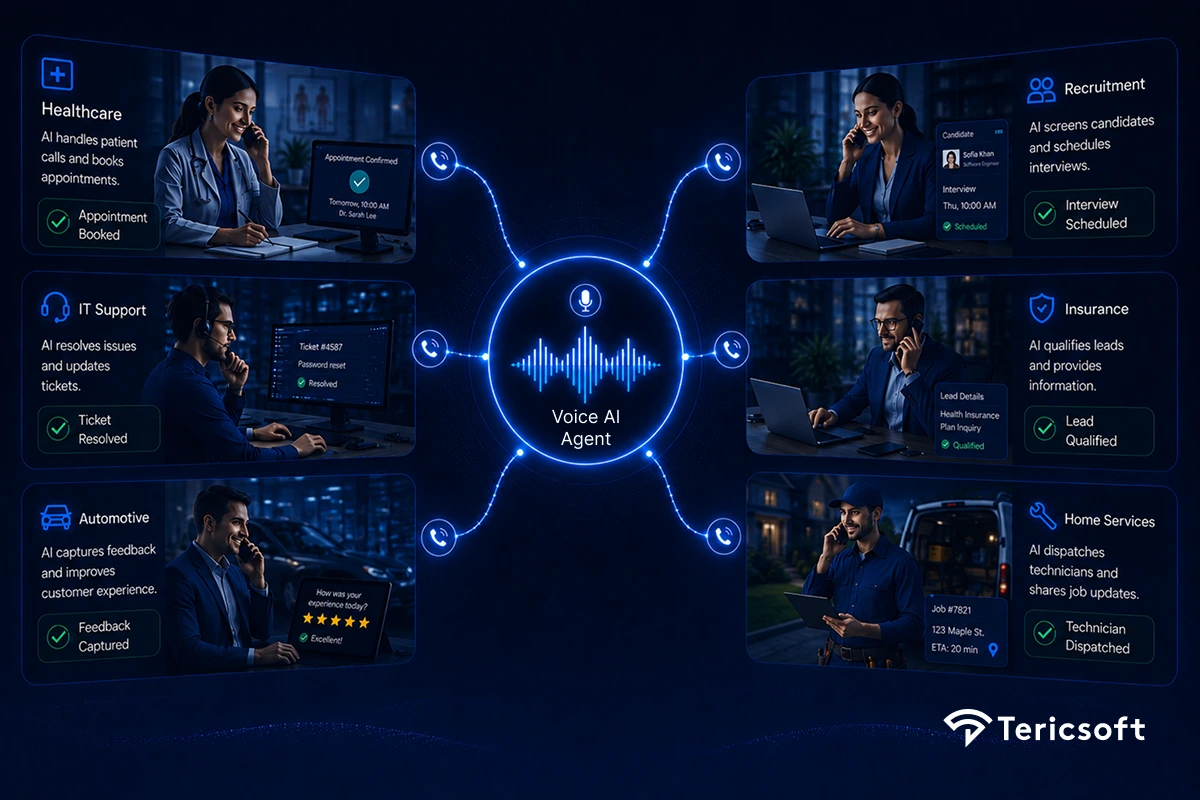
AI voice agents handle these conversations end-to-end. They answer calls in under two seconds, make outbound calls at scale, qualify leads before a human ever gets involved, and pass complex cases to the right person with full context attached. Tericsoft's AI and voice technology capabilities have been deployed across 11 distinct use cases in production environments. This is what each one does, the value it delivers, and the measurable outcomes customers see.
AI Answering Service: Inbound Voice AI Across Industries
When a customer, employee, or patient calls your business, what happens in the first ten seconds determines whether that interaction becomes revenue or becomes a complaint. An AI answering service handles the first ten seconds and everything after it without making a caller wait, without putting them on hold, and without depending on whether a human is available.
Tericsoft has deployed inbound voice AI across four distinct operational environments. Each one has different stakes, different workflows, and different outcome metrics. The common thread is the same: the AI answers every call, resolves what it can, and routes what it cannot, with full context attached.
1. ITSM Voice Agent: How AI Resolves 75% of IT Support Tickets Without Escalation
Enterprise IT teams face the same problem at scale. Seventy to eighty percent of all L1 support tickets are repetitive: password resets, restart guidance, access issues, common configuration fixes. Each one requires a coordinator to log the ticket, attempt a resolution, and route it if they cannot resolve it. At scale, this is an enormous coordination tax on the IT team.
An ITSM voice agent removes that tax. An employee calls a designated number. The AI captures the issue in natural conversation, creates the ticket automatically, attempts first-level resolution by voice, and routes unresolved tickets to human agents with a suggested resolution path already attached. The human agent opens a resolved ticket summary, not a blank form.
What this means in practice:
- Employees get IT support at any time without waiting for a coordinator to be available
- Password resets, access issues, and common hardware fixes resolved in the call without escalation
- Human IT agents handle only the complex cases that require judgment
- Every ticket logged consistently regardless of which agent eventually handles it
75% L1 IT tickets auto-resolved without human escalation | 60% reduction in mean time to resolve
2. Healthcare Front Desk Voice Agent: AI Voice Agent for Healthcare Appointment Booking
A clinic or doctor's practice lives and dies by appointment volume. Every missed call during a busy morning is a slot that stays empty. Every manual booking call is a front desk coordinator's time. Every unpaid booking is revenue that never arrives. The healthcare front desk is one of the highest-cost, highest-friction points in any practice operation.
A healthcare front desk voice agent handles inbound appointment scheduling against the doctor's shared calendar. A patient calls. The AI checks availability, books the slot, sends a payment link by email or SMS, confirms payment, and locks the appointment. The practice captures every inbound call regardless of when it arrives, including evenings and weekends when the desk is closed.
- Appointment bookings captured outside business hours without front desk staff
- Payment confirmed before the slot is locked, eliminating no-show revenue leakage
- Patients receive automated reminders reducing last-minute cancellations
- Front desk staff shift from call handling to patient care during clinic hours
12% increase in monthly bookings from recovered missed calls | 17% reduction in front desk headcount
3. Home Services Inbound Voice Agent: AI for Home Services Missed Call Recovery
Home services businesses spend heavily on paid search. A homeowner searches for emergency HVAC repair, clicks a paid ad, and calls the number. If no one answers, they dial the next result. That paid click becomes a competitor's customer. For HVAC, plumbing, electrical, roofing, and pest control businesses, missed calls are not an inconvenience. They are a direct cost.
A home services inbound voice agent answers every call in 1.5 seconds. It qualifies the job type and urgency, captures the address and contact details, books the appointment directly into the dispatch system, and routes complex or high-value calls to a human dispatcher with full context attached. Calls that were previously lost during peak hours, weekends, and after-hours windows are now captured and booked.
- Every inbound call answered in under two seconds regardless of how many lines are ringing simultaneously
- Job type, urgency, address, and contact details captured before the dispatcher ever picks up
- Appointment booked directly into dispatch, not into a callback queue
- Paid search investment protected: every click that calls gets answered
27% of previously missed inbound calls recovered and booked | $1,200 average revenue per recovered service call
4. Call Center Workforce Optimization Voice AI: How AI Serves 300-Person Call Volume With 40-50 Agents
Large call center operations have a structural problem. The workload that requires 300 people is mostly repetitive. The calls that require judgment, empathy, and domain knowledge are a fraction of total volume. The rest are handled by agents following a script, and those agents cost the same as the ones handling complex escalations.
Call center workforce optimization with voice AI routes repetitive inbound and outbound interactions to the AI and reserves the human team for complex, high-touch cases. The call volume is handled. The quality is consistent. The headcount cost is a fraction of what it was. Service coverage runs around the clock without shift premiums.
- Repetitive interactions handled by AI at consistent quality regardless of volume peaks
- Human agents focus on escalations, complaints, and cases that require judgment
- Round-the-clock service availability without overnight staffing costs
- Consistent agent performance removed from the equation for standard interactions
70% reduction in operational cost per interaction | 3X call handling capacity per team member
AI Outbound Calls: Proactive Customer and Candidate Engagement
Inbound voice AI answers the calls that come to you. Outbound voice AI handles the calls your business needs to make. These are two very different disciplines and two very different revenue levers. Inbound protects what you already have. Outbound expands it.
Most outbound calling programs fail not because the strategy is wrong, but because the execution ceiling is too low. A team of five coordinators can make a finite number of calls per day. An outbound voice AI agent makes thousands, with consistent quality, at any time, in any language, and passes the high-intent contacts to a human the moment they are ready to engage.
5. Automotive Post-Sales Feedback Voice AI: How AI Calls Customers After Every Sale
Customer satisfaction in automotive is both a measurement and a commercial lever. A dealer with strong CSI scores retains customers for service appointments, which is where most dealership revenue lives. But capturing that feedback consistently requires calling every customer after every sale or service event. At volume, manual calling is inconsistent. Email and SMS surveys are ignored.
An automotive post-sales feedback voice AI calls each customer in their preferred language after a vehicle sale or service event. The sales representative primes the customer beforehand. The AI then conducts a natural, structured feedback conversation, captures responses, and feeds them directly into the dealer's CRM. Every customer is called. Every response is logged. No feedback falls through the gaps.
- Every customer called after every sale or service event without coordinator involvement
- Natural conversation captures richer, more accurate feedback than static survey forms
- Feedback captured consistently across an entire dealer or distributor network
- Low CSI scores automatically flagged for immediate human follow-up
3X higher feedback response rate vs email and SMS surveys | 86% service return rate when dealer CSI score is 950 or higher
6. Retail Feedback Recovery Voice AI: Converting Detractors Into Loyal Customers in 48 Hours
When a retail customer submits a one-star or two-star survey response, the window to recover that customer is short. Research consistently shows that a dissatisfied customer who gets a timely, personal response is more loyal than one who never had a problem. The challenge is response time. By the time a human coordinator processes the low-rating queue, the customer has already told ten people.
A retail feedback recovery voice AI is triggered the moment a low-rating response arrives. It calls the customer immediately, opens the conversation naturally, listens to the issue, and issues a recovery offer on the spot. A coupon, a replacement, a direct callback, whatever the configured recovery path is for the rating score. The interaction is captured. The customer feels heard. The brand acts in real time.
- Low-rating responses trigger an outbound AI call within minutes, not hours
- Recovery offer issued during the call without waiting for human approval workflows
- Every detractor interaction logged for operational analysis and service improvement
- Brand acts at the speed of the customer's dissatisfaction, not the speed of a coordinator's schedule
50% of detractor customers recovered within a 48-hour window | 5X cheaper than acquiring a new replacement customer
7. Driver Recruitment Voice Agent: Screening Fleet Candidates at 3X Capacity
Fleet operators and last-mile delivery businesses face a permanent recruitment problem. Driver turnover is high. The hiring pipeline requires constant replenishment. Each candidate needs to be contacted, screened against eligibility criteria, and scheduled for an in-person onboarding session. At the volumes required, a small recruitment team cannot keep up.
A driver recruitment voice agent makes outbound cold calls to driver candidates, introduces the opportunity, screens against license type and vehicle ownership requirements, schedules in-person onboarding sessions, and routes confirmed candidates to the recruitment team for documentation and verification. The human recruiter receives a calendar of confirmed onboarding appointments, not a list of candidates to call back.
- Outbound calls made at scale without recruiter involvement in first-contact screening
- Eligibility criteria checked in conversation before any human time is invested
- Onboarding sessions booked directly into the recruitment calendar
- Dropout rate between first contact and onboarding reduced through immediate scheduling
3X driver screening capacity per recruiter at same cost | 50% reduction in cost per onboarded driver
AI Agent Use Cases in Sales, Lead Qualification, and Growth
The third category of voice AI use cases sits at the intersection of sales and operations. These are the conversations that sit between a lead showing interest and a human closing the deal. Qualification, intent scoring, appointment booking, product explanation, and first-screen interviews. Every one of these conversations is valuable, repeatable, and time-consuming when done manually.
AI voice agents in this category do not replace sales teams. They handle the volume work that prevents sales teams from focusing on the relationships that close. A human advisor who spends their day on qualified, pre-screened, appointment-booked leads closes more than one who spends half their day on cold qualification calls.
8. Campaign Response Voice AI: Qualifying Every Inbound Lead at Scale
When a company runs a recruitment or marketing campaign at scale, the inbound call volume that follows is both the proof that the campaign worked and the operational challenge that breaks manual teams. Every prospect calls the campaign number. The human team answers what it can. Everything else goes to voicemail, rings out, or waits in a queue until the caller gives up.
A campaign response voice AI handles every inbound call. It qualifies the candidate or lead, captures the required information, applies consistent qualification logic regardless of call volume, and routes high-intent contacts to human representatives immediately. This is particularly relevant in regulated markets like the United States and Europe, where outbound telemarketing restrictions apply but inbound handling is permitted.
- 100% of inbound campaign calls answered regardless of concurrent volume
- Consistent qualification logic applied to every contact, not just the ones a coordinator reaches
- High-intent leads routed to human reps in real time while engagement is still high
- Compliant inbound handling for markets with outbound calling restrictions
95% inbound call answer rate at peak campaign volume | 60% faster lead qualification and advisor handoff
9. Insurance Voice AI: How AI Agents Qualify Leads, Drive Renewals, and Reactivate Dormant Customers
Insurance and loan businesses operate across three simultaneous lead management challenges. New inbound leads need qualifying before an advisor invests time in them. Existing customers need renewal reminders and EMI follow-ups. Dormant customers who showed interest but did not convert need reactivation. Managing all three manually means most of the pipeline goes uncontacted at any given time.
An insurance voice AI handles inbound and outbound conversations across all three workflows. On inbound, it qualifies new leads, captures policy or loan requirements, applies KYC and pre-qualification logic, and books appointments with human advisors. On outbound, within consent-based regulatory boundaries, it drives renewals, EMI reminders, and dormant lead reactivation across the full customer base. The human advisor team handles the conversations that are ready to close.
- New lead qualification handled before any advisor time is committed
- KYC and pre-qualification logic applied consistently across every inbound call
- Renewal reminders and EMI follow-ups run automatically across the customer base
- Dormant lead reactivation campaigns run at scale without additional headcount
3X faster lead-to-advisor handoff at the same agent count | 60% reduction in operational cost per qualified lead
10. Training Institute Voice AI: How AI Converts Course Inquiries Into Seminar Bookings
Training institutes and vocational programs have a specific conversion challenge. A prospective student expresses interest in a course. The admissions team needs to call them, qualify their intent and eligibility, answer basic program questions, and book them into a seminar or in-person counsellor meeting. The window between interest and commitment is short, and a small admissions team cannot cover the full volume of inbound inquiries.
A training institute voice AI runs outbound qualification campaigns for leads who have shown interest. It calls each prospect, qualifies their intent and eligibility, answers standard program questions, and books confirmed seminar attendance directly into the admissions calendar. Human counsellors receive a queue of confirmed seminar attendees, ready for the conversion conversation. This is active in aviation, cabin crew, and hospitality training programs.
- Every inbound inquiry followed up by an outbound qualification call within hours
- Program eligibility and intent confirmed before any counsellor time is invested
- Seminar attendance booked automatically for qualified leads
- Human counsellors focus on confirmed attendees with the highest likelihood of enrolling
10X outbound calling capacity per counsellor at same cost | 20% lead-to-seminar conversion across qualified pipeline
11. Recruitment Workflow Voice Agent: AI That Screens Candidates and Fills Recruiter Calendars
Recruitment is a volume game with a quality problem. There are more applications than recruiters can screen, and resume-only shortlisting filters out strong candidates before any conversation happens. The screening call, which should be the first real qualification step, gets skipped or rushed because the recruiter is already working through a backlog.
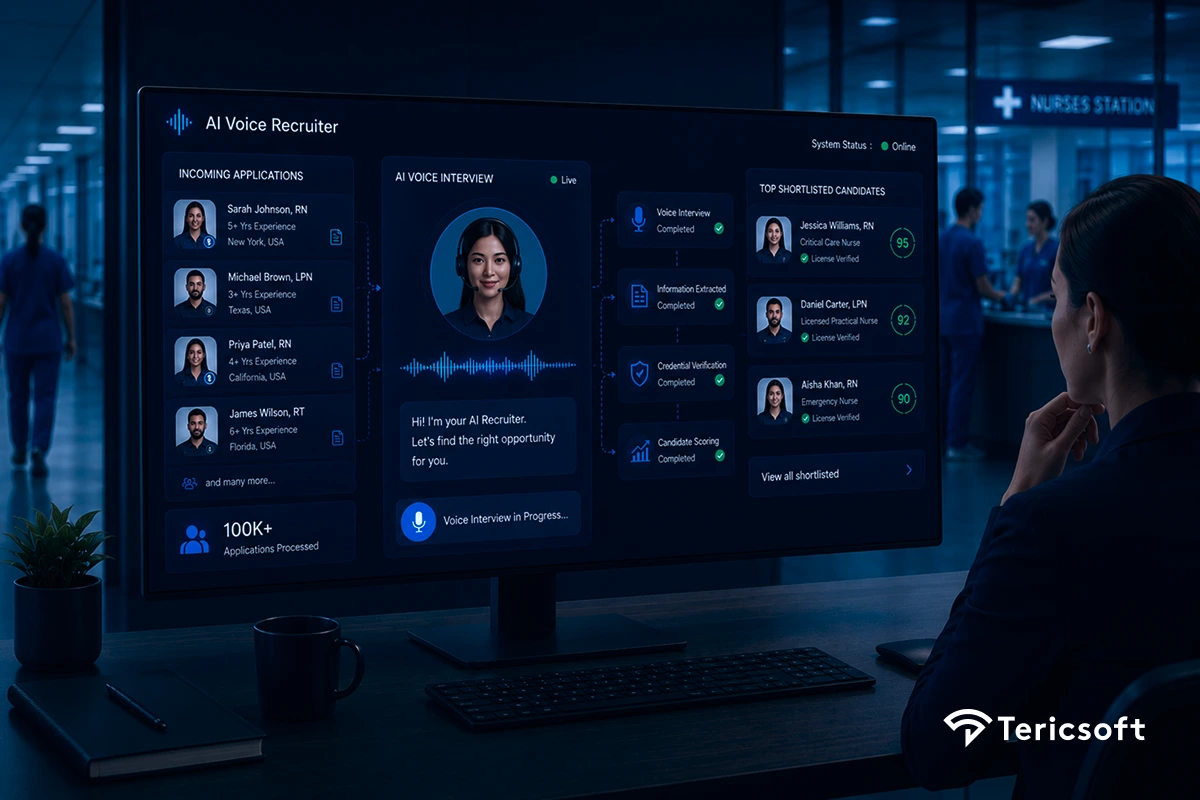
A recruitment workflow voice agent runs the first-screen step end-to-end. It calls or receives calls from candidates, runs a structured screening script, captures qualifications, scores fit against the role, and schedules interviews directly into the recruiter's calendar. The recruiter's morning starts with a full calendar of pre-screened, pre-scored candidates, not a call list. This use case is deployed in healthcare and high-volume hiring environments. For a deep-dive case study, see the Voice AI Recruiter for healthcare staffing.
- Every applicant receives a structured first-screen call regardless of application volume
- Qualification criteria scored consistently without recruiter judgment variance
- Interview slots booked directly into the recruiter's calendar before the call ends
- High-quality candidates routed immediately with a conversation summary attached
23% reduction in time-to-hire from application to offer | 75% recruiter time saved on first-round screening calls
How Tericsoft Builds and Deploys Voice AI for Production Environments
All 11 use cases run on the same production-grade voice AI infrastructure. The technology stack is built for real operational environments: high call volume, variable network conditions, multilingual customer bases, and 24-hour availability requirements.
The core stack:
- LiveKit: real-time voice orchestration across web and phone channels
- Twilio: telephony layer handling all regular phone call connections
- ElevenLabs: speech-to-text and text-to-speech on both ends of the voice layer for natural, low-latency conversation
- OpenAI GPT: primary LLM powering conversation logic, qualification scripts, and transcript analysis
- Google Gemini: backup LLM and TTS layer configured for resilience when primary models are under load
Above the technology layer, every deployment includes a context layer specific to the use case: CRM integration for lead capture, calendar systems for appointment booking, credential verification for healthcare hiring, KYC for insurance and loan products, dispatch systems for home services, and feedback databases for automotive and retail. The voice AI is never a standalone tool. It is integrated into the operational workflow it is designed to serve.
Tericsoft operates as a long-term technology partner across all engagements. Voice AI systems in production environments evolve: scripts are refined as data accumulates, integrations extend as operations grow, and new use cases are added to existing platforms. The engagement model reflects that reality.
For businesses evaluating a new voice AI deployment, Tericsoft's voice AI system development approach begins with a discovery phase to map the specific workflow, integration requirements, and success metrics before any code is written.
See all case studies from Tericsoft across voice AI, computer vision, and platform development.
Which Voice AI Use Case Fits Your Business?
The 11 use cases in this reference represent the production deployments Tericsoft has built and is actively maintaining. They span inbound answering, outbound engagement, and lead qualification workflows across healthcare, insurance, automotive, home services, retail, staffing, training, and enterprise IT.
Some businesses will recognise their use case immediately from this list. Others will see two or three that apply simultaneously. A healthcare staffing business might need both the healthcare front desk voice agent and the recruitment workflow voice agent. An insurance company might need campaign response handling, lead qualification, and renewal outbound calling in a single integrated platform.
The right starting point is not which use case to build. It is which manual conversation is costing the most time, the most revenue, or the most operational capacity right now. That is the one to automate first.

Specific business applications where an AI voice agent handles phone or web conversations including inbound answering, outbound calling, lead qualification, and candidate screening.
A voice AI agent conducts a natural two-way conversation, understands context, adapts in real time, and takes actions like booking appointments or routing tickets automatically.
Healthcare, automotive, insurance, home services, retail, enterprise IT, staffing, training institutes, and fleet and logistics operations across 11 deployed use cases.
Yes. Tericsoft builds integrated platforms where multiple use cases share the same infrastructure, such as front desk booking and recruitment screening running together.
Simple inbound deployments go live in four to six weeks. Multi-workflow platforms with CRM and dispatch integrations typically take eight to twelve weeks from discovery to production.