Can a healthcare staffing company truly scale recruiting without adding headcount? Learn how a US staffing platform processed 100K+ candidates using a Voice AI Recruiter.
In high-volume healthcare staffing, the recruiter is the bottleneck. Every application that arrives requires a human to screen it. Every credential requires a human to verify it. Every candidate who never gets a conversation is a placement that never happens.
The manual model has a hard ceiling. At 15,000 to 20,000 monthly placements, that ceiling breaks.
A leading US healthcare staffing company partnered with Tericsoft to remove that ceiling. The engagement: build and integrate a Voice AI Recruiter that runs the entire front end of the recruitment funnel end-to-end. This is how Tericsoft's AI and voice technology capabilities were applied to transform ai for recruiting from a manual, coordinator-dependent process into a fully automated system.
The Client: A US Healthcare Staffing Platform Operating at Scale
The client runs a US healthcare staffing company connecting qualified clinical and allied health professionals to provider organisations across the country on both permanent placement and contract terms. Client identity is withheld per NDA.
Their ownership runs the full distance: sourcing, screening, credentialing, shortlisting, placement, making sure the staff actually reports to the customer site, and onward into contracting and payroll. They operate as an on-demand, end-to-end staffing supplier.
The strategic mission of this engagement was clear: deliver a consistent experience for high-value staffing demand, scale to peak load without scaling recruiter headcount, and run the front end of the recruitment funnel at the lowest possible operational cost per placement.
Why the Manual Recruiting Model Hit a Hard Ceiling
The manual recruiting model worked when volume was manageable. At scale, it produced three compounding problems that no amount of additional recruiter headcount could solve structurally.
Automated Candidate Screening: What Was Missing From the Funnel
The platform was receiving hundreds of applications per vacancy in a high-volume, high-stakes hiring market. Recruiters had to screen these by resume alone.
The result: every role produced a shortlist of five to twenty persons before any actual conversation could happen. The remaining 80 to 95 percent of applicants never got a chance to speak with anyone. Recruiter capacity was the single biggest constraint on growth.
Specific pain points the manual screening model created:
- Strong candidates were filtered out on paperwork before any conversation happened
- Resume keywords became the primary filter rather than actual fit or communication quality
- Recruiters spent most of their capacity on screening, not on placement
- As vacancy volume grew, the screening backlog grew proportionally
- No structured data from the screening process to improve shortlisting over time
Insight: Recruiter capacity is not a headcount problem. It is a process design problem. When every application requires a human to evaluate it, growth cannot outpace the recruiter. The constraint is structural.
Compliance and Credentialing Gaps in High-Stakes Healthcare Hiring
Healthcare hiring carries non-negotiable compliance checks. Every candidate has license validity, document expirations, and role-specific credential requirements that must be verified before they can be considered.
Doing this manually was slow, inconsistent, and error-prone across different recruiters. The same verification could be done differently by different people on the same team.
What was missing from the manual credentialing process:
- No automated check against role-specific credential requirements at the point of application
- License expiration verification done manually and inconsistently across the team
- Identity verification not standardised before candidate conversations began
- A single missed expiry or unchecked document created downstream compliance risk for the end provider
- Compliance summaries assembled manually for every shortlisted profile
Insight: In healthcare staffing, credentialing is not an administrative task. It is a liability management task. When it is done manually, inconsistency is inevitable. Inconsistency in a regulated hiring environment creates risk for every party in the chain.
Inconsistent Candidate Experience in a Tight Clinical Talent Market
Most applicants never reached a recruiter conversation, so they had no visibility into pay range, role expectations, or what to prepare for the next round. The application process ended in silence for most candidates.
The candidates who did get through had wildly different experiences depending on which recruiter handled them. Some received detailed briefings. Others received a basic call and a role description. No consistency.
The impact on the business:
- Candidate drop-off during the process due to lack of information and clarity
- Employer brand weakened in a market where clinical talent has multiple competing offers
- No standardised candidate data captured from conversations for platform-wide use
- Strong profiles that did not match one vacancy were discarded rather than routed to other openings
Insight: In a tight US clinical talent market, candidate experience is a competitive differentiator. The platforms that deliver clarity, speed, and consistency at the first touchpoint will attract the best candidates. The ones that do not will lose them to competitors who do.
Recruiting Automation: How Voice AI Replaced the Manual Hiring Funnel
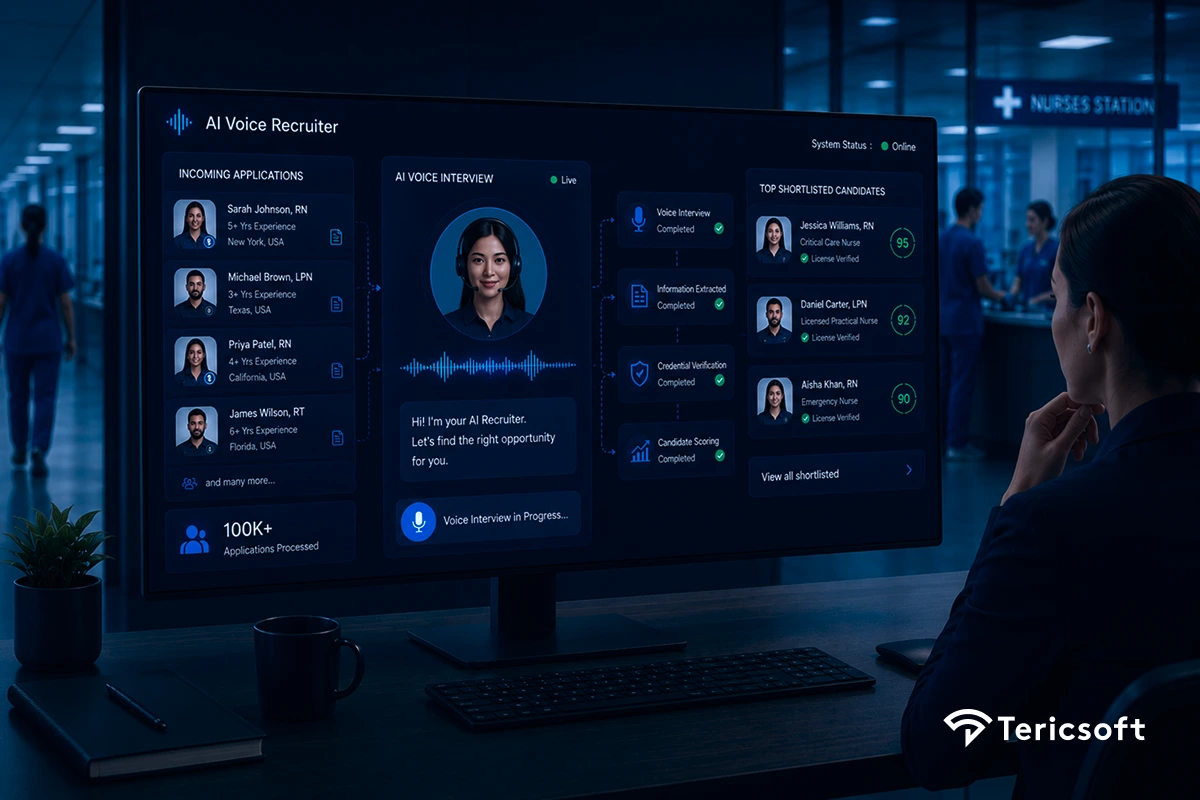
Tericsoft built and integrated a Voice AI Recruiter into the client's existing staffing platform. The system handles the front end of the recruitment funnel end-to-end: interview scheduling, credential verification, voice-led assessment, scoring, and downstream candidate matching across vacancies.
The AI system devemlopment approach was to build the Voice AI Recruiter as a fully integrated component of the existing platform, not a standalone tool. Every candidate who applies now moves through the same structured, automated process regardless of when they apply or which recruiter is on shift.
Recruitment Automation Software: How Every Applicant Gets a First-Round Interview
The moment a candidate applies, the Voice AI Recruiter analyses the resume, the job description, and the end-customer profile metadata. It then schedules the interview slot based on the candidate's stated availability and sends the invite.
When the candidate joins, on a web application or a regular phone call, the bot navigates a structured interview script built specifically for that role. The conversation is not generic. It is calibrated to the position, the client requirements, and the candidate's background.
What the recruitment automation software delivers at this stage:
- Every applicant gets a structured first-round interview within minutes of applying, including candidates who apply at 2am
- Interview script is role-specific and adapts based on the candidate's submitted resume and the job description
- Transcript analysed after every call and a score generated against the job profile
- Recruiters receive a ranked shortlist based on actual conversation data, not resume keywords
- Non-selected candidates are not discarded: their profiles are scored against other open vacancies on the platform automatically
Every applicant gets a fair first round. Recruiter capacity is freed entirely from the screening phase. The bottleneck is removed.
Insight: Resume screening is a filter designed for a world with low application volume. In high-volume healthcare staffing, it becomes a liability. Recruitment automation software replaces the filter with a structured conversation. That conversation generates data. The data improves the shortlist.
Healthcare Credentialing Software: Automated KYC Before Every Interview
Compliance is verified before the candidate ever speaks to the AI. This is not a post-interview step. It is a prerequisite gate.
Before the interview begins, the system pulls the candidate's submitted documents, runs identity checks to confirm the same profile is showing up to interview, and validates licenses and certifications against the role's mandatory healthcare credential checklist.
What the healthcare credentialing software layer delivers:
- Automated identity verification confirms the candidate submitting documents is the same person joining the interview
- License validity checked against role-specific credential requirements before any conversation begins
- Document expiration flags raised automatically for any out-of-date credentials
- Missing items flagged and interview held until prerequisites are cleared
- Recruiters receive a signed-off compliance summary attached to every shortlisted profile
The compliance layer removes a full round of manual checking from the pipeline. No recruiter needs to verify a license manually. No shortlisted profile reaches the human review stage without a clean credential summary attached.
Insight: Healthcare credentialing software does not just save recruiter time. It standardises compliance across every candidate, every recruiter, every shift. Standardisation in a regulated environment is not a quality improvement. It is a liability reduction.
Healthcare Staffing Software: The Technology Stack Behind the System
The Voice AI Recruiter runs on a production-grade voice AI stack built for reliability, resilience, and real-world healthcare staffing conditions.
The technology stack:
- LiveKit: real-time voice orchestration across web and phone channels
- Twilio: telephony layer handling all regular phone call connections
- ElevenLabs: speech-to-text and text-to-speech on both ends of the voice layer for natural, low-latency conversation
- OpenAI GPT: primary LLM powering interview logic, question generation, and transcript scoring
- Google Gemini: backup LLM and TTS layer configured for resilience when primary models are unavailable
- Context layer: resume parsing, JD analysis, credential verification, and KYC assembled ahead of every interview
The backup configuration across both LLM and TTS layers is not standard practice for most voice AI implementations. It was built in from the start because healthcare staffing operates 24 hours a day and candidate drop-off due to system downtime is not acceptable.
The cross-vacancy matching layer compounds the value of every interview. When a vacancy is filled, the remaining strong profiles from that funnel are not discarded. The system scores them against open requirements from other clients on the platform and routes matching candidates into those funnels automatically. The candidate pool becomes a platform-wide asset instead of a per-vacancy resource.
The Numbers That Now Define the Funnel
The Voice AI Recruiter now sits at the front of every job application on the platform. Candidates who apply on a Monday afternoon are interviewing within hours, on the channel they prefer. Clients receive ranked shortlists with compliance summaries attached, ready for a human final round.
100K+ Candidates Processed Through the Voice AI Recruiter
More than 100,000 candidates have been processed through the Voice AI Recruiter since deployment. Each one received a structured first-round interview, an automated credential check, and a scored profile. Each one was treated with the same standard regardless of when they applied.
30% Profile Quality Lift
The quality of shortlisted profiles improved by 30 percent compared to the resume-only shortlisting baseline. When the first-round filter is a structured conversation rather than a resume scan, the candidates who advance are the candidates who can actually do the job and articulate it.
97%+ Vacancies Filled on Time
More than 97 percent of active client vacancies are being filled on time across the platform. Recruiter capacity no longer scales linearly with application volume. The Voice AI Recruiter handles first-round volume at any scale without adding headcount.
95%+ Candidate Satisfaction Score
Candidate satisfaction scores are above 95 percent across interviewed applicants. Every candidate gets a consistent, clear, low-pressure experience. They receive role information, pay structure clarity, and honest expectation-setting regardless of the shift or the recruiter.
*All figures are early-stage. This engagement is in active transformation phase. Figures are pending full client validation.
Key Lessons From This Voice AI Recruiting Case Study
These lessons apply to any healthcare staffing company or staffing platform operator considering a move from manual, coordinator-dependent hiring to automated, AI-led recruitment.
Automate the Front of the Funnel Before the Back
The instinct in most staffing operations is to automate reporting, scheduling, and back-office tasks first because they are easier to define. The front of the funnel, where screening and first contact happen, feels too human to automate.
This instinct is backwards. The front of the funnel is where the most volume is, where the most recruiter time is consumed, and where the most value is lost. Automate the front first. The rest of the efficiency gains follow.
Compliance Cannot Be an Afterthought in Healthcare Hiring
In general recruiting, credentialing is an administrative step that can happen at any point in the process. In healthcare staffing, it is a prerequisite. A candidate who advances past the screening stage without a clean credential check creates risk for every party in the chain.
Building the credentialing layer as a prerequisite gate, not a post-interview step, is the difference between compliance as a process and compliance as a standard.
Candidate Experience Is a Competitive Differentiator in a Tight Market
The US clinical talent market is tight and getting tighter. Healthcare professionals have choices. The platforms that deliver a fast, clear, consistent first-round experience will attract the candidates who have options. The ones that do not will receive the candidates who are left.
Candidate experience is not a nice-to-have in healthcare staffing. It is a supply chain problem.
Voice AI Healthcare Recruiting: What This Shift Means for Staffing Companies
The manual recruiting model was built for a world where application volume was manageable and candidate expectations were lower. Neither of those conditions holds today. Application volume in high-demand healthcare roles is measured in hundreds. Candidate expectations for speed and clarity are rising.
Voice AI healthcare recruiting does not replace recruiters. It replaces the part of recruiting that should never have required a recruiter: the first-round screen, the credential check, the role briefing. When those steps are automated, the recruiter does what only a recruiter can do: manage relationships, close placements, and handle exceptions.
See more case studies from Tericsoft across AI, healthcare, and complex operational environments.
Why Healthcare Staffing Companies Need a Long-Term Technology Partner
Deploying a Voice AI Recruiter across a live, high-compliance healthcare staffing platform is not a project with a fixed scope and a handoff date. The platform evolves. Credential requirements change by state and by role. Interview scripts need refinement as scoring data accumulates. New client profiles require new context layers.
Tericsoft worked with this client as a long-term technology partner from the first architecture conversation through to production deployment and active iteration. That model of engagement is the only one that works for AI systems operating in live, high-stakes environments.
Conclusion
The manual recruiting model in healthcare staffing has a ceiling. That ceiling is the recruiter. Every new placement at scale requires more recruiter time, more manual credential checks, and more inconsistency in how candidates are treated.
The Voice AI Recruiter Tericsoft built removes that ceiling. Every applicant gets a structured first-round interview. Every credential is verified before any conversation begins. Every strong profile is matched across the full vacancy network. Recruiters focus on placements, not on screening.
The model now handles six-figure annual candidate volume at a fraction of the operational cost of the manual funnel. Recruiter headcount no longer scales linearly with demand. The platform scales instead.

How Tericsoft built a Voice AI Recruiter for a US healthcare staffing company, processing 100K+ candidates through recruiting automation.
Replacing manual screening and first-round interviews with an automated voice AI system that processes every applicant before any recruiter gets involved.
It verifies identity, checks license validity, and validates credentials before the interview begins. Recruiters receive a clean compliance summary with every profile.
A voice-led interview system on web and phone using LiveKit, Twilio, ElevenLabs, and OpenAI GPT that scores every applicant against the job profile.
100K+ candidates processed, 30% profile quality lift, 97%+ vacancies filled on time, and 95%+ candidate satisfaction score pending full client validation.