How are AI voice agents transforming fleet, ride-hailing, and EV operations? Explore why traditional mobility support models are struggling, how conversational AI improves customer and driver experiences, and what businesses need to scale operations more efficiently.
Most mobility operations hit the same wall at the same time. Contact center queues surge during peak demand. Drivers struggle to reach dispatch teams when routes change unexpectedly. Riders abandon calls after navigating lengthy IVR menus. Support teams become overwhelmed, response times increase, and customer satisfaction begins to decline.
The challenge is not unique to ride-hailing companies. Fleet operators, employee transportation providers, airport mobility services, logistics companies, and EV fleet operators face similar operational bottlenecks every day. As fleets expand and customer expectations continue to rise, traditional call centers and manual coordination processes become increasingly difficult to scale.
This is where AI voice agents are changing the game.
Powered by conversational AI, large language models (LLMs), speech recognition, and real-time business integrations, AI voice agents can handle thousands of customer and operational conversations simultaneously. They can answer questions, coordinate drivers, manage bookings, provide trip updates, support charging operations, and escalate complex issues to human teams when needed.
For mobility businesses, AI voice agents are no longer just a customer service tool. They are becoming a critical operational layer that helps organizations improve efficiency, reduce costs, and deliver a better experience across every journey.
Why Traditional Mobility Support Models Are Breaking Down
Mobility operations have become significantly more complex over the last decade. Customer expectations have increased while operational margins remain under constant pressure.
Rising Customer Expectations
Today's passengers expect instant responses and real-time information. Whether they are checking a driver's arrival time, changing a booking, or requesting support during a trip, waiting several minutes on hold is no longer acceptable.
Customers increasingly compare every service interaction to the best digital experiences available in the market. Mobility providers that fail to meet these expectations often experience lower retention rates and reduced customer satisfaction.
Operational Complexity at Scale
As fleets grow, so does the number of daily interactions that require human attention.
Dispatch teams manage driver communications. Customer support teams handle booking modifications. Operations teams coordinate routes, schedules, incidents, and vehicle availability.
When thousands of vehicles and passengers are involved, manual communication processes become a major bottleneck.
High Contact Center Costs
Mobility companies often need large support teams to manage peak demand periods, after-hours requests, and multilingual customer interactions.
Maintaining round-the-clock support can become expensive, especially when a significant portion of inquiries involve repetitive questions that could be handled automatically.
What Are AI Voice Agents?
AI voice agents are conversational systems capable of understanding spoken language, processing context, making decisions, and responding naturally in real time.
Unlike traditional IVR systems that force users through predefined menu options, AI voice agents understand intent and engage in dynamic conversations.
A passenger can simply say:
"My driver hasn't arrived yet. Can you tell me where they are?"
The AI agent understands the request, retrieves trip information from operational systems, and provides a relevant response instantly.
How AI Voice Agents Work
Modern AI voice agents combine several technologies:
- Automatic Speech Recognition (ASR) to convert speech into text
- Large Language Models (LLMs) to understand intent and context
- Business logic engines to execute workflows
- Operational system integrations for accessing real-time data
- Text-to-Speech (TTS) systems to generate natural voice responses
Together, these technologies create conversations that feel significantly more human than traditional automated systems.
Traditional IVR Systems vs AI Voice Agents
Key Use Cases for AI Voice Agents in Mobility
AI voice agents can support nearly every stage of a mobility operation.
1. Ride Booking and Reservation Assistance
Customers can book rides, modify reservations, confirm schedules, and receive trip details through a simple voice conversation.
The AI agent can automatically verify availability, estimate costs, and complete bookings without requiring human intervention.
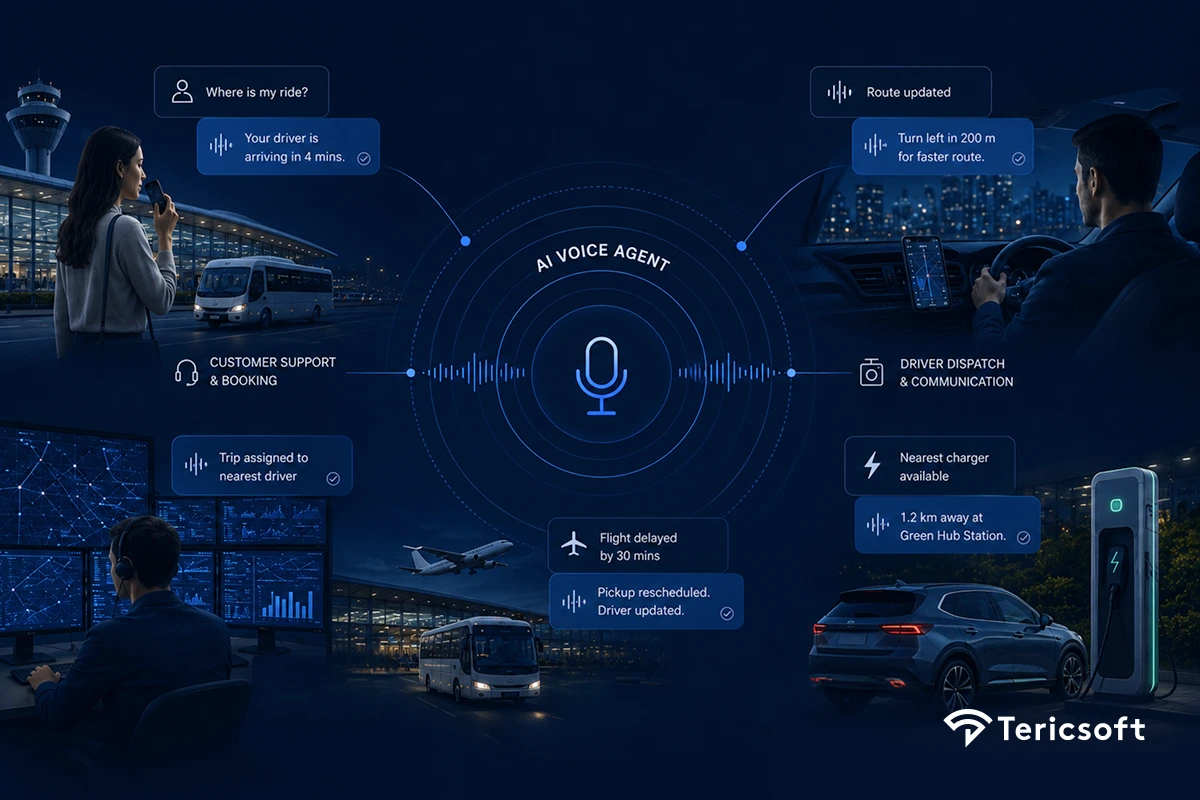
2. Driver Dispatch and Communication
Dispatchers often spend significant time coordinating with drivers through phone calls and messages.
AI voice agents can automate many of these interactions by:
- Assigning trips
- Confirming driver availability
- Communicating schedule updates
- Providing route information
- Escalating exceptions when necessary
3. Real-Time Trip Status and ETA Updates
Passengers frequently contact support teams for trip updates.
AI voice agents can instantly provide:
- Driver location
- Estimated arrival times
- Delay notifications
- Trip status updates
- Route changes
This reduces support call volumes while improving customer satisfaction.
4. Customer Support and Complaint Resolution
AI voice agents can handle a wide range of customer inquiries, including:
- Lost and found requests
- Payment issues
- Cancellation requests
- Booking changes
- Service complaints
More complex cases can be transferred seamlessly to human agents with full conversation context.
5. Airport Transfer and Shuttle Coordination
Airport mobility operations often involve frequent schedule changes and passenger coordination challenges.
AI voice agents can:
- Confirm arrivals
- Coordinate pickups
- Verify passenger details
- Handle flight delays
- Communicate driver information
This reduces manual coordination efforts while improving operational reliability.
6. Fleet Maintenance and Service Scheduling
AI voice agents can proactively communicate with drivers regarding:
- Vehicle inspections
- Service appointments
- Maintenance schedules
- Compliance requirements
This helps organizations improve fleet utilization and reduce downtime.
7. /EV Charging and Range Assistance
For EV fleets, AI voice agents can assist drivers with:
- Charging station locations
- Charging schedules
- Battery status information
- Range-related questions
- Charging availability updates
These capabilities become increasingly valuable as EV adoption continues to accelerate.
How AI Voice Agents Improve Fleet Operations
While customer service is often the first use case, the operational benefits can be even more significant.
Faster Incident Reporting
Drivers can report breakdowns, accidents, or operational issues through voice conversations.
The AI agent captures information, categorizes incidents, and automatically routes cases to the appropriate teams.
Automated Driver Support
Drivers frequently need assistance with:
- Route updates
- Shift schedules
- Vehicle assignments
- Operational policies
AI voice agents provide instant answers without requiring dispatcher involvement.
Reduced Dispatcher Workload
Many routine communications that traditionally require dispatch teams can be automated.
This allows dispatchers to focus on higher-value operational decisions rather than repetitive administrative tasks.
24/7 Operational Coverage
Mobility operations do not stop when business hours end.
AI voice agents provide consistent support around the clock without requiring large overnight support teams.
AI Voice Agents for Ride-Hailing Platforms
Ride-hailing companies operate in highly dynamic environments where demand fluctuates continuously.
Handling Peak Demand Without Increasing Headcount
During weekends, holidays, and special events, support volumes can increase dramatically.
AI voice agents help organizations scale support capacity without proportionally increasing staffing costs.
Improving Rider Experience
Faster responses and instant access to trip information create a more seamless rider experience.
This contributes directly to customer satisfaction and retention.
Automating Cancellation and Rescheduling Requests
Booking changes represent a large portion of support interactions.
AI voice agents can process these requests automatically while enforcing operational policies and availability constraints.
The Role of Conversational AI in EV Fleet Management
As electric mobility continues to expand, fleet operators face new operational challenges.
AI voice agents can help bridge information gaps for drivers and operations teams.
Charging Station Assistance
Drivers can receive guidance on:
- Nearby charging locations
- Charger availability
- Charging compatibility
- Charging durations
Battery and Vehicle Health Notifications
AI systems can proactively notify drivers regarding:
- Low battery levels
- Charging requirements
- Vehicle diagnostics
- Service recommendations
Predictive Maintenance Communication
By integrating with fleet management systems, AI voice agents can automatically communicate maintenance alerts before issues become critical.
This supports higher vehicle uptime and lower maintenance costs.
Business Benefits of AI Voice Agents for Mobility Companies
Organizations implementing conversational AI often experience benefits across multiple areas.
- Lower Support Costs: Automating repetitive interactions reduces the need for large support teams while maintaining service quality.
- Faster Response Times: Customers receive assistance immediately rather than waiting in queues.
- Improved Customer Satisfaction: Natural conversations and quicker issue resolution contribute to better customer experiences.
- Increased Operational Efficiency: Operations teams spend less time handling routine communications and more time managing strategic priorities.
- Better Scalability: AI voice agents enable organizations to handle growing volumes without scaling headcount at the same rate.
Best Practices for Deploying AI Voice Agents in Mobility
Successful implementations require more than simply deploying a chatbot with voice capabilities.
Integrate With Core Operational Systems
Voice agents should connect directly with:
- Fleet management platforms
- Dispatch systems
- Booking engines
- CRM platforms
- Payment systems
Without integration, automation potential remains limited.
Maintain Human Escalation Paths
Not every situation can or should be automated.
Human agents should remain available for complex, sensitive, or exceptional scenarios.
Train Using Real Operational Data
Voice agents perform best when trained using actual customer interactions, driver communications, and operational workflows.
Measure Business Outcomes
Success metrics should include:
- Resolution rates
- Response times
- Customer satisfaction
- Operational efficiency
- Cost reduction
Rather than focusing solely on call volume.
The Future of Mobility Operations Is Conversational
The mobility industry is moving toward increasingly intelligent and automated operations.
AI voice agents are evolving from support tools into operational decision-making systems that can coordinate activities across customers, drivers, vehicles, and dispatch teams.
As conversational AI continues to improve, mobility companies will increasingly rely on voice-first automation to manage complex operations at scale.
Organizations that adopt these capabilities early will be better positioned to improve efficiency, deliver superior customer experiences, and support future growth.
How Tericsoft Builds AI Voice Agents for Mobility Operations
At Tericsoft, we build enterprise-grade AI voice agents designed specifically for mobility businesses. Our solutions integrate with fleet management platforms, dispatch systems, booking engines, customer support workflows, and EV infrastructure to automate high-volume operational conversations.
From ride-hailing platforms and employee transportation providers to airport mobility operators and EV fleet companies, we help organizations deploy conversational AI that improves customer experience, reduces operational costs, and enables 24/7 intelligent support.
Whether the goal is automating bookings, improving dispatch coordination, supporting drivers, or enhancing fleet visibility, AI voice agents are rapidly becoming a core component of modern mobility operations. The companies that embrace this shift today will define the future of mobility tomorrow.

An AI voice agent for mobility holds natural multi-turn conversations and acts across mobility systems. IVR follows fixed menus and routes calls only.
AI voice agents handle calls at around USD 0.11 per minute versus USD 2.70 to 5.60 for humans, with 40 to 60% handle-time reduction reported.
Through bidirectional APIs and event streams that read state, post actions, and log outcomes in real time across CRM, dispatch, and fleet systems.
Yes. Modern voice agents support Hindi, Tamil, Telugu, Marathi, Kannada, and code-switched Hindi-English with mobility-domain vocabulary tuning.
A focused first deployment on one high-volume intent typically reaches production in 90 days with measurable ROI in the first quarter post-launch.