

Why do MVPs built on Lovable and Super Engineer struggle in production? Learn how adding a DevOps foundation transforms rapid builds into enterprise-ready applications.
In today’s fast-moving world, founders and teams want to build applications quickly. That is why platforms like Lovable and Super Engineer are becoming popular. They allow people to rapidly prototype or launch an MVP (Minimum Viable Product) without needing a large engineering team.
For quick idea validation, these tools are excellent. But when applications need to go beyond MVPs and become production-ready, challenges start to appear. That is exactly what we experienced when we worked with Lovable and Supabase as the backend.
The Challenge: What We Faced
When one of our client founders built their application using Lovable, everything worked great for a start. But as usage grew, the following issues appeared:
1. Testing only in production environments
Every new code deployment had to be validated in a production-like setup. This was risky and slowed down iteration.
2. Difficult rollback of changes
If a mistake happened, rolling back or reverting to an earlier version was not straightforward.
3. Security concerns with backend ownership
Supabase was externally managed. Sensitive data and access were not completely in our control. This raised security and compliance concerns.

The Solution: Our DevOps Layer
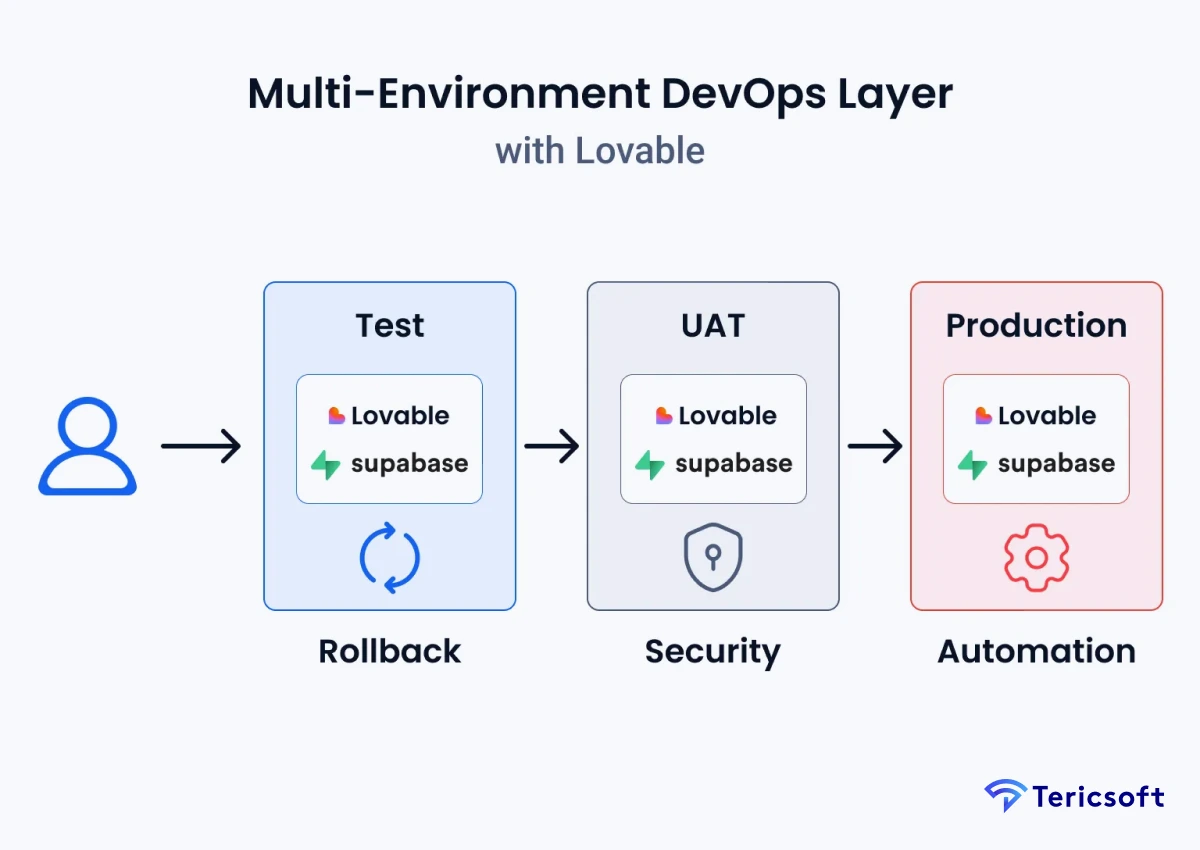
To address these issues, our team at Tericsoft built a custom DevOps Layer on top of the Lovable setup.
This DevOps layer included four key parts:
1. Multi-Environment Setup
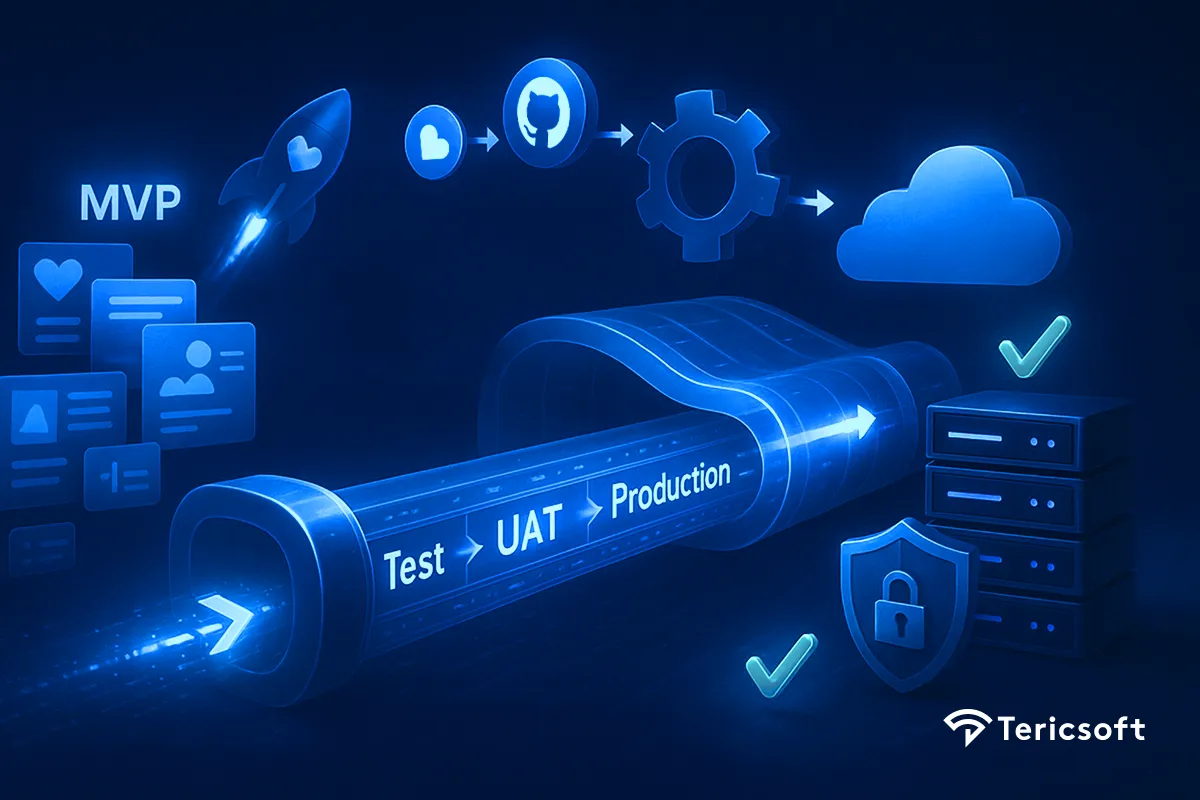
We created separate environments (Test, UAT, and Production) on AWS EC2 servers. Each environment was connected to GitHub for code integration. This allowed safe testing before production.
2. CI/CD Pipelines
We introduced Continuous Integration and Continuous Deployment (CI/CD) . Whenever code is pushed to GitHub:
- Automated builds and tests are triggered.
- Output is validated in Test/UAT environments.
- Production gets updated only when tests are successful.
- This reduced human errors and ensured safer deployments.
3. Environment-Specific Backend Management
We maintained separate Supabase instances for each environment. By doing this:
- Test data stays separate from production.
- Each environment is stable on its own.
- Data ownership and security remain with us.
4. Automated Provisioning
We automated environment setup so new environments can be spun up quickly with consistent configurations. This made scaling simple and reduced manual work.
The Impact
By deploying this DevOps layer, the client gained:
- Safe testing in controlled environments before production.
- Flexibility to roll back quickly when needed.
- Stronger data security with controlled backend setups.
- Faster delivery cycles thanks to CI/CD pipelines.
- Reduced dependency on manual processes through automation.
Why This Matters
Tools like Lovable and Super Engineer are perfect for quick MVPs and idea validation. But scaling those MVPs into production-grade applications requires a stronger foundation.
Our DevOps layer bridges this gap. It combines:
- Environment segregation for safe testing,
- CI/CD automation for reliability,
- Backend security for compliance,
- Provisioning automation for scalability.
This allows teams and founders to keep the speed of low-code tools, while gaining the control and security of enterprise-grade DevOps.
Conclusion
Building fast is important. But building securely and reliably is what takes an MVP to the next level.
By combining Lovable and Super Engineer for rapid development with our DevOps layer for deployment, we created a workflow that supports both agility and long-term stability.
If you are using Lovable, Super Engineer, or any similar platform, and facing challenges in testing, security, or deployments, building a DevOps layer on top might be the solution you need.

Lovable works great for MVPs but lacks robust testing, rollback, and security. Tericsoft’s DevOps layer adds those enterprise-grade essentials.
Tericsoft implements multi‑env setup (Test, UAT, Production), CI/CD pipelines, env-specific Supabase, and automated provisioning on AWS EC2.
Automated CI/CD ensures code goes through testing in dedicated environments before hitting production—reducing risk and human error.
Yes. DevOps layer built by us enabled quick and reliable rollbacks through proper environment segregation and version control pipelines.
By managing separate backend environments per stage (test vs prod), Tericsoft can help secure your Supabase data by keeping sensitive systems under control.