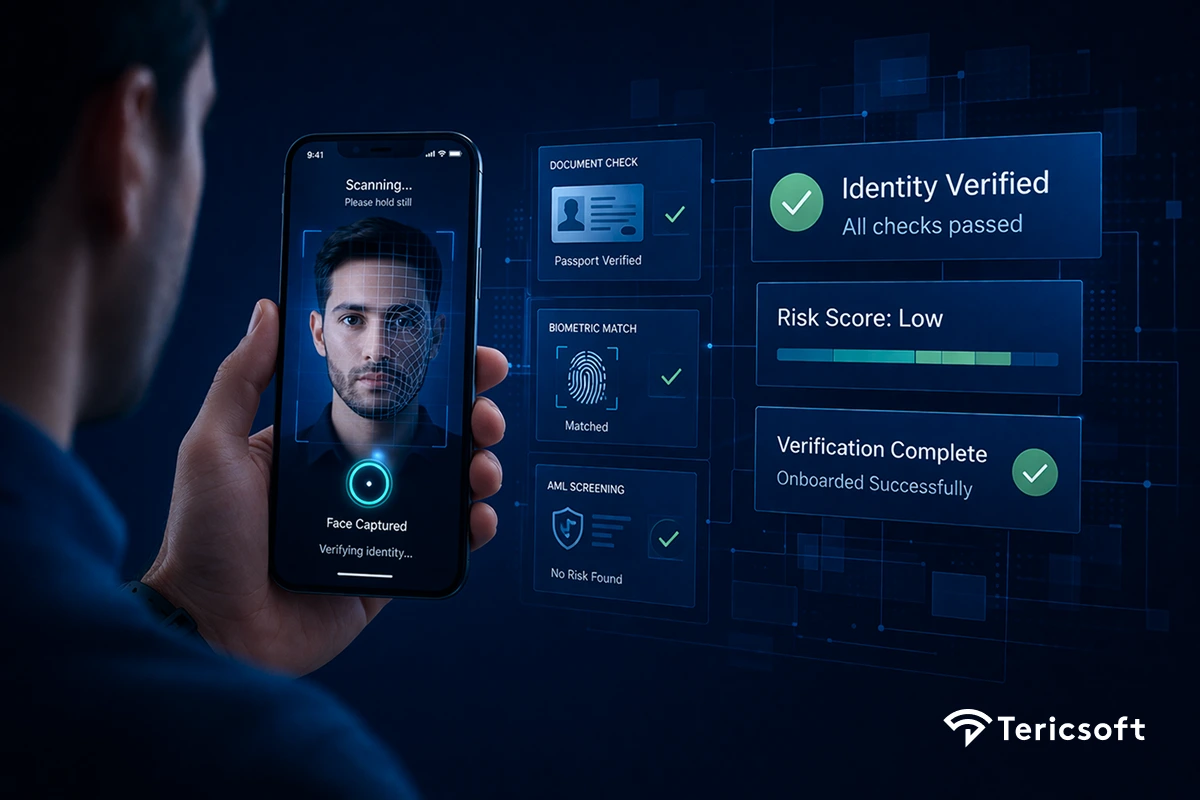
What is Agentic KYC? Why autonomous AI agents change the rules of identity verification and compliance, and how Tericsoft helps banks and fintechs onboard, secure, and monitor users in seconds instead of days.
The global financial ecosystem is operating with a severe disconnect. A modern user downloads a banking app expecting instantaneous access, but behind that sleek interface, risk teams are often drowning in static PDFs, manual data entry, and endless compliance checklists. Customers are left waiting in digital lobbies for days, while institutions burn millions on operational inefficiencies.
This is not just a UX problem. It is a structural failure of compliance infrastructure.
Agentic KYC is an AI-driven identity verification system where autonomous agents perform, analyze, and optimize compliance workflows in real time without human intervention.
Today, throwing more human analysts at this data problem is no longer a viable strategy. We are entering a pivotal era where AI agents will redefine financial compliance the exact same way cloud computing redefined IT infrastructure.
"Gen AI offers enormous potential to significantly alter the business of banking."
— Michael S. Barr, Federal Reserve Governor.
Financial leaders are realizing that rigid, rule-based systems simply cannot keep pace with the hyper-velocity of digital transactions or the growing sophistication of modern fraud rings. The answer is not a bigger back office. The answer is an autonomous, intelligent system capable of real-time reasoning. Welcome to the era of Agentic KYC, where identity verification transforms from a costly operational bottleneck into a dynamic, continuous intelligence engine.
What Is Agentic KYC in Banking and Financial Services
Agentic KYC represents the next evolution of identity verification. It completely bypasses simple "paper-to-glass" digitization and steps firmly into the realm of true operational autonomy, powered by advanced artificial intelligence frameworks.
What "Agentic" Means in the Context of KYC
In traditional software paradigms, a program sits idle until a human clicks a button or inputs a command. It is reactive. In the context of KYC, "agentic" refers directly to the proactive behavior of autonomous AI agents. Think of them as tireless digital investigators. These agents do not merely extract text; they actively perform, analyze, and execute compliance steps. They cross-reference extracted data against global watchlists in milliseconds, initiate biometric liveness challenges, and finalize a contextual risk decision. By leveraging intelligent AI agentic automation, these systems fluidly adapt to new regulatory mandates and emerging fraud patterns on the fly.
How Agentic KYC Differs from Traditional eKYC Systems
Traditional eKYC (electronic KYC) systems successfully eliminated paper, allowing users to upload photos of their IDs rather than visiting a physical branch. However, eKYC still relies heavily on static "if/then" rules and manual reviews to clear backlogs. Agentic KYC systems, conversely, represent a fundamental architectural difference. They utilize multi-agent architectures where different AI models collaborate to solve a problem. One agent specializes entirely in computer vision to detect pixel-level document forgery, while another independently queries external APIs for anti-money laundering (AML) checks, resulting in a highly coordinated, instant decision.
From Rule-Based Verification to Autonomous Decision Systems
The transition from legacy rule-based verification to autonomous AI KYC automation marks a profound shift toward true decision intelligence. Rule-based systems inevitably break down when faced with edge cases because they only catch what they have been explicitly programmed to flag. Autonomous decision systems focus on how decisions continuously evolve. By relying on advanced machine learning models that understand deep context, security decisions are continuously optimized based on the latest global financial threat data.
Why Traditional KYC Processes Are Failing Financial Institutions
KYC is no longer a compliance process. It is becoming a scalability bottleneck and a revenue leakage engine. Banks, lenders, and fintech platforms are currently spending billions on compliance infrastructure, yet they remain dangerously vulnerable. The legacy approach is quite simply fracturing under the weight of modern digital demands.
Manual Verification Bottlenecks and Operational Costs
The sheer volume of human capital required to sustain traditional compliance frameworks is staggering and ultimately unsustainable. Current estimates reveal that an astonishing 10-15% of bank workforce is dedicated to KYC/AML operations. This heavy reliance on manual verification creates immense operational costs that scale terribly. When a financial institution scales its customer base, it is forced to linearly scale its compliance headcount, a reality that severely degrades overall profitability.
Rising Fraud Sophistication and Identity Manipulation
The modern fraudster is no longer relying on a stolen physical ID card. Today, bad actors are deploying highly sophisticated, scalable techniques like deepfakes, synthetic identity creation, and fully AI-generated documents. Traditional verification systems, which look for basic discrepancies like mismatched fonts or incorrect layouts, are completely blind to these high-fidelity attacks. The inability to detect these advanced threats exposes financial institutions to massive financial losses and devastating reputational damage.
Regulatory Pressure and Compliance Complexity (AML, FATF, RBI)
Global regulatory bodies such as the Financial Action Task Force (FATF), the Reserve Bank of India (RBI), and various strict data protection authorities are aggressively tightening their frameworks. Financial institutions must navigate an incredibly complex labyrinth of cross-border compliance rules. Maintaining absolute adherence to these constantly shifting regulations using manual checklists and spreadsheets is practically impossible, leading inevitably to costly regulatory fines and sanctions.
Poor Customer Onboarding Experience and Drop-Off Rates
In today's digital economy, speed is not a luxury; it is a competitive mandate. When a user downloads a fintech application, they expect instant gratification. If the onboarding process takes hours or days to clear manual review, the customer simply closes the app and finds a competitor. Industry data is clear on this consequence: 40% of banking customers abandon onboarding due to KYC friction. This friction represents a massive, measurable loss of immediate revenue and lifetime customer value.
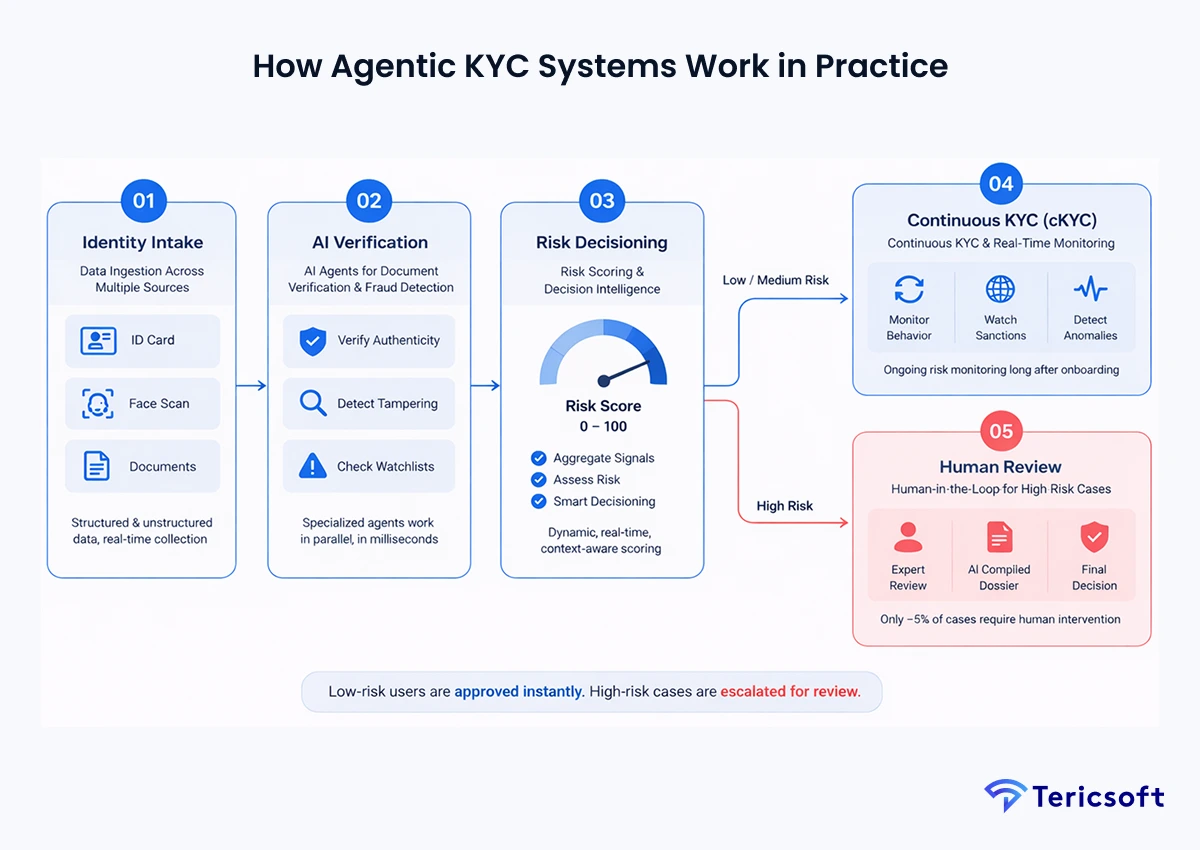
How Agentic KYC Systems Work in Practice
To truly grasp the transformative power of AI in KYC, we must look at how these systems operate beneath the surface. Agentic KYC is not a single software tool. It is a highly orchestrated ecosystem of specialized AI models working in perfect unison.
Step 1: Identity Data Ingestion Across Multiple Sources
The magic begins with frictionless data ingestion. Agentic systems seamlessly pull both structured and unstructured data from diverse sources in real time. This includes government ID scans, live facial biometrics, utility bills, and even complex digital footprints. Within milliseconds, the system synthesizes this vast array of information to create a unified, highly detailed identity profile.
Step 2: AI Agents for Document Verification and Fraud Detection
Once the initial data is ingested, specialized AI agents immediately take over. Using state-of-the-art document verification AI, the system performs exhaustive pixel-level analysis of IDs to detect sophisticated tampering, micro-print alterations, or screen replay attacks. Simultaneously, it cross-references hidden watermarks and holographic data against massive global databases of valid document templates.
Step 3: Risk Scoring and Decision Intelligence Engines
Instead of forcing users through a rigid "pass/fail" binary, agentic systems utilize nuanced decision intelligence engines. These engines aggregate the real-time findings from the document agents, the biometric agents, and external background check APIs to generate a dynamic, highly accurate risk score. If the user presents a low risk, the system approves them instantly. If anomalies are detected, the system intelligently and automatically increases the friction, perhaps prompting the user for one additional layer of verification without stopping the entire flow.
Step 4: Continuous KYC (cKYC) and Real-Time Monitoring
Perhaps the most revolutionary aspect of this technology is the definitive shift toward continuous KYC. Traditional KYC is merely a point-in-time check, a snapshot that quickly goes out of date. Agentic systems, however, monitor user behavior continuously long after the initial onboarding is complete. If an established account suddenly exhibits high-risk transaction patterns or if the user is newly added to a global sanctions list, the AI agent flags the account immediately, drastically reducing the institution's exposure to ongoing financial crime.
Step 5: Human-in-the-Loop for High-Risk Cases
A common misconception is that Agentic KYC entirely eliminates human workers. In reality, it elevates them. The automated system easily handles the standard 95% of routine applications. However, for the highly complex, ambiguous 5% of cases that trigger severe risk alerts, the AI compiles a comprehensive, easy-to-read dossier highlighting the exact reasons for the flag. It then smartly routes this package to a senior human compliance officer for final review. This ensures vital human intuition and robust governance remain firmly in place where they are needed most.
Key Technologies Powering Agentic KYC
Agentic KYC is not powered by a single model, but by a layered AI architecture working in orchestration. The advanced capabilities of autonomous KYC are built on this rock-solid foundation.
LLMs for Identity Intelligence
Large Language Models (LLMs) provide a level of contextual understanding that was previously impossible in software automation. They can read complex, unstructured corporate registry documents spanning multiple languages, extract ultimate beneficial ownership (UBO) hierarchies, and truly understand the nuanced context hidden behind complex financial structures and corporate shells.
Computer Vision for Biometric and Document Validation
State-of-the-art computer vision models act as the highly precise verification layer of the operation. These models execute rigorous 3D liveness detection to ensure the person sitting in front of the mobile camera is a real, breathing human being and not a high-resolution printed mask, a tablet displaying a video, or a digital injection attack.
Graph AI for Fraud Detection
Graph neural networks are masters of connection. They continuously analyze the invisible links between seemingly disparate data points. If a brand new applicant shares a deeply buried device ID, an IP subnet, or a partial physical address with a previously flagged fraudulent account, graph intelligence instantly maps these hidden relationships and blocks the bad actor before they can breach the financial ecosystem.
Retrieval-Augmented Generation (RAG) for Compliance Context
RAG architectures are the brain's reference library. They allow AI agents to securely and instantly query an institution's internal, proprietary compliance manuals right alongside shifting global regulatory databases. This groundbreaking technology ensures the AI is always making decisions grounded in the exact, up-to-date legal frameworks required by the institution's specific, local jurisdiction.
API and Agent Orchestration Layers
The true operational power lives in the orchestration layer. This sophisticated middleware acts as the master conductor, seamlessly routing complex tasks between various specialized AI agents, legacy core banking systems, and external government databases. It ensures the entire multi-step workflow executes flawlessly in mere milliseconds.
Benefits of Agentic KYC for Banks and Financial Institutions
Agentic KYC is not just an operational upgrade. It fundamentally changes the economics of compliance. Deploying an autonomous compliance infrastructure delivers compounding, aggressive returns across the entire enterprise.
Faster Customer Onboarding and Reduced Drop-Off
By fully leveraging onboarding automation, forward-thinking financial institutions can approve legitimate, high-value customers in a matter of seconds. This radically frictionless experience drastically reduces drop-off rates, directly boosting customer acquisition metrics and driving immediate top-line revenue growth.
Significant Reduction in KYC Operational Costs
The financial impact of replacing manual data entry with intelligent automation is nothing short of profound. The numbers speak for themselves: Organizations implementing AI KYC automation have reduced onboarding costs by up to 70% and verification time by 78%, while improving fraud detection accuracy by over 60%.
Improved Fraud Detection and Risk Accuracy
Autonomous AI agents can analyze thousands of distinct data points simultaneously, easily identifying subtle, interconnected anomalies that human eyes cannot possibly perceive. By natively integrating sophisticated AI fraud detection in banking frameworks, institutions can preemptively identify and block synthetic identities and highly organized financial crime rings before they cause damage.
Enhanced Regulatory Compliance and Audit Readiness
Agentic systems meticulously leave an immutable, cryptographic audit trail for every single decision they make. When regulators inevitably request an audit, compliance teams do not need to scramble. They can instantly export a detailed, transparent log showing exactly why an AI agent approved or rejected a specific profile, ensuring complete transparency and peace of mind.
Scalable KYC for High-Growth Fintech Platforms
For rapid-growth fintechs, user acquisition can spike wildly and unpredictably. Agentic AI scales instantly and effortlessly. Whether processing 100 applications on a Tuesday or 100,000 applications during a weekend marketing blitz, the system maintains the exact same consistent speed and rigorous accuracy without requiring sudden headcount increases.
Real-World Use Cases of Agentic KYC
Digital Banking Account Opening
Neobanks and legacy banks alike are deploying agentic systems to finally offer true instant account creation. Customers scan their physical ID, take a quick selfie, and gain full access to premium digital banking services in under 60 seconds.
Lending and Credit Risk Onboarding
In the highly competitive lending sector, AI agents rapidly verify identity, pull diverse credit histories, and deeply analyze income documents. This allows lenders to provide near-instant loan approvals while maintaining incredibly strict risk parameters.
Cross-Border Payments and Remittance Compliance
Global remittance platforms utilize continuous monitoring agents to ensure absolute compliance across multiple complex jurisdictions simultaneously. The agents run instant AML and global sanctions checks in the background just seconds before clearing international funds.
Crypto and Web3 Identity Verification
Cryptocurrency exchanges operate in notoriously high-risk environments facing intense regulatory scrutiny. Agentic KYC allows these advanced platforms to verify unique users securely, block bad actors attempting to launder stolen funds, and maintain trust in decentralized ecosystems.
Challenges and Risks in Implementing Agentic KYC
While the operational benefits are materially transformative, enterprise leaders must skillfully navigate specific architectural and governance challenges to ensure success.
Data Privacy and PII Protection Concerns
Processing highly sensitive Personally Identifiable Information (PII) demands the most rigorous security posture possible. Institutions must guarantee their AI architectures utilize robust encryption and advanced tokenization. Deeply understanding data privadcy in LLM environments is absolutely critical to preventing catastrophic data leaks and ensuring strict GDPR compliance.
Bias and Explainability in AI Decisions
Opaque, "black-box" AI models are strictly unacceptable in regulated finance. If a system rejects a legitimate, marginalized customer due to biased historical training data, it invites massive regulatory fines and reputational ruin. Implementing Explainable AI (XAI) frameworks ensures that absolutely every automated decision is transparent, fair, and easily understood by human auditors.
Integration with Legacy Core Banking and ERP Systems
Many highly successful traditional banks still operate on decades-old monolithic legacy systems. Integrating modern, API-first AI agents into these archaic structures requires specialized middleware engineering and a deeply phased, thoughtful digital transformation strategy.
Regulatory Acceptance of AI-Driven KYC Systems
Understandably, global regulators are cautious about fully autonomous systems making critical financial security decisions. Banks must work proactively and transparently with regulators, actively demonstrating the statistical reliability of their AI models and clearly showing that a human-in-the-loop fallback mechanism is always present and active.
Agentic KYC vs Traditional KYC vs eKYC
Understanding this massive technological leap requires a direct, feature-by-feature comparison.
The Future of KYC: From Verification to Continuous Identity Intelligence
The future of KYC is invisible, continuous, and intelligence-driven. The undeniable trajectory of global identity verification is moving aggressively toward completely zero-friction, ultra-high-security ecosystems.
From Periodic KYC to Real-Time Identity Monitoring
The outdated concept of forcing customers to update their KYC documents every three years is quickly becoming obsolete. The future belongs to real-time identity intelligence, where a user's overall risk profile dynamically and invisibly adjusts based on continuous behavioral and transactional data streams.
AI Agents as Compliance Co-Pilots
As this technology matures, compliance teams will transition away from acting as manual data entry clerks and become highly strategic risk overseers. AI agents will act as tireless, high-powered co-pilots, doing the heavy lifting of massive data analysis and presenting human officers with refined, highly actionable intelligence.
KYC as a Strategic Intelligence Layer for Financial Institutions
Ultimately, KYC will shift from being viewed simply as a frustrating regulatory cost center to a massively valuable core business intelligence layer. The incredibly rich, continuously verified data gathered securely during the onboarding process will fuel hyper-personalized financial product offerings and drive entirely new revenue streams for the bank.
How Enterprises Can Implement Agentic KYC Successfully
Meaningful enterprise transformation requires a highly strategic, well-engineered roadmap.
Building a Secure and Compliant AI Architecture
You must start with an unshakeable foundation of security. Ensure your corporate data lakes are heavily encrypted, your specialized AI models are hosted in tightly compliant environments, and your overarching architecture adheres strictly to global SOC2 and ISO 27001 standards.
Integrating Agentic KYC with Existing Systems (ERP, Core Banking)
Do not attempt a risky "rip and replace" core strategy. Instead, utilize flexible API-first architectures to seamlessly connect powerful new AI agents with your existing legacy CRM, Treasury, and Core Banking systems, ensuring vital data flows smoothly across the entire enterprise.
Governance, Auditability, and Risk Controls
Immediately establish a dedicated, cross-functional AI governance committee. Implement strict version control for all deployed machine learning models and ensure every single automated decision is cryptographically logged in a centralized, immutable ledger for rapid audit purposes.
Choosing the Right Technology and Implementation Partner
Implementing true, enterprise-grade AI KYC automation is incredibly complex. Enterprises cannot go it alone; they must partner with specialized, proven technology providers who possess deep, specialized expertise in both advanced artificial intelligence engineering and complex financial regulatory compliance.
How Tericsoft Enables Agentic KYC for Enterprises
At Tericsoft, we build the underlying intelligence infrastructure that powers the future of finance. We empower ambitious financial institutions to transition seamlessly and securely from fragile legacy processes to robust, autonomous identity intelligence.
Secure, Compliance-First AI Architecture
We proudly design our AI systems from the ground up with strict regulatory compliance at their absolute core. Our sophisticated frameworks are custom-built to satisfy the most stringent, uncompromising requirements of global financial regulators, ensuring your business is always secure and always audit-ready.
Integration with Core Banking, ERP, and Treasury Systems
Our elite engineering teams specialize in deep enterprise integration. We build highly custom middleware solutions that allow our advanced Agentic KYC modules to plug directly into your existing, complex legacy systems without causing a single moment of disruption to your ongoing operations.
PII-Safe RAG and Agentic AI Frameworks
We rigorously protect your most sensitive corporate asset: your customer data. Utilizing highly advanced, PII-safe Retrieval-Augmented Generation, our localized AI agents can rapidly process identity documents and make incredibly intelligent decisions without ever exposing raw, sensitive customer data to risky public AI networks.
Scalable Deployment (On-Prem / Private Cloud)
We deeply understand that tier-one banks require ultimate, uncompromising control over their critical infrastructure. We offer highly flexible deployment models, allowing large institutions to run our Agentic KYC systems entirely on-premises or deeply within highly secure, air-gapped private cloud environments.

Agentic KYC is an AI-driven identity verification approach where autonomous agents perform, analyze, and optimize KYC processes in real time without manual intervention.
Traditional KYC relies on manual checks, while eKYC digitizes the process. Agentic KYC goes further by using AI agents for autonomous decision-making, real-time risk analysis, and continuous monitoring.
AI enhances KYC by enabling document verification, biometric authentication, fraud detection, and real-time risk scoring with higher accuracy and speed than manual processes.
Agentic KYC reduces onboarding time, lowers operational costs, improves fraud detection accuracy, enhances compliance, and delivers a better customer onboarding experience.
Yes, when implemented correctly, Agentic KYC uses secure AI architectures, encryption, audit trails, and compliance frameworks to meet regulatory standards like AML and data privacy laws.