An "AI call center" sounds like a rip-and-replace. The useful version is voice agents on the phone system you already own, no migration, grounded and scoped.
The phrase "AI call center" makes people picture a rip-and-replace: tear out the contact center, buy a new platform, port every number, retrain everyone. There is a quieter version that most operators actually want. It is autonomous voice agents that answer and place calls on the phone system you already own, on the numbers and trunks you already pay for, live on a single queue in days, working alongside the people you already have. This article explains what an AI call center is, how it works on a call, what it should and should not do, and how the integration-first approach lets you add one without replacing anything underneath it.
The pressure to do this is real and the economics are moving. In a 2022 forecast, Gartner projected that conversational AI will reduce contact center agent labor costs by 80 billion dollars in 2026, noted that labor can be as much as 95 percent of contact center cost, and estimated that roughly one in ten agent interactions would be automated by 2026, up from about 1.6 percent in 2022 (Gartner, 2022). The question is no longer whether to put AI on the phone. It is how, and whether how has to mean throwing out what works.

What Is an AI Call Center?
An AI call center is software that uses voice agents to handle phone calls end to end: it answers an inbound call or places an outbound one, understands natural speech, pulls up and updates the right records during the conversation, completes a defined task, and hands the call to a person when it needs human judgment. That is the line between AI call center software and the things it gets confused with. It is not a website chatbot, not a transcription tool, and not an old IVR phone tree with a new voice. It is an agent on the line that can actually do the thing the caller phoned about.
There are two broad ways to buy one, and they are genuinely different. Full-platform products ask you to move your telephony onto them and run the call center there. Integration-first products, including SuperVoice, connect to the phone system you already run and add voice agents on top of it. Both are real; this guide is written from the integration-first side, because for an operator with a working phone system it is usually the faster and cheaper path.
One distinction cuts across both: voice-grade versus text-grade. A chatbot bolted to a phone number stalls on interruptions and talks over people. A real voice agent replies in under a second and handles barge-in, so a caller can cut in the way they would with a person. On the phone, that gap is the whole experience.
How Does an AI Call Center Work?
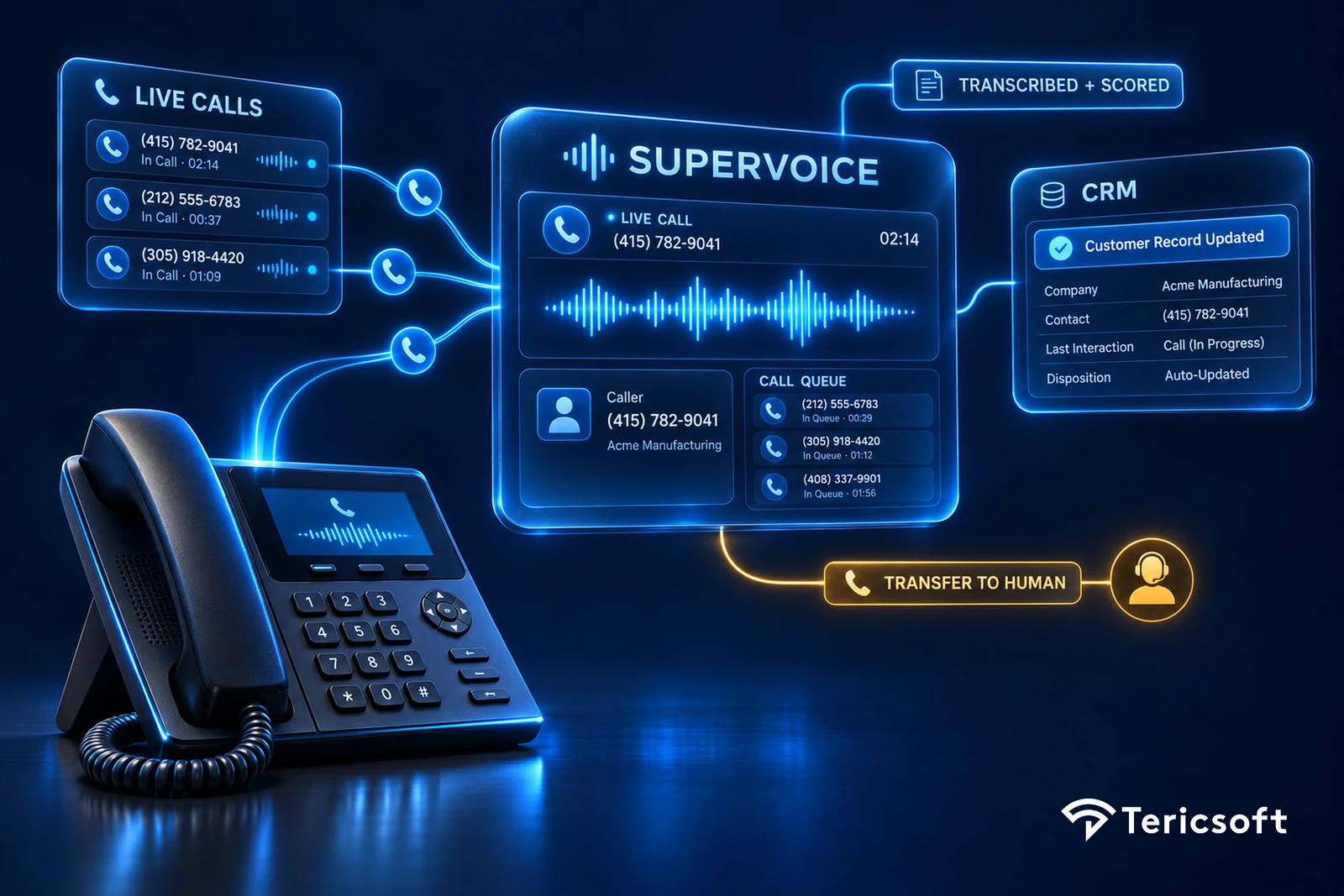
On a single call, an AI call center runs the same short chain every time. A call arrives or is placed. Speech recognition turns the caller's words into text in real time. An intent layer works out why they are calling and routes to the right specialist agent. That agent reasons over the request, fetches the facts it needs from your systems through APIs during the call, and either completes the task or, if the call needs judgment, transfers to a human with the context attached. Text to speech gives the agent its voice, and the whole call is recorded, transcribed, and scored. The flow looks like this:
grounded via your APIs
Here is the same thing as a concrete example. A patient calls a clinic to move an appointment. The agent answers on the first ring, recognizes the intent as rescheduling, looks up the patient and their booking through the clinic's own API, offers the real open slots, confirms the new time, writes it back to the calendar, and sends the confirmation text. If the caller instead describes a symptom that needs a nurse, the agent stops, says so, and transfers to a person with the transcript attached. The whole call is scored against the clinic's criteria. No one waited on hold, and no record was touched by hand.
How AI Call Center Software Works With Existing Phone Systems
Every buyer guide to AI call center software tells you to ask one question in particular: does the platform own its telephony? It is a fair question, and the integration-first answer flips it around. The best telephony to run your AI call center on is often the telephony you already have. Your numbers, your trunks, your carrier relationships, the routing your team already understands. An integration-first voice layer connects to those, ports nothing, and changes no hardware. In SuperVoice deployments a single queue is typically live within days, running next to your existing staff rather than in place of them.
This matters because the migration is where the cost and the risk actually live. The calls do not care which company owns the SIP trunk. Your customers do not notice. What they notice is whether the call got answered and the task got done. Integration also runs both ways into your records: the agent reads and writes through your CRM's APIs during the call, and each call fires a webhook into your systems, so a conversation on the phone updates the same database your people use.
The Rip-and-Replace Trap
The market sells AI call centers in two shapes, and both can be right for some teams. Enterprise contact center suites ask you to migrate your whole telephony stack onto their platform, which suits organizations rebuilding their contact center anyway. Developer voice toolkits give you the pieces and ask you to build and run the stack yourself, which suits teams with engineers to spare. For a mid-market operator that already has a working phone system, a CRM, and trained agents, both start by charging for the most expensive and riskiest part of the project, the migration, before a single call is improved. The three honest options look like this:
The third row is where most operators actually want to be, and it is the approach SuperVoice is built around.
The Benefits of an AI Call Center
When the scope is right, the gains are concrete rather than magical:
- Always on. The line is answered around the clock, with no hold queue and no voicemail, including nights, weekends, and spikes.
- Capacity on tap. A hundred callers at once get answered at once. Capacity scales with the queue instead of with how many people you could hire and train.
- Cost that tracks usage. Per-minute pricing means a quiet hour costs nothing and a busy morning costs what it uses, rather than paying for idle desks.
- Consistency and a record. Every call follows the same scoped script, is grounded in your data, and is recorded, transcribed, and scored on the same criteria, which is hard to guarantee across a human team on a bad day.
- People on the work that needs them. Routine calls are handled automatically and the ones that need judgment reach a person with context, so your team stops triaging and starts resolving.
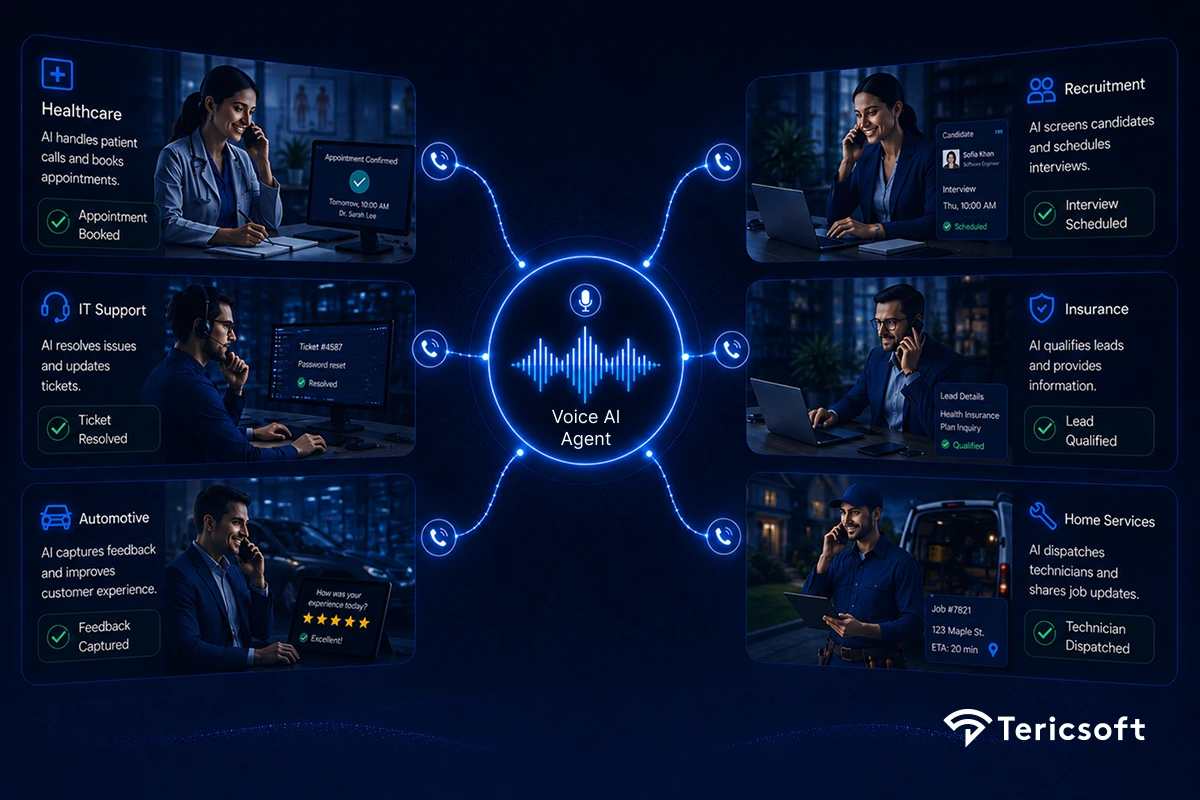
The same pattern shows up across AI voice agent use cases: a narrow, high-volume call type that used to be capped by headcount, handled at machine scale, with humans kept for the exceptions.
What the Agent Should Do on the Call, and What It Should Not
Scope is the whole game. An AI call center earns its keep on bounded, repeatable calls: appointment booking and reminders, order and delivery confirmations, renewals, lead qualification, early-stage collections, verification and status checks. On those calls the agent should do four things well. It should understand speech in real time with sub-second replies and barge-in. It should stay grounded, fetching balances, order status, and availability through your own APIs during the call rather than guessing, with hard scope limits written into each agent so it will not invent an answer. It should execute, triggering your real workflows through your APIs instead of just talking about them. And it should hand off cleanly, passing a call that needs judgment to a human with the full context attached.
The things it should not do matter just as much. It should not freewheel open-ended conversations it was never scoped for, make commitments outside its task, or stand in for a person where disclosure and consent rules apply. A voice agent that stays inside its lane and refuses to make things up is more valuable than one that sounds impressive and occasionally lies to a customer.
Multi-Agent, Not One Mega-Bot
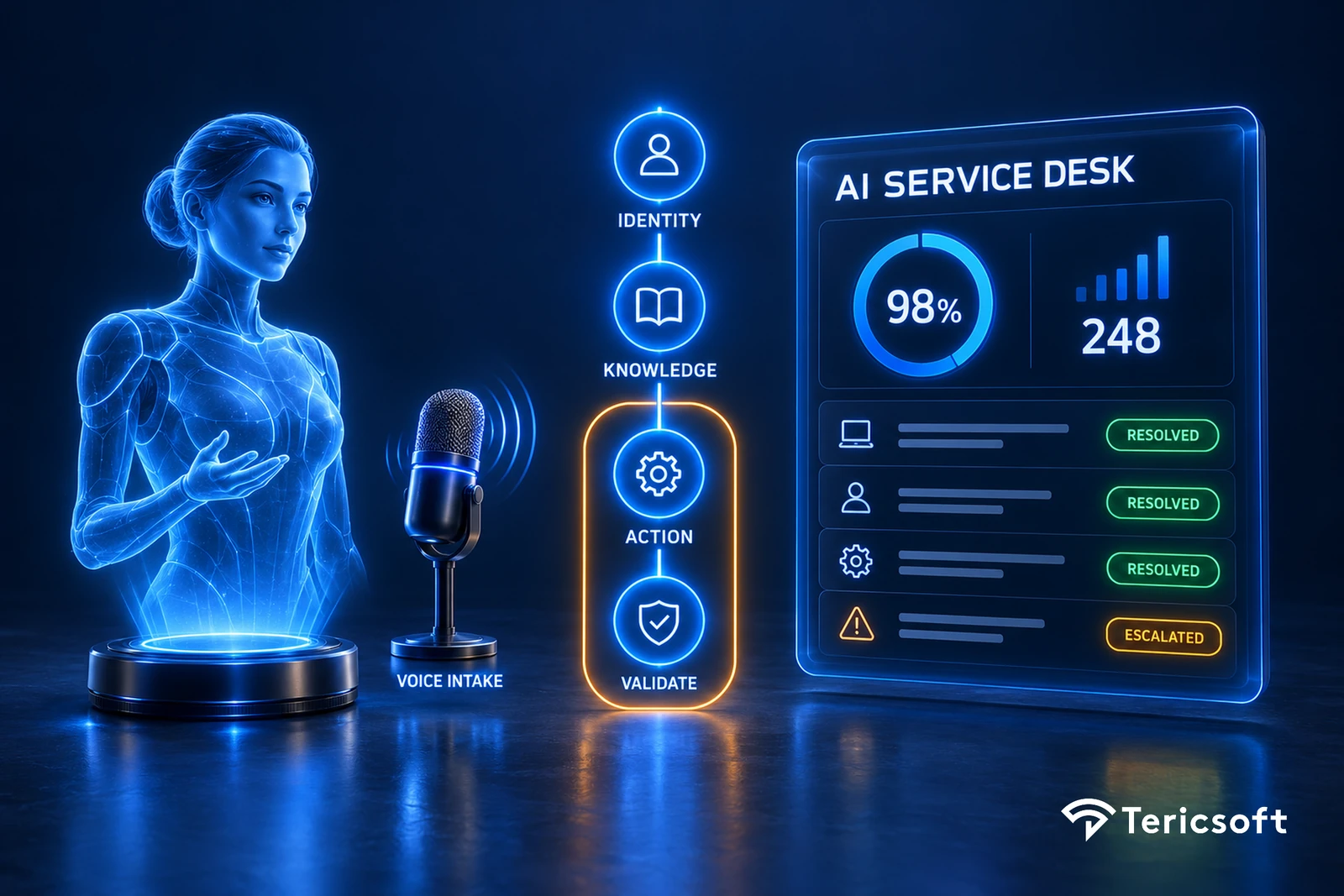
A production AI call center is not one giant prompt trying to do everything. It is a set of specialist agents, one per kind of call, a scheduling agent, a verification agent, a collections agent, a support agent, each with its own scope and its own grading criteria, sitting behind a master intent layer that listens to why the caller rang and routes to the right one. Underneath, the model stack is swappable: speech recognition, text to speech, and the language model all sit behind connectors, so you are never locked to one vendor's voice or one model's pricing. The call center as a whole behaves like one assistant, but it is really a coordinated set of narrow, reliable ones, which is the same lesson that shows up anywhere AI runs real operations, from an AI service desk to fleet operations: the hard part is orchestration rather than any single model.
How to Implement an AI Call Center
The rollout is deliberately small, and it goes queue by queue rather than all at once:
- Pick one bounded, high-volume queue. Something like appointment reminders or delivery confirmation, where the calls are repeatable.
- Connect to the existing number or trunk that queue already runs on. Nothing is ported and no hardware changes.
- Wire it to your CRM through the API so the agent reads and writes the same records your people do, with a webhook firing on each call.
- Set the scope limits and the grading criteria so the agent stays in its lane and every call is judged the same way.
- Run it alongside your staff and watch every call get recorded, transcribed, and scored against those criteria.
- Add the next queue once the first one is working.
There is no multi-quarter migration, because there is no migration. There is a queue that was answered by hold music yesterday and is answered by an agent today.
See AI voice agents work on your existing phone system. Book a live SuperVoice demo and watch SuperVoice handle a real call, read and write to your CRM, and transfer a complex conversation to your team, all on the numbers you already own.
AI Call Center Pricing: Per-Minute vs Per-Seat
AI call center pricing varies by provider. Common models include per-minute usage, monthly subscriptions, per-seat licenses, and platform fees, often in combination. Integration-first products like SuperVoice typically use per-minute usage pricing, where you pay for the minutes the agent actually talks and you see the rate while you build the agent, so cost aligns with call volume rather than with provisioned desks. The reason this model suits bounded, spiky queues is simple: a quiet hour costs nothing, and a busy morning costs what it uses rather than what you staffed for.
A rough illustration shows the shape. The figures below are round, generic market numbers for illustration only, not SuperVoice pricing, and you should replace them with your own. Take a reminders queue of 10,000 calls a month averaging three minutes each, which is 30,000 minutes. Published voice-AI usage rates in the market run roughly 7 to 15 cents a minute; at a round 10 cents, that queue's AI usage lands on the order of 3,000 dollars a month, and it falls when volume falls. Handling the same 10,000 calls with people, at say five minutes of handle time each and a loaded cost around 20 dollars an hour, is on the order of 17,000 dollars a month of staffed time, most of which shifts to the agent as it absorbs the routine calls while people keep the exceptions. The exact numbers are yours to fill in. The point is that usage-based cost tracks demand, while per-seat cost tracks your staffing plan.
AI Call Center vs Traditional Call Center
The two are not the same tool with a different engine. They differ on the dimensions a buyer actually weighs:
The point is not that the AI call center wins every row for every team. It is that for bounded, repeatable, high-volume calls, the AI column is simply a better fit, and for nuanced, high-empathy calls, the human column still is. A good deployment uses both on purpose. These rows are tendencies rather than laws: traditional platforms can bill by usage too, and an AI call center still runs within the capacity you provision and can queue under a large enough spike.
Where This Already Runs in Production
None of this is theoretical. Autonomous voice agents already run bounded call work in production across healthcare, real estate, banking, insurance, and mobility operations, on the operators' own telephony. In one healthcare-staffing deployment, a voice AI recruiter screens candidates around the clock, available 24 hours a day, and has processed more than 100,000 candidates, calls that previously waited for a human recruiter to be free, with the exceptions still routed to a human. The full case study covers how it was built and measured. The pattern is always the same: a narrow, high-volume call type that used to be capped by how many people could hold a phone, handled by an agent that does not take lunch, scored on every call, with the hard ones routed to a person.
How to Choose the Best AI Call Center Software
Skip the feature grid and ask seven questions:
- Does it run on my existing numbers and trunks, or does it require me to migrate my telephony?
- Is it voice-grade, with sub-second replies and barge-in, or a chatbot attached to a phone line?
- Is it grounded in my data through APIs during the call, or does it guess?
- Can it hand a call to a human with the context intact?
- Is every call recorded, transcribed, and scored?
- How is it priced, and does the model track call volume or fixed seats?
- Is it a set of scoped specialist agents, or one mega-bot trying to handle every call type at once?
The answers separate an AI call center you can trust on a live line from a demo that falls apart in week two.
Key Takeaways
- An AI call center can run on the phone system you already own. The integration-first version connects to your existing numbers and trunks and goes live on one queue in days, with no migration.
- Voice-grade, grounded, and scoped beats impressive. Sub-second speech with barge-in, answers fetched from your data through APIs, hard scope limits, and clean human handoff are what make it safe on a live call.
- It is many agents, not one bot. Specialist agents per queue behind a master intent router, on a swappable model stack, is how a real AI call center stays reliable.
- Pay per minute, not per seat. Cost should scale with calls handled and be visible before you spend, not licensed by the desk.
About Tericsoft
Tericsoft is an AI-first technology partner, and SuperVoice is our AI call center: autonomous voice agents that run on the telephony, CRM, and systems a company already owns. We built it because the operators we work with did not need a new contact center. They needed the calls answered and the tasks done, without a migration, a hardware change, or a per-seat license. SuperVoice connects to your existing numbers, grounds every answer in your data, grades every call, and hands the hard ones to your people. If the phone is a bottleneck in your operation and ripping out what works is not an option, that is exactly the problem we built for.
Voice agents that handle calls end to end: understand speech, update your records, complete a task, and hand off to a human when needed.
Speech-to-text transcribes the caller, an intent router picks a specialist agent that uses your APIs to finish the task or hand off.
Depends on the type. Full-platform products need migration; integration-first ones like SuperVoice add agents to numbers you already own.
Yes. It reads and writes records through your CRM's APIs during the call and fires a webhook per call, updating your existing systems.
Pricing varies by provider: per-minute usage, subscriptions, or platform fees. Tools like SuperVoice typically price by usage.