Most "AI service desks" are just a chatbot on the ticket form: they answer, then hand the real work to a human. What does it take to actually resolve?
Most IT teams have been sold an AI service desk that turns out to be a chatbot sitting on top of the ticket form. It answers a few frequent questions, deflects a thin slice of traffic, and hands everything else to a human engineer who starts the ticket from scratch. The gap between a bot that answers and a system that resolves is the whole problem. The difference is not a better chatbot. It is a different architecture.
We built one for a global IT managed-services firm, an AI-powered voice service desk where more than a dozen AI agents resolve the majority of incidents autonomously. This article is what that work made obvious about why most AI service desks stall, and what actually separates a wrapper from a system.
The chatbot wrapper problem
It gets sold as an AI help desk, or as service desk automation, but a scripted chatbot deflects only a small fraction of tickets and escalates the rest, because it can answer a question but it cannot do anything. Most L1 support is not hard, it is repetitive: password resets, access requests, status checks, the same fix applied a hundred times a week. The knowledge to resolve it exists. What is missing is a system that can act on that knowledge safely, end to end, without a human doing the typing.
A wrapper answers. It tells the user how to fix the problem, or it opens a ticket and walks away. The engineer still verifies the caller, still logs the incident, still looks up the fix, still performs it. The chatbot moved the conversation; it did not move the work. Until the AI can take the ticket from intake to resolution, it is a deflection tool wearing an automation label.
Voice-first intake is the unglamorous unlock
The first place work actually leaks is intake. A huge share of tickets still begin as a call or a message where a human collects the user's details, confirms who they are, and creates the incident before anyone has touched the problem. That logging tax is pure overhead, and it is where a real AI service desk starts.
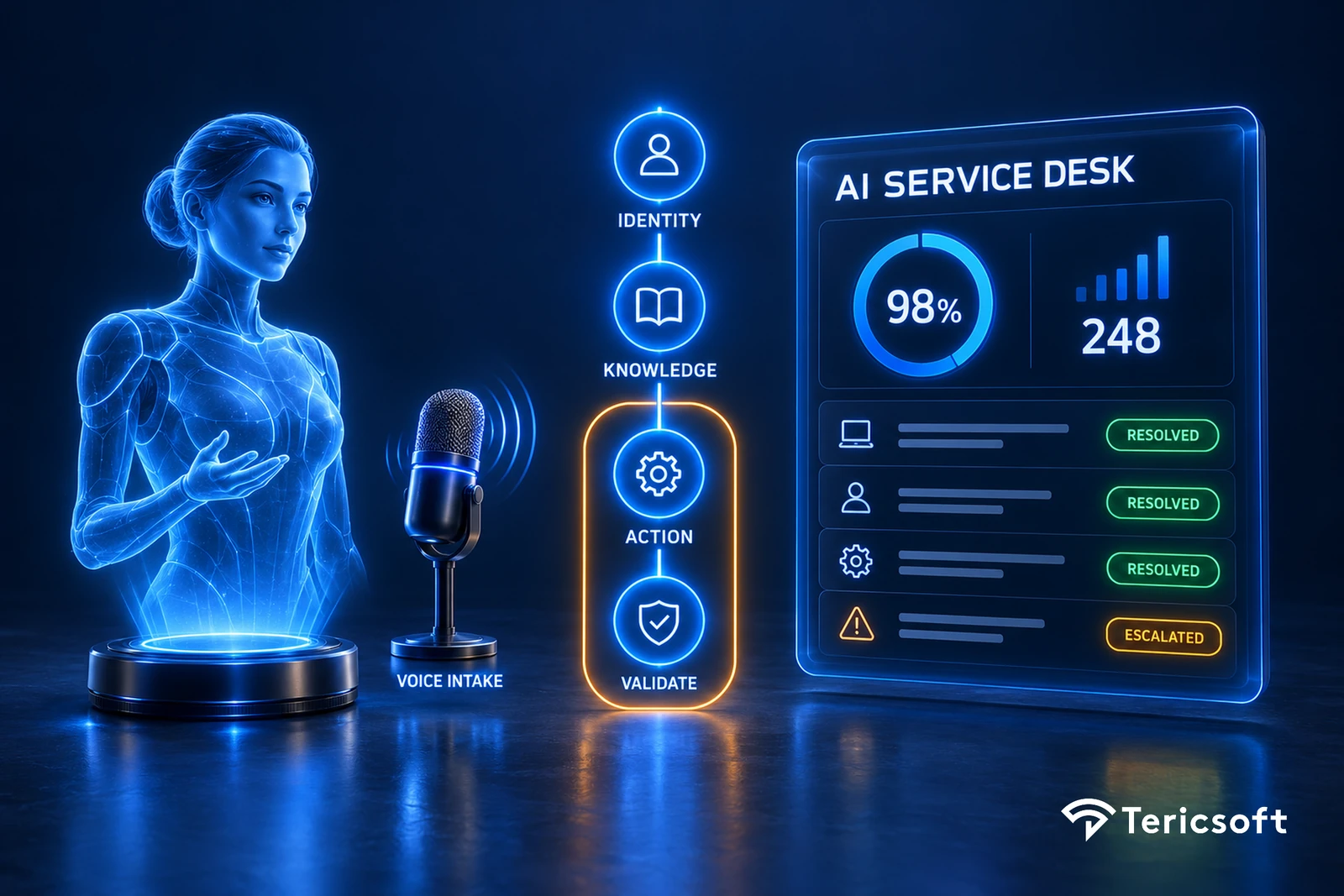
A voice-first AI voice agent takes the call, verifies the caller's identity, and creates a complete, correctly categorized ticket in the existing ITSM, enterprise or homegrown, before a human is ever involved. Identity verification is the part nobody demos and everybody needs, because you cannot reset an account or grant access for a caller you have not confirmed. Get intake and verification right and the ticket arrives ready to resolve, not ready to be re-typed.
A knowledge engine built on your own tickets
The second failure is pretending a general-purpose model knows your environment. It does not. The resolutions that matter are buried in your own closed tickets, runbooks, and SOPs, written in your systems' language, and scattered where no one can find them twice. Engineers re-solve the same incident from scratch because last year's fix is unfindable.
A real AI service desk is built on a self-learning knowledge engine that turns the customer's own ticket history into searchable intelligence, and enriches it every time a resolution is verified. That is what lets the AI recommend the fix that actually works here, not a plausible answer from the open internet. AI IT support is only as good as the knowledge it reasons over, and the best knowledge you have is the record of what already worked.
Multi-agent resolution, with guardrails
The third difference is that one agent does not resolve a ticket. Several do, each with a job: one handles intake, one diagnoses, one acts, and one validates. They work the same ticket in real time while checking security, compliance, and execution at every step. That validation layer is not overhead; it is the thing that makes autonomous action safe enough to allow.
This is where agentic AI ITSM earns its name. An agent that can reset access, push a change, or run a script is useful and dangerous in the same breath, so the guardrails, the identity check, the policy validation, the confidence threshold that escalates to a human, are the product as much as the automation is. Real AI ITSM automation is defined as much by what it refuses to do without a check as by what it can do. Autonomy without validation is not a service desk. It is an incident waiting to happen.
How one ticket actually flows
Here is what that looks like on a single, ordinary ticket. An employee calls, locked out of their account. The voice agent answers, runs an identity challenge, and confirms who they are. It creates a categorized incident in the ITSM with the details already filled in. The knowledge engine matches the issue to the verified fix from the company's own history. An action agent performs the reset within policy, a validation agent confirms it met the security and compliance rules and logs the evidence, and the user is back to work in minutes.
If identity cannot be confirmed, or the fix carries risk, or confidence is low, the same flow hands a fully documented ticket to a human instead. That end-to-end path, from voice intake to a validated action or a clean escalation, not any single model, is what autonomous IT support actually means.
Why most AI service desks fail
The reason this matters is that most AI service desk automation efforts do not survive contact with production. Gartner predicts that more than 40 percent of agentic AI projects will be canceled by the end of 2027, citing unclear business value, weak risk controls, and escalating costs. A chatbot wrapper is cheap to launch and easy to cancel, precisely because it never did the hard part.
The opportunity on the other side is real, and the direction is set across support. Gartner expects agentic AI to autonomously resolve 80 percent of common customer service issues by 2029, cutting operating costs by about 30 percent. That forecast is for customer service rather than the IT service desk specifically, but the economics carry straight over. The teams that capture it will not be the ones with the slickest bot. They will be the ones that integrated with the real ITSM, built verification and guardrails in, and escalated gracefully when confidence was low.
What building this taught us
The system we built runs more than 12 AI agents and autonomously resolves over 83 percent of incidents, holding service-level commitments at 99.5 percent while the AI closes routine tickets in under 10 minutes and escalates the rest to human engineers with full context. The headline number is the resolution rate. The lesson is what it took to earn it.
The AI that answers a question was the easy part. The system that resolves a ticket, voice intake, identity verification, integration with a homegrown ITSM, a knowledge engine on the customer's own history, multiple agents with security and compliance validation, and clean escalation, is the actual product. Build the wrapper and you deflect a few tickets. Build the system and human engineers stop doing the repetitive work and start handling only what genuinely needs them.
Key takeaways
- A chatbot answers; a service desk resolves. Deflection is not resolution, and most AI service desks stop at a bot that moves the conversation without moving the work.
- Intake and identity are the unlock. Voice-first intake that verifies the caller and logs a complete ticket in the existing ITSM removes the overhead a wrapper leaves behind.
- Your tickets are the knowledge. A self-learning engine built on the customer's own resolution history beats a general model that does not know the environment.
- Guardrails are the product. Multi-agent resolution is only safe with security, compliance, and confidence-based escalation built in, which is also why wrappers without them get canceled.
About Tericsoft
Tericsoft builds AI systems that act, not just answer. For this engagement that meant an AI service desk where voice intake, identity verification, a knowledge engine on the customer's own tickets, and a team of validating agents work together to resolve incidents inside the client's real ITSM. We are an AI-first technology partner, and we tend to be called in when a chatbot has already proven it can answer but not resolve. If your AI support deflects tickets but still leaves the real work to people, closing that gap is the problem we engineer for.

AI agents that intake, diagnose, and resolve IT tickets end to end, not just answer. A real one integrates with your ITSM and acts on it.
A chatbot answers; an AI service desk resolves, with voice intake, identity checks, action in your systems, and escalation when needed.
Yes, for routine L1 work, given intake, a knowledge engine on your own tickets, and guardrails. Good systems auto-resolve common incidents.
Gartner expects over 40 percent of agentic AI projects canceled by 2027, from weak controls, unclear value, or cost. Wrappers go first.
No. It removes repetitive L1 work, and escalates anything needing a person. Engineers move from password resets to the hard problems.