Every team runs AI coding agents now, but few can say what they did yesterday. AI observability for coding agents starts with one thing: record every action.
Almost every engineering team now has AI coding agents running inside it, Claude Code, Cursor, Codex, and more, writing code, running commands, and touching production. Almost none of those teams can answer a simple question: what did those agents actually do yesterday? Which prompts, which commands, which tool calls, on whose machine, in which repository, at what cost? AI observability for coding agents is the answer to that question, and it rests on one unglamorous capability: record every action. You cannot govern, cost, or prove AI coding work you never recorded. Everything else is built on the log, or it is built on hope.
The need is not hypothetical. A July 2025 METR randomized controlled trial of 16 experienced developers across 246 tasks found they were about 19 percent slower with AI tools, even though they had predicted a 24 percent speedup. The headline is not that AI is bad. It is that there was a wide gap between what the developers felt AI was doing and what it was actually doing, and the only way to close that gap is to stop guessing and start recording. Super Eye is the observability layer we built to do exactly that: it records every action your AI coding agents take, on your own server.
What AI observability means for coding agents
The term needs a boundary, because it is used for two different things. Most AI observability and LLM observability tools are built for the AI in your product: they trace the model calls and tool calls of an agent you shipped to users, and score its outputs. That is genuinely useful, and it is a different problem from the one most organizations now have. The new problem is observability for the coding agents your developers run, not the ones you ship.
The question is not whether your AI feature is behaving. It is what the AI coding agents inside your company are actually doing all day. The data is different, the stakes are higher because they involve your source code, your production systems, and your secrets, and the place it has to live is different, because that data cannot safely leave your network to be observed. Coding-agent observability therefore records at the level of the action: every prompt, every reply, every command, every tool call, each one tied to a person, a machine, and a repository.
The two are easy to confuse by name and very different in practice:
Record every action: the foundation
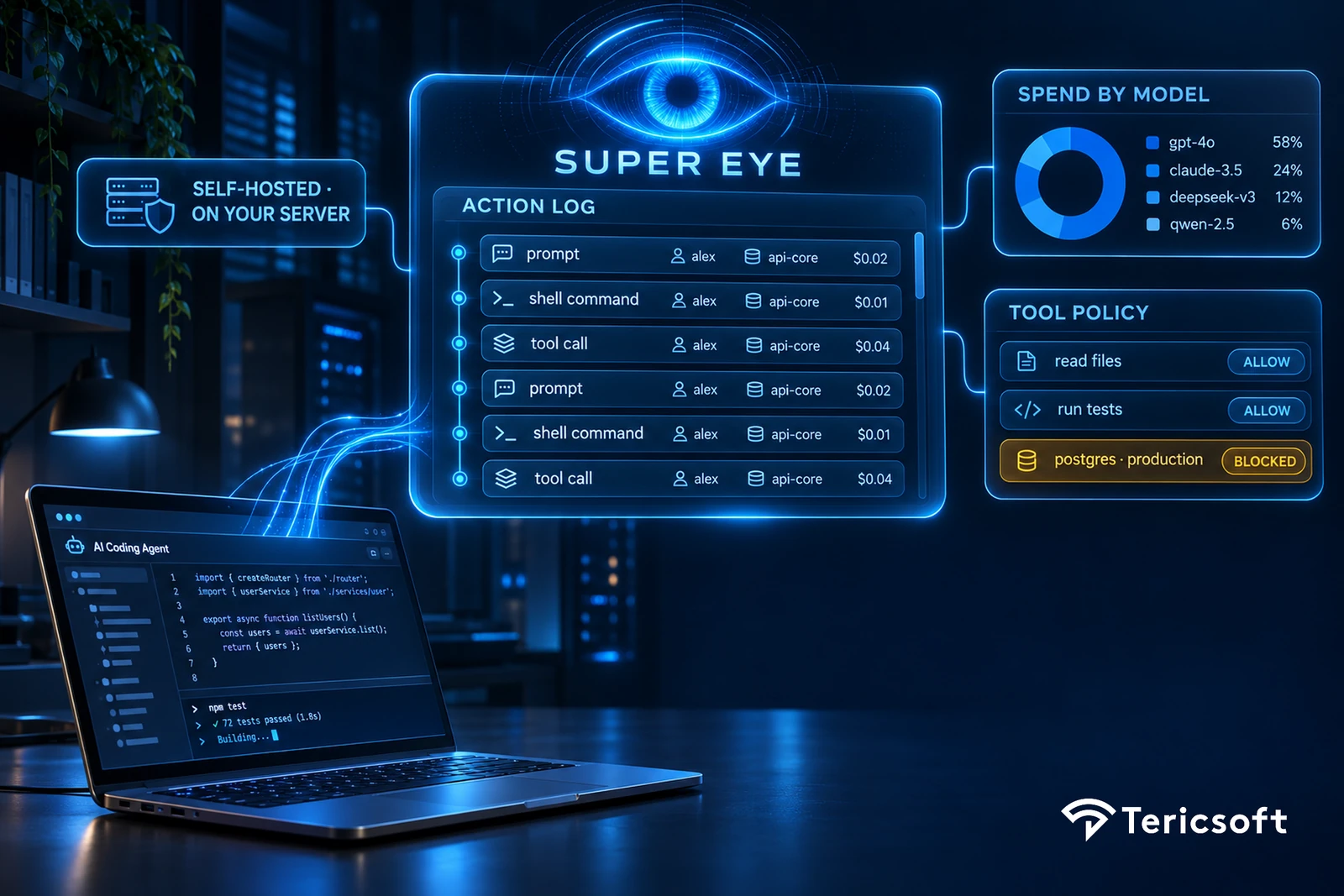
The unit of record is the action, not the outcome. A coding agent's day is thousands of small actions: a prompt, a file edit, a shell command, an API call, a tool invocation. Observability means capturing all of them, searchably, with the cost attached to each. Super Eye records every prompt, reply, command, and tool call, ties each one to who ran it, on which machine, and in which repository, and lets you search any prompt and see exactly what it cost.
Why the action rather than the outcome? Because the merged pull request tells you the result, and the action log tells you how it got there: which commands ran, what the agent touched, and where it went off script. That is the record you need when something breaks at two in the morning, when a secret leaks, or when a client asks what the AI actually did to their code. The outcome is what shipped. The actions are what happened.
The three things you cannot do without the recording
Observability is the base layer, and the useful capabilities sit on top of it. Three of them make the dependency obvious:
- You cannot govern what you do not record. Blocking a risky tool call, a write to production, an outbound email, requires seeing the tool calls in the first place.
- You cannot cost what you do not record. Spend by developer, team, and model is a report computed from recorded actions, not a number you can estimate.
- You cannot prove what you do not record. An evidence report of AI time and cost per task, for a client invoice or an internal review, is only as real as the log underneath it.
That is why Super Eye is organized as three packages that build on one another, and why recording is the one that comes first:
"Record every action" is not one feature among many. It is the floor the whole oversight stack stands on.
What makes a recording trustworthy
Recording is easy to claim and easy to get wrong. A coding-agent recording you can actually rely on has four properties:
- Complete. Every action, not a sample. A sampled log always misses the one command that mattered.
- Attributed. Tied to a person, a machine, and a repository, so no action is ever anonymous.
- Tamper-evident. If recording is switched off on a laptop, that machine is flagged in the admin view, rather than quietly going dark. A gap you can see is safe; a gap you cannot see is the whole problem.
- Safe to keep. Secrets such as keys and phone numbers are hidden as they are typed, before anything is stored, so the log itself does not become a fresh liability.
Super Eye is built around these: secrets are hidden at the source, a flag is raised the moment recording is turned off, and every action carries its person, machine, and repository.
It is worth being precise about what the words mean, because enterprise buyers rightly ask. "Every action" means every prompt, reply, command, and tool call that passes through the supported agent integrations, captured at the agent and tool boundary rather than by scraping a screen. If a machine goes offline, its records are held locally and sent to the server once it reconnects, so a dropped network delays the log without losing it. "Tamper-evident" does not mean recording cannot be turned off; it means that when it is, the machine is flagged in the admin view, so the gap is visible instead of silent, and a visible gap is one a lead can ask about. Redaction happens before storage: sensitive values such as keys and phone numbers are matched and masked as they are typed, so they are never written to the log in the first place rather than scrubbed afterward.
Where the recording has to live
The most important design decision in coding-agent observability is where the log lives, because the actions being recorded are your prompts, your source code, your production commands, and your secrets. Sending that to a vendor's cloud in order to observe it trades one exposure for another. Super Eye is self-hosted: it runs on your own server inside your network, laptops send their records to that server, and nothing is sent to Tericsoft. The observability data never leaves the perimeter it is meant to protect. For a security team, that single property is often the difference between a tool they can approve and one they cannot.
How to set up coding-agent observability
Standing it up is deliberately boring, which is exactly what a security review wants. The shape is the same for most teams:
- Stand up the server on your own infrastructure. Because Super Eye is self-hosted, the first step is a server inside your network that holds the log. Nothing leaves to a vendor cloud.
- Install the lightweight recorder on each developer machine. It runs on Mac, Windows, and Linux and sits alongside the agents your developers already use.
- Connect your supported agents. Super Eye works with Claude Code, Codex, Cursor, Antigravity, and VS Code, capturing prompts, commands, and tool calls at the agent and tool boundary.
- Set attribution and policy. Tie every action to a person, team, and repository, and pick the package you need: Observe to record and search, Govern to add allow and block rules, Prove to add per-task evidence.
- Read the rollup. The overview, sessions, tasks, and people views turn the raw log into spend, policy, and proof a lead can act on.
The deployment decision usually comes down to one question buyers care about most, and the answer is that the data never leaves your network. If you do not have a team to watch the logs, Tericsoft can run the deployment for you as a managed option.
From a log to a picture you can act on
Raw logs are not observability on their own; a picture a human can act on is. On top of the recording, Super Eye rolls the actions up into an overview, sessions, tasks, and people, so a lead can see spend by person and model, review which sessions ran, and search any prompt in seconds. The recording is the ground truth, and the dashboard is how someone reads it.
To make that concrete: over a recent seven-day window on our own engineering fleet, Super Eye recorded 846 prompts across 85 sessions, logged 3,330 actions against 59 tools under policy, and accounted for 2,661 dollars of our own AI tool spend, broken down by model. Those figures are counted directly from the recorded action log, not estimated. They are what recording every action produces, and they are the kind of picture almost no team had before the recording existed.

Observe first
The lesson from building this is an ordering one. Teams reach for governance or for proof first, because blocking a dangerous command and handing a client a clean evidence report are the visible wins. But both collapse without the recording underneath. Governance without a complete log is a rule you cannot verify. Proof without a trustworthy record is a number you are asking people to believe. Observe first: record every action, completely, attributed, tamper-evident, and on your own server. Then governance and proof become rules and reports on top of a log you trust, rather than new systems you hope are correct.
Key takeaways
- Observability for coding agents is action-level recording. Every prompt, reply, command, and tool call, tied to a person, machine, and repository, with cost attached.
- It is a different problem from LLM observability. Tracing the AI in your product is not the same as recording what the coding agents your developers run actually do.
- The recording is the foundation. Governance, cost, and proof are all reports and rules built on the log, so Observe comes before Govern and Prove.
- A trustworthy log is complete, attributed, tamper-evident, and self-hosted. The data never has to leave your network to be observed.
About Tericsoft
Tericsoft is an AI-first technology partner, and Super Eye is our oversight layer for AI coding agents. We built it because our own engineers were running Claude Code, Cursor, and Codex every day, and we could not answer basic questions about what those agents were doing, spending, or touching. Super Eye records every action on a server we control, hides secrets before they are stored, flags any machine that stops recording, and turns the log into spend, policy, and proof. We run it on our own fleet first, which is why the numbers in this article are ours. If your engineers are already using AI coding agents and you cannot yet see what they do, that is the gap we built Super Eye to close.
Recording every action a coding agent takes, every prompt, command, and tool call, tied to a person, machine, and repository, with cost.
LLM observability traces the AI in your product. Coding-agent observability records what the coding agents your developers run actually do.
Every prompt, command, and tool call, with who ran it, on which machine, and what it cost, as a searchable, complete log.
Not with a self-hosted tool. Super Eye runs on your own server and nothing is sent to Tericsoft, so the data never leaves your network.
The outcome tells you what shipped; the actions tell you how. When something breaks or a client asks, the action log answers.