Most EV charging happens at home, which is exactly why apartment and community residents are left out. What does it take to make every parking spot EV-ready?
Most electric vehicle charging happens at home, which is exactly why apartment and gated-community residents are the ones left out. A driver with a private garage plugs in overnight and never thinks about it. A driver who parks in a shared basement has no outlet, no meter, and no easy answer. Making a community EV-ready is not a matter of bolting chargers to a wall. It is a matter of solving three constraints the home charger never has to face, all at once. Get any one of them wrong and the deployment either trips the building or strands the resident.
We built the platform behind exactly this for Eveco, a community-scale EV charging ecosystem for apartment societies and villa communities. This article is what that work made clear about why community charging is its own problem, and what it takes to make every parking spot ready for an electric car.
Why community charging is a different problem
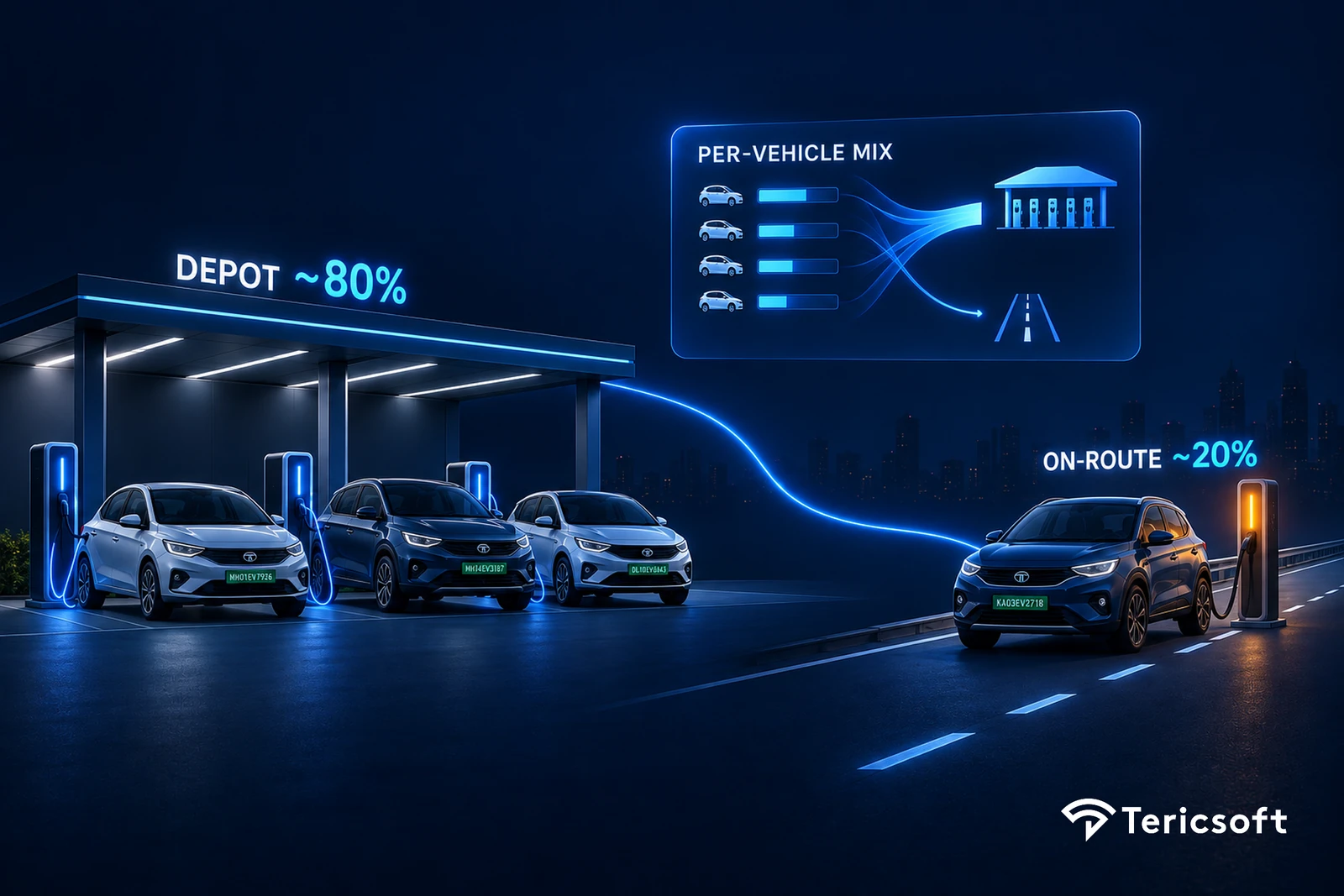
The scale of the gap is easy to miss. The US Department of Energy reports that around 80 percent of EV charging happens at home, and cites a National Renewable Energy Laboratory estimate that as many as 25 percent of EV drivers will not be able to charge at home in the future, largely the residents of apartments and multi-unit dwellings. The people who most need a reliable place to plug in are the ones the market served last.
That gap exists because an apartment or gated community is not a bigger version of a house. The electricity is shared, the parking is often underground, and the bill has to be split fairly among dozens of residents. Those are not installation details. They are the three structural constraints that decide whether community charging works at all, and each one needs its own answer.
Constraint one: the shared grid was never built for EV load
A home circuit serves one household. A community's electrical service was sized for lifts, lighting, pumps, and flats, not for a car park full of chargers all pulling power at once. Add enough chargers and the naive outcome is an overloaded feeder, a tripped main, or an expensive demand on the utility for a bigger connection.
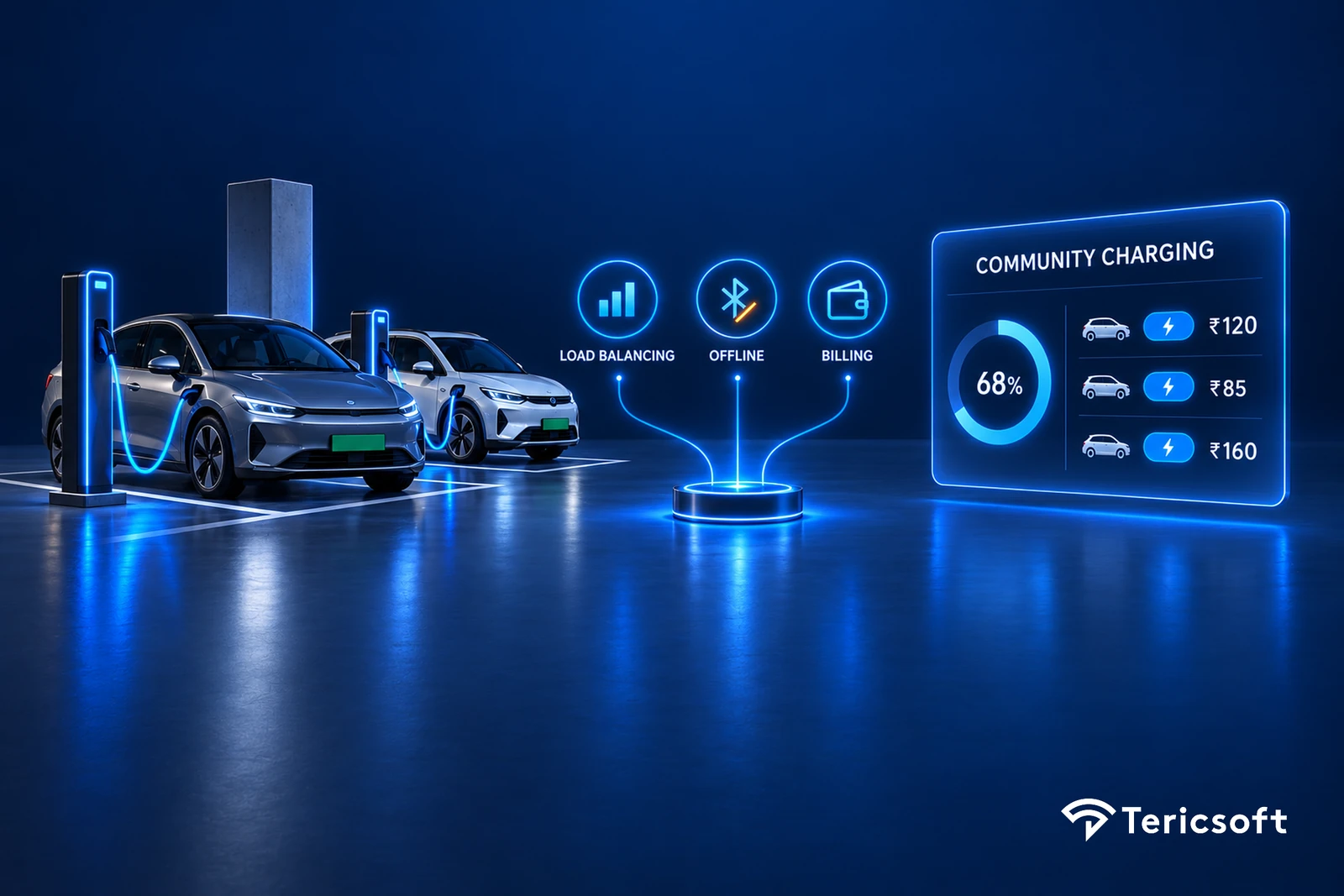
The fix is not a bigger wire; it is EV load balancing. A dynamic load-management engine reads how much capacity the building actually has free at any moment, and shares it across the active chargers, throttling them down when the lifts and lights are drawing and ramping them up overnight when demand falls. Research on AI-driven charging control points the same way: coordinated, demand-aware charging lets far more vehicles share a fixed supply than static allocation ever could. Done well, a community can often charge its whole fleet on the service it already has, avoiding or deferring a grid upgrade, though how far that stretches depends on the building's spare electrical capacity.
Constraint two: the chargers live where the internet does not reach
Here is the constraint nobody budgets for, and it is specific to EV charging in apartment buildings. The cars park underground, and underground is exactly where mobile signal and WiFi die. A charger that depends on a live cloud connection to authorize a session, meter energy, or take payment simply stops working in a basement, which is the one place community chargers actually live.
So the architecture has to be offline-first. The charger and the resident's app must complete a session locally, over a direct link such as Bluetooth, with no round trip to a server in the critical path. Offline EV charging means the cloud is used for analytics and reconciliation, not permission: sessions start, meter, and finish on local intelligence, then sync up the moment connectivity returns. Build it cloud-only and the product works in the showroom and fails in the car park. Build it offline-first and a resident taps to charge in seconds whether the network is there or not.
Constraint three: the bill has to be fair, per resident, across mixed chargers
A house has one meter and one bill. A community has dozens of residents, often several different charger models installed over time, and a management committee that needs every kilowatt-hour attributed to the right flat. Without a shared metering backbone, billing becomes a spreadsheet nightmare and disputes follow.
This is where a unified EV charging management software layer earns its place. One platform meters every session, across every charger variant, into a single wallet and billing system, so each resident pays for exactly the energy they drew and the society sees the whole picture. The metering has to be accurate enough to bill on and consistent across hardware, because a charging network residents do not trust to bill them fairly is a network they stop using.
One backbone, not three point solutions
The temptation is to buy three products: a load balancer, an offline-capable charger, and a billing app. The problem is that the three constraints are entangled. Load balancing has to keep working when the building is offline. Billing has to meter sessions that completed locally. A session that starts on Bluetooth still has to respect the building's live power budget.
That is why real society EV charging solutions are a platform problem, not a parts problem. The load management, the offline-first control, and the metering have to be one backbone that shares state, so a charge that starts underground on a constrained grid still ends up correctly balanced, fully metered, and fairly billed. Stitch three vendors together and the seams are exactly where it breaks. Build one coordinated system and it holds.
What building this for a community taught us
For the Eveco platform, chargers deliver a flexible 3.3 to 22 kilowatts of output, balanced dynamically across the community rather than fixed per stall. In the deployment, tap-to-charge was measured at under 3 seconds, online or over Bluetooth, with live estimates of duration, consumption, and wallet spend, and the data synced cloud-to-device and back without breaking the session. The same platform was built to scale from a handful of chargers in one society to large multi-community networks without re-architecting.
The lesson was that the hard part was never the charger. It was making power, connectivity, and money behave as one system in a place with constrained supply and no reliable internet. Solve that and community charging stops being a pilot and starts being infrastructure, the kind that makes every parking spot in a building ready for an electric car.
Key takeaways
- Community charging is its own problem. Most charging is at home, but apartment and gated-community residents are largely locked out, and a community is not a scaled-up house.
- The shared grid needs load balancing, not a bigger wire. Dynamic load management lets a community charge on much more of its existing service, often avoiding or shrinking a grid upgrade, depending on the building's spare capacity.
- It has to work offline. Chargers live in basements where the internet does not reach, so sessions must start, meter, and finish locally and sync later.
- Billing must be fair and unified. One metering and wallet backbone across every charger variant is what residents trust and what makes the network usable.
About Tericsoft
Tericsoft builds the software backbone that makes physical infrastructure work in the real world. For a community EV deployment that meant one platform where dynamic load balancing, offline-first charging control, and per-resident metering share state, so a session that starts in a basement on a constrained grid still ends up balanced, metered, and fairly billed. We are an AI-first technology partner, and we tend to be brought in where hardware meets hard constraints: shared power, dead connectivity, and money that has to be exactly right. If your charging plan works on paper but strains against the grid or the basement, that gap between the plan and the building is the problem we engineer for.

A home has one circuit, meter, and bill. An apartment shares power, parks underground where signal is poor, and must bill many residents.
It shares a building's power across chargers, so a community charges on much more of its existing service, within its spare capacity.
Yes, if built offline-first. The charger and app finish a session locally, often over Bluetooth, then sync later. Essential for basements.
A unified metering and wallet platform tracks each session per resident across every charger, so everyone pays for the energy they used.
Often not. Load balancing shares existing capacity across chargers; the deployment size supported depends on the building's spare capacity.