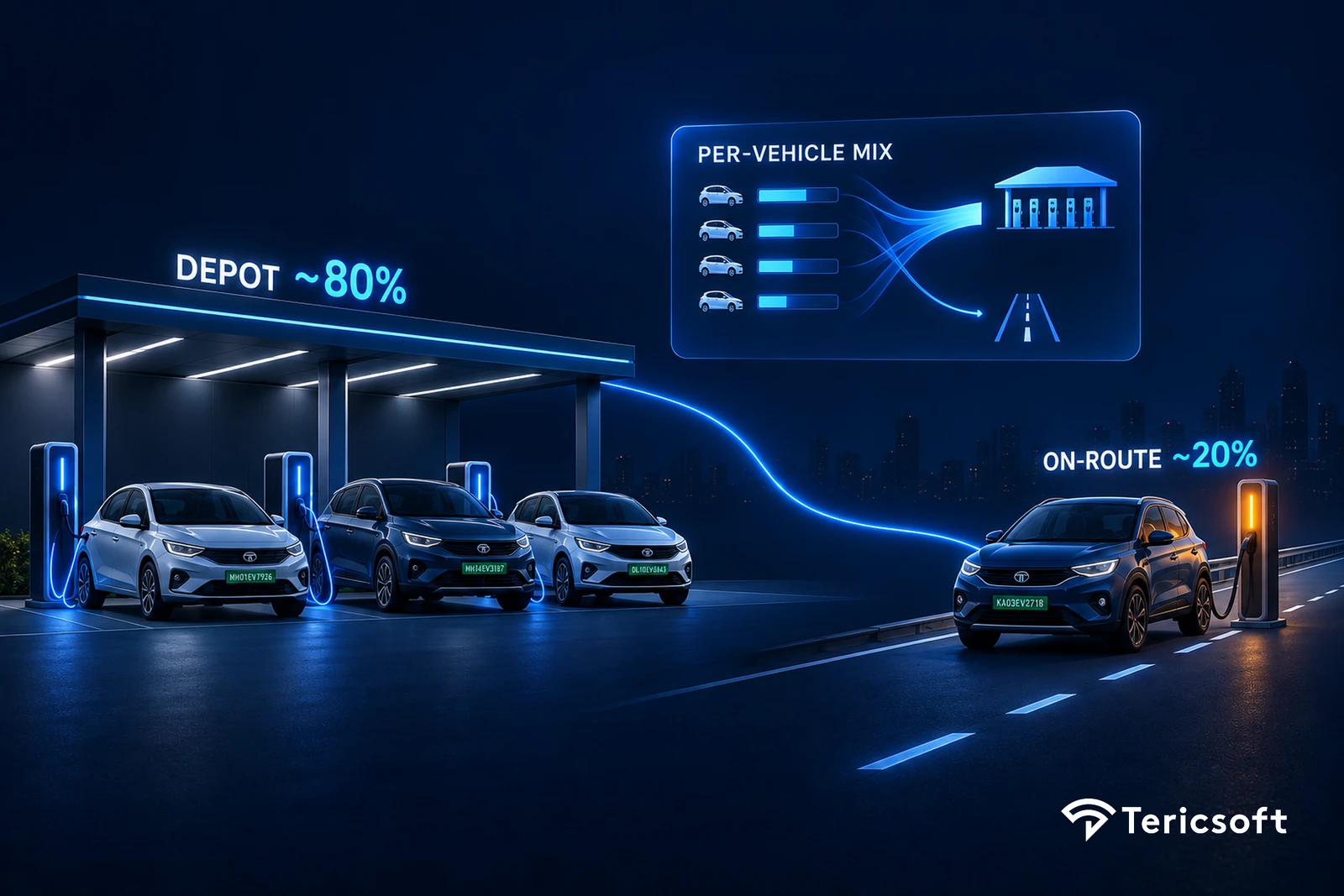
For a growing fleet, is the charging decision really "build a depot"? No. The real question is the depot versus on-route mix, and it keeps shifting as you scale.
For a growing fleet, EV charging infrastructure planning is usually framed as one decision: build a depot. That is half the plan. The real question is the mix of depot and on-route charging, decided per vehicle from the fleet's own dwell and energy data. And that mix keeps shifting as the fleet grows, because the depot's power demand and the grid behind it do not scale in a straight line. Get the split wrong and you either over-build a depot the grid cannot feed or strand vehicles with nowhere to charge on route.
This article is written from running the platform behind one of the world's larger electric deployments, a 3,000-plus vehicle fleet. Charging there is planned against each vehicle's real duty cycle, not a fleet-wide average. The two charging models below are not rivals to pick between. They are a ratio to get right, and to keep getting right as you scale.
Depot charging: the default, and its ceiling
Depot charging is what most fleets picture: chargers at a site you own or lease, vehicles plugged in overnight or during scheduled dwell, energy bought at your own off-peak rate, and full control over timing. It is the default for good reason. Research on fleet charging consistently finds that roughly 80 percent of a fleet's energy can be met at the depot during dwell, with only the rest needed on route.
The ceiling shows up when the fleet grows. Chargers are capital: the US Department of Energy puts Level 2 charging near 2,500 dollars per connector and DC fast charging at 20,000 to 60,000 dollars per connector, before the grid. And the grid is the real limit. Every charger added raises the site's peak power, and beyond a point the utility has to upgrade the service, a process that runs 6 to 18 months from the day you apply. A depot plan that ignores that lead time discovers it the hard way, mid-growth.
On-route charging: flexibility, at a price
On-route charging, also called opportunity charging, is topping up away from the depot: public or partner DC fast chargers used during a break, a delivery stop, or a long route the battery cannot finish on one depot charge. It covers the roughly 20 percent of energy that does not fit the overnight window, and it absorbs the vehicles whose return times are too unpredictable to schedule.
Its value is flexibility, and flexibility has a price. Public energy is bought at retail, not your off-peak rate, so the per-mile cost is higher. You do not control the charger, the queue, or its uptime, so a route that depends on a public stop inherits that station's reliability. On-route charging is the right tool for range extension and unpredictable duty, and the wrong tool to lean the whole fleet on. Used well it is a release valve. Used by default it is a recurring, uncontrolled cost.
Why the mix is a data problem, not a rule of thumb
The 80-20 split is a fleet-wide average, and averages are exactly what break an infrastructure plan. Per vehicle, the reality is bimodal: a large share of the fleet can live entirely on depot charging, a smaller share genuinely needs on-route power, and the line between them is drawn by duty cycle, dwell time, route energy, and return schedule, not by a percentage.
Planning the mix means reading those variables per vehicle, not per fleet. Which routes exceed a single depot charge? Which vehicles return with too little dwell to refill overnight? Which shifts overlap and spike the depot peak at the same hour? This is where charging management stops being a dashboard and becomes a planning input. Answer those questions from real telematics and the depot-versus-on-route ratio falls out of the data. Guess at them and you build for the average vehicle, which does not exist.
What breaks as the fleet grows
A charging plan that works at fifty vehicles rarely survives at five hundred, and the reasons are structural. The depot peak climbs with every vehicle, so the grid service upgrade that was optional becomes mandatory, on the utility's slow clock. Demand charges compound: on many commercial tariffs they run 15 to 30 dollars per kW a month, billed on the highest simultaneous draw, so a fleet that plugs in together at shift end pays for a peak it never needed.
Capital front-loads at the worst time, exactly when the fleet is spending to grow the fleet itself. The plan that scales treats charging as a portfolio: a right-sized depot for the predictable core, on-route charging for the variable edge, a buildout phased to the growth curve rather than poured in one slab, and the utility engaged long before the power is needed. Growth does not just add vehicles. It changes the ratio.
Managed charging: the multiplier on both
Whether energy comes from the depot or on route, managed charging is what keeps the plan affordable. Managed, or smart, charging schedules each vehicle into off-peak windows and staggers the depot so the whole fleet never draws at once. NREL analysis of fleet charging shows that unmanaged charging spikes demand charges sharply, and that managed charging cuts both the peak and the size of the grid service upgrade the site actually needs.
That last point is the one that changes an infrastructure plan. The service upgrade is sized to peak power, and managed charging lowers the peak, so the depot you have to build, and the utility work you have to wait on, both shrink. Managed charging is not a feature bolted on after the chargers land. It is the assumption that decides how many chargers and how much grid you needed in the first place.
How to plan it
The order that avoids expensive mistakes is consistent across fleets.
- Measure before you build. Pull each vehicle's real dwell windows, route energy, and return times. The plan starts from the fleet you actually run, not the spec sheet.
- Split the fleet, not the average. Mark which vehicles fit depot charging and which need on-route power, by duty cycle, and size each accordingly.
- Size the depot to the managed peak. Plan the site around the staggered, scheduled peak, not the unmanaged worst case, so you build and connect less.
- Engage the utility early. Start the interconnection conversation 6 to 18 months ahead of the power you will need, not when the chargers arrive.
- Phase to the growth curve. Build depot capacity in steps that track vehicle additions, and lean on on-route charging for the variable edge in between.
What running 3,000 EVs taught us
Across the deployment behind this article, more than 1 billion telemetry events a month are normalized across manufacturers into one model, held at over 98 percent real-time visibility, and charging is planned from that data rather than a template. The depot-versus-on-route ratio is set per vehicle and revisited as duty cycles change, not fixed once at rollout.
Charging is run as a profit-and-loss line, not a driver habit: windows are scheduled into off-peak, the depot peak is flattened so demand charges stay down, and the vehicles that genuinely need on-route power are the ones routed to it, not whoever happens to arrive low. The lesson from operating at scale is that charging infrastructure is not a one-time build. It is a ratio the fleet manages continuously, and it can only be managed from data that ties every charge back to the vehicle and the route that needed it.
Key takeaways
- The decision is a mix, not a choice. Depot charging carries most of the load, on-route covers the variable edge, and the ratio is what you actually plan.
- The mix is a data problem. Duty cycle, dwell time, route energy, and return schedule decide it per vehicle. The fleet-wide average hides the vehicles that break the plan.
- Growth changes the ratio. Depot peak, grid capacity, demand charges, and utility lead times all scale nonlinearly, so the plan has to be phased and revisited.
- Managed charging sizes the whole plan. Scheduling the peak down shrinks the chargers and the grid upgrade you have to build and wait for.
About Tericsoft
Tericsoft does not sell chargers or a charging network. We build the data layer that tells a fleet where its energy actually has to come from, reading each vehicle's dwell, route, and duty cycle so the depot-versus-on-route mix, the depot size, and the managed-charging schedule are planned from the fleet you run rather than an average. If your charging plan works on a spreadsheet but strains at the depot or the grid as you grow, that gap between the plan and the fleet is the problem we engineer for.

Both, in a ratio. Depot charging carries about 80 percent of a fleet's energy during dwell; on-route covers range and variable returns.
Charging at a site you own or lease, overnight or during dwell, at your own off-peak rate. Lowest cost and most control, capped by grid.
Topping up off-depot at public or partner fast chargers, on breaks or long routes. Flexible for range, at higher cost and less control.
Near 2,500 dollars per connector for Level 2 and 20,000 to 60,000 for DC fast. The slow cost is a utility upgrade of 6 to 18 months.
Smart charging staggers into off-peak windows so the fleet never peaks at once. It cuts demand charges and shrinks the grid upgrade.