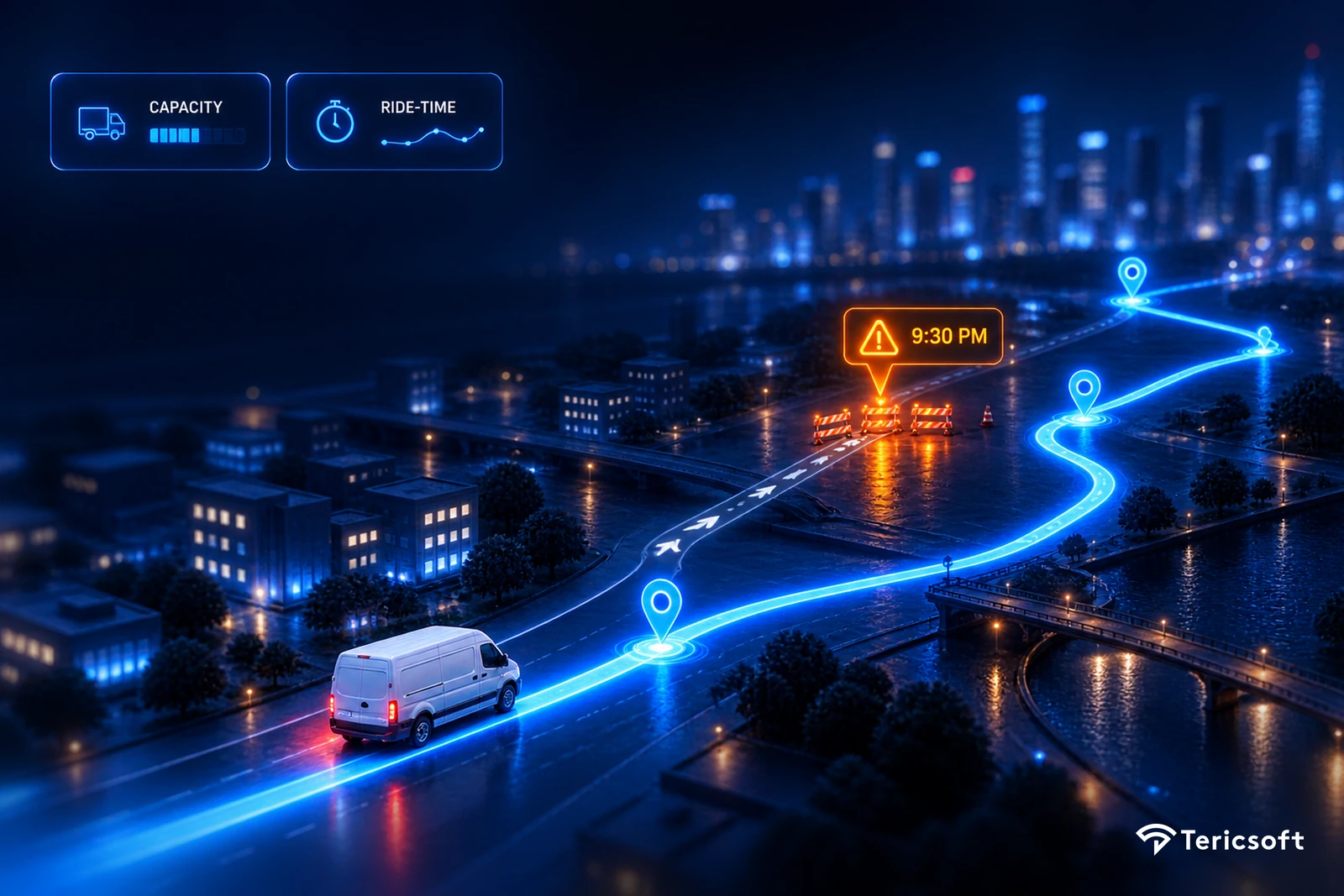
What is route optimization software, how does it actually work, and how do you choose? The vehicle routing problem, the constraints, the categories, and the honest buy versus build line.
Route optimization software computes the best sequence of stops and the best vehicle assignments for a fleet, minimizing distance, time, and cost while honoring real-world constraints such as vehicle capacity, delivery time windows, driver hours, and passenger ride-time limits. Behind that simple promise sits one of computing's classic hard problems, and in front of it sits a crowded market where a tool built for pizza delivery gets sold to a fleet moving five thousand employees a night.
This guide explains how the software actually works, where the categories differ, and how to choose, written from the builder's side. Tericsoft engineers routing and allocation engines inside production mobility platforms, including employee-transport routing where safety rules are enforced inside the algorithm and dispatch runs across a fleet of more than three thousand electric vehicles. The aim here is not to rank ten tools. It is to give you the machinery a buyer actually needs: what the software is really solving, why the constraints matter more than the map, and how to tell a routing engine that will run your operation from one that will merely impress you in a demo.
How route optimization software works
The problem it solves. Give the software a set of stops, a set of vehicles, and a list of rules, then ask for the cheapest way to cover them all. That is the Vehicle Routing Problem, the challenge Dantzig and Ramser first formalized back in 1959 as the truck dispatching problem (Management Science).
Here is why it is hard. Every stop you add multiplies the number of possible routes, and the count explodes far past what any computer can check one by one. So no tool finds the mathematically perfect answer for a real fleet. What good software does instead is find a near-perfect answer fast, using shortcut methods known as metaheuristics: local search, savings algorithms, and genetic approaches, run over live road-network data. Even Google's own routing library works this way, because brute force stops being an option past a handful of stops (Google OR-Tools).
The constraints are the product. Any solver can minimize kilometers on a whiteboard. Production routing is defined by what it must respect:
- Capacity. Seats, weight, or volume, per vehicle type. The classic capacitated vehicle routing problem is the baseline every serious engine solves.
- Time windows. Delivery slots, shift arrival bands, customer availability.
- Ride-time caps. In passenger transport, no rider stays aboard longer than the contractual maximum. This is the constraint that makes employee routing genuinely hard.
- Driver rules. Hours, breaks, skills, and vehicle familiarity.
- Hard policy constraints. In employee transport: escort requirements, first-pickup and last-drop ordering for night shifts, restricted zones and timings. The critical design test is whether these live inside the solver, so every route is compliant by construction, or are checked afterward, so routes are compliant only by luck, the design choice that decides both safety and cost in employee transport.
- Energy constraints. For electric fleets, the real remaining range of each vehicle and its charging windows, so no route is assigned that the battery cannot finish, the core of charge-aware EV fleet operations.
Static plans versus living plans. The optimal plan built at 8 p.m. is stale by 9:30, undone by no-shows, breakdowns, traffic, and roster changes. The real dividing line in this market is re-optimization: software that plans once per day versus software that continuously repairs the plan as reality diverges, re-clubbing stops and reassigning vehicles in minutes. If your operation is volatile, and passenger transport always is, re-optimization is not a feature. It is the product.
Route planning software vs route optimization software
The terms get used interchangeably, and the difference is the whole point. Route planning software sequences stops, manually or with simple rules, and answers the question of what order one vehicle should visit its stops in. Route optimization software solves assignment and sequencing together, across the entire fleet, under every constraint at once, and typically cuts trips and kilometers by double-digit percentages against a manual plan.
This is also the honest answer to a question many teams start with: can Google Maps do route optimization? Maps and similar consumer tools will sequence a short list of waypoints on a phone, which is genuine value for a single driver with a dozen stops. They do not assign hundreds of stops across a mixed fleet, respect capacity and ride-time and driver rules, or repair the plan when a vehicle breaks down at 9:30. A multi-stop planner is a better whiteboard. Route optimization software is a solver. The moment your constraints stop fitting on a whiteboard, you have left planning and entered optimization.
The categories of route optimization software
Most disappointment with routing software traces to a category mismatch: a delivery optimizer asked to pool passengers, or a field-service tool asked to respect escort policy. The constraint set is the category. Buy, or build, for yours.
The delivery category is the loudest, because delivery route optimization is where the volume and the venture money went. But a delivery optimizer has no concept of a rider who cannot sit in the vehicle for more than seventy-five minutes, or a night shift that must be dropped last with an escort aboard. Vehicle routing software written for parcels treats every stop as identical and interchangeable. People are not parcels, and that single fact is why passenger transport is its own category, almost always delivered inside a management system or a custom engine rather than as shelf software.
Buy vs build route optimization software
Buy when your constraints match a category above cleanly. A delivery fleet with time windows should buy a last-mile optimizer and be live in weeks. Paying to build what you can license is a waste of capital and time.
Build, with an engineering partner, when your constraints are your business. That is the case for multi-vertical fleets sharing vehicles across contract types, employee transport with client-specific safety policies, electric operations where range and charging windows shape every plan, and allocation logic that maximizes yield across revenue models rather than minimizing kilometers alone. At that point the routing engine encodes your margin, and renting a near-fit means paying a subscription plus the manual planning that bridges the gap the product cannot. This is the engineering-partner model: proven solver components, your constraints, a route optimization API that plugs into the rest of your stack, deployed in your cloud and owned by you. We break down the full economics of building versus buying fleet software separately.
The tell is simple. If a demo tool can run your real roster with your real rules and the plan is correct, buy it. If every demo requires you to relax a rule that you cannot actually relax in production, you have found the boundary of the shelf market, and the honest move is to build.
How to choose route optimization software: 8 questions
Skip the feature grid. These eight questions expose weak routing software faster than any comparison table, and they answer what buyers really mean when they search for the best route optimization software: the best one is the one that survives them.
- Show my constraints running. Bring your real roster or stop list to the demo. Synthetic demos hide constraint gaps by design.
- What happens at 9:30 p.m.? Trigger a no-show, a breakdown, a roster change, and watch the re-optimization. Time it.
- Are policy rules hard constraints or reports? Ask to see a rule the solver cannot violate, not a rule it flags after the fact.
- Occupancy and experience together? In passenger transport, how does it trade seat-fill against the ninety-fifth-percentile ride time? A tool that optimizes only cost will empty your seats through rider attrition.
- Is it energy-aware? Real range per vehicle and charging windows inside the plan, or a diesel assumption wearing a green badge?
- Does it learn your ground truth? Real service times, gate delays, and site quirks, or datasheet averages forever?
- Is it API-first? Routing has to consume rosters and orders and publish plans to dispatch, driver apps, and telematics verification. A routing silo is a spreadsheet with extra steps.
- Whose intellectual property is the configuration? Years of encoded constraints are an asset. Know who owns them at renewal time.
What good fleet route optimization looks like in production
Here are the numbers to expect when the category fits and re-optimization actually runs. Occupancy climbs from the roughly two-and-a-half riders per four-seater of manual planning toward three and above. Trips and dead kilometers fall by double-digit percentages for the same demand. Planners move from midnight spreadsheet sessions to exception handling. In our multi-vertical deployment at Srinivasa Travels, optimization-driven unified dispatch contributed to a fifteen percent lift in fleet utilization, the equivalent of dozens of vehicles nobody had to buy. The full fleet utilization case study breaks down how that gain was measured.
And because routing plans are only promises, the last mile of good routing is verification. Telematics confirms the plan was executed, geofences timestamp arrivals against the schedule, and deviations escalate automatically instead of surfacing in a complaint the next morning. Fleet route optimization that ends at a printed plan is optimizing on faith. The systems that hold their gains close the loop between the plan and what the vehicles actually did.
About Tericsoft
Everything to this point applies whatever tool you choose. Where Tericsoft fits is narrow, and worth stating plainly: we build routing and allocation engines for operators whose constraints do not fit a product. That work has taught us one thing above all, and it is the thesis of this whole guide: in routing, the constraints are the product, and the engine is where your margin is encoded. The pretty map is the easy part. The hard part, the part worth owning, is a solver that keeps every route compliant by construction, repairs the plan when the night falls apart, and trades cost against rider experience the way your business actually needs it to.
We work most often with multi-vertical and passenger-transport fleets, diesel and electric, in operations where a near-fit product would mean permanent manual bridging. If your routing rules are the thing that makes you money, renting an approximation of them is the expensive option. Owning the engine is the cheaper one, and it is the conversation we are glad to have in an engineering register.
Key lessons
- The constraint set is the category. Buy the tool built for your constraints, or accept permanent manual bridging.
- Re-optimization is the real product. Static daily plans die on contact with operations. Judge software by how it repairs plans, not how it prints them.
- Policy belongs inside the solver. Safety and compliance as hard constraints cost nothing per route. As afterthoughts they cost audits and incidents.
- Routing encodes margin. When the rules that make you money fit no product, owning the engine beats renting an approximation.

Software that computes the best stop sequences and vehicle assignments for a fleet, honoring capacity, time windows, and driver rules.
It models stops, vehicles, and constraints, then uses heuristics to find near-optimal routes fast, re-optimizing as conditions change.
Planning sequences stops with simple rules. Optimization solves assignment and sequencing together across the fleet under every constraint.
Only if ride-time caps and safety rules like escorts and pickup order are enforced inside the solver. Delivery optimizers lack these.
Buy when your constraints fit a standard category. Build with a partner when the constraints are your business and encode your margin.