Can India's fleet operators turn peak-only fleets into profitable operations? Learn how the employee transport management system business model works at 500+ vehicles.
India's employee transportation market moves millions of IT, GCC, and BPO employees between home and office every single day. Most of the companies doing it operate on margins thinner than the fuel surcharge they bill.
The difference between an employee transport operator that compounds and one that stalls is rarely the size of its fleet. It is seat utilization per shift, and whether the operator's technology lets them see it.
At Tericsoft, we have spent years building the technology backbone for some of India's largest mobility operators, including Lithium Urban Technologies, which runs 3,000+ electric vehicles in corporate employee transport, and
Srinivasa Travels, whose corporate shuttle vertical we unified with its other business lines. This post breaks down how the employee transport management system business model actually works, where the margin hides, and what changes when technology runs the operation instead of spreadsheets.
What Is an Employee Transport Management System (ETMS)?
An employee transport management system (ETMS) is the operational platform a company or transport operator uses to plan, run, and bill daily employee commutes. It handles shift-based rostering, route optimization, live trip tracking, safety compliance, and per-client billing.
Unlike consumer ride-hailing, an employee transportation software platform deals with predictable but spiky demand. The same thousands of employees, at the same office parks, at the same shift changes, five or six days a week.
That predictability is the business opportunity. The spikiness is the business problem.
Problem 1: Shift Economics and the Fleet That Idles Twenty Hours a Day
An employee transport management system (ETMS) is the operational platform a company or transport operator uses to plan, run, and bill daily employee commutes. It handles shift-based rostering, route optimization, live trip tracking, safety compliance, and per-client billing.
Unlike consumer ride-hailing, an employee transportation software platform deals with predictable but spiky demand. The same thousands of employees, at the same office parks, at the same shift changes, five or six days a week.
That predictability is the business opportunity. The spikiness is the business problem.
Fleet Utilization: Why Off-Peak Hours Are Where Transport Margin Is Made
The brutal arithmetic of employee transport: the entire fleet is needed at 9am and 6pm, and far less of it in between. A fleet sized for peak shifts spends more than half its day parked, while every parked hour burns EMI, parking costs, driver salary, and insurance.
This is fleet utilization economics at its most extreme. The revenue from peak shifts covers the cost base. The profit comes from what operators do with the fleet in the hours between.
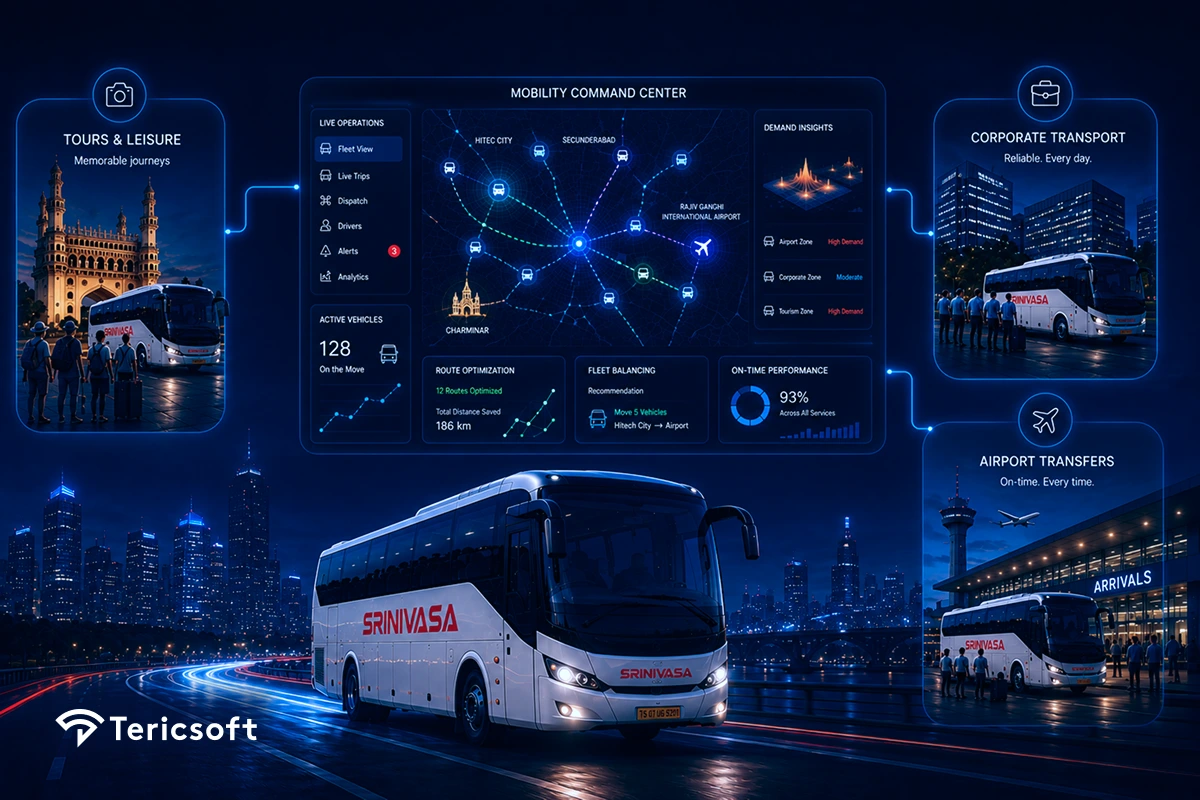
When we unified Srinivasa Travels' three verticals onto one platform : corporate shuttles, leisure tours, and airport transfers. The single biggest lever was filling the corporate fleet's off-peak hours with demand from the other verticals. The result was a 15% lift in fleet utilization. On a large fleet, that is the equivalent of adding dozens of vehicles without buying one.
Problem 2: Why Spreadsheet-Based Rostering Breaks Past 5,000 Employees
The rostering problem does not announce itself when it arrives. It grows quietly as the fleet grows. At a few hundred employees, manual planning is slow but manageable. At a few thousand, it becomes mathematically impossible, and the failures are visible in the numbers: empty seats, missed pickups, SLA penalties, and employees who stop relying on the service. The problem is not the planner. It is the process.
What Employee Transport Management Software Actually Automates at Scale
Every night, route planners at a typical operator manually balance pickup sequences, ride-time caps, vehicle capacity, and compliance rules. This includes escort and women's safety requirements that Indian state regulations and client policies impose on night-shift transport.
At 500 employees this is tedious. At 5,000 it is mathematically beyond any human planner. The cost shows up as half-empty vehicles, breached ride-time SLAs, and employees who quietly switch to their own transport.
Route optimization is a solved computer-science problem. What is not solved at most operators is connecting that math to live rosters, last-minute shift changes, and no-shows. This is why employee transport management software only works as part of an integrated platform, not as a standalone tool.
Why Operators Call It Cab Management Software: And Why That Undersells the Problem
Most transport operations teams and HR administrators reach for the term cab management software when they begin evaluating technology. It is the vocabulary they know. But the scope of what an operator needs to run is much wider than booking and tracking cabs.
A proper employee transport management system covers automated shift rostering, compliance enforcement in the routing algorithm, live deviation alerts, SLA measurement against contractual KPIs, and billing generated from verified trip data. A cab booking tool handles none of that.
The cost of underbuilding is real. Half-empty vehicles drive up cost per employee per trip. Breached ride-time SLAs expose the operator to penalty clauses. Employees who experience inconsistent service switch to personal transport, reducing demand and weakening the operator's utilization numbers further.
Problem 3: SLA Management Software and How Billing Reconciliation Eats the Margin
A large employee transport operator typically serves dozens of corporate clients, each with its own contract. Per-trip versus per-seat versus per-km billing, SLA penalty clauses, separate escalation matrices, and separate MIS report formats.
When billing is reconciled manually from trip sheets, two things happen consistently. Invoices go out late, stretching already-long receivable cycles. Disputed trips get quietly written off because no one has the data to win the argument.
On thin margins, a 2 to 3 percent billing leakage is the difference between profit and loss. The SLA penalty problem compounds it further. Penalties are the price of escalations that did not happen in time. Without automated SLA tracking, operators often discover a breach after the penalty has already been applied.
Fleet Management Software for India's Employee Transport Operators: The Four-Layer Stack
The employee transport management system stack Tericsoft builds for operators has four layers working off a single data spine. Each layer feeds the next. Each one would be weaker without the others.
Fleet Route Optimization: From Nightly Manual Planning to Real-Time Automated Dispatch
Layer 1 is automated rostering and route optimization. Shift rosters flow in from client HR systems. Routes, pickup sequences, and vehicle assignments are generated automatically. Compliance rules, including escort requirements, ride-time caps, and geofenced corridors, are enforced in the algorithm rather than checked after the fact.
This is the difference between compliance as an audit and compliance as a constraint. When the routing engine cannot produce a route that violates a safety rule, no human needs to check whether the rule was followed.
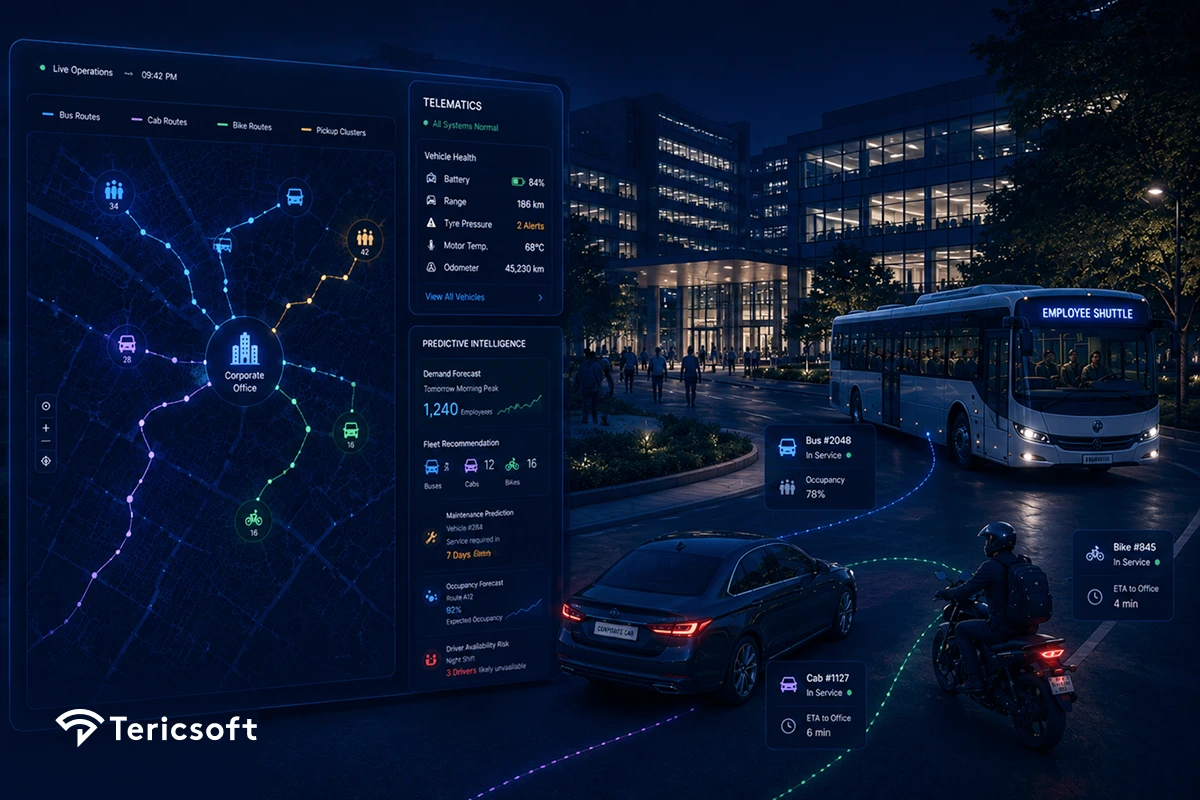
Layer 2 is the real-time trip tracking and safety layer. Live telematics on every vehicle, SOS and escort verification, deviation alerts when a vehicle leaves its assigned corridor.
For Lithium Urban's 3,000+ EV fleet, this layer delivers more than 98% real-time visibility and processes data at the scale of 1 billion+ API calls per month. The full detail of that deployment is documented in the Lithium Urban EV fleet case study.
Layer 3 is client-facing SLA dashboards. Every contractual KPI, including on-time arrival rate, ride duration, and vehicle occupancy, is measured automatically. The client sees the same data the operator sees. When both sides are looking at the same numbers, billing disputes collapse before they begin.
Layer 4 is automated billing and reconciliation. Invoices are generated from verified trip data according to each client's contract logic. Not from paper trip sheets. Not from memory. From the same data that drives every other layer of the platform.
EV Fleet Management Software: What Changes When Dispatch Runs on Charge State, Not Fuel
For EV-based operators, a fifth layer matters. Off-the-shelf transport management system India deployments built for diesel fleets do not model this constraint: charge state.
A charging-aware dispatch engine knows each vehicle's state of charge and range before assigning it a route. Vehicles that cannot complete a route on current charge are not assigned to it. Charging windows become planned off-peak downtime rather than unplanned lost trips.
This turns a liability into an advantage. Off-peak charging costs are lower than peak charging costs. An operator whose dispatch engine understands charge state can schedule charging at the lowest cost window while still meeting shift demand.
The newest layer we deploy on top of this stack is an AI operations agent. It reads each client's SLA terms and the operator's SOPs, watches every workflow against them, and when something drifts toward a breach, escalates through the company's own hierarchy. An app notification first, then WhatsApp, then an AI voice phone call to the accountable manager for genuinely critical events.
What the Numbers Look Like
Across Tericsoft's mobility engagements, the pattern repeats consistently.
- 15% fleet utilization lift at Srinivasa Travels after unifying three verticals on one dispatch platform
- 98%+ real-time fleet visibility across Lithium Urban's 3,000+ electric vehicles
- 50% faster operational decision-making once COOs work from live data instead of next-morning reports
- 70%+ of internal workflows digitized at Srinivasa Travels within the engagement
Run the model on your own fleet. If your vehicles average two revenue shifts a day and technology adds even one off-peak revenue trip to 15% of the fleet, that additional revenue lands on a cost base that barely moves. In employee transport, margin is made in the off-peak hours.
Key Lessons for Operators
These are not theoretical observations. They come directly from building and running the technology behind Lithium Urban's 3,000+ EV fleet and Srinivasa Travels' cross-vertical dispatch operation. Each lesson reflects a decision point where the right technology choice had a measurable impact on unit economics.
Margin in ETMS Is Made in the Off-Peak Hours
Peak-shift revenue covers the cost base. Off-peak utilization is where profit comes from. Operators who cannot see their idle capacity in real time cannot deploy it. The technology makes the capacity visible. The dispatch logic makes it deployable.
Compliance Is a Product Feature, Not Paperwork
Safety and escort rules enforced in the routing engine cost nothing per trip. Enforced manually, they cost a control room, a compliance audit, and occasionally a contractual penalty. The question is not whether to enforce compliance. The question is where in the system the enforcement happens.
Billing Accuracy Is a Data Problem
If billing and trip tracking run on the same data spine, disputes collapse. The technology does not make billing more accurate. It makes inaccurate billing structurally impossible. Two parties looking at the same verified trip data cannot sustain a billing dispute.
EV Fleets Change the Model
Charging windows are a scheduling constraint and an off-peak cost advantage. They are only an advantage if the dispatch engine understands state of charge. An EV fleet managed with diesel-era dispatch logic carries the cost structure of electric vehicles without the operational benefit.
Where This Goes Next
The largest corporate transport buyers in India are consolidating toward operators who can prove, with live data, that they hit SLAs and run safe, compliant fleets. The operators winning those contracts are not the ones with the most vehicles. They are the ones whose technology makes every vehicle count.
If you are running 500+ vehicles and your rostering, tracking, and billing still live in three different systems, that is the gap.
About Tericsoft
Tericsoft is an AI-first technology partner that builds the operational backbone for India's employee transport operators and enterprise mobility businesses. Tericsoft's engagements cover automated ETMS platforms, AI operations agents for fleet SLA management, EV fleet management software, and transport billing automation.
- Technology backbone behind Lithium Urban Technologies: 3,000+ EVs, 98%+ real-time visibility, 1B+ API calls/month
- Cross-vertical dispatch unification for Srinivasa Travels: 15% fleet utilization lift, 70%+ workflows digitized
- AI operations agent deployed for real-time SLA escalation and billing compliance across mobility clients
- EV fleet management software with charging-aware dispatch for zero-emission corporate fleets
An ETMS is a platform that manages daily employee commutes: shift-based rostering, route optimization, live vehicle tracking, safety compliance, and per-client SLA billing for corporate transport operators in India.
Operators bill corporates per trip, per seat, or per km under SLA contracts. Profitability depends on fleet utilization per shift, off-peak fleet deployment, and billing accuracy far more than fleet size.
Cab management software handles bookings and tracking. An ETMS covers automated rostering, compliance enforcement, SLA measurement, EV charge-aware dispatch, and billing reconciliation from a single data spine.
Three things: automated routing lifts seat occupancy, cross-vertical dispatch fills off-peak idle hours, and billing from verified trip data eliminates reconciliation leakage typically moving operators from low single-digit to sustainable margins.
EVs reduce per-km cost but add a constraint: charge state. An EV fleet management software engine that assigns routes based on real-time range turns charging windows into planned off-peak downtime instead of lost trips.