What is telematics, and how does the device-to-decision pipeline actually work? Telematics vs GPS tracking, the data it collects, benefits for fleets, EV telematics, and AIS-140 in India.
Telematics is the technology that collects data from a vehicle, its location, speed, engine or battery condition, driver behavior, and fuel or energy use, and transmits it wirelessly to software that turns the stream into monitoring, alerts, and decisions. The word merges telecommunications and informatics, and the idea is simple: the vehicle continuously reports what it is doing, and a platform makes that report useful.
You may have met the word in other places. Insurers sell a telematics black box that scores young drivers for cheaper premiums, and carmakers use telematics to power connected-car apps that unlock doors from a phone. Those are real, but they are narrow consumer uses of the same idea. This guide is about fleet and commercial telematics, the version that runs delivery vans, buses, trucks, and electric fleets, and it is written from the consuming end of the pipeline. We engineer the platforms that ingest telematics at scale, including one that processes over one billion telemetry events every month from a fleet of more than three thousand electric vehicles, so what follows covers not only how telematics works, but where it breaks, what it is really worth, and what separates a data feed from an operating advantage.
Telematics meaning: telecommunications plus informatics
The telematics meaning is easiest to see in the word itself. Telematics is a portmanteau of telecommunications, the wireless movement of data, and informatics, the processing of that data into information. Put them together and the telematics definition becomes precise: the practice of sending machine-generated vehicle data over a network and turning it into something a person or a system can act on.
That definition matters because it draws a line most marketing blurs. A device bolted to a vehicle is not telematics. A map with a moving dot is not telematics. Telematics is the whole loop, from the sensor on the vehicle to the decision at the other end. Everything expensive and everything valuable lives in that loop, not in the box.
How does telematics work: the five-stage pipeline
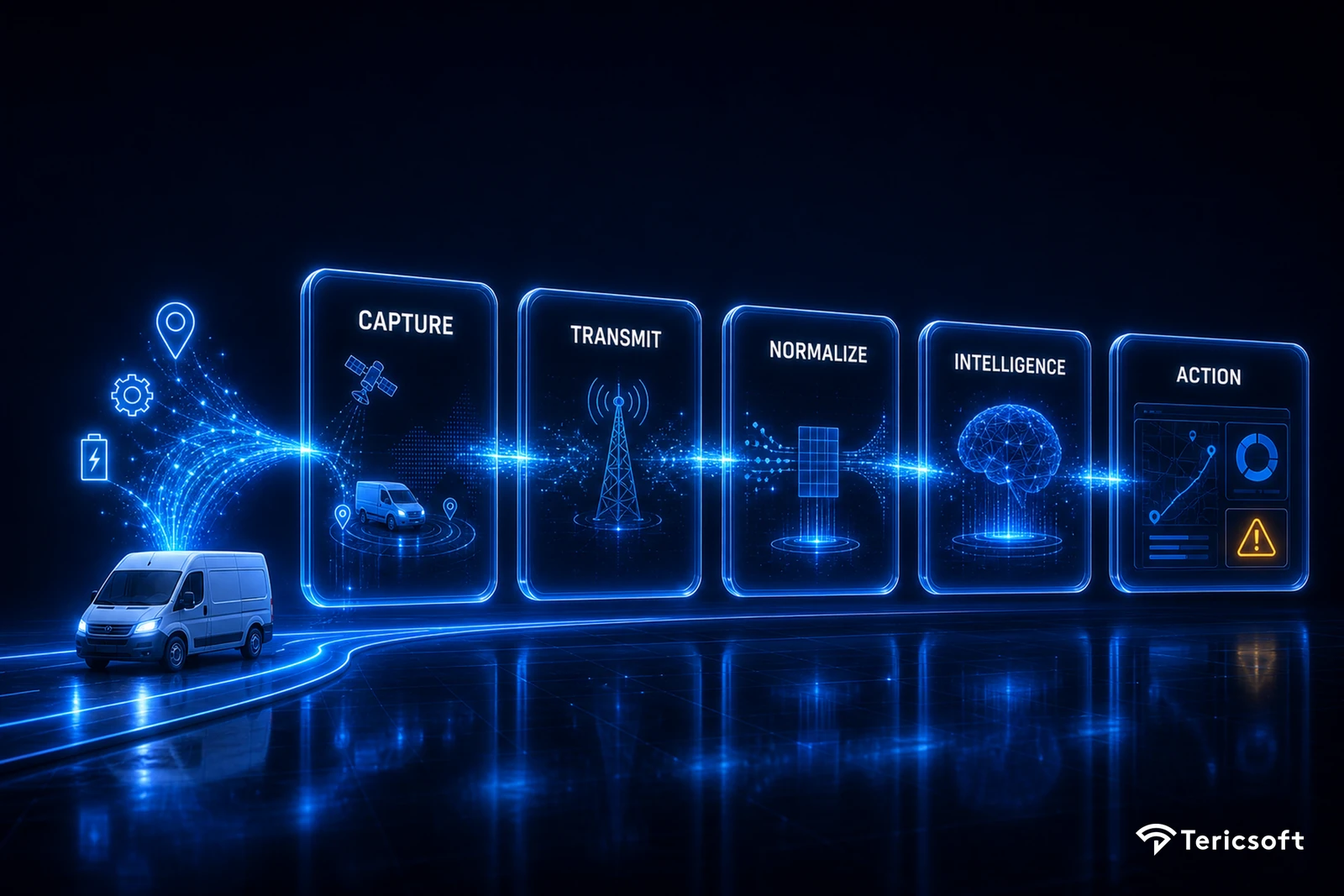
Ask how does telematics work and most answers stop at the idea that a device sends data to a server. That skips the part that decides whether any of it is useful. A production telematics system is a five-stage pipeline, and the value is made or lost in the middle three stages, not the first.
- Data capture on the vehicle. Some fleets use a dedicated telematics device plugged into the OBD-II port, some use a hardwired black box, and increasingly the vehicle manufacturer streams its own embedded telematics from the OEM cloud. Sensors capture satellite position, speed, ignition state, engine diagnostics and fault codes, harsh-driving events from the accelerometer, and fuel level. In electric vehicles the CAN bus adds state of charge, charging status, and battery data.
- Transmission. Data moves over cellular networks, with store-and-forward buffering so nothing is lost in a tunnel or a dead zone, either straight from the device or by way of the OEM servers, at intervals from a few seconds to a few minutes depending on configuration.
- Ingestion and normalization. The stage every simple explainer skips, and the one that decides whether everything downstream works. A real fleet mixes OEM feeds and device vendors, each with different fields, units, and failure quirks. A production platform maps all of it into one normalized model and corrects source-specific faults: electric-vehicle CAN feeds, for instance, routinely flat-line state of charge during a charging session, so the session has to be rebuilt from the surrounding data. Get this stage wrong and every dashboard above it lies.
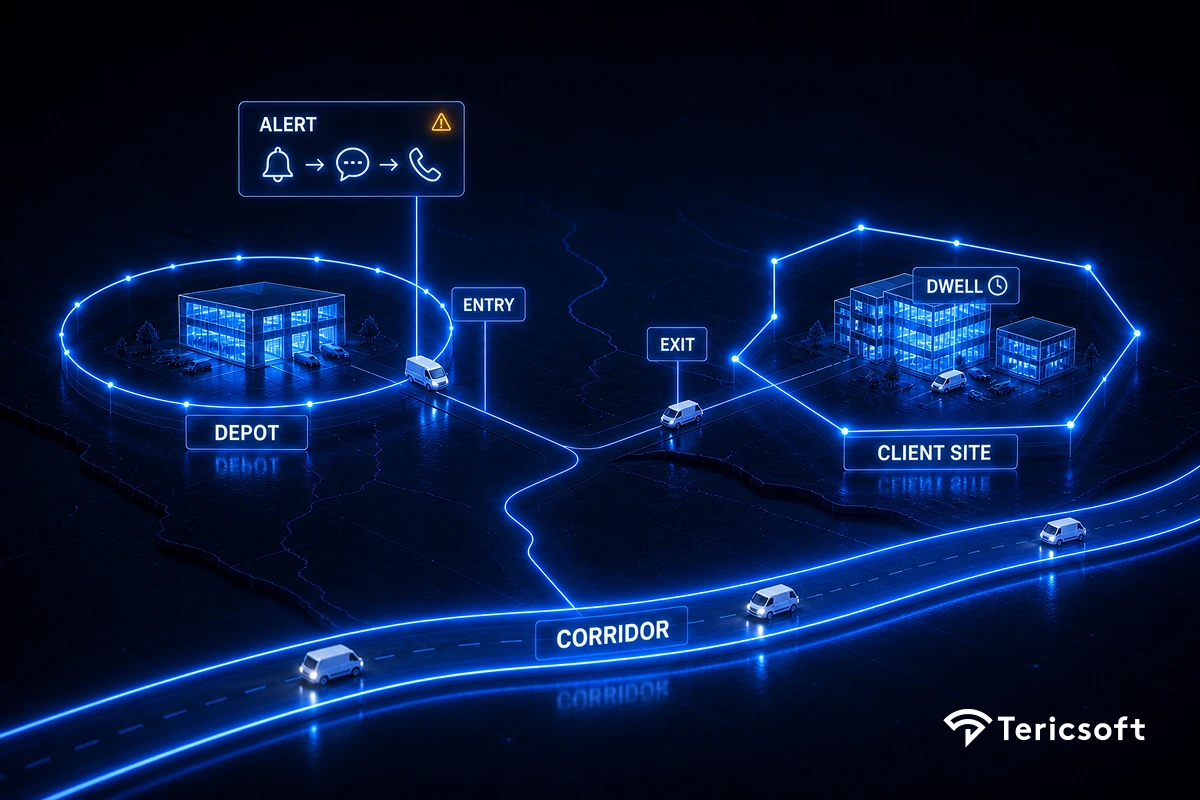
- Processing and intelligence. The normalized stream feeds live dashboards, geofence evaluation, ranked exception alerts such as idling vehicle, overspeed, route deviation, offline device, and charging anomaly, and the analytical models behind maintenance prediction and utilization.
- Action. The stage that pays for the other four. Alerts route to the accountable owner, workshop tickets open automatically from a failure prediction, trips get reassigned, and escalations chase the responsible manager until someone responds. Telematics that ends at a dashboard is a subscription. Telematics that ends in an action is an operating system.
Vehicle telematics vs fleet telematics
Vehicle telematics and fleet telematics describe the same technology at two different scales. Vehicle telematics is the single-asset view: one car or truck reporting its position, health, and behavior. It answers questions about that one vehicle, which is enough for a consumer or an owner-operator with a handful of assets.
Fleet telematics is the operations view. It takes the same feeds from tens, hundreds, or thousands of vehicles and turns them into fleet-wide decisions: which assets are earning and which are idle, which routes are slipping, which vehicles are due for service, and where losses are hiding. The hard problems only appear at fleet scale, because that is where mixed makes, mixed devices, and millions of daily data points collide. Fleet telematics is less about any one vehicle and more about running the economics of the whole operation from a single normalized picture.
Telematics vs GPS tracking: what is the difference
The terms telematics and GPS tracking get used as if they mean the same thing. They do not, and the difference is the whole point.
GPS tracking is a component of telematics, not a synonym for it. Satellite positioning is accurate to roughly five meters under open sky, according to the United States government's GPS information service. (GPS.gov accuracy) That is plenty to place a vehicle on a map, and if placing vehicles on a map is all your system does, you bought a vehicle tracking system. Telematics adds the engine, the battery, the driver, and the events, and that is what turns a location feed into an operating picture.
What data does telematics collect
Ask what telematics data actually contains and the honest answer is more than any team can read by hand, which is exactly why the platform matters. The categories that carry operational weight are these.
One mid-size fleet generates millions of these data points every day. That volume is why the real telematics question is never whether you can get the data, but whether you can make it decidable. Raw telemetry is noisy: satellite positions drift near tall buildings, where the signal bounces off surfaces before it reaches the receiver (u-blox), accelerometers report harsh-braking events that never happened, and timestamps skew between sources. Cleaning that signal so the alerts can be trusted is engineering work, and it is the work that separates a platform people act on from a dashboard people learn to ignore.
The benefits of telematics for fleets, with mechanisms
Skip the generic idea that telematics saves costs. Every real telematics benefit has a mechanism behind it, and the mechanism is what tells you whether the benefit is achievable in your operation.
- Utilization. Trip-state classification separates earning hours from idle ones for each vehicle, and operators who recover that visibility routinely find double-digit idle capacity they were paying for and not using. In one multi-vertical deployment, unified telematics-driven dispatch lifted fleet utilization by around fifteen percent.
- Maintenance. Fault codes and telemetry patterns flag failures before they become breakdowns. In our production models the warning arrives two to three weeks ahead, which converts a roadside failure into a scheduled workshop visit.
- Safety and compliance. Behavior scoring, corridor compliance, and auditable trip records give safety policy a way to prove it actually executed, which in employee transport is the difference between a policy and a promise.
- Asset protection. Offline-device alerts, after-hours movement, and unauthorized-zone entries surface the leakage patterns that never show up in a booking report. A useful benchmark is keeping more than ninety-eight percent of the fleet visible in real time, with the missing slice itself alarmed, because the invisible vehicle is where losses concentrate.
- Billing truth. Telemetry-verified trips end revenue disputes, and second-by-second journey replay turns a demand to prove it into a lookup.
Commercial vehicle telematics and EV telematics
Commercial vehicle telematics carries a heavier burden than the consumer version because the vehicle is a revenue asset and every hour of downtime has a price. Trucks, buses, and vans add heavy-duty diagnostics over the J1939 standard, hours-of-service and compliance needs, and multi-driver assignment, so the platform has to reconcile who was driving, in what condition, against what schedule.
EV telematics raises the stakes again. For an electric fleet, telematics is the only instrument that can see the most expensive component on the vehicle: battery packs averaged about one hundred and eight dollars per kilowatt-hour in 2025, a five-figure sum on a commercial pack, and their health, real range, and charging behavior are invisible to inspection. They exist only in longitudinal telemetry. State-of-charge-aware dispatch, charging-window discipline that avoids peak tariffs, and battery-degradation tracking all run on the telematics stream, which is why an EV fleet cannot be run on diesel-era tracking.
AIS-140 telematics and compliance for fleets in India
In India, telematics is not only operational, it is a legal requirement for large classes of vehicles. The AIS-140 standard from the Ministry of Road Transport and Highways requires public service and commercial vehicles to carry an approved Vehicle Location Tracking Device and emergency panic buttons, reporting to state monitoring backends. (Ministry of Road Transport and Highways) AIS-140 telematics is a compliance category as much as a technology one, and any platform serving Indian fleets has to speak it natively.
A VLTD is a certified device with defined obligations: continuous position reporting, panic-button integration, tamper and battery-backup requirements, and health reporting so authorities know it is alive. AIS-140 also requires the Indian regional satellite system, NavIC, alongside GPS, so positioning does not depend on one constellation. (ISRO NavIC) The practical point is that telematics India adoption is often driven first by the mandate and only later by the operational upside, so the platform has to satisfy the regulator and the operations team in one deployment.
Where telematics is heading: from reporting to acting
The frontier is not more data, it is delegation. AI layers now sit on top of the telematics stream: models that predict failures and demand, optimization engines that allocate vehicle-hours, voice agents that handle driver calls, and agentic systems that watch service-level agreements and escalate a breach, first a push notification, then a message, then a phone call up the management chain. Telematics becomes the sensory layer of a fleet that is increasingly operated by software rather than merely watched by it, a stack covered end to end in AI in Transportation.
Key lessons
- Telematics is a pipeline, not a device. The device is only one part of the problem. Normalization, intelligence, and action are where value is made or lost.
- Data quality is invisible until it is not. Dirty telemetry produces alerts nobody trusts, and distrust, once earned, kills adoption.
- Buy tracking, build decisions. Position data is a commodity. The decision layer tuned to your operation is the competitive asset.
- Electric fleets raise the stakes. The battery is the most expensive component on the vehicle, and telematics is the only instrument that can see it.
See a production telematics pipeline live
Everything above is running in production today. If you operate a fleet large enough that only exceptions matter, and you want to see telematics working as an operating system rather than described in a feature list, book a technical deep-dive. We will walk through ingestion across multiple OEMs, the normalized model, the ranked alert queue, and a replayed journey, with your engineering team asking anything.
About Tericsoft
We think the industry has the telematics story backwards. The device gets the marketing, but the device is increasingly a commodity layer. The advantage lives in the pipeline nobody photographs: the ingestion that swallows a dozen incompatible feeds, the normalization that makes them one clean model, and the action layer that turns a signal into a booked workshop slot or an escalation someone answers. That is the layer we build, and the one that decides whether a fleet program pays for itself.
We work with operators who have outgrown the map-with-dots stage and need telematics that runs the economics, across mixed OEMs, diesel and electric, and India's compliance reality. If that is where your fleet is, the conversation is a technical one, and we are glad to have it in that register.

Technology that sends a vehicle's location, condition, and driver data over wireless networks to software that turns it into decisions.
GPS tracking shows where a vehicle is. Telematics adds what it is doing and its condition: diagnostics, behavior, energy, and events.
Location and movement, engine and battery health, driver behavior, energy use, and events like geofence crossings and device disconnects.
Not quite. The insurance black box scores one driver for premiums. Fleet telematics runs the operations and economics of many vehicles.
For many public and commercial vehicles, yes. AIS-140 requires a certified tracking device and panic buttons, with NavIC and GPS.