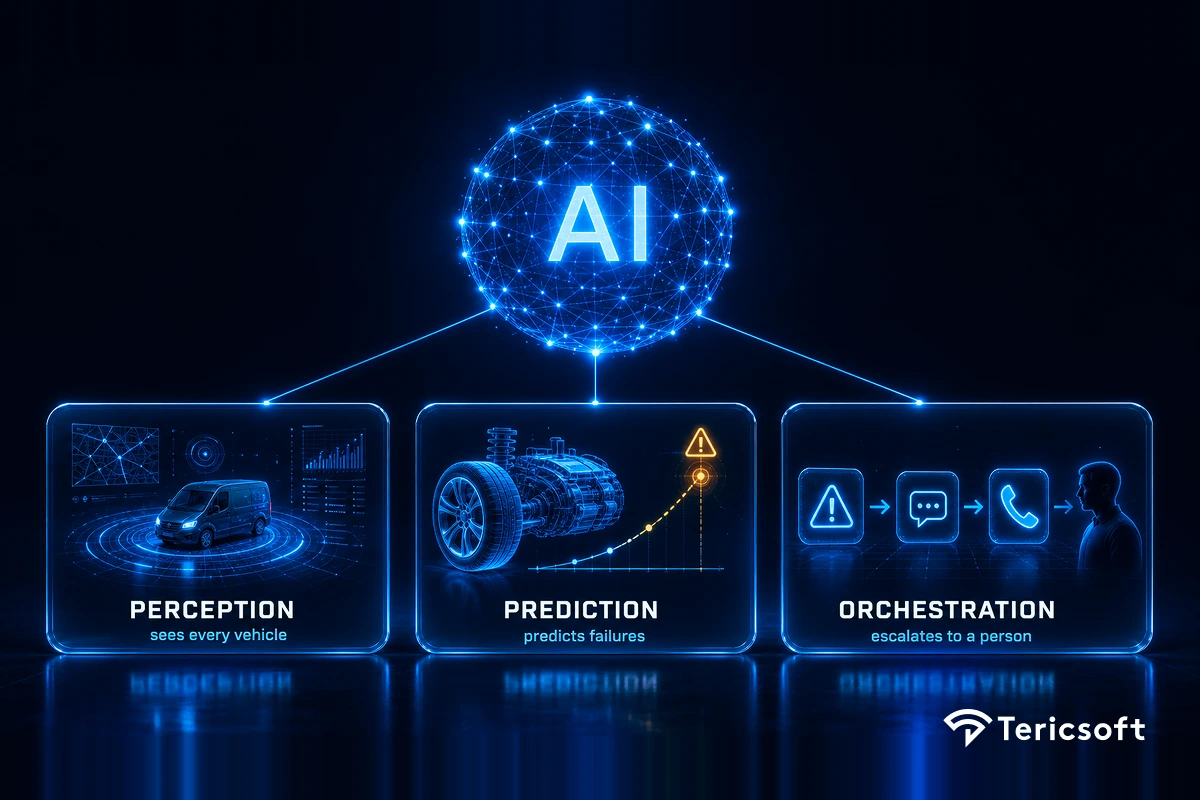
What does AI in transportation actually look like in production in 2026? The five deployed layers, from predictive maintenance and route optimization to voice AI and agentic AI, with the real numbers behind each.
At three in the morning, the most valuable thing happening inside a large fleet is something that does not happen. A bus does not break down on the first school run, because seventeen days earlier a model flagged the wheel bearing that was about to fail and a work order was raised while the vehicle was still healthy. A route does not run half empty, because overnight an optimizer rebalanced it against the demand the morning would actually bring. A missed pickup does not quietly become a lost contract, because an agent caught the service level breach at 3:14 and called the duty manager until someone owned it. No screen lit up dramatically in the moment, and no driver was replaced. That is what AI in transportation looks like in 2026, and it looks almost nothing like the driverless future that fills most of the writing on the subject.
Underneath those quiet outcomes is a plain definition. AI in transportation is the application of machine learning and intelligent agents to how vehicles, fleets, and transport networks are operated: normalizing messy telemetry, predicting failures and demand, optimizing routes and utilization, handling voice conversations at scale, and orchestrating the follow through that used to depend on someone noticing a problem in time. The category moved from pilot to production fast enough to show up in the numbers, valued at roughly 5.5 billion US dollars in 2025 and projected to exceed 34 billion US dollars by 2034, according to industry market data. (AI in transportation market data) The safety case behind it is not speculative either, given how large a share of road incidents still trace back to human error.
Most writing on this topic comes from people who have never shipped AI into a fleet. It recycles the same futures, self driving cars and smart city traffic grids, and skips the unglamorous truth: the AI that matters in transportation today is already running, quietly, inside fleet operations, reading telemetry, predicting component failures, filling seats, making phone calls, and escalating problems while the dashboards sleep. This guide covers only that, the AI genuinely in production, organized into the five layers we use to build it. Every layer explains what it is, what is actually deployed, and the numbers we can stand behind.
Tericsoft engineers AI native mobility platforms, including the operational backbone for one of the world's larger electric vehicle fleet deployments: more than 3,000 electric vehicles, over 1 billion telemetry events processed each month, and better than 98 percent real time fleet visibility. The claims below come from running that system, not from imagining it.
How AI is used in transportation today: a deployed versus not-yet map
The honest starting point is a clear line between what is running in production and what is still a slide. Before the five layers, here is the map, because credibility begins with admitting where the frontier actually sits.
That last row is the important one. The real state of the art is AI doing the watching and the chasing while people keep the judgment, and that division of labor, done well, is worth more margin than any moonshot. The five layers below are ordered the way they have to be engineered, from the data up.
Layer 1, Perception: AI that reads what every vehicle is actually doing
Everything starts with a problem nobody advertises: fleet data is a mess. Every vehicle manufacturer exposes different interfaces. Every telematics device sends a different payload. The raw feed also lies, because units disconnect, GPS drifts, and electric vehicle data routinely flat-lines state of charge during charging, hiding the fleet's single most important cost activity.
The deployed AI here is unglamorous and decisive. It normalizes telemetry into one enterprise data model covering location, state of charge, odometer, speed, charging, and events, processes it as a stream, and runs data quality intelligence that detects and corrects source specific faults. It can, for example, reconstruct charging sessions and classify fast versus slow charging from data patterns alone, with no extra hardware. On top of that clean layer sits the perception operators actually feel: ranked exception alerts for idle vehicles, overspeed, route deviation, offline units, charging anomalies, and safety events, tuned to the operator's own procedures, plus second by second journey replay for audits and disputes. In production this layer normalizes more than 1 billion telemetry events each month across multiple manufacturers and device vendors, keeping better than 98 percent of a 3,000 vehicle fleet visible in real time, with the missing sliver flagged as alerts, because the invisible fraction is exactly where leakage lives.
Layer 2, Prediction: predictive maintenance and demand forecasting
Prediction is where transportation AI earns its keep, because every surprise in a fleet is expensive three ways over: the repair, the dead vehicle days, and the trip you failed to serve.
Predictive maintenance is the anchor. Models trained on fleet wide telemetry patterns flag component failures two to three weeks before they happen and generate workshop tickets automatically, so a prediction becomes a scheduled repair rather than better informed anxiety. Scale is a structural advantage here, because 3,000 vehicles build a failure pattern library that a 30 vehicle operation never could. For electric fleets, battery health intelligence is a second discipline: the battery is 30 to 40 percent of vehicle value and degrades invisibly to physical inspection, so longitudinal charging and range data are used to expose per vehicle degradation curves that feed maintenance, warranty, and resale decisions. AI demand forecasting completes the layer, predicting demand by zone, hour, and shift so that vehicles are positioned before demand arrives rather than dispatched after it. Together these disciplines avoid breakdowns worth two to four vehicle days each, stop healthy vehicles being pulled off the road for calendar based servicing, and across our electric fleet engagements contribute to a fleet productivity improvement of more than 10 percent. We go deeper in our guide to predictive fleet maintenance.
Layer 3, Optimization: AI route optimization and utilization
A fleet is a portfolio of vehicle hours, and optimization AI allocates each one to its highest value use under real world constraints.
Route optimization solves pickup sequencing, ride time caps, and capacity at the same time, and in employee transport it enforces safety and escort rules inside the solver, so every route it generates is compliant by construction rather than by later review. Utilization optimization separates earning hours from idle ones through trip state classification, then redeploys capacity across business lines. Unifying dispatch across one operator's three verticals lifted fleet utilization by roughly 15 percent, the equivalent of dozens of vehicles added for free. For electric fleets, charge aware dispatch means no trip is ever assigned beyond a vehicle's real remaining range, and charging is scheduled into demand valleys and cheaper tariff windows, turning downtime into cost capture. Business simulation sits on top, modeling fleet size, utilization, pricing, and profitability from measured operating data before capital is committed to a new contract or market. Optimization compounds, because occupancy, dead kilometers, idle hours, and energy cost all improve from the same clean data layer, which is why operators who solve Layer 1 first see Layer 3 pay back fastest.
Layer 4, Conversation: voice AI for drivers, candidates, and customers
The telephone is still transportation's real interface, and voice AI has industrialized it.
Driver recruitment agents answer campaign calls instantly, around the clock, in the caller's own language, screen candidates within minutes of an application, call opted in candidate pools the moment seats open, and nudge new hires through onboarding to their first trip. Driver supply, not vehicles, caps growth for most operators, and speed to first conversation decides who wins the driver. Operational voice agents handle the rest: attendance confirmation, trip reminders, no show follow ups, and customer notifications, at a volume no human team could staff. In a comparable staffing deployment, our voice AI saves one client more than 100 hours of manual calling every week while filling positions roughly 30 percent faster, and that is the same pattern now running inside fleet operations.
Layer 5, Orchestration: agentic AI that runs the follow-through
This is the frontier layer, and the one we believe defines the next five years. Fleets do not lack data, they lack follow through. Dashboards inform whoever happens to look. Service level breaches die in group chats. Penalties are simply the price of escalations that did not happen in time.
The deployed answer is an AI operations agent, a pattern we call the AI COO. It reads the operator's service level terms, standard procedures, and checklists, watches every workflow against them from end to end, and escalates deviations through the company's own hierarchy at policy defined urgency: an application notification first, then a message, and for genuinely critical events an AI voice call to the accountable manager, climbing level by level until the issue is owned. Every step is logged, and every role is addressed at its own altitude, so supervisors get incidents, operations heads get trends, and leadership gets patterns. What it changes is decision latency, which collapses from hours to minutes. Across our engagements, live operational intelligence cuts decision time by roughly 50 percent, and the escalation agent compresses it further because decision makers no longer have to find out before they can decide. The control room's job shifts from watching screens to handling escalations that arrive pre routed and pre documented. We describe the pattern in full in our guide to the AI COO for fleet operations.
How the five layers of AI in transportation compound
The sequence is the strategy. Perception makes the data true. Prediction and optimization make it valuable. Conversation and orchestration make it act. Operators who buy Layer 5 ambitions without Layer 1 foundations end up with agents escalating false alarms, which is why every deployment we run starts at the data layer, however unfashionable that is. Four principles follow from building this way.
- AI in transportation is an operations story, not a vehicle story. The deployed wins live in how fleets are run, not in the vehicle itself.
- Data quality is the ceiling on every ambition above it. Normalize first, because the AI inherits its truthfulness from the pipeline.
- Automate the follow-through, not the judgment. The trust that makes teams adopt AI comes from keeping that division clear.
- Scale is an AI advantage. Bigger fleets build better failure libraries, demand models, and benchmarks, which means large operators are structurally best positioned for this technology.
Where this sits in AI in logistics and supply chain
It helps to place fleet operations AI inside the wider conversation about AI in logistics and the broader use of AI in supply chain, because the two are often confused. Logistics and supply chain AI tends to optimize the network: which warehouse ships which order, how inventory is positioned, how freight is consolidated. Fleet operations AI optimizes the assets that move inside that network: the vehicles, the drivers, the energy, and the hours. They connect at the edges, since a demand forecast that positions vehicles is also a signal a supply chain planner can use, but the disciplines are distinct. The five layers in this guide are the fleet operations half of that picture, and they are the half most often left unbuilt, because it depends on solving the vehicle data problem first. For the build versus buy view of that platform decision, see our guide to fleet management software.
See it running, not rendered
Every claim in this guide is running in production somewhere today. If you operate a large fleet, anywhere, and you want to see the five layers live rather than in slides, book a technical deep dive. We will walk your engineering team through the ingestion pipeline, the alert queue, a replayed disputed trip, and a live AI escalation call, and then map which parts of your operation a platform can and cannot compute today.
About Tericsoft
We build fleet AI on one belief: the value is not in showing the fleet, it is in acting on it. Most platforms stop at a dashboard, which is the easiest layer to demo and the least useful layer to own. We are interested in the parts that decide margin, the normalized data layer nobody shows in a sales meeting, the prediction that becomes a scheduled repair, the alert that becomes an escalation, the model that prices a contract from real cost rather than an annual average. We hold to a simple discipline: automate the watching and the chasing, and leave the judgment with the people accountable for it. That is the division operators trust, and it is why the AI we ship gets adopted instead of admired. If you run a large fleet and your current software shows you everything but changes nothing, that gap is the work we do.

AI in transportation applies machine learning and intelligent agents to operating vehicles, fleets, and transport networks. In production it spans five layers: telemetry perception, predictive maintenance and demand forecasting, route and utilization optimization, voice AI, and agentic orchestration.
In five deployed layers: perception normalizes and monitors vehicle telemetry, prediction forecasts failures two to three weeks ahead, optimization handles routing and charge-aware dispatch, voice AI runs recruitment and operations calls, and agentic AI watches service levels and escalates breaches automatically.
Measured in real deployments: double-digit fleet productivity gains, utilization lifts near 15 percent from AI-allocated capacity, breakdowns prevented weeks ahead, more than 100 staff-hours saved weekly by voice agents, and decision time cut by roughly 50 percent.
The hardest part is data, not algorithms. Fragmented manufacturer interfaces and unreliable raw telemetry mean AI built on unnormalized data produces alerts nobody trusts. The second challenge is workflow integration, because predictions must generate tickets, calls, and escalations, or they change nothing.
In production systems today, no. AI replaces the watching and the chasing, not the judgment. Voice agents screen candidates but people hire, models flag failing components but workshops decide, and escalation agents make sure managers know in minutes while managers still make the call.