What must EV fleet management software actually do that diesel-era tools cannot? The seven EV-native capabilities, an honest provider landscape, and the eight-question checklist that exposes a retrofit.
EV fleet management software is the platform that runs an electric fleet's daily operations, tracking every vehicle's location and state of charge, assigning trips within real battery range, scheduling charging into the cheapest windows, monitoring battery health, and turning charging data into cost control. The distinction from conventional fleet software is not cosmetic. EV support bolted onto a legacy platform too often means a battery icon on the same old map.
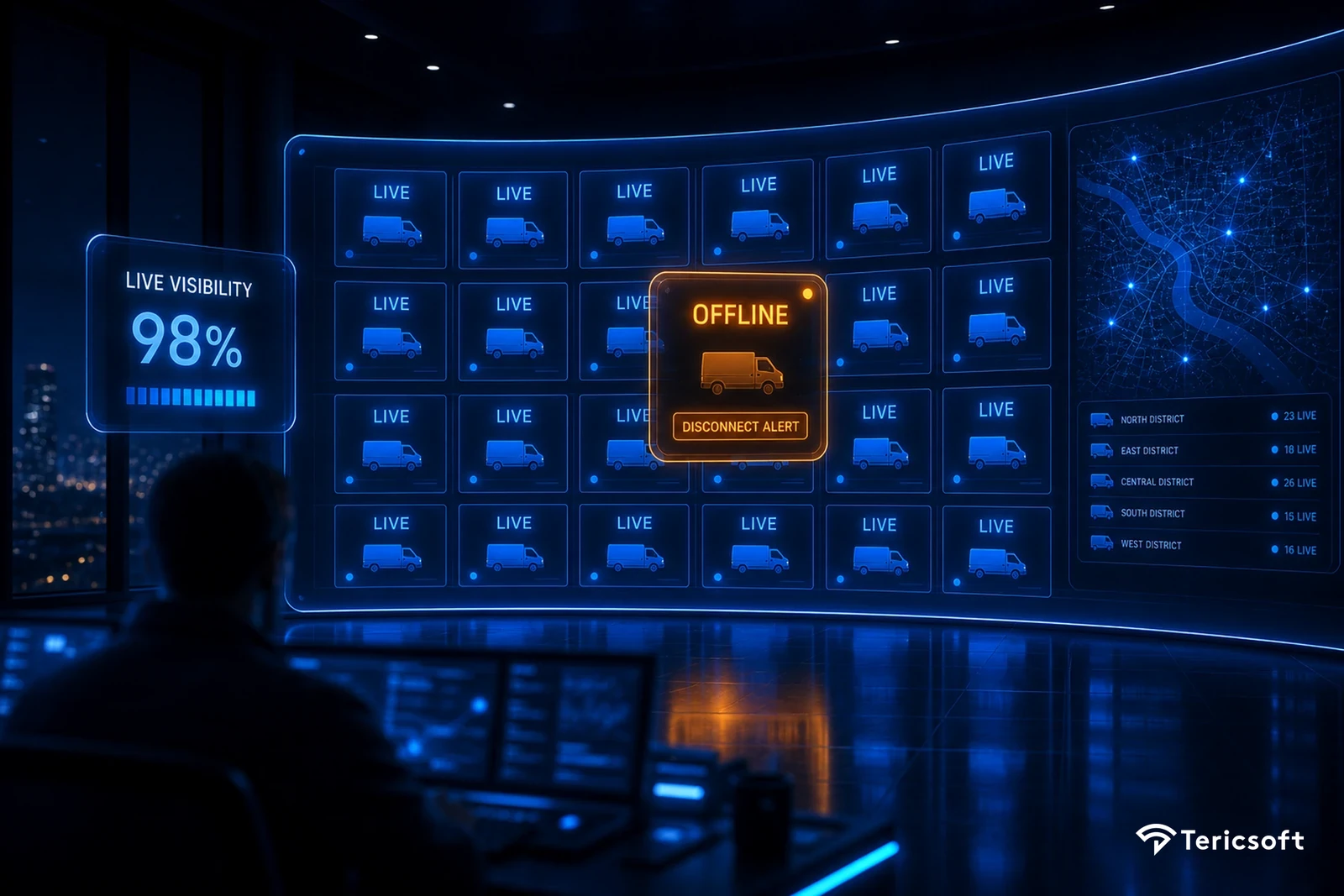
This article is written from production rather than from a feature-comparison spreadsheet. Tericsoft engineers the operational platform behind one of the world's larger electric deployments, a 3,000-plus electric vehicle fleet processing more than 1 billion telemetry events monthly at over 98 percent real-time visibility.
How electric vehicle fleet management differs from diesel fleet software
Electric vehicle fleet management breaks three assumptions diesel-era software was built on. Range becomes a hard dispatch constraint rather than a full-tank afterthought. A trip assigned beyond a vehicle's real remaining range does not simply run late, it strands.
Charging is the second break. It replaces fueling as a scheduled, priced, data-verified activity, where a five-minute errand at the pump becomes a multi-hour event whose timing and cost the software has to plan.
The battery is the third, and the sharpest. Industry estimates put it at 30 to 40 percent of an EV's value, yet it degrades invisibly, exposed only in longitudinal telemetry and never in a walk-around inspection. Retrofitted platforms display these three facts on a dashboard. EV-native platforms operate on them inside dispatch, routing, and the profit-and-loss.
The seven capabilities an EV fleet management system must run natively
The test of an EV fleet management system is not whether it shows electric data, but whether it acts on it. These seven capabilities have to live in the engine, not on the screen.
1. State-of-charge-aware dispatch. The cardinal rule of electric operations is to never assign a trip the battery cannot finish. That requires live state of charge per vehicle and effective range, adjusted for battery health, load, and route, inside the allocation engine itself. Software that shows state of charge on a dashboard but ignores it in dispatch manufactures its own breakdowns.
2. Charging session intelligence. Here is the problem nobody prints on a datasheet. In our production telemetry, OEM CAN feeds frequently flat-line state-of-charge data during charging sessions, so naive software goes blind precisely during the fleet's most cost-critical activity. Production-grade platforms reconstruct session timing and fast-versus-slow classification from telemetry patterns, with no extra hardware. Ask any vendor how they handle it. The answer separates platforms that have run electric vehicles from platforms that added a leaf icon.
3. Charging-window cost optimization. Electricity, unlike diesel, changes price by the hour. A fleet that schedules charging into off-peak windows captures the tariff spread across every vehicle, every night. A fleet that charges opportunistically donates it. The software's job is to plan each vehicle's charging window against its next-day duty cycle, then flag every deviation. This is the part of EV charging management a charger vendor's dashboard cannot reach, because it has to know each vehicle's duty cycle and cost exposure, not just its charging state.
4. Battery health analytics. The battery is the most expensive component you own, and it degrades where no inspection can see it, in a steepening degradation curve or a cell group drifting out of balance. Only longitudinal charging and range telemetry expose it, feeding predictive maintenance, warranty claims, and resale timing. This is asset management for a balance-sheet item, not a maintenance line.
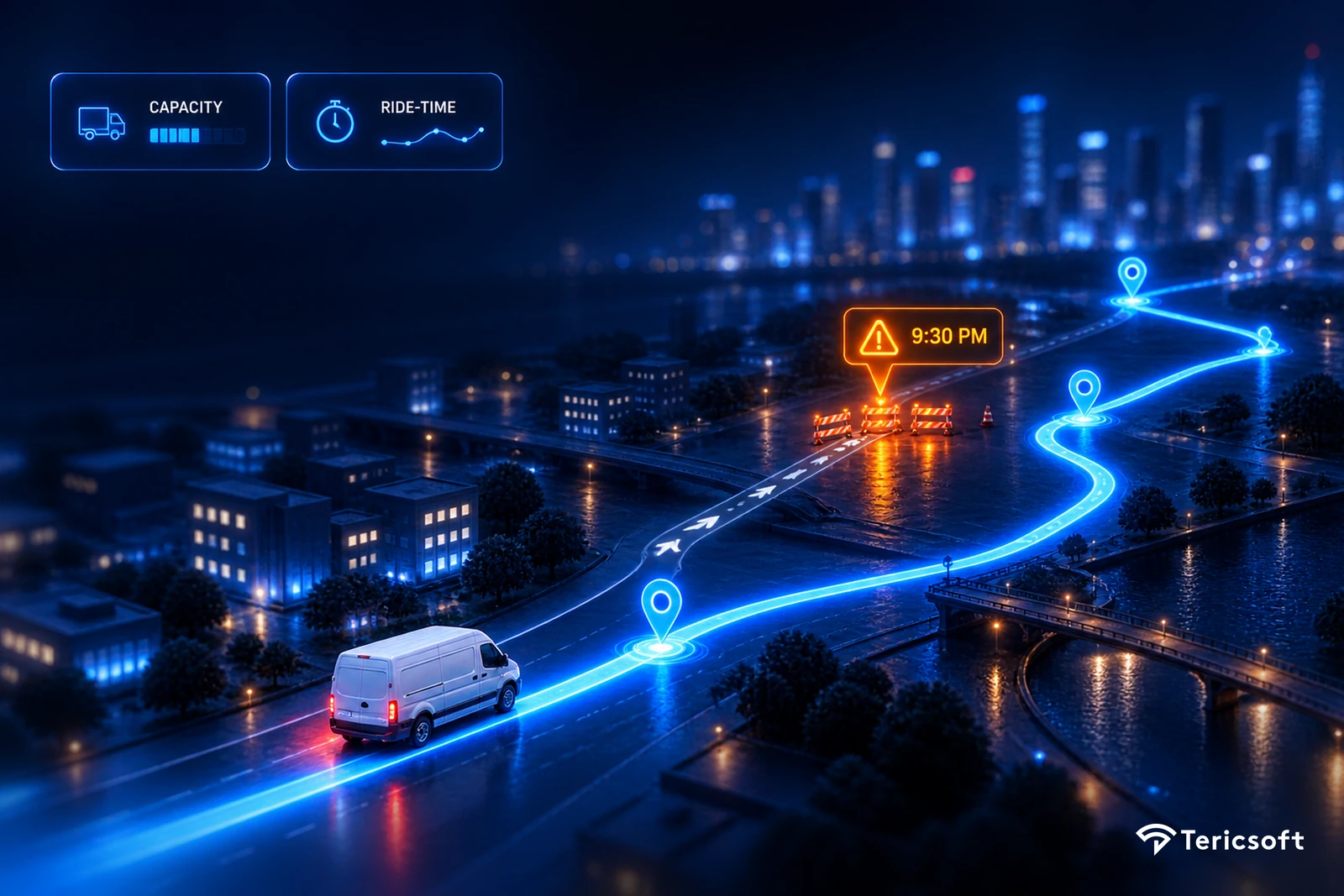
5. Range-aware route planning. Routing for electric vehicles adds constraints diesel never had: energy consumption by route profile and load, charging stops as schedulable events, and range buffers set per vehicle rather than per spec sheet. This is where route optimization stops being a distance problem and becomes an energy problem.
6. Multi-OEM data normalization. Most electric fleets are multi-brand within two years, and every manufacturer's telematics API speaks a different language. Without a normalization layer mapping all of it into one data model, each brand becomes its own silo with its own dashboard. This layer is where telematics integration quietly decides whether a fleet has one operating picture or five.
7. Energy cost per kilometre, per vehicle, per client. The electric cost advantage is real, but it has to be proven. Energy cost per kilometre computed from actual charging data, joined to trips and contracts, rolls into per-vehicle and per-customer profitability. If the software cannot show which contracts the electric economics are winning, the finance team is flying blind.
The electric fleet software provider landscape, honestly
There are three genuinely different paths to buying electric fleet software, and most buyer regret comes from not knowing which one you are on.
Mixed-fleet telematics leaders (Samsara, Geotab). Mature, hardware-rich platforms with electric features added to a conventional core, covering state-of-charge monitoring, charging status, and electric reports. Right for mixed combustion and electric fleets under a few hundred vehicles that want one standard platform quickly. The trade-offs are per-vehicle pricing that compounds forever, electric logic that is monitoring-first rather than operations-first, and workflows configured within the vendor's limits.
Charging and energy specialists (Driivz, ChargePoint, Synop, Ampcontrol). EV charging management software and electric analytics products that go deep on energy but narrow on operations. They are often excellent at the charger and thin at dispatch, billing, and fleet-wide workflows. They are useful as components and risky as the whole platform.
Engineering-partner platforms (Tericsoft). For operators past a few hundred electric vehicles whose operating model no longer fits any product: a platform built electric-native from the data layer up, customized to your dispatch rules and contracts, deployed in your cloud, and owned by you. Full intellectual property, near-zero marginal cost per added vehicle, and a first module live in weeks. This is what runs the 3,000-plus vehicle deployment behind this article. It is not the right answer below a few hundred vehicles, where standard software is faster and cheaper, and we say so.
The eight-question checklist that exposes retrofits
- “Show me dispatch refusing a trip beyond a vehicle's real range.” Not a range display, an allocation engine that says no.
- “How do you handle state-of-charge data that flat-lines during charging?” In our experience, the fastest way to tell an EV-native platform from a retrofit.
- “Where does charging-window planning live?” A tariff-aware schedule per vehicle, or a report of what already happened?
- “Show me a battery degradation curve for one vehicle over 18 months.” If the answer is a current-health percentage, the longitudinal data does not exist.
- “How many OEM brands are live on one screen today?” Multi-OEM claimed is not multi-OEM normalized.
- “What is energy cost per kilometre for this vehicle last month, and which client contract absorbed it?” This tests whether the energy data reaches the profit-and-loss.
- “What happens when a vehicle misses its planned charging window?” The answer should be an alert with an owner, ideally an automated escalation that chases a human up the chain.
- “Who owns the platform, the data, and the per-vehicle economics in year five?” A subscription forever, or an asset you own?
What running 3,000 EVs taught us about EV fleet operations
The numbers behind this article come from production, not a brochure. Real-time visibility above 98 percent is held as a tracked KPI, because the invisible slice is where losses live, so the gap itself is alarmed and worked. More than 1 billion telemetry events monthly are normalized across multiple manufacturers into one operational model.
Component failures, including battery-signal anomalies, are flagged 2 to 3 weeks before breakdown and converted into workshop tickets automatically. Charging discipline is managed as a profit-and-loss line rather than a driver habit. And the fleet runs three revenue models at once on one platform, with profitability visible per vehicle, driver, site, and customer. That is what EV fleet operations software has to be when the fleet is the business.
Key lessons
- EV-native beats EV-added. The battery, the charge, and the range have to live inside dispatch and economics, not beside them on a dashboard.
- Charging is the new fuel management, and it is harder. Time-of-day pricing, session data quality, and battery impact make charging a software discipline in its own right.
- The battery is a balance-sheet item. Manage its health with longitudinal data, or discover its depreciation at resale.
- Match the path to your scale. Standard software below a few hundred vehicles, electric-native owned platforms when the fleet is the business and the operating model is yours.
About Tericsoft
Everything above holds whatever manufacturer or vendor you standardize on. Where Tericsoft fits is narrow. We do not sell chargers or telematics boxes. We build and run the platform layer that decides which trip a battery can safely take, what a flat-lined charging feed actually means, and how five manufacturer APIs resolve into one profit number per vehicle. Our vantage point is operational rather than promotional, earned by running an electric fleet at a scale where a bad dispatch decision strands a paying trip. If your electric fleet has outgrown the products built to monitor it and needs software that operates it, that is the problem we engineer for.

Software that runs an electric fleet: state-of-charge dispatch, charging scheduling, battery health, and energy cost joined to trips.
It models what diesel tools never did: range as a hard dispatch limit, charging as a scheduled priced activity, and battery as an asset.
Yes. Good platforms normalize both into one data model and apply range and charging logic only to the electric vehicles.
SaaS costs per vehicle monthly, forever. Custom EV-native platforms front-load engineering and drop marginal cost toward zero at scale.
OEM feeds often flat-line state of charge while charging. Platforms that reconstruct sessions from telemetry recover accurate energy costs.