What is a vehicle tracking system, how does it work, and how do you choose one for a commercial fleet? The device types, what tracking cannot see, and the missing 2 percent that separates toy tracking from fleet-grade.
A vehicle tracking system uses GPS and GNSS positioning together with wireless networks to report where every vehicle in a fleet is, live and historically, through devices installed in the vehicle or telematics built in by the manufacturer. That is the textbook definition, and for a five-vehicle business it is the whole story. For a commercial fleet it is only the first chapter. At scale the hard question stops being “where are my vehicles?” and becomes “which ones are not reporting, which movements are unauthorized, and what do I do about it in the next ten minutes?”
This guide covers both chapters: how tracking works and which device to buy, then the part no vendor page writes, which is what tracking alone cannot see. It is written from inside running tracking at scale. Tericsoft engineers fleet platforms that hold more than 98 percent real-time visibility across a 3,000-plus vehicle EV fleet, and the story of the missing 2 percent is the most valuable section on this page.
How a GPS vehicle tracking system works
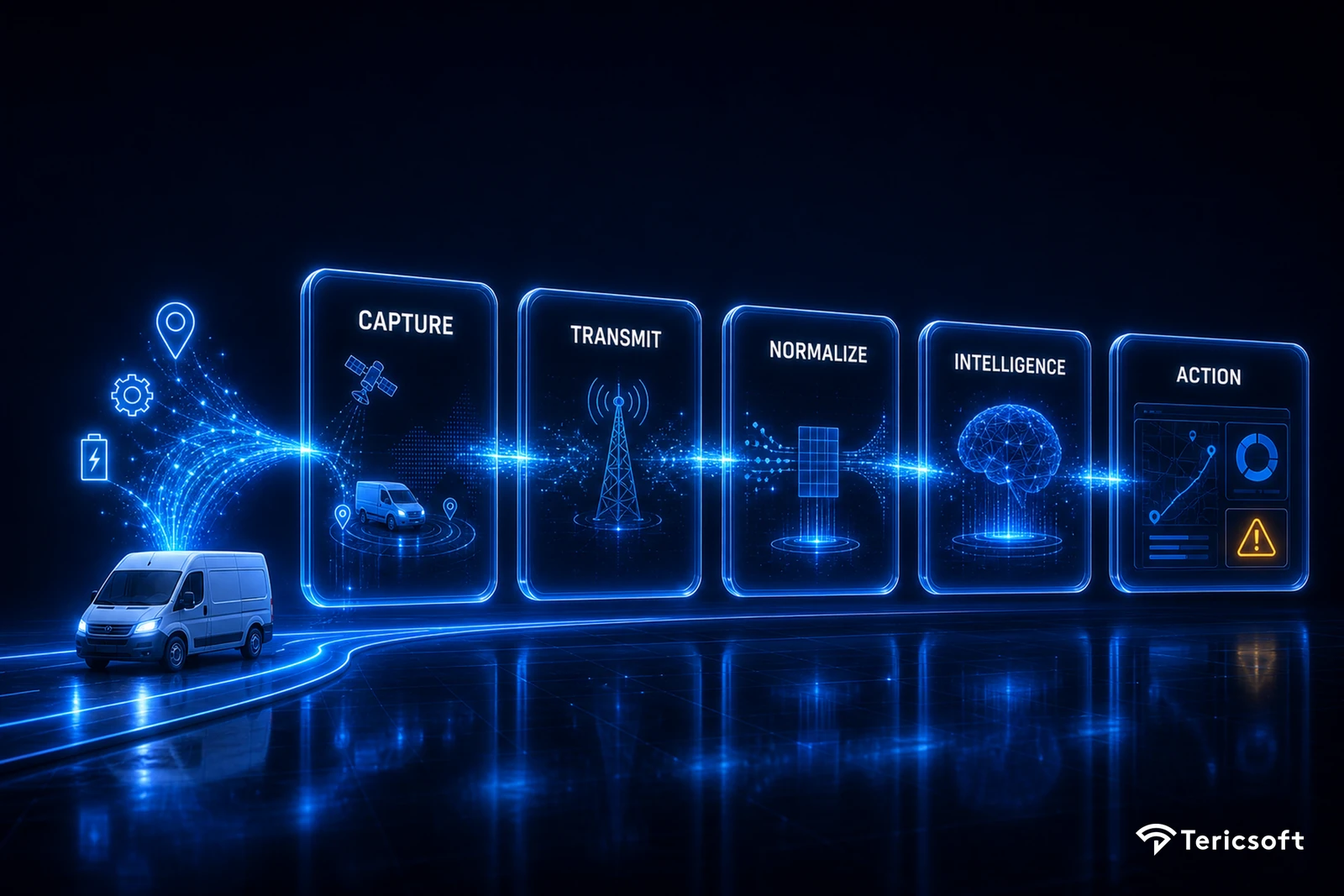
Underneath the map, every vehicle tracking system runs the same five-stage chain. The differences between a toy and a fleet-grade platform live in the last stage, but the first four are where the data quality is won or lost.
- Positioning. The device computes its location from satellite constellations. Good units read several at once, the American GPS plus typically GLONASS and Galileo, which produces faster and more reliable fixes in dense cities than GPS alone. Under open sky the underlying service is accurate to within a few meters (GPS.gov accuracy), and the device reports position, speed, and heading every few seconds.
- Capture. Alongside position, most devices read ignition state, and units wired into the onboard diagnostics or CAN bus add vehicle data such as odometer, engine faults, fuel, or battery level. The OBD-II port that makes this possible is a regulated standard present on every compliant vehicle (US EPA on OBD systems), which is why a plug-in tracker can read diagnostics on almost any car or van without custom wiring.
- Transmission. Data streams over cellular networks. Good devices buffer readings during coverage gaps and forward them when the network returns, so the history has no holes. Store-and-forward is the most under-appreciated spec on a device sheet: a tracker that drops data in tunnels produces a trip record you cannot trust for disputes.
- Platform. Software plots live positions, stores trip history, evaluates geofences, and raises alerts. This is where real-time vehicle tracking becomes visible to a dispatcher as a moving dot and a timeline.
- Action. The differentiating stage. Events are routed to owners with consequences attached, not left as markers on a map for someone to notice. A fleet system is judged here, and almost nothing on the current market competes on it.
The first four stages are close to commodity: any competent device moves a dot around a screen. The fifth stage is where a vehicle tracking system stops being a viewer and becomes an operating tool.
Vehicle tracking device types compared
There is no single best vehicle tracking device, only device types, each with a job, and large fleets run several at once. The table below is the honest version of a choice most vendor pages present as one product.
Large fleets almost always end up hybrid: OEM feeds for the newer vehicles, wired devices for the older ones, and asset trackers on trailers. That is why the platform's ability to unify sources into one data model matters more than any single device's spec sheet. The device you argue about today is replaceable; the data model that must absorb five device types for the next decade is not. OEM-embedded telematics is arriving fast enough that multi-source normalization is tomorrow's requirement hiding inside today's purchase.
What real-time vehicle tracking gives a commercial fleet
Here is what commercial vehicle tracking actually delivers once it is live across a fleet.
- A live operational picture. Every vehicle, every depot, on one screen. Dispatch stops phoning drivers to ask where they are, and planning stops running on guesses.
- Trip history and evidence. Automatic trip logs replace driver-reported sheets. Disputes about arrival times or the route taken become lookups instead of arguments, and at the platform level this extends to second-by-second journey replay.
- Security. After-hours movement alerts, unauthorized-zone entries, and recovery support when a vehicle is stolen.
- Customer service. Live ETAs and arrival notifications generated from position, not from promises.
- The foundation for everything else. Utilization measurement, routing verification, maintenance scheduling, and billing all consume tracking data as their ground truth.
That last point is the one to hold onto. Tracking is not a feature beside the others; it is the data floor they stand on, which is why the quality of the tracking layer sets the ceiling for everything above it.
The missing 2 percent: what separates toy tracking from a fleet tracking system
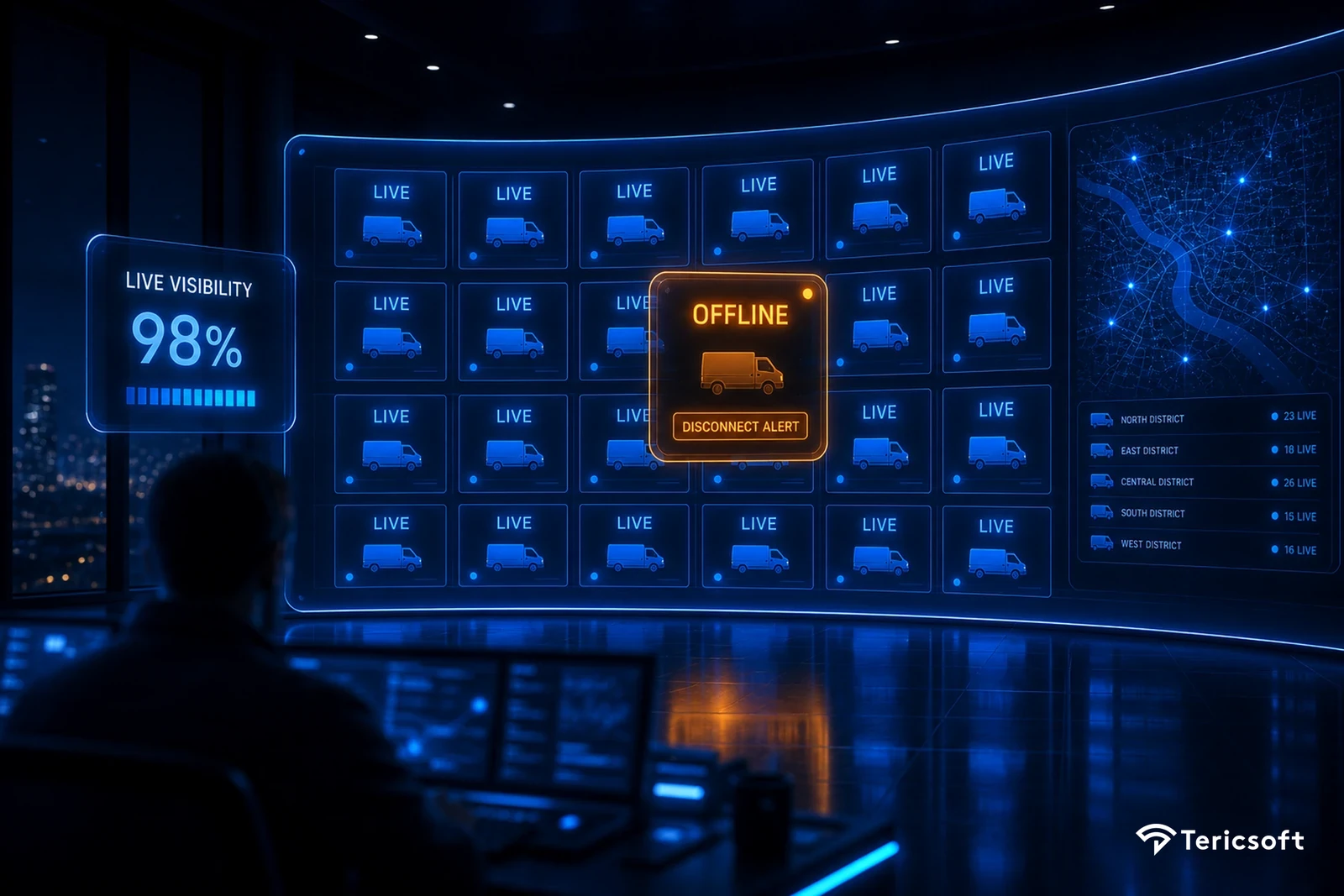
Here is the metric almost no tracking vendor discusses: what percentage of your fleet is reporting live right now, and what happens about the rest?
In production, devices fail, SIMs lapse, antennas break, and, the pattern that matters most, devices get unplugged on purpose. An OBD tracker takes two seconds to remove, and an unplugged tracker is the signature of off-book trips, moonlighting, and fuel theft. In a fleet of 1,000 vehicles, a quiet 5 percent visibility gap is 50 vehicles operating on trust, and no amount of pretty mapping fixes a fleet that cannot see them.
A real fleet tracking system treats the gap itself as the alarm:
- Disconnect and offline events are ranked alerts, raised in minutes, not buried as rows in a monthly report.
- Visibility is a KPI with an owner. We hold deployments above 98 percent live visibility, and the residual is a worked queue, not an accepted loss.
- Escalation is automatic. A critical vehicle offline too long chases a human up an automated escalation ladder: an app push, then a message, then a phone call up the chain.
Ask any tracking vendor one question: what is your workflow when a device goes dark? The quality of that answer tells you whether you are buying dots or discipline.
What vehicle tracking alone cannot see
A tracking dot answers where. It cannot, on its own, answer any of the questions a fleet actually makes money on:
- Is this vehicle earning? A parked dot waiting for its next trip and a parked dot that dispatch forgot look identical. Separating them needs trip-state context, which is the core of utilization intelligence.
- Is it healthy? Failures announce themselves in diagnostics and telemetry patterns, not in positions. That is the domain of telematics and predictive maintenance.
- Can it finish the next trip? For EVs, dispatching on position without state of charge manufactures breakdowns, because range-aware allocation is the heart of charge-aware EV operations and needs battery data, not map data.
- Is anyone acting? A map has no memory of whether an alert was handled. Fleet operating systems route every exception to an owner and log the outcome.
This is the maturity path most fleets walk: tracking, then telematics, then intelligence, then AI-operated workflows, each stage consuming the data the last one produced. The common mistake is stopping at stage one and calling it a fleet management system. Tracking is necessary, but it is not the building.
Choosing a vehicle tracking system: the shortlist filter
You do not need a feature matrix with 80 rows, just six questions that quietly fail the weak products. Use these to judge any vehicle tracking software or hardware you are shown, and notice how few vendors answer the last two well.
- Update frequency and buffering. Seconds, not minutes, with store-and-forward for dead zones. Ask what the record looks like after a tunnel.
- Disconnect detection. Tamper and offline alerts as first-class events, not a report you have to go looking for.
- Multi-source support. OEM APIs plus devices, unified into one model. Your fleet will be hybrid within two years even if it is not today.
- Open APIs. Position data has to flow into routing, dispatch, billing, and analytics. A closed portal caps your ceiling at whatever the vendor imagined.
- History depth and replay. Full-resolution trip history you can reconstruct for a dispute, not decimated averages that smooth away the moment you need.
- Behavior at scale. Ask to see the platform at 1,000-plus vehicles. Is the primary interface a ranked exception queue, or a map with a thousand dots that no one can watch? The answer tells you whether the product was designed for a fleet or demoed on a handful of vans.
The best vehicle tracking system for you is the one that answers questions five and six without flinching, because those are the two a product built for driveways cannot fake.
Key lessons
- Tracking is the floor, not the system. Buy it as the foundation of telematics and intelligence, or you will rebuy in eighteen months.
- The gap is the signal. Fleet-grade means the untracked slice is alarmed, owned, and worked. Above 98 percent visible, with the residual escalated.
- Plan for hybrid sources. OEM-embedded telematics is taking over, and multi-source normalization is tomorrow's requirement hiding in today's purchase.
- Dots do not act. Value begins where position data triggers owned, logged, and escalated action.
About Tericsoft
Everything above holds whatever device or vendor you choose. Where Tericsoft fits is narrow, and worth stating plainly. We do not sell trackers. We build and run the platform layer that decides what a disconnect means, which offline vehicle gets chased first, and how five device types resolve into one trustworthy record. Our vantage point is operational rather than promotional: we treat the missing slice as a worked queue with an owner, not a number in a dashboard. If your fleet has outgrown the map and needs tracking that behaves like an operating system, that is the problem we engineer for.

A system using GPS and GNSS over cellular networks to report each fleet vehicle live and past location into mapping and alerting software.
A device fixes position from GPS, GLONASS, and Galileo, adds OBD or CAN vehicle data, and transmits over cellular, buffering coverage gaps.
Five: OBD plug-ins, hardwired black boxes, OEM-embedded telematics, battery asset trackers, and driver apps. Large fleets run a hybrid.
Yes, an OBD unit unplugs in seconds. Fleet-grade systems raise ranked disconnect alerts, escalate, and hold visibility above 98 percent.
Tracking answers where vehicles are. Fleet management adds health, utilization, maintenance, and workflows routing exceptions to an owner.