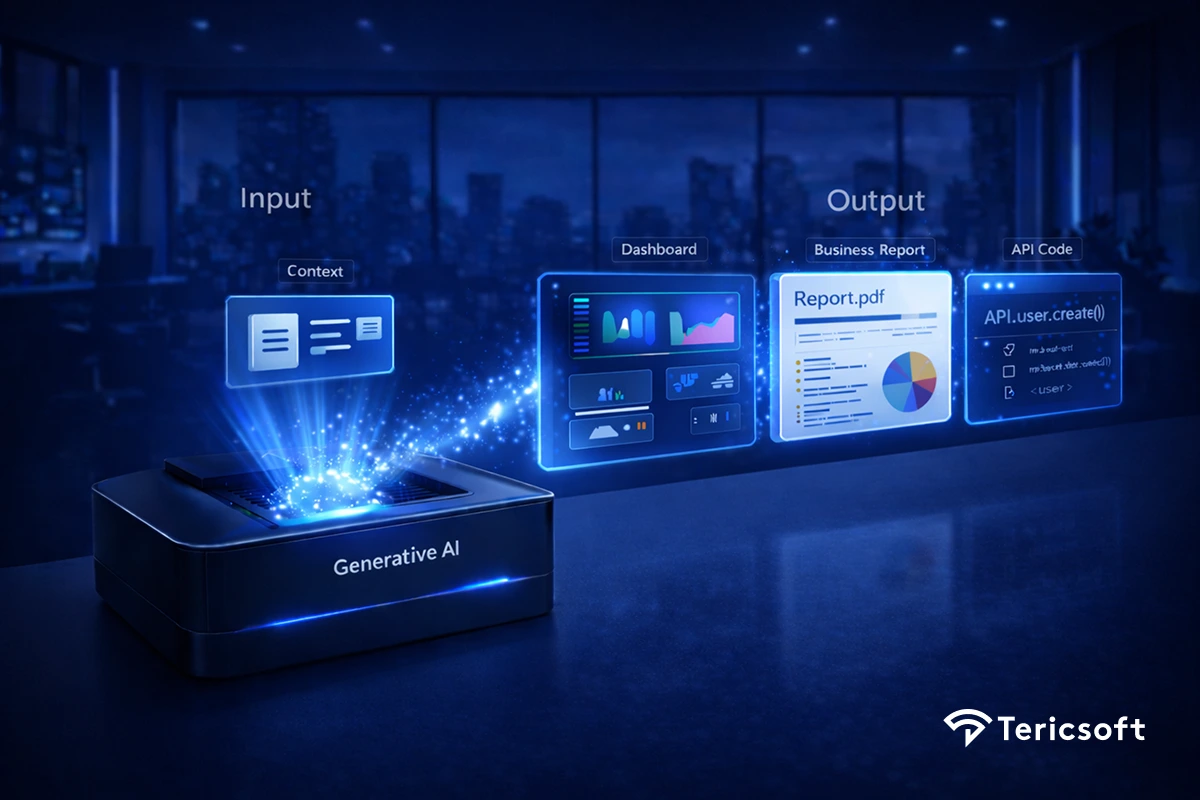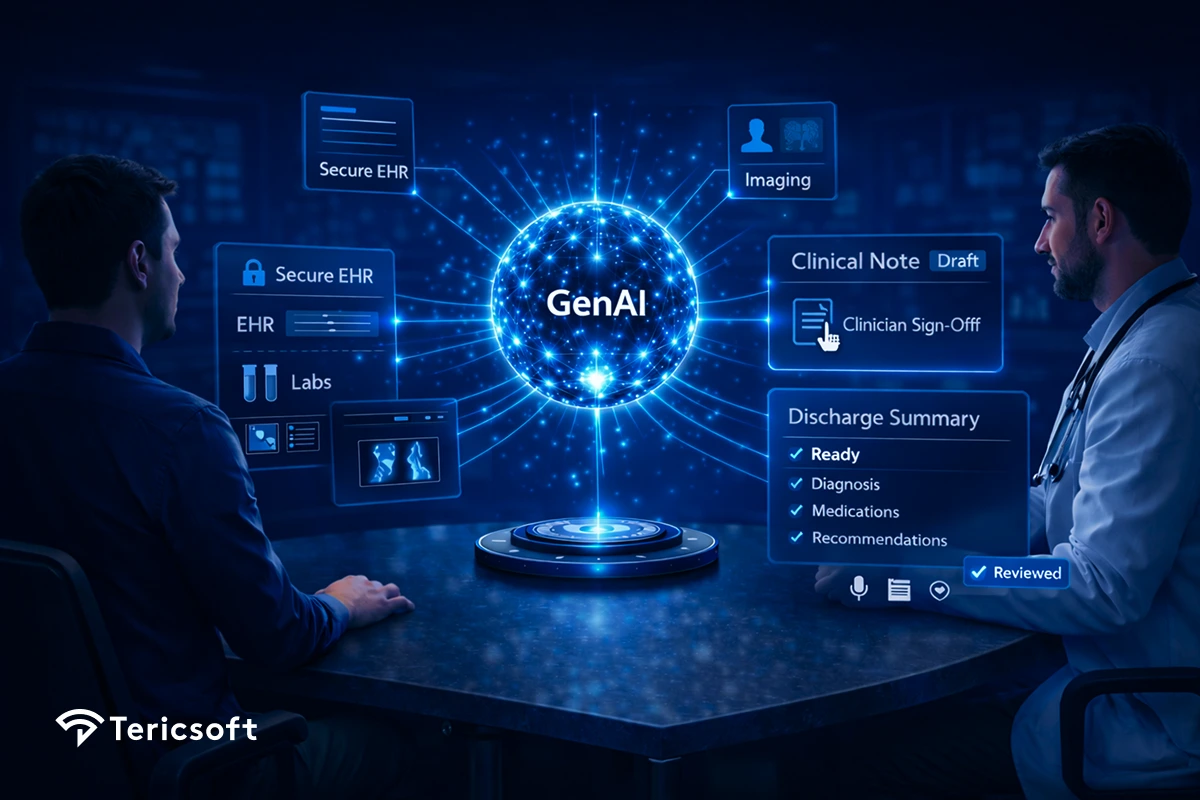
What is Generative AI in healthcare?, how does it transform fragmented clinical data into one trusted system of intelligence, and why is it becoming indispensable for organizations seeking to scale medical operations without risking clinician burnout or diagnostic inconsistency?
The quiet hum of a hospital ward is often masked by the frantic clicking of keyboards. Today, for every hour a physician spends with a patient, they spend two additional hours on administrative tasks and clinical documentation. Healthcare is at a breaking point: clinician burnout, fragmented data silos, and a reactive care model have created a system that is no longer sustainable.
We are entering a new era where the shift from static, rule-based software to context- aware, learning-driven intelligence is not just an upgrade: it is an inevitability. Generative AI is moving beyond the hype of chatbots to become the cognitive co-pilot that clinicians have long needed to reclaim their time and refocus on healing.
This emergence of Generative AI (GenAI) represents a fundamental shift in how we process medical intelligence. Unlike previous waves of digital health that focused on digitizing records, GenAI focuses on understanding them. It is the bridge between a massive, unorganized ocean of clinical data and the actionable insights required at the point of care. For hospital CIOs and HealthTech leaders, this is the move from systems of record to systems of intelligence. By 2034, the global Generative AI in healthcare market is projected to reach USD 39.70 billion, expanding at a staggering CAGR of 35%. This growth is fueled by a singular realization: Healthcare does not need more data; it needs better intelligence.
"The greatest opportunity offered by AI is not reducing errors or workloads, or even curing cancer: it is the opportunity to restore the precious and time-honored connection and trust—the human touch—between patients and doctors."
— Dr. Eric Topol, Deep Medicine
What Is Generative AI in Healthcare?
Generative AI in healthcare refers to artificial intelligence systems capable of creating clinically meaningful outputs (such as summaries, recommendations, and synthetic medical data) by understanding deep medical context rather than just identifying simple patterns. While traditional AI might flag an abnormal lab result, Generative AI can synthesize that result with a patient's three-year history, current medications, and the latest clinical guidelines to draft a discharge summary or a personalized care plan.
How generative AI uses LLMs?
At the heart of this revolution are Large Language Models (LLMs). These models are trained on vast datasets of medical literature, textbooks, and anonymized clinical records. Unlike a simple keyword search, an LLM understands semantics: the meaning behind the words.
In a clinical setting, LLMs interpret unstructured data:
- Physician Notes: Converting shorthand and dictation into structured EHR data.
- Lab Reports: Summarizing complex longitudinal data into a narrative trend.
- Discharge Summaries: Synthesizing weeks of inpatient data into a concise handoff document.
Generative AI in healthcare examples
The practical applications are already delivering measurable value across the care continuum:
- Ambient Clinical Intelligence: AI medical scribes that listen to patient-provider conversations and automatically generate high-quality clinical notes.
- Diagnostic Summarization: Synthesizing radiology reports and pathology findings to help specialists identify key focus areas faster.
- Patient Education: Translating complex medical jargon into easy-to-understand instructions for patients in their native language.
- Research Acceleration: Scanning thousands of clinical trials to match patients with life-saving experimental therapies in minutes.
Insight: Generative AI does not replace clinicians: it removes cognitive overload.
Generative AI vs Traditional AI in Healthcare
The distinction between traditional AI and generative AI is often misunderstood, yet it is critical for strategic planning.
Traditional AI predicts outcomes; Generative AI supports decisions. While traditional systems answer predefined questions (e.g., "Is this a fracture?"), Generative AI helps clinicians reason through complex, open-ended clinical scenarios.
Applications of Generative AI in Healthcare
Generative AI is transforming high-friction areas of the healthcare ecosystem. These applications focus on where clinical value meets operational impact.
- Clinical Documentation & AI Scribes: By automating the 2.6 hours of daily documentation time reported by many physicians, AI scribes directly address the leading cause of burnout. One study showed burnout rates falling from 51.9% to 38.8% after implementing ambient AI tools.
- Diagnostic Assistance: Beyond identifying anomalies, GenAI can draft differential diagnoses by cross-referencing patient symptoms with global medical databases, serving as an expert second opinion.
- Personalized Treatment Planning: By analyzing a patient's genomic profile alongside clinical history, GenAI suggests tailored therapeutic pathways, particularly in oncology and rare disease management.
- Revenue Cycle Management (RCM): Automating prior authorizations and clinical appeals by extracting relevant clinical evidence from the EHR to justify medical necessity, reducing claim denials.
How Generative AI Healthcare Systems Work?
To be effective in a clinical environment, Generative AI cannot be a black box or a standalone chatbot. It must be an architected system designed for accuracy and safety.
What is RAG in healthcare?
Retrieval-Augmented Generation (RAG) is the grounding mechanism of healthcare AI. While a standard LLM relies only on the data it was trained on, a RAG-enabled system first retrieves relevant, up-to-date information from a trusted source (like a hospital's EHR or a specific medical journal) before generating a response.
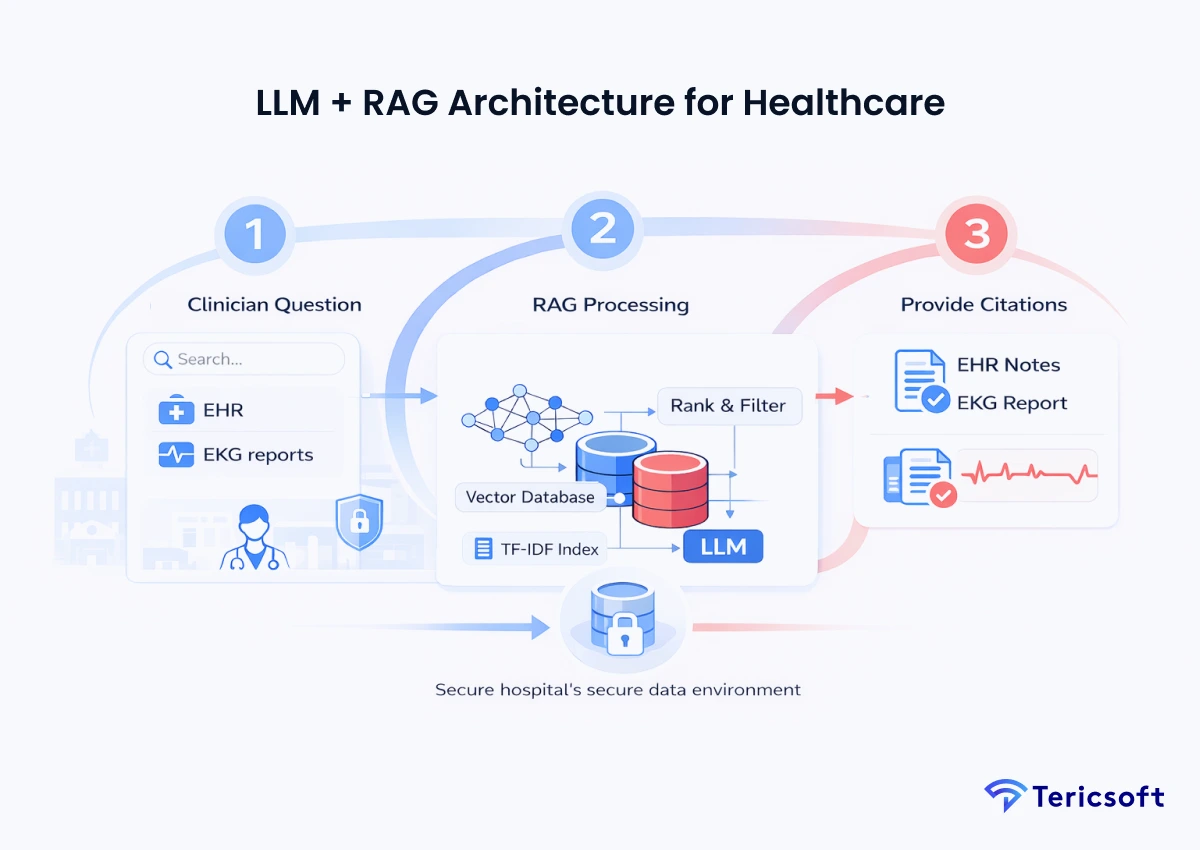
LLM + RAG architecture for healthcare
The synergy between LLMs and RAG is what makes AI clinical-grade. RAG prevents hallucinations (where an AI makes up facts) by ensuring every claim is backed by a specific document in the hospital's secure data environment.
- Step 1: The clinician asks a question (e.g., "Summarize the cardiac history").
- Step 2: The system searches the secure EHR for cardiology notes and EKG reports.
- Step 3: The LLM synthesizes only that retrieved data into a summary.
- Step 4: The system provides citations so the clinician can verify the source.
Crucial Metric: RAG-enhanced models have been shown to improve accuracy from approximately 60% in base models to 87% or higher in complex medical guideline testing.
How Healthcare Organizations Can Implement Generative AI?
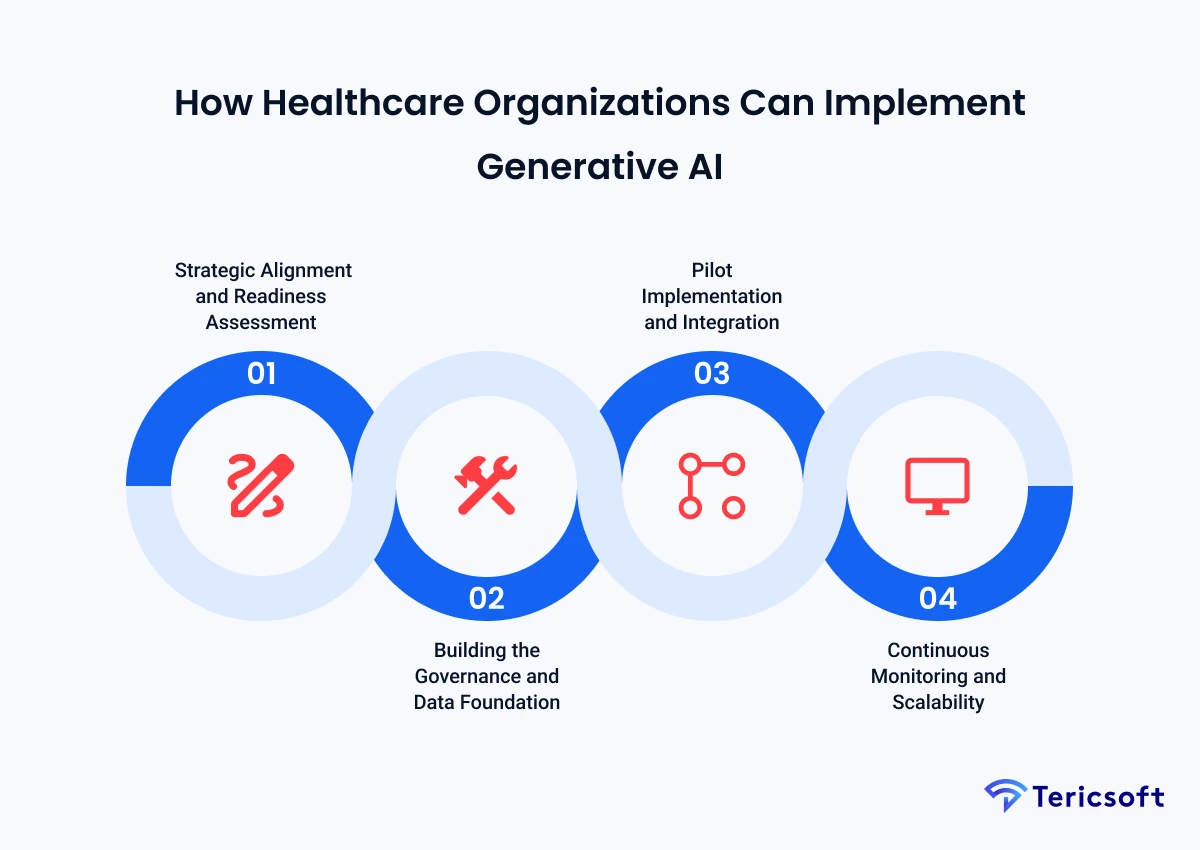
Moving from a pilot project to a production-grade clinical tool requires a disciplined roadmap. Implementation is not a single event but a journey through four distinct phases.
Phase 1: Strategic Alignment and Readiness Assessment
Before touching code, leadership must define what success looks like. This involves identifying high-impact, low-risk use cases. For instance, automating discharge summaries offers high efficiency gains with lower immediate clinical risk compared to diagnostic assistants. Organizations should assess their data maturity using frameworks like the HIMSS Analytics Maturity Assessment Model to ensure their infrastructure can support AI orchestration.
Phase 2: Building the Governance and Data Foundation
Healthcare AI adoption fails without trust. Organizations must establish a multidisciplinary AI Safety Committee comprising clinicians, IT, and legal experts.
- Data Unification: Unify siloed data from fragmented EHRs, departmental systems, and imaging platforms into a secure, clean data lake.
- Model Selection: Choose between secure private clouds or on-premises models based on data sovereignty needs.
- Guardrails Implementation: Deploy tools to quantify expected responses and implement defensive UX, which clearly communicates to users that they are interacting with AI.
Phase 3: Pilot Implementation and Integration
AI should exist within the clinician's existing workflow (e.g., Epic or Cerner) rather than as a separate browser tab.
- Minimum Viable Products (MVPs): Launch narrow pilots, such as AI-powered radiology report drafting or patient communication triage.
- Workflow Co-design: Work directly with physicians to ensure the tool reduces clicks rather than adding them.
- Human-in-the-Loop (HITL): Ensure every AI-generated insight requires a licensed clinician to review and sign off.
Phase 4: Continuous Monitoring and Scalability
AI is not a set and forget technology. Models can drift, and new medical guidelines emerge constantly.
- Evaluation Pipelines: Establish continuous validation pipelines to test the AI across diverse patient demographics to prevent bias.
- Workforce Literacy: Invest in training and change management to help staff view AI as a workforce ally rather than a threat.
- Measuring ROI: Track specific metrics such as reduction in documentation hours, faster claim approvals, and improved patient engagement scores.
Benefits of Generative AI in Healthcare Systems
The Return on Investment (ROI) of GenAI maps directly to the core pain points of the modern health system:
- Reduced Clinician Burnout: Freeing providers from the keyboard tax allows them to focus on the patient, improving both provider and patient satisfaction.
- Faster, Better-Informed Decisions: Real-time synthesis of fragmented data reduces diagnostic delays.
- Operational Efficiency: Automating RCM and prior authorizations can save the healthcare sector an estimated USD 150 billion annually.
- Scalable Care Delivery: Virtual assistants can manage routine patient queries, allowing nursing staff to focus on high-acuity cases.
Data Privacy, Compliance & Safety in Generative AI Healthcare
In healthcare, an ungrounded model is not innovation: it is risk. A robust AI strategy must prioritize:
- PHI Protection: Ensuring models are HIPAA-compliant and that patient data is never used to train public AI models.
- Explainability: Every AI-generated insight must include source grounding, which is a trail back to the original clinical note or lab result.
- Human-in-the-Loop (HITL): AI should suggest, but a clinician must always maintain control and oversight.
- Bias Mitigation: Continuous monitoring to ensure the AI provides equitable recommendations across all patient demographics.
"AI will amplify human intelligence, not replace it."
— Yann LeCun, Chief AI Scientist for Facebook AI Research
Choosing the Right Generative AI Partner
Building a production-ready AI system in a regulated environment is vastly different from building a demo. Healthcare organizations need more than a technology vendor: they need a strategic partner who understands clinical nuances and compliance rigors.
Why Your Choice of Partner Matters
The wrong partner can create integration issues, jeopardize patient trust, and waste valuable resources. A specialized Generative AI partner like Tericsoft brings deep healthcare experience, respecting your clinical environment while working collaboratively to integrate solutions seamlessly.
What to Look for in a Healthcare AI Partner
- Clinical Workflow Expertise: Do they understand the difference between an inpatient discharge and an outpatient summary? Can they integrate directly into Epic or Cerner?
- Safety First Architecture: Do they prioritize RAG and source grounding to prevent hallucinations?
- Compliance Rigor: Are they experts in HIPAA, GDPR, and emerging AI governance frameworks?
- End-to-end Capabilities: Do they offer a complete path from initial strategy and POC to full-scale, production-grade deployment?
Tericsoft helps healthcare organizations design and deploy secure, compliant, production-ready Generative AI systems. We focus on building AI that works in real-world clinical environments, ensuring that your transition to the future of medicine is safe, scalable, and impactful.
Why Generative AI Is the Future of Healthcare
We are moving from reactive care to intelligent care systems. The future of healthcare is not a world where AI replaces doctors, but one where AI removes the friction that prevents doctors from being doctors.
By transitioning from documentation overload to decision intelligence, we can finally build a healthcare system that is as smart as the people who work within it. The transition is no longer optional: it is the path forward for any organization committed to clinical excellence and sustainable growth.

Generative AI in healthcare refers to AI systems that understand medical context and generate clinical summaries, recommendations, and decision-support outputs.
Traditional AI predicts outcomes using fixed models, while Generative AI understands context and creates narratives, insights, and clinical documentation.
Yes, when implemented with safeguards like RAG, human-in-the-loop review, and compliance with HIPAA and data-privacy standards.
Common use cases include AI medical scribes, clinical documentation automation, diagnostic summarization, patient communication, and decision support.
No. Generative AI supports clinicians by reducing administrative burden and cognitive load, allowing doctors to focus on patient care.