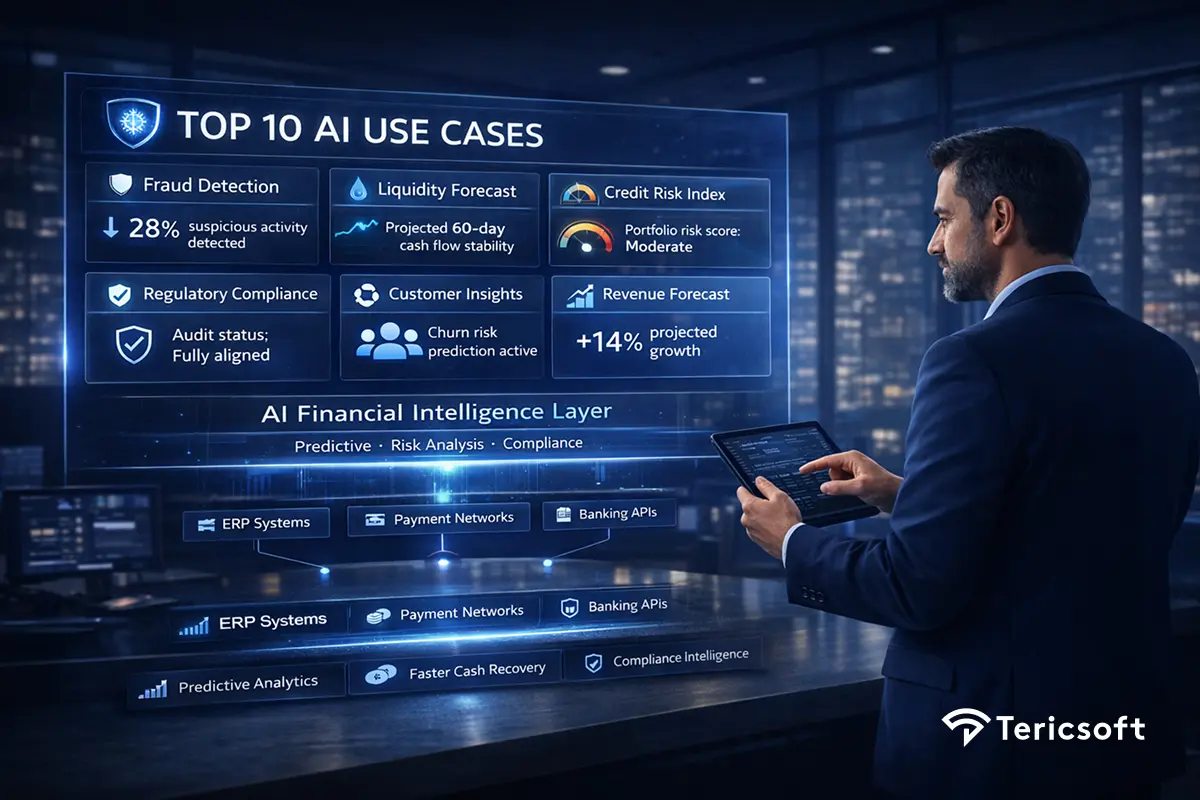
How are AI-powered systems transforming banking and financial services in 2026? Discover the top 10 AI use cases helping institutions move beyond traditional reporting toward real-time fraud detection, predictive forecasting, intelligent automation, and data-driven financial decision making.
For decades, financial institutions have relied on structured reporting systems to understand their financial health. Monthly reports, quarterly forecasts, and manual reconciliation processes defined the rhythm of financial decision-making across banks and financial institutions.
But the financial world of 2026 looks very different.
Today, banks and financial institutions operate in high-velocity digital ecosystems where billions of transactions move across global payment networks, digital banking platforms, fintech integrations, and enterprise ERP systems every day. Financial data is no longer generated in predictable cycles; it is produced continuously across multiple systems and channels.
This explosion of financial data has created a fundamental challenge for financial leaders.
Traditional analytics systems are designed to explain what already happened. But modern financial institutions must understand what is about to happen next.
Artificial intelligence is emerging as the technology that bridges this gap.
AI systems can analyze complex financial datasets in real time, detect patterns across millions of transactions, and generate predictive insights that support faster financial decision-making. Instead of reacting to financial events after they occur, institutions can anticipate risks, opportunities, and liquidity changes before they materialize.
According to McKinsey, generative AI could generate $200 billion to $340 billion annually in value for the banking industry.
At the same time, industry adoption is accelerating. Research shows that nearly 70% of banking institutions are already exploring or deploying AI systems across their operations.
“AI is the new electricity.”
— Andrew Ng
Just as electricity transformed manufacturing, artificial intelligence is now becoming the operational backbone of modern financial institutions.
In this article, we explore the top 10 AI use cases in financial services, examining how financial institutions are evolving from reactive reporting systems toward predictive financial intelligence platforms.
AI Transformation in Financial Services
Financial services have historically been early adopters of transformative technologies—from electronic trading platforms to online banking infrastructure.
Artificial intelligence represents the next phase of that evolution.
Banks today manage enormous volumes of financial data across global markets, payment systems, and digital platforms. At the same time, regulatory complexity continues to increase, forcing institutions to maintain rigorous compliance frameworks across risk, reporting, and operational governance.
These pressures are pushing financial institutions toward intelligent automation and predictive analytics.
Across the banking sector, AI is now being embedded into core operational areas including:
- fraud detection
- credit risk analysis
- treasury management
- regulatory compliance monitoring
- financial forecasting
- customer intelligence systems
Industry forecasts suggest that the global AI market in banking could exceed $450 billion by 2035, highlighting the scale of investment financial institutions are making in intelligent infrastructure.
This shift represents a broader transformation: financial institutions are moving beyond digital banking toward intelligent banking ecosystems powered by AI.
Top 10 AI Use Cases in Financial Services
1. AI Fraud Detection and Transaction Monitoring
Fraud detection is one of the earliest and most widely deployed AI applications in financial services.
Traditional fraud monitoring systems relied heavily on static rules, for example flagging transactions above a certain threshold or detecting transactions from unusual locations.
However, modern fraud patterns are significantly more complex. Criminal networks frequently exploit behavioral loopholes that static rules cannot detect.
AI-powered fraud detection systems analyze transaction patterns across millions of financial events, identifying anomalies that may signal fraudulent activity.
These systems evaluate signals such as:
- transaction timing patterns
- unusual merchant behavior
- cross-account behavioral anomalies
- network-level fraud correlations
This allows banks to detect fraud in real time rather than after losses occur.
To better understand how these systems are structured, this breakdown of AI fraud detection in banking examines the underlying architecture.
2. AI Credit Risk Assessment
Credit evaluation has traditionally relied on historical indicators such as credit scores, repayment history, and income documentation.
However, modern AI models analyze a far broader set of behavioral and financial signals.
Machine learning systems can evaluate:
- transaction patterns
- spending behavior
- repayment consistency
- macroeconomic indicators
- industry-specific financial signals
By combining these datasets, AI models generate more dynamic borrower risk profiles.
This allows financial institutions to reduce default risk while also expanding credit access to new customer segments.
In many cases, AI-driven credit models enable banks to move beyond static credit scoring toward predictive borrower intelligence systems.
3. AI Treasury Intelligence and Liquidity Forecasting
Treasury operations are often described as the financial nerve center of an enterprise.
Treasury teams must monitor liquidity across multiple accounts, currencies, and financial instruments while also managing debt exposure, funding strategies, and capital allocation decisions.
However, treasury data is frequently fragmented across:
- ERP systems
- treasury management platforms
- banking reports
- internal financial systems
This fragmentation makes liquidity forecasting one of the most difficult responsibilities for finance teams.
AI-powered treasury intelligence platforms address this challenge by integrating financial data across systems and generating predictive liquidity insights.
These platforms enable organizations to:
- forecast cash flow more accurately
- detect liquidity risks earlier
- optimize capital allocation strategies
This analysis of AI treasury intelligence examines how artificial intelligence supports treasury visibility and forecasting.
4. AI Financial Forecasting and Predictive Analytics
Financial forecasting has traditionally relied on spreadsheets and manual financial modeling.
While these tools remain valuable, they struggle to incorporate the growing complexity of financial data ecosystems.
AI-powered forecasting platforms analyze historical financial data alongside operational and market signals to generate predictive insights.
Machine learning models can forecast:
- revenue growth trends
- operational cost fluctuations
- liquidity pressure scenarios
- market volatility impacts
These insights allow CFOs and financial leaders to perform scenario-based financial planning, enabling organizations to evaluate multiple possible outcomes before making strategic financial decisions.
5. AI Compliance Monitoring and Regulatory Intelligence
Regulatory compliance is one of the most resource-intensive areas of financial operations.
Banks must monitor millions of transactions while ensuring alignment with regulatory frameworks such as AML (Anti-Money Laundering) and KYC (Know Your Customer).
AI compliance systems help automate many of these monitoring processes.
Capabilities include:
- automated regulatory reporting
- real-time transaction monitoring for compliance risks
- AI-driven anti-money laundering detection
- early risk alert generation
Natural language processing models can also analyze regulatory updates and flag changes that may affect institutional policies.
These systems significantly reduce operational burden while improving regulatory accuracy.
6. AI Workflow Automation in Banking Operations
Many financial workflows still rely on manual operational tasks.
Examples include reconciliation, transaction validation, exception handling, and financial record verification.
AI workflow automation platforms streamline these processes by orchestrating tasks across finance systems.
These systems can:
- automate financial reconciliation workflows
- detect anomalies during transaction validation
- route exceptions to appropriate teams
- synchronize workflows across financial departments
As a result, banks can significantly reduce operational inefficiencies while improving financial accuracy.
7. AI Customer Intelligence and Personalization
Modern financial customers expect highly personalized experiences across digital banking platforms.
AI customer intelligence systems analyze financial behavior patterns to better understand customer needs and preferences.
These systems can identify:
- customer lifecycle stages
- financial behavior trends
- potential churn risks
- product recommendation opportunities
For banks and fintech companies, these insights enable more personalized financial services, improving both customer satisfaction and long-term retention.
8. AI Financial Document Processing
Financial institutions process enormous volumes of documents every day.
These documents include:
- financial statements
- invoices
- loan applications
- regulatory filings
- contracts
Manual document processing introduces delays and increases the risk of errors.
AI-powered document intelligence systems use natural language processing and machine learning to extract structured insights from unstructured financial documents.
These systems enable:
- automated financial document classification
- structured data extraction from reports and invoices
- faster compliance verification
- improved financial reporting workflows
The role of natural language processing in enterprise AI systems is discussed in greater detail here.
9. AI Investment and Portfolio Intelligence
Artificial intelligence is also transforming how financial institutions analyze markets and manage investment strategies.
AI investment intelligence platforms evaluate large datasets including market trends, economic signals, and portfolio performance metrics.
Using predictive modeling, these systems can:
- simulate market scenarios
- evaluate portfolio risk exposure
- identify emerging investment opportunities
These insights allow financial analysts and investment managers to make more informed portfolio decisions.
10. AI Decision Intelligence for Financial Leaders
Perhaps the most transformative application of AI in finance is executive-level decision intelligence.
Modern AI platforms aggregate financial data across enterprise systems including:
- ERP platforms
- treasury systems
- banking APIs
- financial data warehouses
These systems generate executive dashboards that provide real-time financial insights.
Capabilities include:
- predictive financial analytics
- scenario simulation for strategic planning
- real-time financial performance monitoring
- automated risk alerts for finance leaders
These tools enable CFOs and financial strategists to move beyond manual financial oversight toward data-driven financial decision-making.
How AI Integrates with Financial Data Ecosystems
For AI to deliver meaningful financial intelligence, it must integrate seamlessly with existing financial infrastructure.
Modern financial AI platforms typically connect to:
- banking systems
- ERP platforms such as SAP, Oracle, and Microsoft Dynamics
- payment infrastructure
- treasury management systems
- enterprise financial data pipelines
These integrations allow AI models to continuously analyze operational data and generate insights across financial operations.
In highly regulated industries like banking, these systems must also satisfy strict requirements for explainability, governance, and auditability.
A practical overview of how enterprise AI platforms integrate with banking infrastructure is discussed in this analysis of AI solutions for finance and banking.
The Future of AI in Financial Services
Financial services are entering a period where intelligence, not just infrastructure, defines competitive advantage.
Banks that operationalize artificial intelligence across fraud detection, treasury management, forecasting, and customer intelligence will be able to:
- detect financial risks earlier
- optimize liquidity management
- automate regulatory workflows
- deliver highly personalized financial services
“Tech is what changes everything… AI is real, and AI in total will pay off.”
— Jamie Dimon, CEO of JPMorgan Chase
For financial leaders, CFOs, banking CTOs, and enterprise architects: the question is no longer whether AI will transform financial operations.
The real question is how quickly financial institutions can evolve from reactive reporting systems toward predictive financial intelligence platforms.
About Tericsoft
Tericsoft is an enterprise AI strategy and implementation partner specializing in financial and regulated industries.
The company designs and deploys intelligent AI systems that transform fragmented financial data into compliant, decision-ready intelligence across treasury, payments, wealth management, and risk operations.
Key capabilities include:
- AI-driven financial intelligence platforms
- workflow automation for finance operations
- integration with ERP systems and banking infrastructure
- secure deployment in private cloud or on-premise environments
Tericsoft helps financial institutions transition from manual financial operations toward AI-driven decision intelligence.
This analysis of AI use cases in fintech also examines how AI is reshaping financial technology platforms.

AI helps banks analyze massive transaction data, predict risks, automate compliance, and generate faster financial insights.
Key use cases include fraud detection, credit risk analysis, treasury forecasting, compliance monitoring, and customer intelligence.
AI analyzes transaction behavior across millions of events to detect anomalies and identify fraud patterns in real time.
AI analyzes financial data across systems to predict liquidity changes, cash flow trends, and potential financial risks.
Banks integrate AI with ERP platforms, banking systems, payment networks, and data pipelines to create predictive finance platforms.