Every AI voice agent is sold on a rate per minute. The rate is not what you pay, and what it leaves out is where the first invoice goes wrong.
Almost every AI voice agent is sold on a single number: a rate per minute. It looks simple, and that is the problem. A per minute rate reads like the whole price, but it is only the surface of a bill that is assembled from several moving parts. Two agents quoted at the same rate can cost very different amounts once real calls run through them, because the rate is not what you pay. What you pay is the rate multiplied by how your calls actually behave, plus whatever the rate quietly leaves out.
This is a guide to the real cost per minute of an AI voice agent: the parts the rate is built from, what drives the number up or down on live traffic, how the common pricing models compare, and how to read a quote so the figure on the page matches the figure on your invoice. The dollar figures below are public market ranges from vendor guides, not Tericsoft or SuperVoice pricing, and they are here only to show the shape of the cost.
What a per minute rate is actually made of
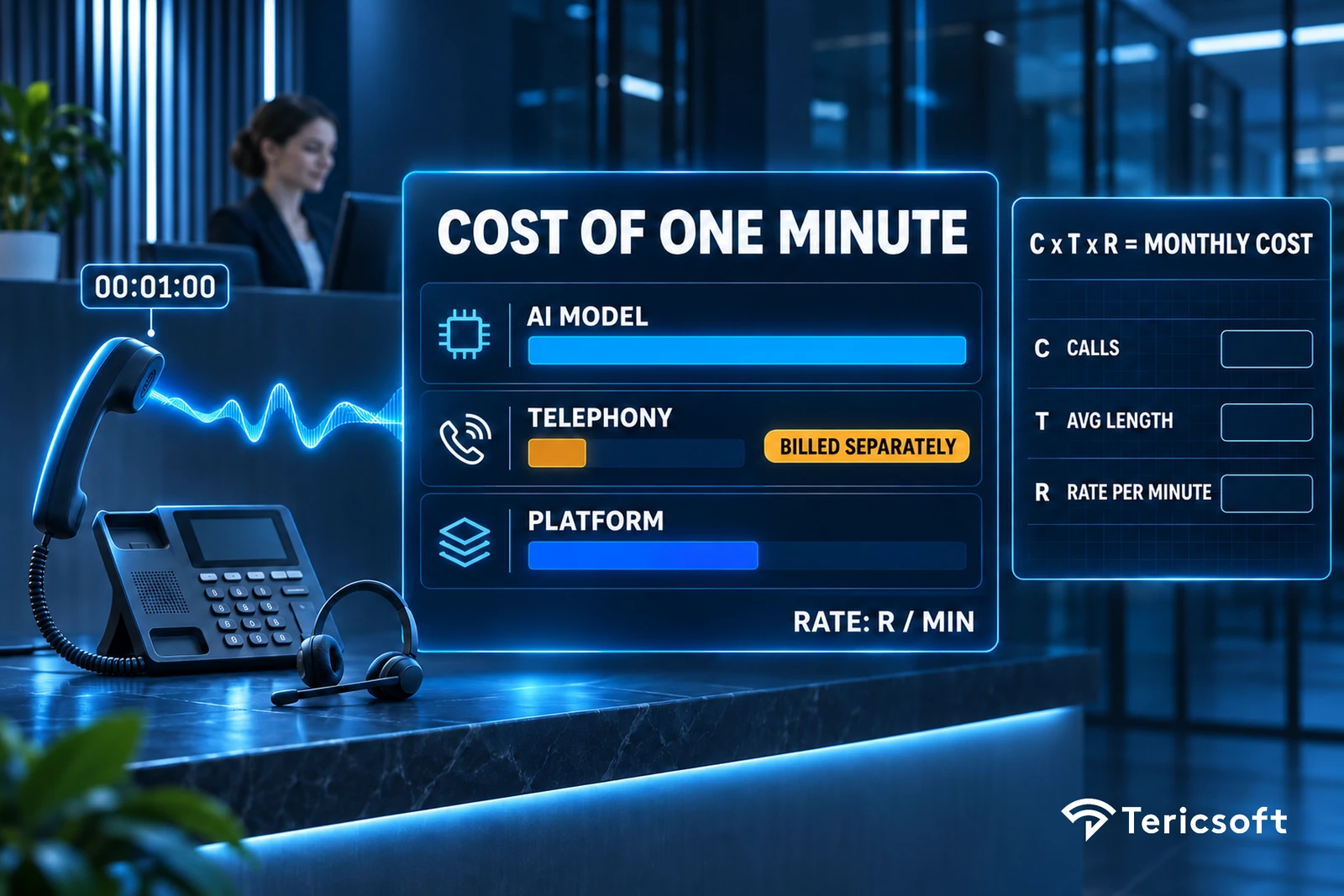
An AI voice agent is not one service. A single spoken minute passes through three layers, and each layer has its own cost that the headline rate rolls into one figure.
The first layer is the AI model. This covers speech to text, which turns the caller's audio into words, the language model that decides what to say and which action to take, and text to speech, which turns the reply back into a voice. Each of these is a separately metered service with its own rate. When AssemblyAI breaks down what sits inside a minute of agent time, the speech layer, the language model reasoning, the voice generation, turn detection, and noise handling all appear as distinct lines before hosting and the phone line are added. Which of these is the largest slice depends on the stack. Some cost models find that voice generation dominates, others that the speech layer or the language model does, and the balance shifts with how capable each model is and how much it has to read and generate on each turn.
The second layer is telephony. This is the carrier minute itself: the cost of the call being connected over the phone network. It is easy to overlook because it is small per minute, often in the range of one to three cents, but it behaves differently from the AI layer and it is frequently quoted separately. In its 2026 breakdown of what sits inside a minute of agent time, AssemblyAI states plainly that carrier minutes are extra on every option it compares. Whether telephony is inside the rate you were quoted is one of the biggest sources of surprise on a first invoice.
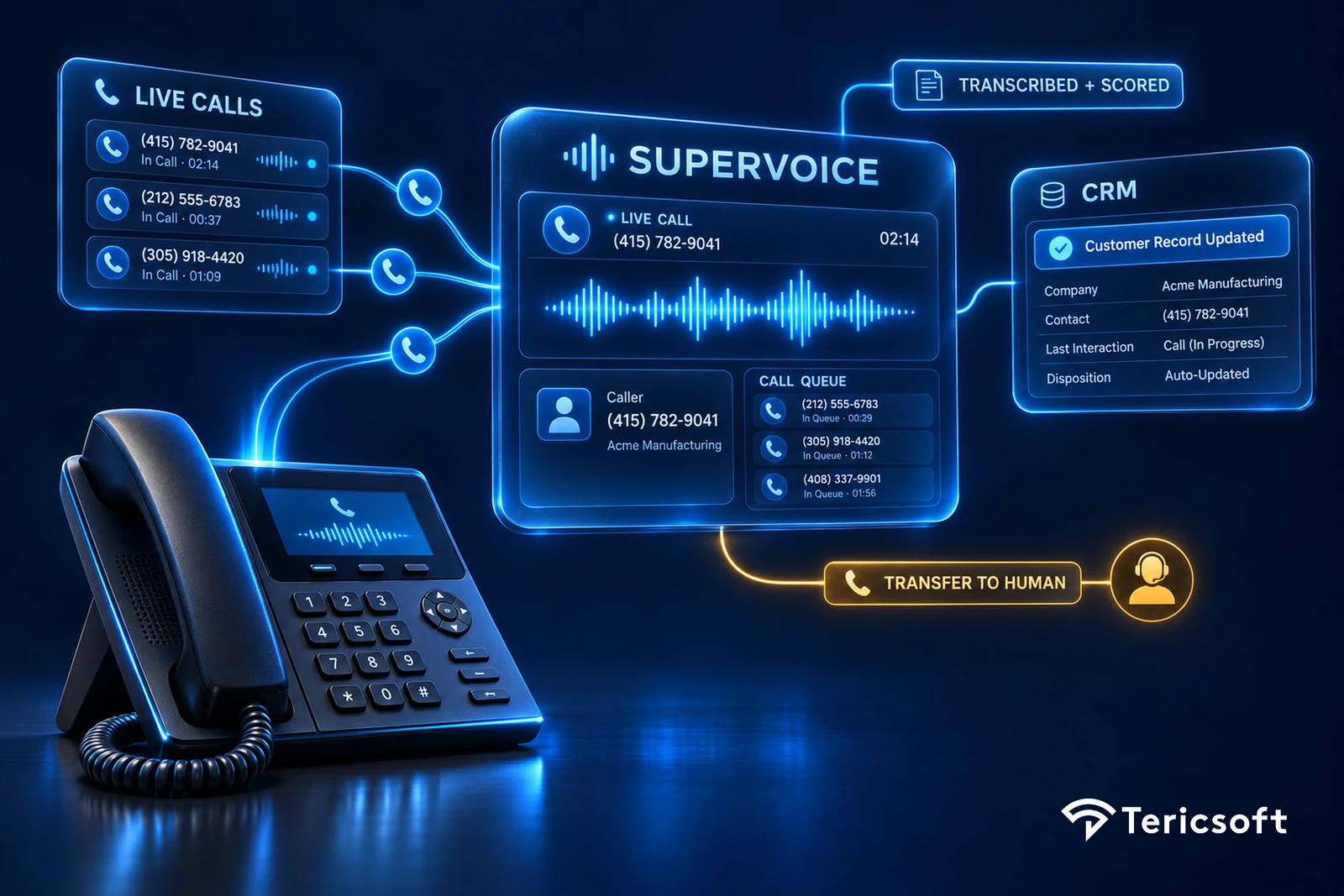
The third layer is the platform. This is the orchestration that holds everything together: routing the call, running the conversation turn by turn, calling your systems to look up a record or book a slot, handing off to a person when needed, and recording the result. It is the layer that turns three separate services into one working agent, and it carries the provider's margin.
Add the three together and you get an all in rate. Murf describes what that single figure is really carrying: the rate usually bundles speech to text, the language model, text to speech, telephony, infrastructure, and provider margin. The important thing is not any particular number but how far the published numbers disagree. Across the vendor guides that rank for this question, all in estimates run from about a cent a minute at the low end to around a dollar at the high end, a spread of roughly 100 times, and no two guides agree on the range. CloudTalk spans that full width in one article, while Murf puts a typical production agent at roughly 7 to 49 cents a minute all in. That disagreement is the first warning sign, and it exists because the guides are not describing the same thing. A rate only means something once you know which of the three layers it includes, so the useful question is never what the rate is, it is what the rate covers.
What actually drives your cost per minute
Once the rate is set, your bill is decided by how your calls behave. Five factors move the real cost per minute far more than the headline number does.
1. Call length
You are billed per minute, so a thirty second call and a four minute call cost very different amounts at the same rate. The question that matters is not the rate, it is your average handle time, and a good agent that resolves a call in ninety seconds can be cheaper than a cheaper agent that takes four minutes to do the same job.
2. Model and voice choice
The language model and the voice are the two biggest levers in the AI layer. A more capable model or a more premium voice costs more per minute than a lighter one. The right choice depends on the task: a straightforward booking or a payment reminder may run well on a lighter model and a standard voice, while a complex troubleshooting call may need a stronger model. A platform that lets you change the model without rebuilding the agent lets you tune this per use case instead of paying one rate for everything.
3. Concurrency and volume
Concurrency is the number of calls an agent can hold at the same time. Some platforms cap it by plan or charge for extra concurrent lines, so a busy hour can cost more than its minutes suggest. Volume works through tiers and bundles. Published plans of this shape, such as those CloudTalk compares, pair a monthly fee and a block of included minutes with a separate rate for every minute beyond the block. Two numbers matter in that structure: the included block sets a floor under your bill whether you use it or not, and the overage rate sets the real cost of growth. Check both against your expected volume, not just your pilot volume.
4. Inbound versus outbound
Outbound calls carry different telephony costs and often different regulatory handling than inbound, and campaigns that reach many numbers behave differently on the bill than a steady inbound queue. The same agent can cost more to run outbound than in.
5. Telephony bundling
This is the factor most likely to surprise you. If the quoted rate covers only part of the stack, the rest arrives as separate lines. AssemblyAI separates its speech layer price from the language model, voice, hosting, and carrier minutes around it, and states that carrier minutes are extra on every option it lists. A rate that excludes telephony is not wrong, but it is not the whole price, and you cannot compare it against a rate that includes telephony without adding the missing layer back in.
How much does an AI receptionist cost
The most common first use case is an AI receptionist or an AI answering service: an agent that picks up, greets the caller, answers routine questions, books or reschedules, and routes anything it should not handle to a person. The cost question here is the same per minute question in a different wrapper, and the answer depends entirely on volume and call length rather than on a fixed monthly figure.
Traditional human answering services and virtual receptionists are usually billed by the minute or by a bundle of minutes, which is why buyers searching for answering service cost or virtual receptionist pricing are already used to a usage based model. An AI receptionist fits the same mental model: you pay for the minutes you actually use. Where it differs is capacity. A human service charges more as call volume rises because it needs more people; an AI receptionist adds call capacity without adding seats, so the cost scales with minutes rather than with headcount.
Rather than borrow a number from somebody else's rate card, estimate it with your own. The arithmetic only needs three inputs, two of which you already have in your phone system. If C is your monthly call volume, T is your average call length in minutes, and R is the all in rate per minute, then your monthly cost is C multiplied by T multiplied by R.
A worked example with market figures. A clinic takes 3,000 calls a month at an average of 2.5 minutes, which is 7,500 minutes. At an all in rate of 7 cents a minute that is about 525 dollars a month. At 25 cents it is about 1,875 dollars. Same calls, same minutes, and more than three times the cost, which is why R is the input worth questioning.
Run it once per call type rather than once for the business, because average call length varies far more between a password reset and a complex booking than rates vary between vendors. We do not publish a rate card for this reason: the only honest figure is the one calculated against your own call profile, and that is the number worth comparing.
Per minute versus per seat: the model matters more than the rate
Underneath every quote is a pricing model, and the model shapes your cost more than the rate does. There are four common ones.
The difference is not academic. A per seat model ties cost to how many agent seats you license, which made sense when a seat meant a person who could take one call at a time. An AI agent does not work that way. Its real limit is concurrency, the number of calls it can hold at once, which is usually far higher than a seat count and can be raised without new licences. A usage based model ties cost to the thing you actually consume, which is minutes of conversation. Outcome based pricing is newer and fits mature, well defined call flows where the buyer wants the vendor accountable for results. For most AI voice workloads, the model you choose will decide whether your cost grows with your business or with your contract, which is why pricing is one of the things to settle early when you stand up an AI call center on a queue you already run.
How to compare AI voice agent pricing honestly
A fair comparison is not a comparison of rates. It is a comparison of total cost at your own call profile, and a few habits make it reliable.
Cost it at your volume. Take your expected monthly minutes, split across your real call types and their average lengths, and run each quote through them. A rate that wins at a hundred minutes can lose at a hundred thousand, and only your own numbers will tell you which.
Make the layers explicit. For every quote, ask what the rate includes. Does it cover the AI model only, or the telephony too, and is the platform a separate fee. Put each provider on the same basis by adding back any layer a quote leaves out, or you are comparing a part against a whole.
Insist on seeing the rate before you spend. A model that shows the cost on screen while you build and configure the agent lets you see what a change to the model or the call flow does to the rate before it reaches an invoice. A quote you can only verify after the bill arrives is not a quote, it is an estimate.
Separate the rate from the result. The cheapest minute is not the cheapest call if it takes longer to resolve or fails more often and escalates to a person. Weigh the per minute rate against resolution: how often the agent finishes the job without a human, and how long it takes to do it. A slightly higher rate that resolves more calls in less time is often the lower total cost.
About Tericsoft and SuperVoice
Tericsoft is an AI first, outcome driven technology partner that builds and runs AI voice agents for businesses through SuperVoice, our voice agent platform. SuperVoice is built on the pricing principles in this guide rather than around a single headline rate.
The model is usage based. You pay per minute of conversation, with no per seat licence, so you add call capacity without adding seats. The rate is shown on screen while you build the agent, which means you see the cost before you spend it. SuperVoice runs on the telephony, CRM, and ITSM systems you already use, so it connects to the numbers and trunks you already pay for, with no new carrier contract. You keep your existing carrier bill, and the SuperVoice rate covers the AI model and platform layers, so you know exactly what each line on your invoices is for. And because the model stack is swappable, you can adopt a better or cheaper model for a given use case without a rebuild, tuning one of the biggest cost levers to the job.
A per minute rate is a fair way to price an AI voice agent, as long as you can see what the rate is made of and what it leaves out. Read the three layers, cost it at your own volume, and judge the rate against how often and how fast the agent actually resolves a call. Do that, and the number on the page will be the number on your invoice.

Published estimates run from about a cent to around a dollar a minute, because each covers a different mix of layers. Compare coverage.
It depends on your call volume and average call length, because an AI receptionist is billed for minutes used rather than per seat.
Three layers: the AI model (speech to text, language model, text to speech), the telephony or carrier minute, and the platform.
Both exist, plus hybrid and outcome based models. Usage based pricing bills minutes used; per seat charges a fixed fee per seat.
Not always. Some rates cover only the AI layer and bill carrier minutes separately, so confirm which layers a quote includes.