Can AI voice agents call customers without breaking the TCPA? Learn which consent each AI call needs and what changes in the rules on November 25, 2026.
Short answer: Under the Telephone Consumer Protection Act (TCPA), an AI-generated voice counts as an "artificial or prerecorded voice." Any outbound AI call to a US consumer therefore needs prior express consent, and sales calls need prior express written consent. The call must identify the business at the start. Inbound calls answered by an AI agent are treated differently. New FCC consent-revocation rules take effect on November 25, 2026.
In brief:
- Outbound AI calls are regulated like robocalls. Consent comes first
- Marketing AI calls to cell phones need signed, written consent
- Inbound AI receptionists sit largely outside the TCPA's robocall restrictions
- From November 25, 2026, callers can designate one opt-out method and treat revocations by call category
- Compliance is cheapest when it is designed into the call flow, not added afterwards
Most teams adopting AI voice agents ask the same question late: is this legal? The answer depends less on the AI and more on the direction of the call, its purpose, and the consent behind it. The rules are not new. Their application to AI is.
This article is general information for business decision-makers, not legal advice. Review your calling program with qualified counsel.
TCPA rules for AI voice calls at a glance
Is AI Calling Legal Under the TCPA?
Yes. AI calling is legal in the United States when the call has the consent the TCPA requires for its type and purpose. What is not legal is placing outbound AI calls to consumers without that consent.
The confusion comes from a popular shortcut: "AI cold calling is illegal." It is half right. An unsolicited AI sales call to a consumer's cell phone without written consent violates the TCPA. An appointment reminder to a patient who gave their number, or an AI agent answering an inbound call, is a different case. The technology is the same. The legal position is not.
What Is TCPA?
The Telephone Consumer Protection Act is a 1991 federal law, codified at 47 U.S.C. 227, that restricts calls using autodialers and artificial or prerecorded voices. The Federal Communications Commission writes and enforces its rules, mainly at 47 CFR 64.1200.
The law was written for recorded robocalls. It now governs AI voice agents. That is the gap most teams underestimate.
How the FCC Treats AI Robocalls
In February 2024 the FCC issued a declaratory ruling (FCC 24-17) confirming that AI technologies that simulate a human voice are an "artificial or prerecorded voice" under the TCPA. The ruling took effect immediately and applies to any AI technology that initiates an outbound call.
In practice, an AI robocall is treated like any other robocall. It needs consent, it must identify the caller, and marketing calls must offer an opt-out. The scale of the problem explains the scrutiny. According to the YouMail Robocall Index, US consumers received 52.5 billion robocalls in 2025.
Which TCPA Laws Apply to Inbound and Outbound AI Calls?
The direction of the call is the first line to draw. The TCPA's restrictions on artificial voices apply to calls a business makes or initiates. In its 2024 AI rulemaking notice (FCC 24-84), the FCC stated that the TCPA's requirements do not extend to technologies used to answer inbound calls.
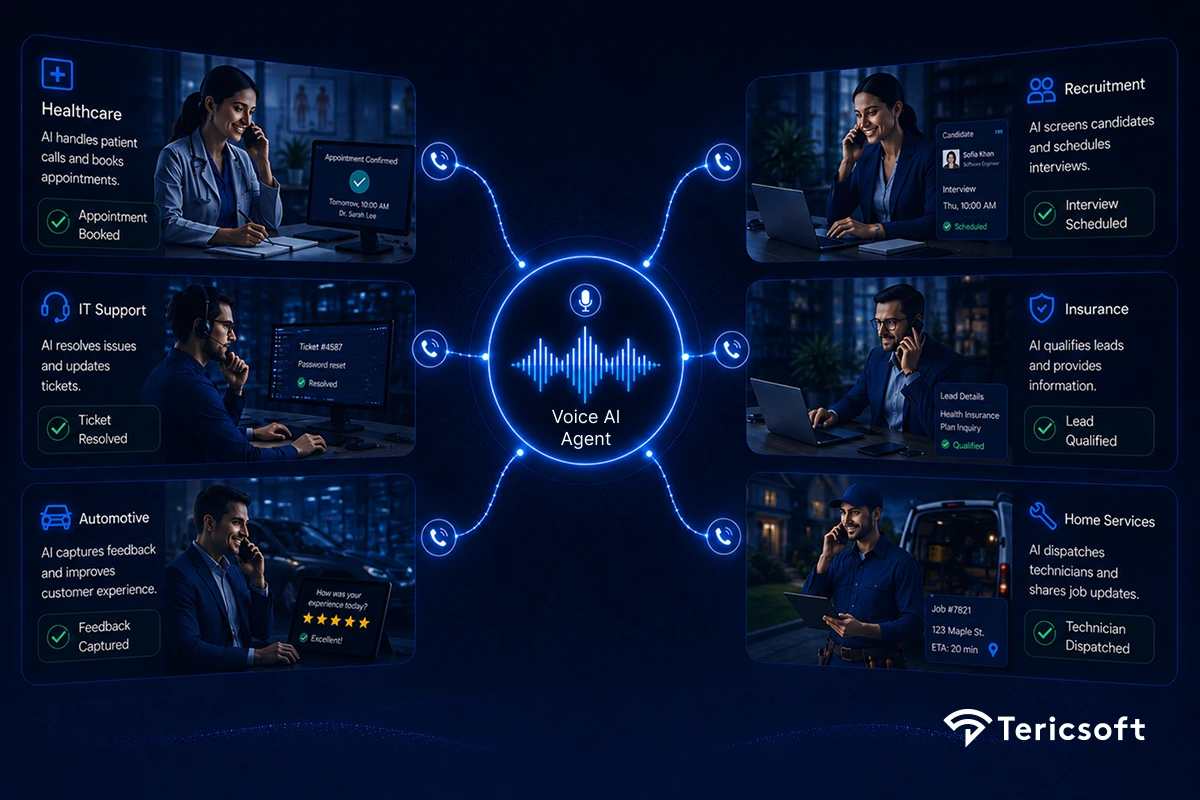
That distinction matters for most healthcare and customer service deployments, where an AI agent answers the phone rather than dialing out. Many real programs mix both directions: the AI voice agents for mobility that answer dispatch lines are also used for shift confirmations and reminders. It is not a blanket exemption. The FCC statement sits in a proposal, not a final rule. State laws can still require AI disclosure. And the moment the same system places a callback, reminder, or follow-up, it is an outbound call under the TCPA.
Inbound is the lower-risk entry point. Outbound is where the rules bite.
What TCPA Consent Does Each AI Call Need?
TCPA consent depends on what the call is for, not on how sophisticated the voice is. There are three working categories:
Mixed-purpose calls are where programs fail. A renewal reminder that turns into an upsell can become a telemarketing call. Script the call to its consent category, and keep it there.
When You Need Prior Express Written Consent
Prior express written consent is required for telemarketing or advertising calls that use an artificial or prerecorded voice, including AI, to wireless numbers, and for artificial-voice telemarketing to residential lines. It must be a signed written agreement, electronic signatures included, that clearly authorizes the business to deliver such calls to a specific number.
A planned stricter version, the FCC's "one-to-one" consent rule, was vacated by the Eleventh Circuit in January 2025, before it took effect. The written-consent standard itself remains in force.
The TCPA Healthcare Exemption for Patient Calls
The TCPA healthcare exemption allows certain patient calls without written consent. Under 47 CFR 64.1200, a call that delivers a "health care" message from a HIPAA covered entity or business associate is exempt from the written-consent requirement. It still needs prior express consent when it goes to a cell phone.
A narrower provision allows free-to-the-patient calls to cell phones for specific purposes: appointment reminders, lab results, pre-operative instructions, post-discharge follow-up, prescription notifications, and home health instructions. The conditions are strict:
- Calls go only to the number the patient provided
- The provider is named, with contact details, at the start of the call
- No marketing, billing, or financial content
- Voice messages last about one minute or less
- No more than one message per day and three per week
- An interactive opt-out on live calls, honored immediately
The exemption is real, but it is narrow. Build the limits into the dialer, not into a policy document.

What TCPA Regulations Change on November 25, 2026?
On September 30, 2026, the FCC adopted new consent-revocation rules (FCC 26-67), published in the Federal Register on October 26, 2026. They take effect on November 25, 2026.
TCPA Revocation of Consent by Category
Since April 2025, consumers have been able to revoke consent by any reasonable means, and callers must honor the request within 10 business days. That deadline stays.
What changes is scope. A revocation made in response to an informational call can now be treated as covering only that category of informational calls. A revocation in response to a telemarketing call still revokes all of that caller's telemarketing. This replaces the broader "revoke all" approach the FCC had previously delayed.
The implication for AI calling is operational. Every call needs a category tag, and every revocation needs to be stored against that category.
TCPA Opt Out: One Designated Method
Callers may now designate one exclusive TCPA opt-out method, provided it is disclosed clearly and conspicuously on the call or in the text. The permitted options are:
- An interactive voice or key-press opt-out on the call
- A reply text using a standard word such as "stop" (all seven standard words must still be honored)
- A website or phone number the caller designates
Callers that do not designate a method must keep accepting revocation by any reasonable means. A confirmation text sent within five minutes of a revocation is presumed to be within consent.
For an AI voice agent, the voice opt-out is the natural choice. The caller says they want no more calls, and the agent records it on the spot.
What Is Still Pending: AI Disclosure on Every Call
The FCC's 2024 proposal (FCC 24-84) would require callers to disclose AI use when obtaining consent and at the beginning of each AI-generated call. It has not been adopted. A separate rulemaking published alongside the November rules asks whether to shorten the 10-business-day revocation window.
Neither is law yet. Both are worth designing for now. Some states already go further. California, for example, has required AI disclaimers in certain patient communications from health facilities since January 2025.
What Do TCPA Violations Cost?
TCPA violations carry statutory damages of $500 per call, rising to as much as $1,500 per call when the violation is willful or knowing. Damages are per call, which is why a single faulty campaign can become a class action.
Litigation is steady. Industry tracking cited by JD Supra counted 2,810 TCPA lawsuits filed in 2025. Regulators act on AI calls specifically. The FCC issued a $6 million fine against the consultant behind the 2024 AI-generated robocalls that imitated a presidential candidate's voice in New Hampshire.
At AI scale, one wrong setting does not cause one bad call. It causes ten thousand.
Why TCPA Compliance Is an Architecture Decision
TCPA compliance for AI voice agents is usually treated as a legal review at the end of a project. That is the expensive way to do it. An AI agent can place thousands of calls an hour. A rule that lives in a policy document is enforced only if the system enforces it.
The workable approach is to place each rule at the point in the call flow where it applies:
This is how we approach outbound calling in SuperVoice, Tericsoft's AI voice agent platform. The workflow below separates two things clearly: capabilities SuperVoice already provides, and compliance controls we configure for each deployment against the client's own consent records and rules.
The capabilities in the solid boxes are part of SuperVoice today. The dashed controls are built for each deployment, because consent records, call categories, and opt-out channels differ from one business to the next. Compliance becomes something the system checks on every call, not something a team hopes for.
Where This Already Runs in Production
Two implementations show the same discipline at work:
- A national healthcare staffing company. The voice AI recruiter we built runs first-round interviews by phone, around the clock, and has processed 100,000-plus candidates. Identity, license, and credential checks run before the interview, not after it
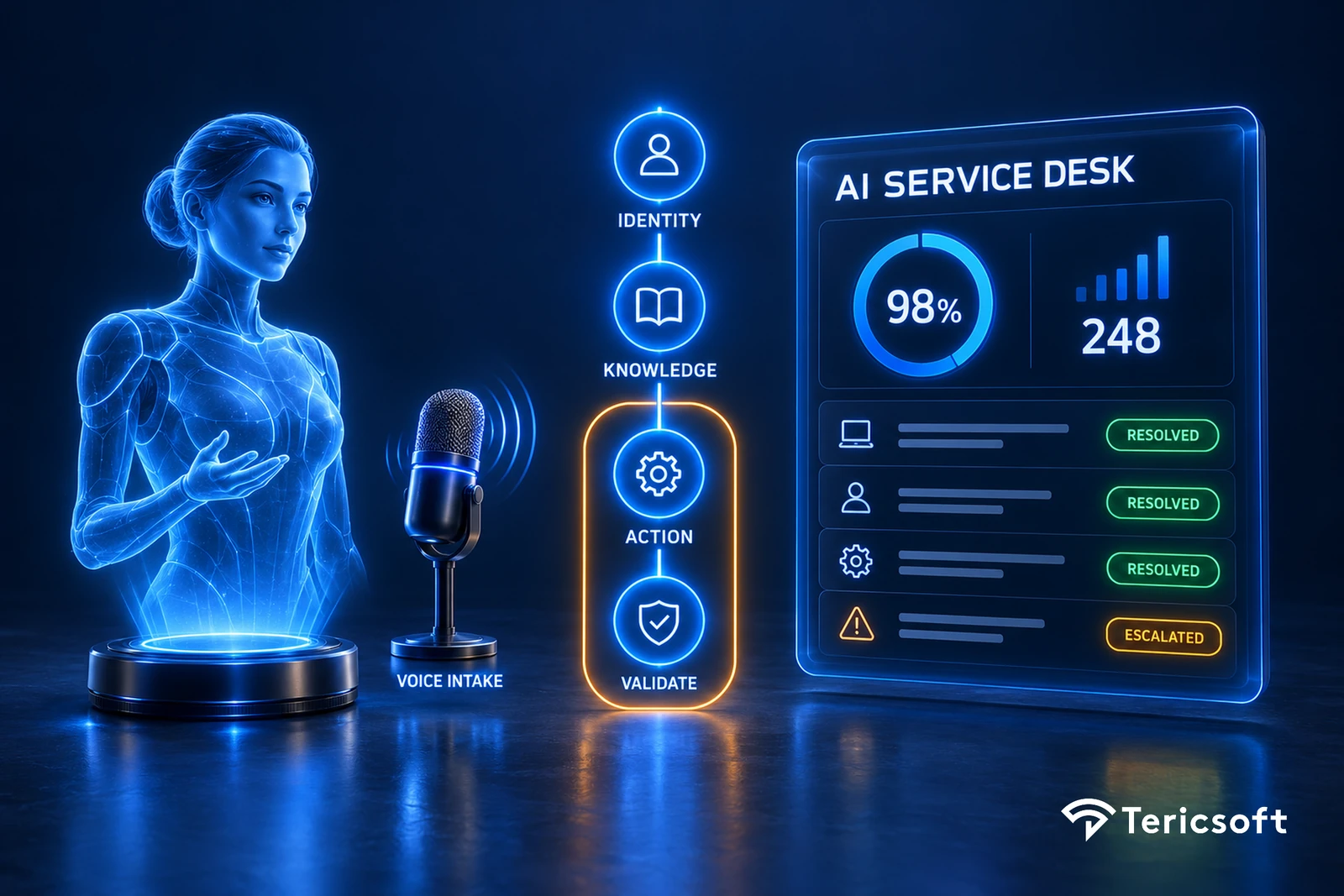
- A global IT services firm. In the AI-powered voice service desk, caller identity is verified and guardrails run inside the call before any action is taken. Our article on the AI service desk explains that design in detail
In both, the checks sit inside the call flow. That is the pattern TCPA compliance needs.
TCPA Compliance Checklist for AI Voice Agents
Use this TCPA compliance checklist before an AI voice agent places its first outbound call:
- Classify every call type as informational, telemarketing, or emergency
- Store consent per number and per category, with the source and date it was given
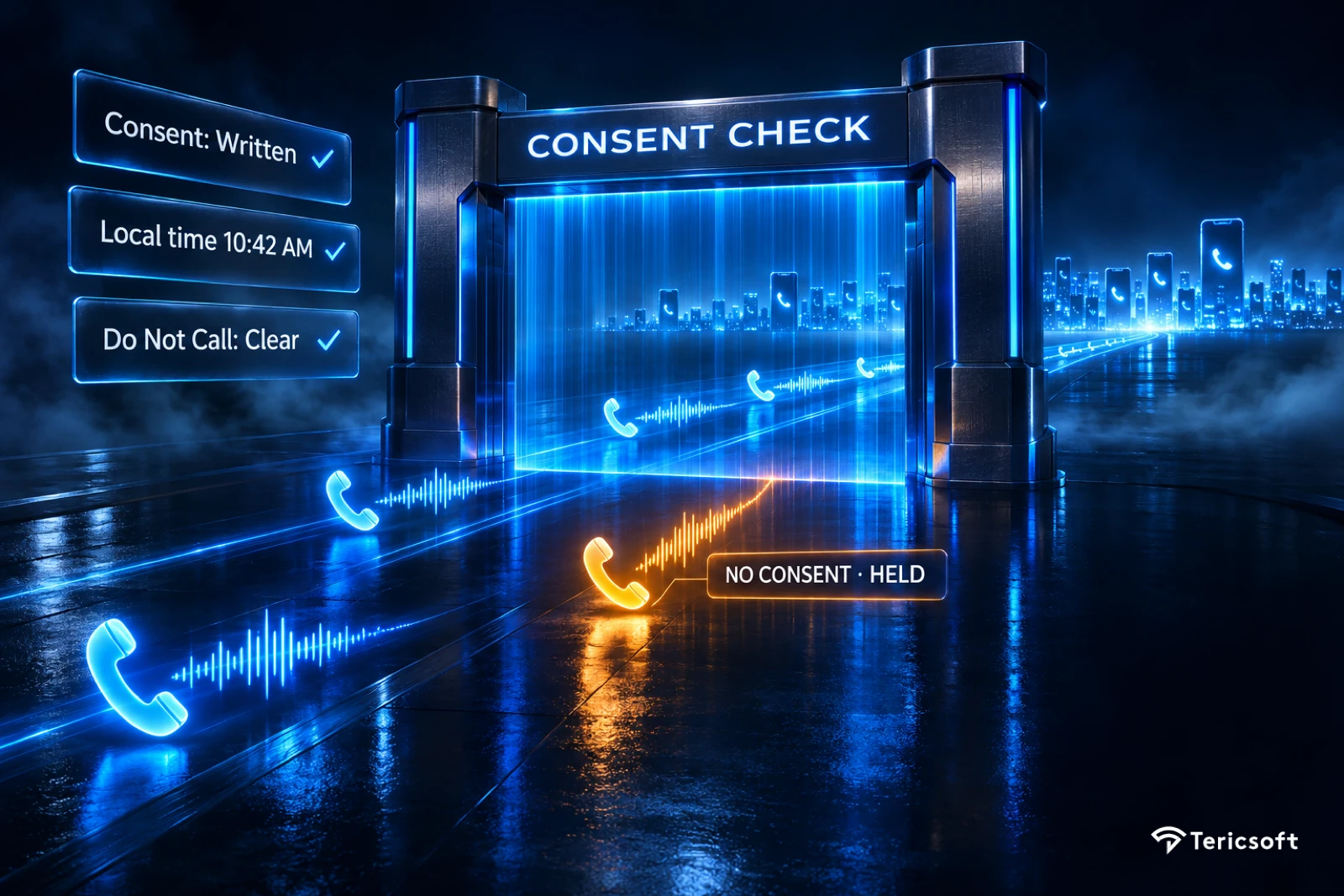
- Check consent, the Do Not Call registry, and the callee's local time before every dial
- Open every call with the business name and a callback number, in fixed wording
- Offer a voice or key-press opt-out on marketing calls within two seconds of identification
- Decide whether to designate an exclusive opt-out method, and disclose it on every call
- Write revocations back to the CRM against the right category, within 10 business days
- Keep healthcare reminder calls within the exemption limits: one per day, three per week, about one minute
- Disclose AI use at the start of the call, ahead of any final FCC rule
- Record, transcribe, and review every call against these criteria, and keep the evidence
Key Takeaways
- AI voices are robocalls in law. Outbound AI calls need the same consent as any artificial-voice call.
- Direction and purpose decide the rules. Inbound answering is lower risk; outbound marketing needs written consent.
- November 25, 2026 changes revocation. Revocations can be scoped by category, and one opt-out method can be designated.
- Compliance belongs in the call flow. Rules enforced by the system hold at scale. Rules in a document do not.
About Tericsoft
Tericsoft builds AI voice agents that run on the telephony, CRM, and ITSM systems a business already uses. For regulated calling, that means consent checks, fixed disclosures, opt-out handling, and call grading built into the call flow itself, so every call can be shown to follow the rules. Our voice work spans healthcare staffing, IT service desks, and mobility operations, and SuperVoice is where those patterns come together.
Yes, with the right consent. Outbound AI calls need prior express consent, and AI marketing calls need prior express written consent.
Generally no. The FCC has said TCPA voice rules do not extend to tech answering inbound calls. AI callbacks and reminders are covered.
Callers can scope revocations by call category and designate one opt-out method. The 10-business-day deadline to honor them stays.
Federal rules require business identification at the start. An FCC proposal would add AI disclosure; some states already require it.
Statutory damages are $500 per call, up to $1,500 if willful or knowing. Per-call damages make AI-scale campaigns a class-action risk.