Can AI systems truly anticipate financial risks before they manifest, or are they just faster mirrors of the past? Learn how predictive intelligence is redefining risk posture, liquidity resilience, and why foresight, not just reporting, is becoming the real measure of an enterprise finance function.
The quarterly board meeting begins with familiar questions. Why did exposure rise last month? Why did fraud losses spike in one region? Why was liquidity tighter than forecasted?
The finance team has reports, but not answers fast enough. Data sits across ERP systems, spreadsheets, treasury platforms, and operational tools. By the time risk is measured, the risk has already moved. Decisions are being made on stale data, turning the risk function into a forensic department rather than a strategic one.
That is the new reality of enterprise finance. Risk is no longer annual, quarterly, or even daily. It is continuous. And continuous risk requires continuous intelligence. That is where AI in Risk Management for Finance becomes a strategic advantage.
“Risk comes from not knowing what you're doing.”
— Warren Buffett
What Is AI in Risk Management for Finance
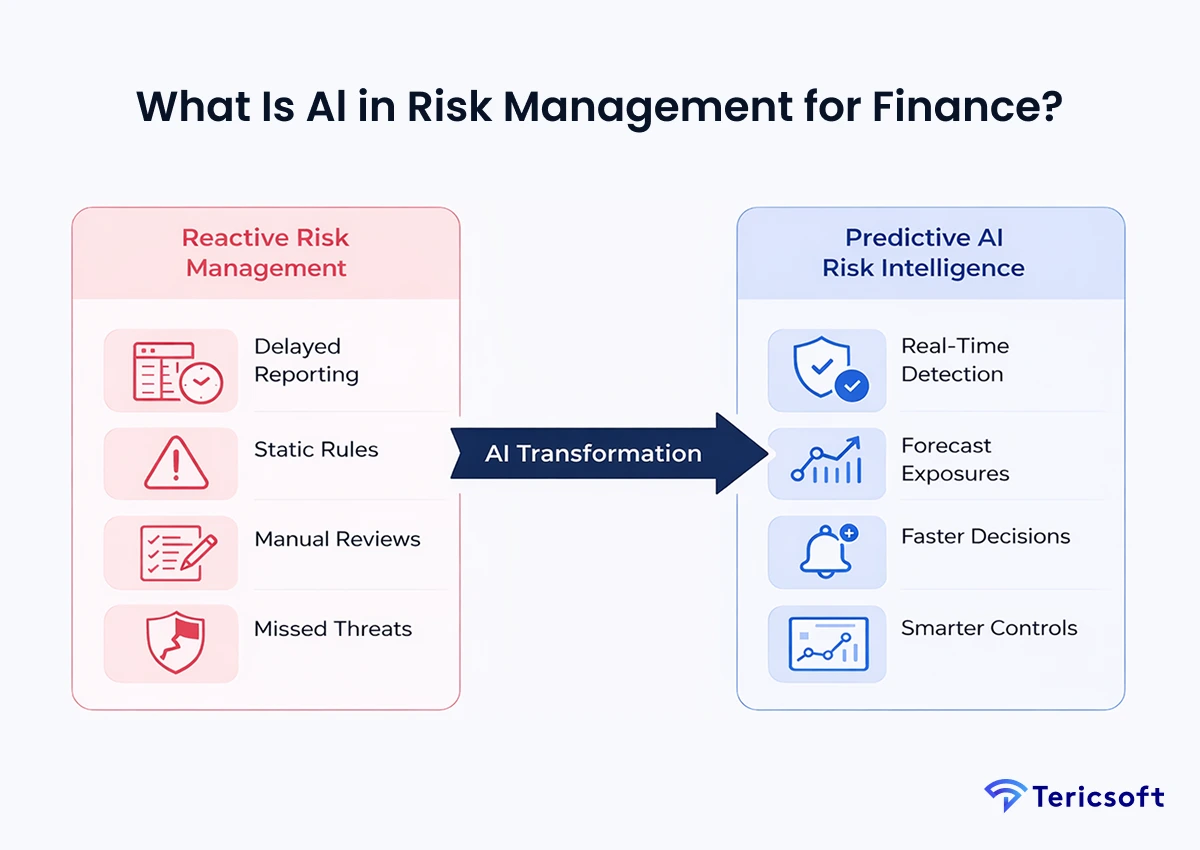
AI in Risk Management for Finance uses machine learning, predictive analytics, automation, and intelligent decision systems to detect threats, forecast exposures, improve controls, and support faster financial decisions. It transforms risk management from reactive reporting into proactive intelligence.
Unlike traditional systems that rely on rigid, human-coded "if-then" logic, these systems can learn from massive volumes of historical and real-time data to detect "weak signals" that precede a crisis. Leveraging predictive risk analytics transforms the function from a defensive cost center into a strategic foresight hub that supports faster, more confident decisions.
How AI Transforms Traditional Financial Risk Management
Traditional models depend on historical snapshots and periodic reviews. They are fundamentally backward-looking, telling you where you were rather than where you are going. AI continuously analyzes live data, identifies anomalies, and updates risk signals as conditions change.
Insight: The shift is from backward-looking reports to forward-looking decisions.
Why Finance Leaders Are Adopting AI for Risk Decisions
Finance leaders need speed, precision, and resilience. In volatile markets, the gap between a risk identified and a risk mitigated is where losses live. Financial risk AI helps leadership evaluate scenarios faster, reduce uncertainty, and prioritize action before losses occur. This enables a shift from a reactive posture to a proactive growth strategy.
Benefits of AI in Risk Management for Enterprises
- Faster detection of emerging risks: Identifying systemic shifts before they impact the balance sheet.
- Better forecasting accuracy: Reducing variance between predicted and actual cash flow through predictive risk analytics.
- Lower fraud and error losses: Catching sophisticated criminal patterns in real time.
- Reduced manual review effort: Automating the noise so experts focus on high-impact anomalies.
- Stronger governance and audit trails: Providing a digital record of every decision and its rationale.
- Scalable decision support: Deploying intelligence across global business units instantly.
AI in Risk Management vs Traditional Risk Management Models
Legacy frameworks rely heavily on static thresholds and manual judgment. If a transaction is under $10,000, it might never be flagged, regardless of its frequency or destination. AI adapts patterns dynamically, learns from new signals, and improves over time, catching the "low and slow" risks that standard models miss.
Major Financial Risks AI Can Help Manage
Modern enterprises face multiple financial risks simultaneously. Through a structured approach, AI helps unify risk visibility across these categories by addressing specific pain points with intelligent interventions.
1. AI for Credit Risk Assessment and Default Prediction
The Problem: Credit scores are lagging indicators. By the time a customer’s score drops, they have likely already begun defaulting on obligations, leaving the lender with high exposure and limited recovery options.
The AI Solution:Machine learning analyzes payment behavior, cash flow trends, macro indicators, and customer patterns to predict defaults long before they appear on traditional credit reports. This precision is critical for AI Adoption in Finance where precision lending directly impacts margins.
2. AI for Fraud Detection and Transaction Monitoring
The Problem: Traditional "if-then" rules miss sophisticated fraud networks and high-frequency "low and slow" attacks that stay just below threshold limits.
The AI Solution:Behavioral models establish a baseline for "normal" and flag any deviation. A bank improved fraud detection by over 31% after deploying deep learning models. Additionally, AI increased fraud detection by approximately 60% while reducing false positives by approximately 50%. Explore our guide on AI Fraud Detection in Banking.
Mini Case Example: Fraud OperationsA retail bank deployed a behavioral anomaly detection system that prioritized high-risk alerts, reducing investigator workload and accelerating fraud response times.
3. AI for Market Risk and Portfolio Volatility Analysis
The Problem: Sudden geopolitical events or sector shifts can render a portfolio toxic within hours, yet manual stress tests take days to process.
The AI Solution:Automated systems monitor market movements, stress scenarios, correlations, and portfolio sensitivities in real time, allowing for automated hedging or portfolio rebalancing before the market settles.
4. AI for Liquidity Risk and Cash Flow Forecasting
The Problem: Manual forecasting often has a high variance, leading to "idle cash" that misses investment opportunities or unexpected liquidity shortfalls that incur high borrowing costs.
The AI Solution: AI Treasury Intelligence analyzes seasonality, customer behavior, and external events to provide hyper-accurate 90-day forecasts, ensuring leaders are never surprised by a sudden cash crunch.
Mini Case Example: Treasury RiskA global manufacturer used predictive risk analytics to reduce idle cash balances and improve short-term liquidity planning across 12 regions.
5. AI for Operational Risk and Process Failures
The Problem: Human error and process bypasses often go unnoticed until an audit, which is often months after the financial damage has occurred.
The AI Solution:Continuous monitoring identifies breakdowns in workflows, control failures, processing delays, and high-risk operational bottlenecks as they happen, flagging internal failures before they escalate.
6. AI for Compliance and Regulatory Risk Monitoring
The Problem: Regulatory changes happen faster than manual policy updates can keep up, leading to exponential increases in compliance costs and potential fines.
The AI Solution:AI scans transactions, documents, communications, and controls for policy breaches or reporting gaps, ensuring constant alignment with Basel, GDPR, and AML. Read more about AI in Banking Compliance.
7. AI for Vendor and Third-Party Risk Management
The Problem: Supply chain disruptions are often invisible until a shipment fails to arrive, causing production delays and financial penalties.
The AI Solution:AI evaluates supplier financial health through news signals and social sentiment, alerting leadership to distress long before a contractual failure occurs.
How AI in Risk Management Works in Practice
The implementation of financial risk AI is not a single software installation but the deployment of a continuous intelligence pipeline. This architecture connects siloed data sources to sophisticated analytical engines to provide real-time decision support.
Phase 1: Multi-Source Data Ingestion
AI systems begin by ingesting massive volumes of structured and unstructured data. This includes core ledger data from ERPs (SAP, Oracle, Microsoft Dynamics), transaction records from banking systems, and customer interactions from CRMs. Crucially, the system also monitors external unstructured data: market news, social sentiment, geopolitical updates, and regulatory filings: to identify risks brewing outside the organization's walls.
Phase 2: Risk Scoring & Predictive Modeling
Once the data is normalized, the analytical engine applies multiple machine learning models. These models score risk by identifying non-linear patterns. For instance, while a legacy system might ignore ten small transactions, an AI model identifies them as a "structuring" attempt related to money laundering. The system continuously refines its "baseline of normal," ensuring that alerts are high-confidence and context-aware.
Phase 3: Intelligent Alerting & Prioritization
Instead of generating a flat list of potential issues, the AI prioritizes threats based on potential impact and probability. Dashboards provide risk officers with a ranked queue, moving the most critical vulnerabilities to the top. Each alert includes a "Reason Code" or natural language summary explaining why the system flagged the event, providing the necessary context for rapid investigation.
Phase 4: Expert Review & Augmented Decisioning
The final stage of the loop involves the human expert. The AI provides a recommended next action: such as initiating a currency hedge, adjusting a credit limit, or blocking a suspicious transaction. The professional reviews the evidence provided by the AI and makes the final decision. This "Human-in-the-Loop" approach ensures that institutional knowledge and nuanced judgment guide the most critical choices.
Phase 5: Automated Feedback & Model Calibration
The process concludes with continuous learning. Every decision made by the human expert: whether they agree with or override the AI recommendation: is fed back into the model. This creates a self-optimizing system that reduces false positives over time and adapts to new market conditions or criminal tactics without manual reprogramming.
Typical Flow Summary:Data Sources → Risk Models → Alerts → Human Review → Decision → Continuous Learning
Insight: AI should augment expert judgment, not replace it. The objective is to provide the risk officer with the most relevant information at the moment it matters most.

Why Traditional Risk Management Models Are Failing
Legacy frameworks struggle because business environments now change faster than update cycles. They are often built on assumptions that no longer hold true in a post-digital world.
Common Reasons:
- Dependence on outdated assumptions: Systems built during low-volatility periods fail during sudden shifts.
- Static thresholds that miss new patterns: Criminals know your rules and work just below them.
- Siloed data across departments: Treasury lacks visibility into Procurement, creating visibility gaps.
- Slow reporting cycles: Decisions made on last month's data are essentially guesses.
- High manual workload: Teams are so busy reporting that they have no time for actual risk analysis.
- Weak scenario adaptability: Inability to quickly ask "what if" during a crisis.
“The greatest danger in times of turbulence is not the turbulence; it is to act with yesterday’s logic.”
— Peter Drucker
AI Use Cases Across Banking, Insurance, and Enterprise Finance
How to Implement AI in Risk Management
Successful programs begin with business outcomes, not algorithms. It requires a disciplined approach to enterprise financial risk management.
Build a Unified Data Foundation
Connect ERP, finance, treasury, CRM, and operational data into a governed analytics layer. Without a clean data pipeline, even the most advanced financial risk AI will fail.
Integrate AI With ERP, Core Banking, and Existing Systems
AI should sit across current systems rather than forcing expensive replacements. Leaders are finding success by learning How to Automate Financial Operations Without Replacing ERP.
Start With High-ROI Risk Use Cases
Prioritize use cases with measurable impact such as fraud reduction, forecasting accuracy, or faster credit decisions. A narrow pilot with clear success is better than a broad project that never finishes.
Measure ROI Through Loss Reduction and Efficiency Gains
Track fraud prevented, defaults reduced, hours saved, faster close cycles, and improved forecast variance. These metrics provide the business case for further expansion.
Choose the Right AI Implementation Partner
Select a partner with domain expertise, governance capability, enterprise integration skills, and measurable delivery experience. Tericsoft specializes in bridging the gap between complex AI and regulated financial reality.
Establish Governance, Explainability, and Human Oversight
Every predictive system should have ownership, auditability, escalation paths, and performance monitoring. Every system must provide a reason code or audit trail for its outputs.
Challenges of AI in Risk Management for Finance
While the opportunity is vast, unmanaged implementation can increase exposure. Leaders must navigate these carefully.
- Poor data quality leading to weak predictions: Analytical outputs are only as good as the history they learn from.
- Black-box models with low explainability: Regulators demand to know the logic behind automated decisions.
- Bias in historical training data: If past decisions were biased, the AI will amplify that bias.
- Regulatory scrutiny over automated decisions: The legal landscape for AI risk management in finance is still evolving.
- Integration complexity with legacy systems: Legacy code can make data extraction difficult.
- Lack of internal adoption by business teams: If the risk team doesn't trust the output, they won't use it.
How to Avoid AI Risk Management Failures
Practical Solutions:
- Clean and govern data before scaling models: Start with the data pipeline, not the algorithm.
- Use explainable AI for regulated decisions: Choose models that can provide a "reason code" for their output.
- Keep humans in approval loops for critical cases: High-value decisions should always have a human sanity check.
- Pilot one use case before enterprise rollout: Prove the value in a controlled environment first.
- Monitor drift and retrain models responsibly: Markets change; your predictive systems must change with them.
- Build cross-functional ownership: Ensure Finance, IT, and Risk teams are aligned on the goal.
Insight: The biggest AI risk is not model failure. It is poor operating design. Understanding the Top 10 AI Challenges in FinTech is the first step toward a resilient implementation.
Metrics Leaders Should Track After Implementation
- Reduction in fraud losses: Mastercard’s systems analyze transactions in 50 milliseconds and process up to 160 billion transactions annually.
- Improvement in forecast accuracy: Tracking the narrowing gap between forecasted and actual cash positions.
- Decrease in false positives: Machine learning can reduce fraud false positives by 54% and deliver €190K in savings.
- Faster approval decisions: The total time saved in credit or claims processing.
- Lower compliance review costs: Automating the first pass of document review.
- Better liquidity visibility: Reduction in idle cash that could be invested elsewhere.
- Reduced operational incidents: Fewer workflow breakdowns and process failures.
The Future of AI in Risk Management for Finance
The next phase of enterprise financial risk management will be autonomous, real-time, and embedded into daily decisions. Instead of separate departments reviewing past events, intelligence will operate directly inside workflows. Finance leaders will move from asking “What happened?” to “What should we do now?” and eventually toward a model of continuous oversight.
The system has already flagged, prioritized, and recommended the next action, with the decision trail ready for immediate review.
“The risks of AI are real but manageable.”
— Bill Gates, Co-Founder of Microsoft
Why Enterprises Choose Tericsoft for AI in Risk Management
At Tericsoft, we bridge the gap between complex AI capabilities and enterprise-grade financial stability. We help organizations deploy secure, scalable, and business-aligned AI solutions that integrate seamlessly with existing finance ecosystems while strengthening governance frameworks.
- Enterprise-grade AI Architecture: Our systems are built for high-volume financial data, ensuring performance and security at scale.
- Seamless ERP and Banking Integrations: We specialize in connecting intelligence layers to core financial ledgers like SAP, Oracle, and global banking APIs.
- Compliance-First Implementation: We ensure every model meets stringent regulatory standards (Basel, GDPR, AML) with built-in auditability.
- Measurable ROI Models: We don't just deliver technology; we deliver outcomes, focusing on loss reduction, efficiency gains, and forecast accuracy.
- Executive-Ready Visibility: Our dashboards turn complex predictive data into actionable leadership insights for faster decision-making.

AI in Risk Management for Finance uses machine learning and analytics to detect risks, predict exposures, and improve financial decisions.
AI analyzes real-time data to identify fraud, forecast liquidity issues, detect anomalies, and support faster risk mitigation.
AI can help manage credit risk, fraud risk, market risk, liquidity risk, operational risk, and compliance risk.
Enterprises adopt AI to improve forecasting accuracy, reduce losses, automate reviews, and gain faster risk visibility.
Companies start with clean data, integrate AI with existing systems, launch high-value use cases, and maintain human oversight.