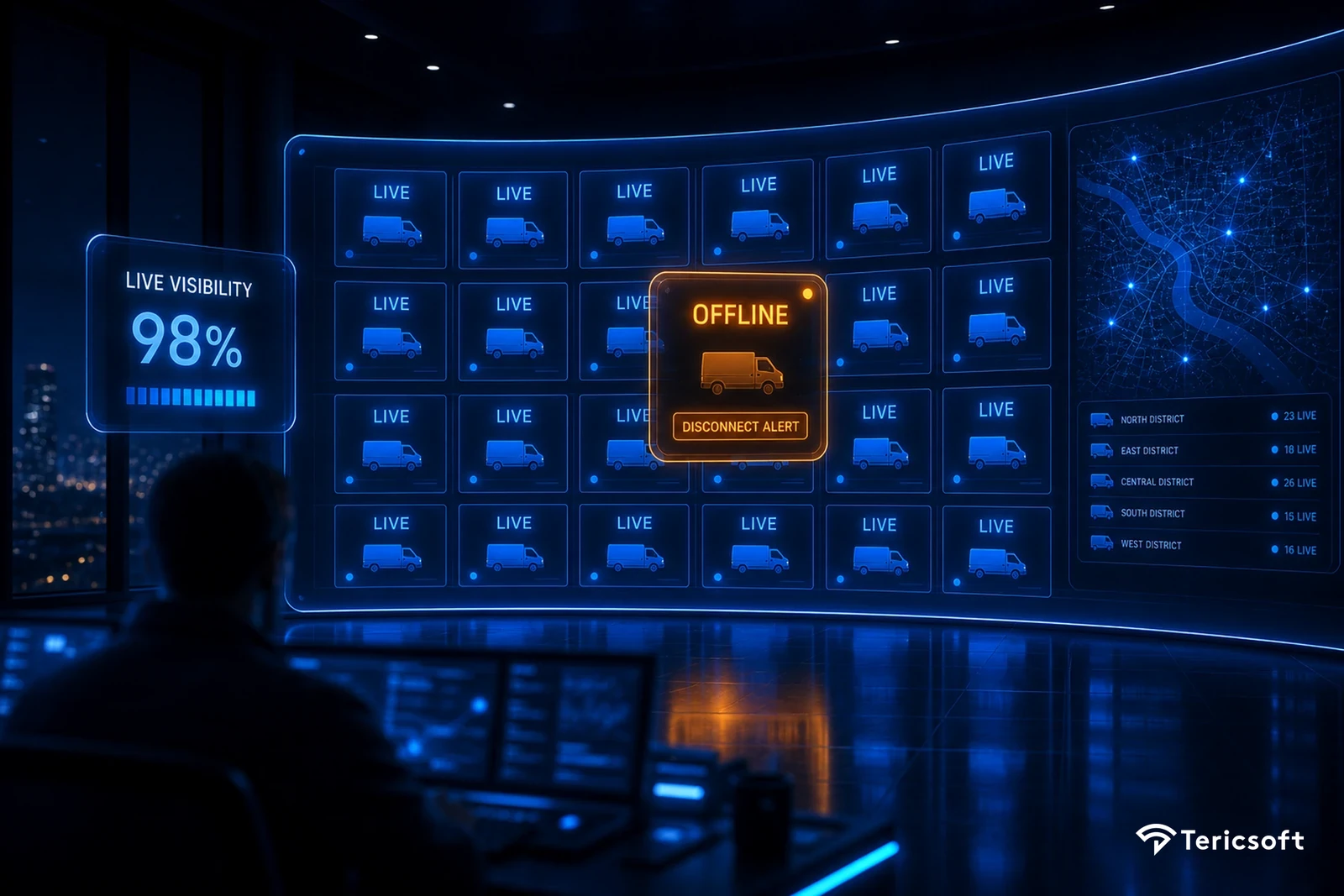
You can see every vehicle on one dashboard and still not trust a number that crosses two vendors. Why? Because a single view is not a single model.
Most fleets do not choose to run many telematics vendors. They end up that way, and then they buy a dashboard that promises to show every vehicle in one place. The dashboard works. The problem is that a single view over mixed-vendor data is not the same as a single model, and the gap between the two is where cross-vendor decisions quietly go wrong. You can watch all your vehicles on one screen and still be unable to say which of them costs the most per mile, because the vendors underneath do not agree on what a mile is.
This article is written from running the platform behind one of the world's larger electric deployments, a 3,000-plus vehicle fleet whose vehicles report through several different manufacturers and devices, all normalized into one model. The distinction below, between connecting vendors and reconciling them, is the whole job.
Why mixed fleets end up multi-vendor
Most fleets of any size end up running more than one telematics vendor, and the reasons are structural, not sloppy. Vehicles arrive with OEM telematics already embedded, different for every manufacturer. Older vehicles carry aftermarket devices chosen years ago. Acquisitions bring whole sub-fleets on someone else's platform. Regional operations pick the provider that works in their geography. Best-of-breed procurement adds a specialist tool for cameras or cold-chain.
The result is a fleet that reports through a handful to a dozen platforms at once, each with its own portal, its own login, and, the part that matters, its own definition of the data. This is the normal state of a growing fleet, not an exception to fix. The question is never how to get down to one vendor. It is how to make many vendors read as one fleet.
Aggregation is the easy part
The first instinct is to connect everything, and connecting everything is now largely a solved problem. Most providers expose a telematics API, an integration layer polls or subscribes to each one, and the feeds land in a single platform. That is real work, but it is bounded, well understood engineering. Within weeks a fleet can have every vehicle from every vendor visible on one screen.
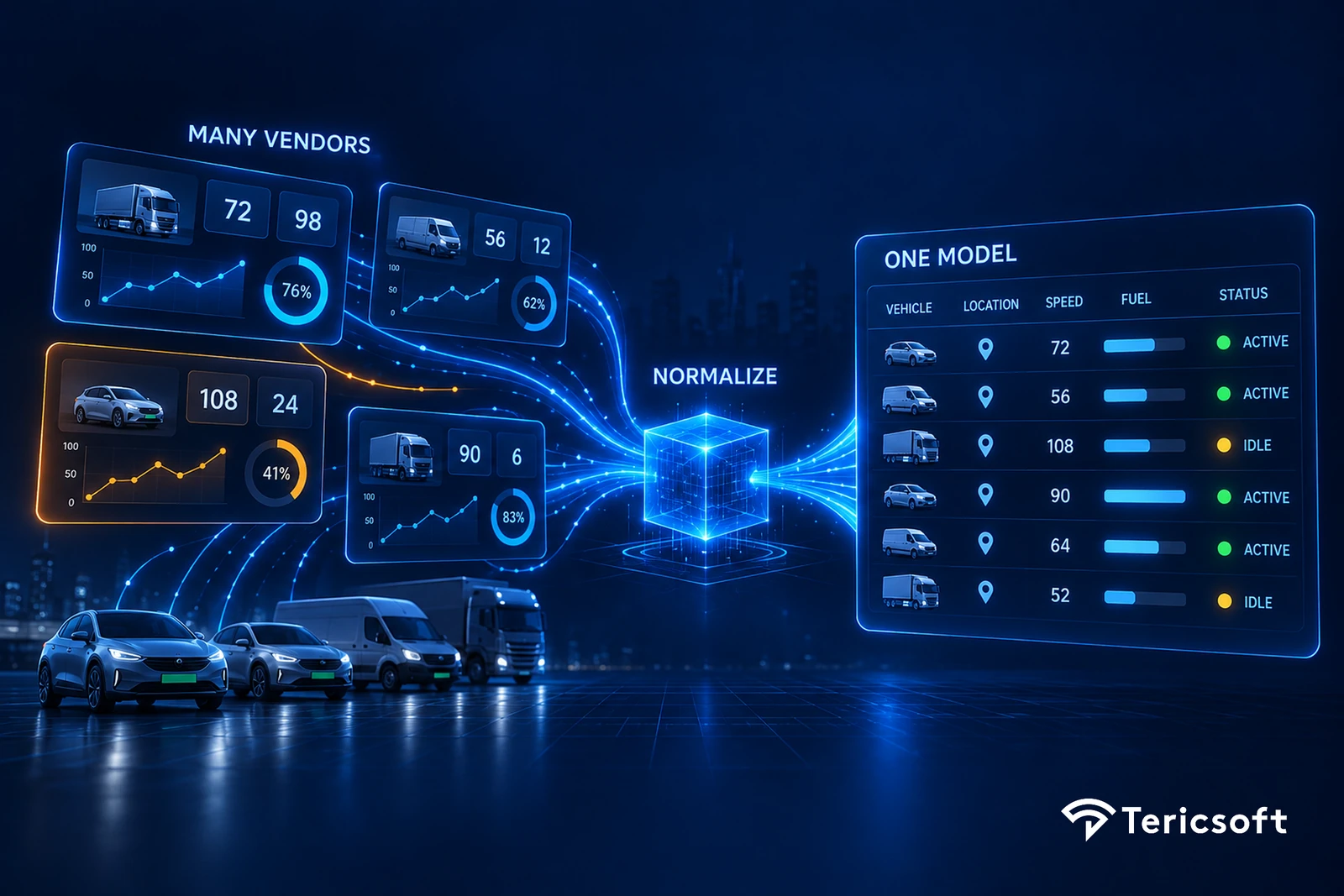
Then the harder truth arrives. A single dashboard shows the data side by side; it does not make the data comparable. Vehicle A reports through vendor X and vehicle B through vendor Y, and the screen puts them in the same table, which quietly implies their numbers mean the same thing. They do not.
The aggregation gave you a shared window, not a shared language. Most integration projects stop exactly here, mistaking the window for the language.
The real problem is semantics, not plumbing
Here is where multi-vendor telematics integration actually lives. Vendors routinely define the same words differently. One counts a trip from ignition-on to ignition-off; another splits it at every stop over three minutes. One reports odometer from the vehicle bus; another estimates it from GPS distance.
It does not stop at trips and odometers. Idle, harsh braking, a fuel-level reading, a fault code, even the timestamp and time zone: each is a small modeling decision, and each vendor made it on its own.
Land those feeds in one table without reconciling the definitions and you get a unified view of non-unified data, which is worse than obviously separate systems because it looks trustworthy. Sum idle hours across two vendors that define idle differently and the total is meaningless, but it still renders as a clean number on the dashboard. This is fleet data integration at the level that decides whether a cross-vendor comparison is real or an artifact, and it is a semantics problem, not a connectivity one.
Why the standards only get you partway
The industry has known this for years and built standards to fix it, which is exactly why the limits of those standards are worth understanding. In heavy equipment, ISO 15143-3, the AEMP telematics standard, defines a common format so mixed-vendor machines report consistent fields to any software that reads it. On heavy trucks, SAE J1939 standardizes how vehicles speak on the bus so applications can be manufacturer-independent.
These standards are genuinely useful, and they are not enough on their own. ISO 15143-3 standardizes on the order of 20 data points, a fraction of what an operating fleet actually decides on.
Coverage also tends to be partial across on-road light and mixed fleets, conformance can vary by vendor and model year, and the richest operational signals often sit outside the standard. A standard narrows the gap. It does not close it, which is why a real mixed fleet still needs a layer that reconciles what the standards leave unreconciled.
What a normalization layer actually does
The layer that makes multi-vendor integration real does one thing: it maps every vendor's events into a single canonical model, so a field means the same thing no matter which box produced it. A trip is defined once. An idle event is defined once. Odometer, fuel, fault severity, location, timestamp: each is translated from each vendor's dialect into one shared definition on the way in, not left to be reconciled by whoever reads the dashboard later.
Once that model exists, the questions a fleet actually asks become answerable across vendors rather than within each one. Cost per mile compares vehicle to vehicle because a mile is one thing. Utilization ranks the whole fleet because a working hour is one thing. Predictive maintenance reads fault severity consistently because severity is mapped, not guessed. The dashboard stops being a place where numbers merely coexist and becomes one where they can be added, ranked, and trusted.
The payoff: vendor independence
A normalization layer changes the fleet's relationship with its vendors, not just its data. When your operating model is your own and vendors feed into it, swapping a provider is a mapping change, not a migration of your whole history and a retraining of everyone who reads it. Onboarding an acquired sub-fleet becomes connecting one more source to a model that already exists, rather than a rip-and-replace that stalls the integration for a year.
That is leverage. A fleet that owns its data model negotiates from strength, because no single vendor holds the definition of its business. A fleet whose model lives inside a vendor's platform is renting its own history, and pays for it every time it wants to change anything. Multi-vendor integration done right is not just tidier reporting. It is the difference between managing your vendors and being managed by them.
What running 3,000 vehicles across vendors taught us
Across the deployment behind this article, more than 1 billion telemetry events a month arrive from several manufacturers and device types and are normalized into one model, held at over 98 percent real-time visibility. The engineering that matters is not the connectors, which are routine. It is the mapping: the canonical definitions of trip, idle, energy, distance, and fault that let a vehicle from one vendor sit honestly next to a vehicle from another.
Because the model is owned rather than rented, a new source, an acquired sub-fleet or a new device type, is typically mapped and live in 2 to 3 weeks, not a multi-quarter project. The lesson from operating at this scale is blunt: the value was never in seeing every vehicle in one place. It was in making every vehicle mean the same thing in one place, and that is a modeling discipline the dashboard alone will never give you.
Key takeaways
- Multi-vendor is the normal state of a fleet. OEM telematics, aftermarket devices, and acquisitions make integration a permanent capability, not a one-time cleanup.
- Aggregation is the easy part. Connecting APIs into one dashboard gives you a shared window, not a shared language.
- The real work is semantics. Vendors define trip, idle, odometer, and fault differently, so a single view over mixed data is not one model.
- A canonical model buys independence. Normalize every vendor into one owned definition and you can compare vehicles honestly, swap providers, and onboard sub-fleets without a rip-and-replace.
About Tericsoft
Tericsoft does not sell telematics devices or resell a provider's platform. We build the data layer underneath a mixed fleet, where every vendor's events are mapped into one canonical model so a trip, a mile, and a fault mean the same thing no matter which box reported them. That is what turns a wall of vendor dashboards into a fleet you can actually compare, decide on, and act across. If you can see all your vehicles in one place but still cannot trust a number that crosses two vendors, that gap between the view and the model is the problem we engineer for.

Bringing vehicles from different telematics providers into one system, and normalizing each vendor's data so metrics mean the same thing.
Vehicles come with different OEM telematics, older ones carry aftermarket devices, acquisitions add platforms, and regions pick local ones.
No. It puts all vehicles on one dashboard but does not make data comparable, because vendors define trips, idle, and faults differently.
They help but do not finish it. They cover a limited set of fields, conformance varies, and the most operational signals sit outside them.
Mapping every vendor's events into one canonical definition on the way in, so a trip, a mile, and a fault are all defined once.