Is a CMMS the same as fleet management software? Not quite. One maintains the assets, the other operates the moving fleet, and the difference decides what you buy.
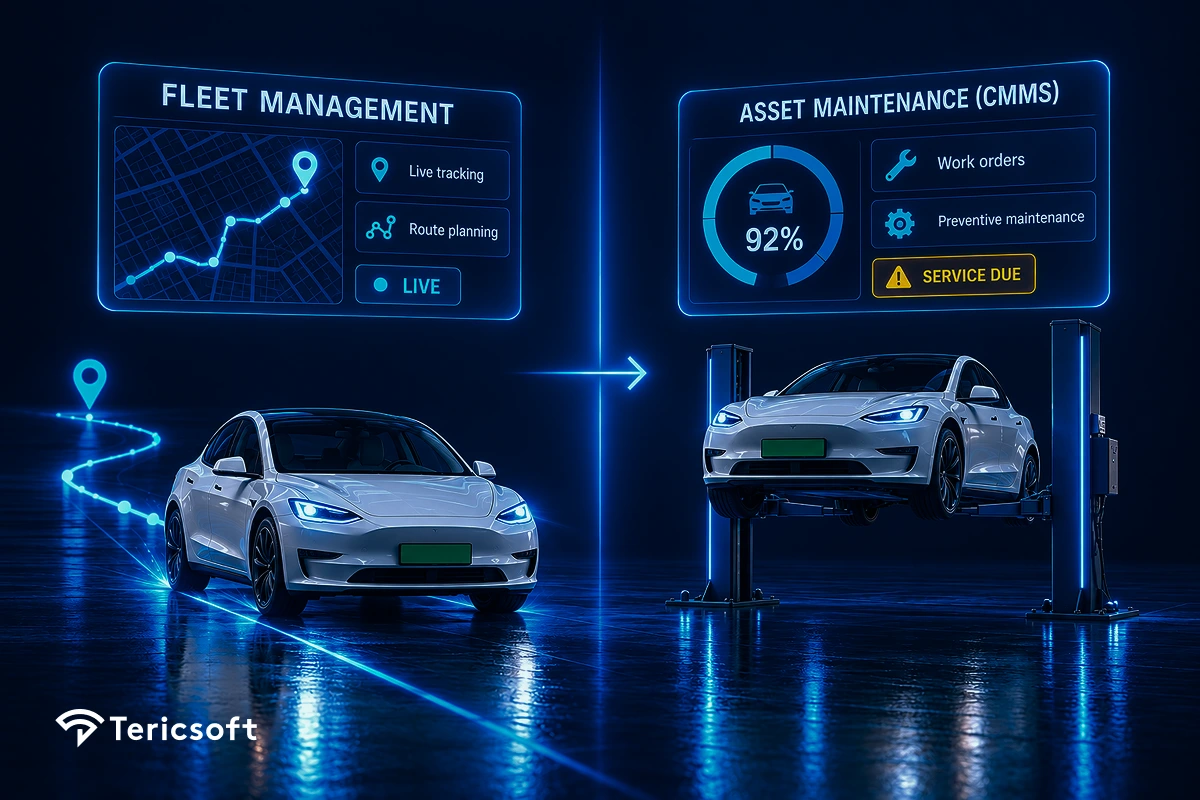
Fleet management software runs the vehicles. A CMMS maintains the assets. One operates the moving fleet: where each vehicle is, who is driving, how it is routed and fueled. The other keeps the assets healthy: what is due, what is failing, what the repair costs. They are not rivals to choose between, and they overlap at one module while answering two different questions.
Confusing them is expensive. Buying one while believing it covers the other is how fleets end up with tracking they trust and maintenance they do not.
This article is written from running both at once. Tericsoft engineers the platform behind one of the world's larger electric deployments, a 3,000-plus vehicle fleet where operations data and maintenance data live in a single model rather than two disconnected tools.
What fleet management software actually does
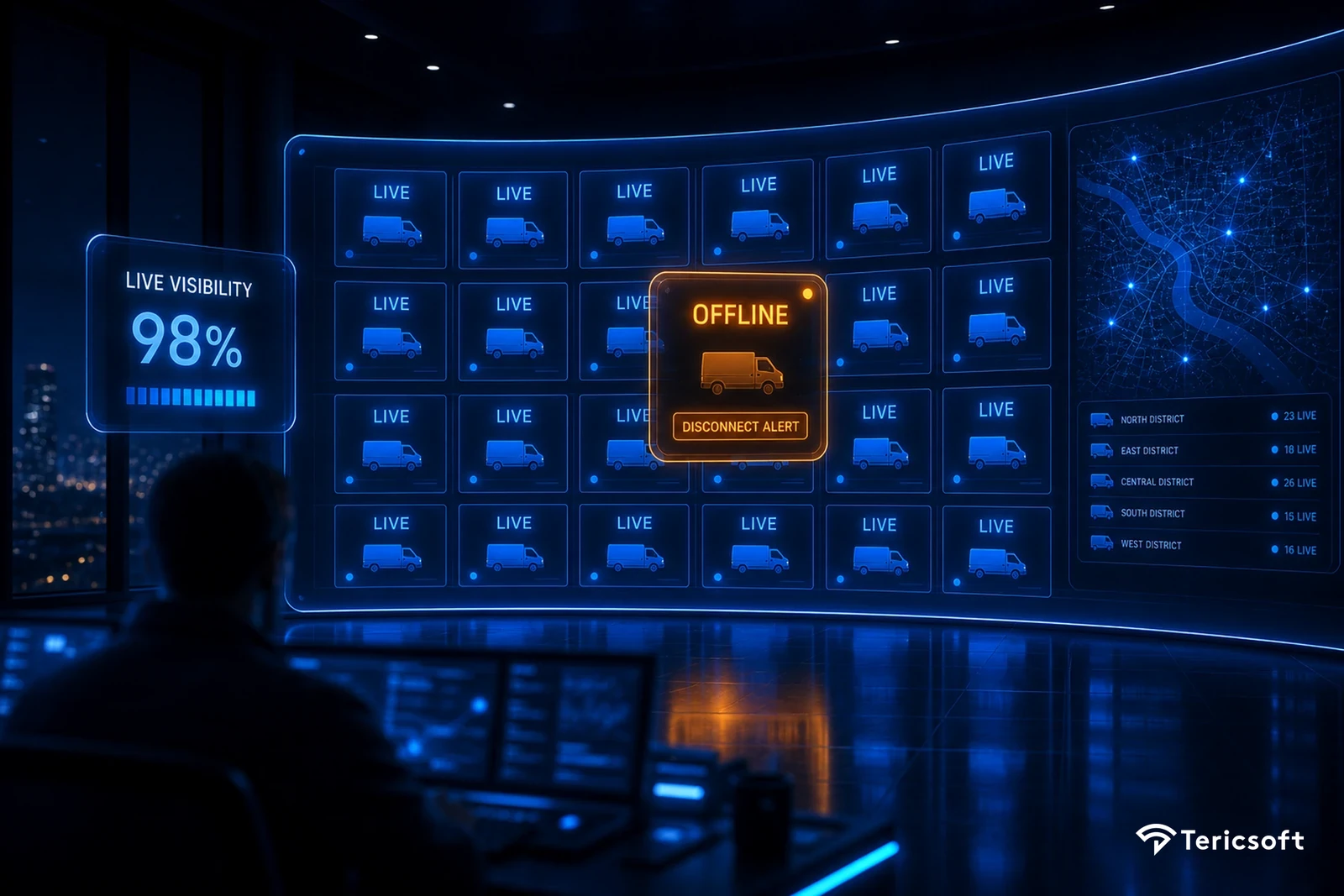
Fleet management software runs the operational side of a fleet. Its center of gravity is the moving vehicle and the day it is having. That means live location and vehicle tracking, trip and dispatch assignment, route planning, driver behavior and safety, fuel and energy, and utilization across the fleet.
Underneath most of it sits telematics, the live feed of position, speed, and engine data from each vehicle. A fleet management system is, at heart, the software that turns that feed into operational decisions: which vehicle takes the next job, which driver is idling, which route is bleeding time. The question it answers is always some version of where, who, and how, right now.
What a CMMS actually does
A CMMS, short for computerized maintenance management system, runs the maintenance side. Its center of gravity is the asset and its condition over time, not its position today. If you have ever asked what is a CMMS, the shortest honest answer is that it is the system of record for keeping physical assets healthy.
That means work orders, preventive-maintenance schedules, parts and inventory, repair and service history, inspections, warranty and compliance records, and the cost analytics on top. Where fleet management software asks where a vehicle is, a CMMS asks when it is next due, what failed last time, and what the maintenance is costing per asset. For vehicles specifically, that discipline shows up as fleet maintenance software, a CMMS shaped for assets that earn revenue on the road.
Where a CMMS and fleet management software overlap
The confusion is not imaginary, because the two genuinely overlap at one place: the maintenance module. Most serious fleet management platforms include some maintenance features, and any CMMS can be pointed at a fleet of vehicles. That shared ground is exactly why buyers assume one replaces the other.
It rarely does. A maintenance module bundled into an operations platform is usually built to log service, not to run a maintenance program. It handles a reminder and a work order, then thins out at parts, warranty, degradation history, and cost-per-asset analytics. A maintenance-first CMMS is the reverse, deep on the repair and shallow on the road. The overlap is real, but it is a seam, not a merger.
At a glance, the split looks like this:
Fleet management softwareCMMSPrimary purposeFleet operationsAsset maintenanceCore questionWhere, who, how?When, what failed, how much?TrackingCore featureNot coreRouting and dispatchYesNoWork ordersUsually basicCore featureParts and inventoryLimitedCore featureMaintenance historySomeDetailedTelematicsCore inputCan consume data
The real difference: assets that move versus assets that sit
The sharpest way to tell the categories apart is to ask whether the asset moves. Generic CMMS software grew up in plants and buildings, where the asset sits still. Maintenance is scheduled by the calendar, the inspector is a technician on site, and compliance means facility and safety standards. Fleet changes every one of those assumptions.
On a fleet, the asset moves, and that changes everything about maintenance. Preventive service triggers on odometer and engine hours, not the calendar. The inspector is often a driver on a phone. The maintenance signal arrives through telematics, not a walk-around.
Compliance is its own world too. In the United States, commercial vehicles require driver vehicle inspection reports and annual periodic inspections under federal motor-carrier rules, a workflow a static-asset CMMS was never built to model. This is why a fleet on a generic CMMS spends its life configuring around vehicle reality, and why fleet-native maintenance tools exist at all.
Which one does your fleet need?
The decision is less about the two categories and more about your primary asset and your seams.
If vehicles are the operation, start with fleet management software for the operational side and make sure its maintenance is genuinely deep, or pair it with vehicle-native fleet maintenance software. Do not accept a thin maintenance tab as a maintenance program.
If you run significant static equipment and a vehicle fleet, a plant, a depot full of gensets and forklifts, plus the trucks, you may genuinely need both a CMMS for the fixed assets and fleet software for the vehicles, or one platform wide enough to model both.
Either way, the value and the leakage are at the seam. A fleet that tracks vehicles but runs maintenance in a disconnected tool knows exactly where every truck is. It does not reliably know what is due on each one. That is how a predictable failure becomes a roadside one. When the telematics feed and the maintenance program share nothing, predictive maintenance is impossible, because the data that would have predicted the failure never reaches the system that would have raised the work order.
CMMS versus EAM, in one minute
One more acronym clears up the rest of the confusion. CMMS vs EAM is not the same axis as CMMS versus fleet software. Enterprise asset management, or EAM, covers an asset across its whole life: procurement, financials, depreciation, and disposal. The CMMS, the maintenance-execution layer, is one part of it. Fleet management software is the operational sibling to both. EAM owns the asset on the balance sheet, the CMMS keeps it running, and fleet management software puts it to work on the road.
What running operations and maintenance on one platform taught us
The categories are useful for thinking, but a fleet does not experience them as separate. On the 3,000-plus vehicle deployment behind this article, operations data and maintenance data sit in one model, and the payoff shows up at the seam the two categories usually leave open.
A fault signaled on the road becomes a scheduled service rather than a note nobody actions. Because tracking and maintenance cost per vehicle sit on the same screen, the fleet knows not just where a vehicle is but whether it is earning its keep. That is the practical lesson. The line between a CMMS and fleet management software is conceptual, and the value shows up when the two stop being separate systems.
Key takeaways
- Different centers of gravity. Fleet management software operates the moving fleet, a CMMS maintains the assets. One answers where and who, the other answers when and how much.
- They overlap at maintenance, and that is the trap. A bundled maintenance tab is not a maintenance program, and a generic CMMS is not built for assets that move.
- Match the tool to your primary asset. Vehicles first means fleet-native software and real maintenance depth. Mixed static and mobile assets may need both.
- The seam is where the money is. Operations and maintenance sharing one data model is what makes prediction, cost control, and honest per-vehicle economics possible.
About Tericsoft
Tericsoft does not sell a tracking product or a maintenance product with a price per vehicle. We build the platform layer for fleets large enough that the split between operating the vehicles and maintaining them has become a real cost, where a telematics feed that does not reach the maintenance program is money leaking at the seam. What we engineer is the single data model underneath both, so a fault on the road becomes a work order, a maintenance cost lands against the trip that caused it, and one screen answers where the vehicle is and whether it is worth keeping. If your operations software and your maintenance software have stopped talking to each other, that is the problem we solve.

Fleet software runs operations: tracking, dispatch, routing, fuel. A CMMS runs maintenance: work orders, PM, parts, and repair history.
No, but related. Fleet software is an operations platform that bundles a maintenance module. A CMMS is a maintenance system of record.
Only if you run static equipment plus vehicles. If vehicles are your operation, one fleet-native platform with deep maintenance covers it.
Not as its primary function. Live tracking and telematics belong to fleet software; a CMMS consumes that data but manages maintenance.
EAM covers an asset's whole life, from finance to disposal. A CMMS is the maintenance-execution part. Fleet software runs the vehicles.