A fleet AI co-pilot is sold as one smart assistant. In production it is several specialized AI systems orchestrated behind one surface a human commands, co-pilot, not autopilot.
The pitch for a fleet AI co-pilot is seductively simple: bolt a smart assistant onto your dashboard and let it run the fleet. The reality of putting AI behind every operational decision is almost the opposite. It is not one model. It is several specialized AI systems, each solving a different problem, working together behind a single surface that a human operator drives. And it is a co-pilot, not an autopilot: the AI forecasts, advises, and acts on command, while the person keeps the judgment. Get that distinction wrong and you get a demo. Get it right and you get an operation. The difference is not a slogan. It is the whole architecture.
We built this layer for one of India's largest electric fleet operators, across a 3,000-plus vehicle fleet. The AI operations co-pilot there now runs 5-plus AI systems in production and handles more than 1 billion API calls a month. This article is what that work made clear about what a fleet AI co-pilot actually is, and why so many of the ones being sold are not that at all.
The market is full of co-pilots that are not
Walk any fleet software expo floor and every product has grown an AI co-pilot. Most of them are a chat box over a dashboard. Gartner has a word for the pattern. According to a June 2025 analysis from Gartner, the market is rife with "agent washing", the rebranding of chatbots and assistants as agents, and the firm predicts that over 40 percent of agentic AI projects will be canceled by the end of 2027, undone by rising costs, unclear value, and weak controls.
The projects that survive have one thing in common. They are not a window you type into. They are built into the operation, wired to the data and the decisions the operation actually runs on. That is the line between fleet AI that demos well and fleet AI that holds up on a Monday morning.
Co-pilot, not autopilot
The first distinction to get right is the one in the title, and it is architectural, not cosmetic. An autopilot tries to own the decision and take the human out of the loop. A co-pilot augments the human: it answers questions, surfaces options, and executes when instructed, while the operator keeps the calls that need judgment.
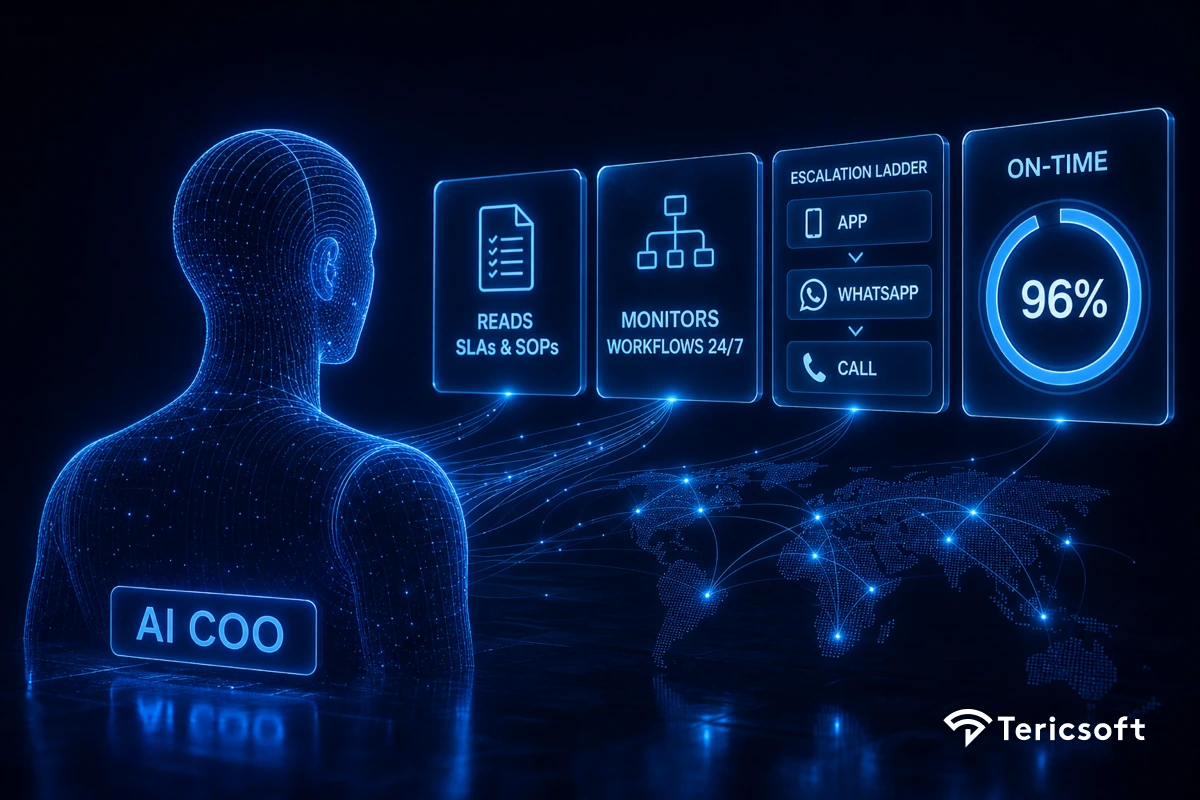
There is a place for autonomy. An autonomous agent that chases a service-level breach up an escalation ladder until someone owns it is a genuinely different mode, and a powerful one. But most fleet decisions are not that. Which standby vehicle to pull, whether a soft fault can finish the shift, which site to leave short when demand spikes everywhere, these need a person who can weigh context a model does not have. The co-pilot makes those decisions faster and better informed. It does not pretend they do not need a human. Automate the routine, keep the person on the judgment, and the operator stops being a dispatcher and becomes a decision-maker with leverage.
A co-pilot is a system of systems
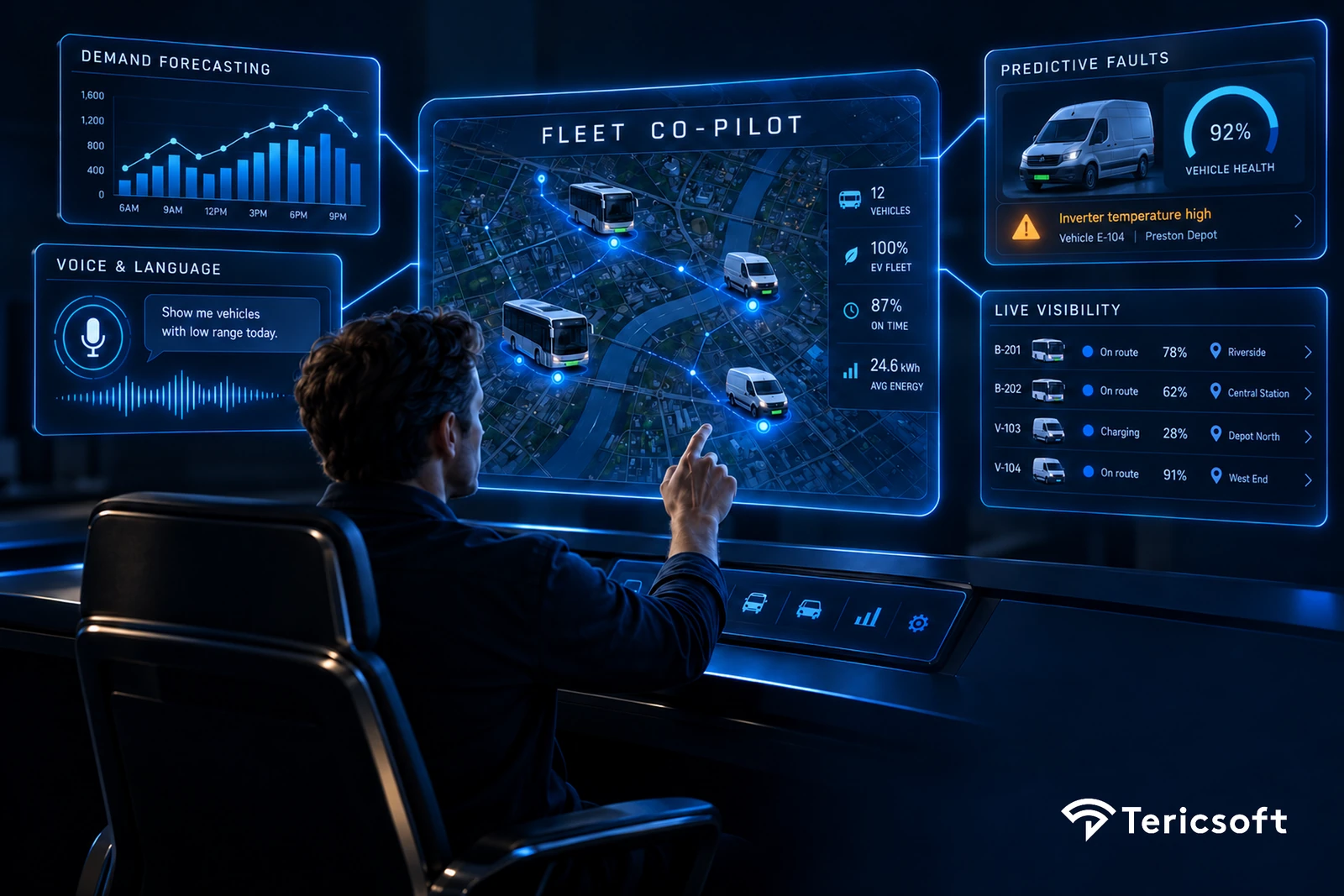
Here is the part the word co-pilot hides. Putting AI behind every operational decision is not one clever model doing everything. It is a portfolio of specialized systems, each a different discipline of AI, each with its own data, failure modes, and refresh cadence. In our deployment, 5-plus run in production at once, and they are not variations on a theme:
- A demand forecasting and cross-utilization engine that balances charging, driver rosters, and live demand across sites in real time, so vehicles are where the demand is. This is a forecasting and allocation problem, closer to operations research than to chat.
- A predictive fault prevention system that turns driver inspections and live telematics into early warnings, shifting maintenance from reactive repair to planned care. This is anomaly detection on time-series data, the heart of predictive maintenance.
- A natural-language and voice interface, including a human-like voice agent that reaches drivers by voice, SMS, and push, and a chat surface supervisors query in plain language. This is a language and speech problem.
- A live visibility layer that keeps an accurate real-time picture of every vehicle, the streaming-data foundation everything else reads from.
- An orchestration layer that routes between all of them and resolves it into one surface.
Call the bundle a co-pilot and it sounds like a single thing. It is really five products wearing one face, and the face is the easy part. The shape of it looks like this:
balances charging, rosters, live demand
telematics and inspections to early warnings
plain-language queries, driver voice agent
real-time state every system reads from
The hard part is orchestration, not the model
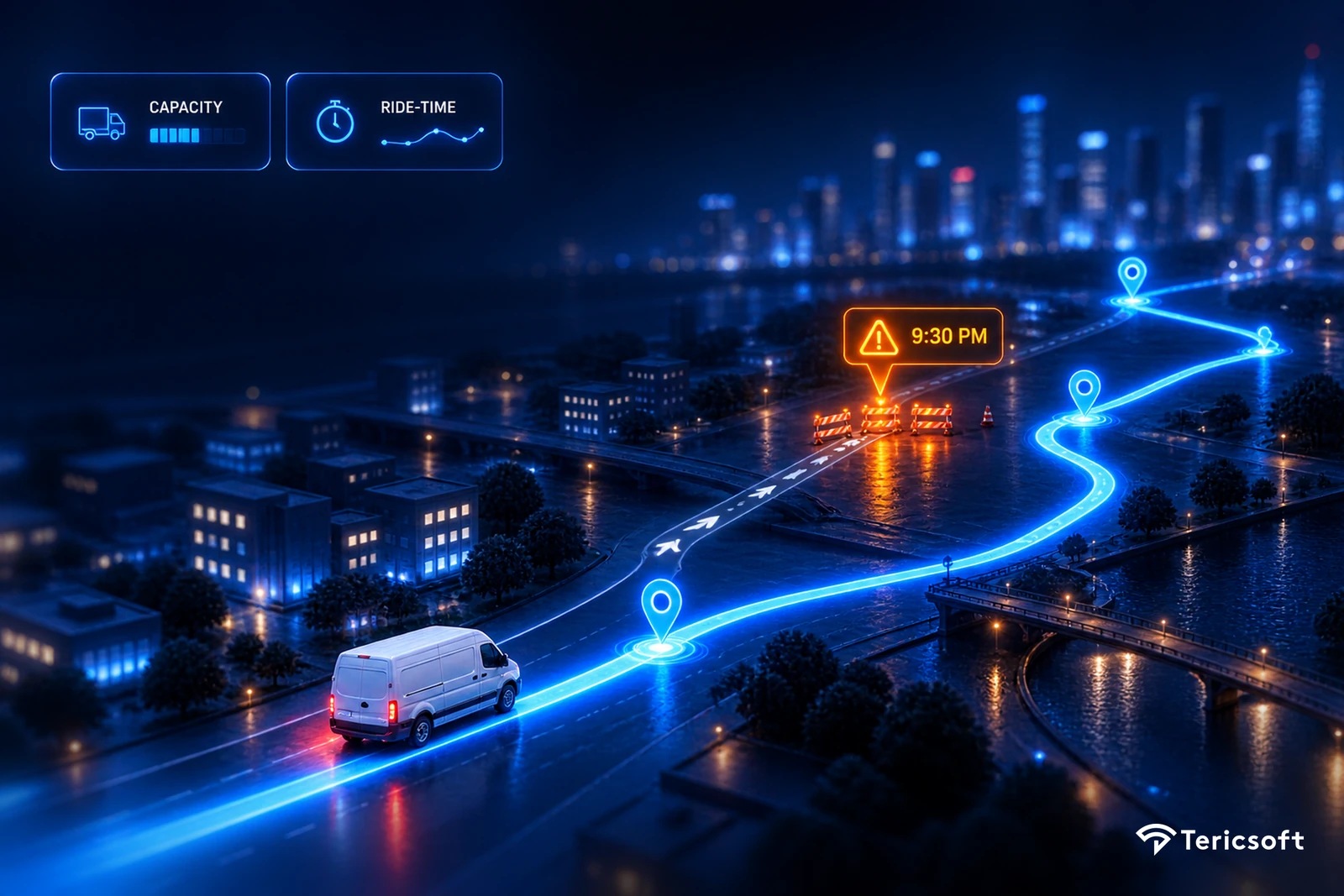
Any one of those systems is a solvable project on its own. What turns five of them into a co-pilot is the orchestration: shared state, so the allocation engine knows what the fault model just flagged and does not send a vehicle on a long route it might not finish; handoffs, so a voice call to a driver fires from the right system at the right moment; and one surface where all of it resolves for the operator without them opening five tools.
That is why the 1 billion-plus API calls a month is the real headline, not any single model's accuracy score. A co-pilot lives in production, acting on a live operation, where a wrong call strands a vehicle or misses a trip. Latency, reliability, and graceful failure across many systems at once are the product. This is also precisely why the chat-box-on-a-dashboard version falls over the moment it is asked to do anything: there is nothing underneath it to orchestrate.

Natural language is the cockpit
If the co-pilot is really many systems, why does it feel like one? The interface. The operator does not open five tools and reconcile them. They ask. A supervisor messages the co-pilot on WhatsApp and gets the nearest available vehicles in seconds. What used to be repeated phone calls across sites collapses into one conversation in under 3 minutes. A driver gets a call in their own language from a voice agent, not a cryptic SMS.
Natural language is how a human commands many models at once, and that is exactly the co-pilot relationship made concrete: the person expresses intent, the systems underneath do the work, and the person keeps the decision. The cockpit is a conversation, and behind it sits the whole orchestra.
Why a co-pilot is built, not bought
All of this is why a real fleet AI co-pilot is not a feature you switch on. The co-pilots sold as a checkbox are mostly a chat layer that can answer where is vehicle 12. Useful, and for many fleets genuinely enough: a smaller or more standard operation that mainly needs visibility, reporting, compliance, and the occasional answer is well served by a mature off-the-shelf platform, and building its own co-pilot would be over-engineering a problem it does not have. A good number of operators should buy, run the proven product well, and never look back. The calculus changes only when AI has to make or shape the decisions themselves. One that puts AI behind every decision has to be wired into your forecasting, your allocation rules, your maintenance signals, your contracts, and your escalation logic, because those are what your decisions are actually made of.
Buy the chat box if you want answers to questions you could already look up. Build the co-pilot, with an engineering partner, if you want the operation itself to get faster and the team to run several times the work without several times the headcount. The moment the co-pilot has to act on your specific rules rather than a vendor's generic ones, you have left the feature market, and that is the point where owning it starts to pay.
What building it taught us
The numbers worth repeating are not any one model's. Across a 3,000-plus vehicle electric fleet, the co-pilot runs 5-plus AI systems in production, handles 1 billion-plus API calls a month, and has contributed to roughly a 20 percent gain in fleet productivity and about 3 times the operations capability the same team could run before, by automating routine coordination and keeping people on the decisions that need them.
The lesson underneath those figures is about reliability and command, not cleverness. The gains came from making several specialized systems dependable together behind one surface, with the human kept firmly in the decision. A fleet AI co-pilot is not a product you install. It is an operating layer you build, and it behaves like a co-pilot precisely because a person is still flying.
Key takeaways
- Co-pilot, not autopilot. The AI forecasts, advises, and acts on command while the operator keeps the judgment. Automate the routine, keep the person on the decisions that need context.
- A co-pilot is a system of systems. Putting AI behind every decision means several specialized AI systems, forecasting, fault prevention, language, visibility, running together under one orchestration layer.
- Orchestration is the hard part. Shared state, handoffs, and one surface across many systems in production, at over a billion API calls a month, are the real engineering, not any single model's accuracy.
- It is built, not bought. A co-pilot wired into your forecasting, rules, and contracts is an operating layer you own, not a chat box switched on over a dashboard.
About Tericsoft
Tericsoft builds the AI systems that run real-world operations, and the layer that makes several of them behave as one. For a large electric fleet that meant a co-pilot where demand forecasting, cross-utilization, predictive fault prevention, live visibility, and a natural-language interface are orchestrated into a single surface an operator commands. We are an AI-first technology partner, and we tend to be brought in when an operation needs AI behind its decisions rather than a dashboard beside them, and when the real challenge is making many production systems reliable together. If you want your operation to get faster rather than just better instrumented, that is the problem we engineer for.
An operating layer that puts AI behind fleet decisions: forecasting, fault prevention, and a language interface behind one surface.
A co-pilot advises and acts on command while the person keeps judgment. An autopilot or autonomous agent owns the decision end to end.
Many. It is a system of systems: forecasting, predictive maintenance, live visibility, and voice, tied together by an orchestration layer.
You can buy a chat box for lookups. A co-pilot that acts on your forecasting, rules, and contracts has to be built into your operation.
Orchestration more than any single model: shared state, clean handoffs, and one surface, built for reliability across many live systems.